
Report Feature
Medical Gel Card Centrifuge Market Trends and Forecast
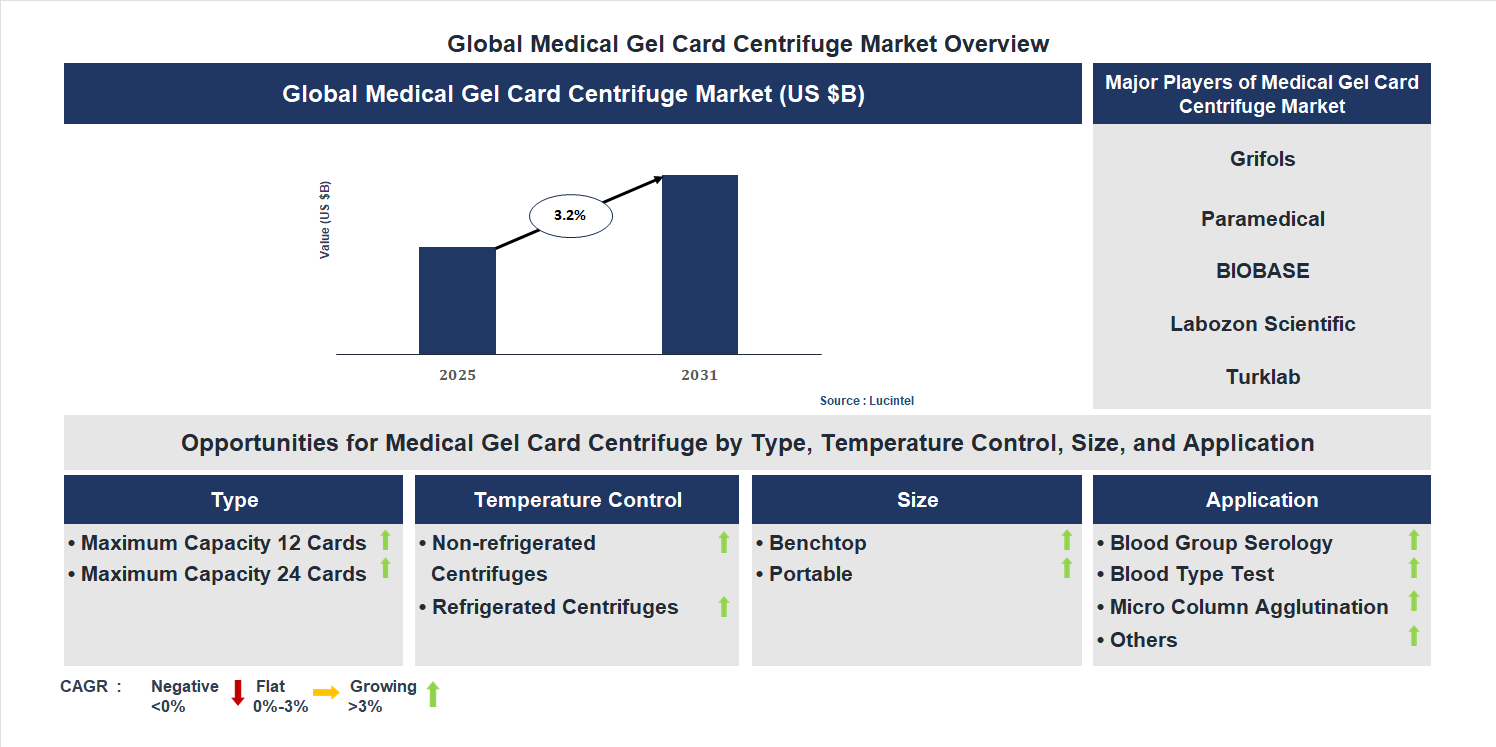
The future of the global medical gel card centrifuge market looks promising with opportunities in the blood group serology, blood type test, and micro column agglutination markets. The global medical gel card centrifuge market is expected to grow with a CAGR of 3.2% from 2025 to 2031. The major drivers for this market are the increasing demand for blood compatibility testing, the rising use of gel card diagnostics, and the growing adoption of automated laboratory centrifuges.• Lucintel forecasts that, within the type category, maximum capacity 24 card is expected to witness higher growth over the forecast period.
• Within the application category, micro column agglutination is expected to witness higher growth.
• In terms of region, APAC is expected to witness the highest growth over the forecast period. Gain valuable insights for your business decisions with our comprehensive 150+ page report. Sample figures with some insights are shown below.
Emerging Trends in the Medical Gel Card Centrifuge Market
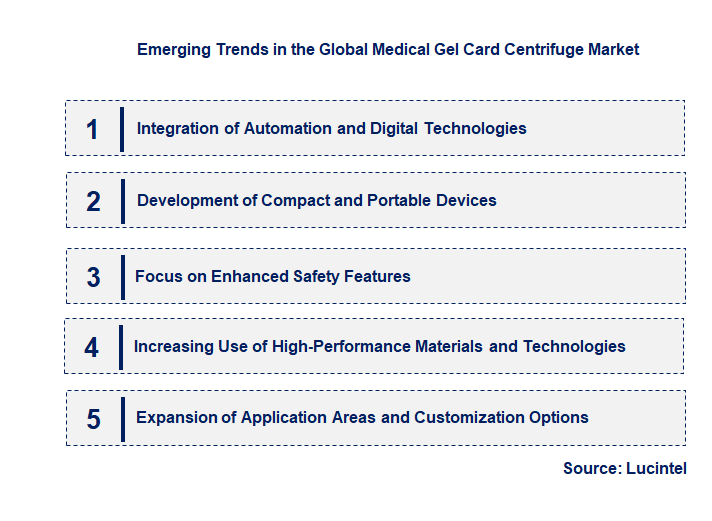
The Medical Gel Card Centrifuge Market is experiencing rapid evolution driven by technological advancements, increasing healthcare demands, and a focus on efficiency and accuracy in diagnostic procedures. As medical institutions seek more reliable and faster testing methods, the market is adapting with innovative features and expanding applications. These developments are not only improving diagnostic outcomes but also enhancing operational workflows in laboratories worldwide. The following key trends highlight the significant shifts shaping this market, reflecting a move towards smarter, more efficient, and user-friendly centrifuge solutions that meet the growing needs of healthcare providers and patients alike.• Integration of Automation and Digital Technologies: Automation is transforming centrifuge operations by reducing manual intervention, minimizing errors, and increasing throughput. Digital interfaces and connectivity enable real-time monitoring, data management, and remote control, enhancing efficiency and accuracy. Automated systems also facilitate compliance with regulatory standards and improve reproducibility of results, which is critical in clinical diagnostics. This trend is driven by the need for faster, more reliable testing processes and the increasing adoption of digital health solutions across laboratories.
• Development of Compact and Portable Devices: The demand for portable centrifuges is rising, especially in point-of-care testing, field diagnostics, and small laboratories. Compact designs offer ease of use, space-saving benefits, and quick deployment in diverse settings. Portable devices are often battery-operated, making them suitable for remote or resource-limited environments. This trend expands the reach of diagnostic testing, enabling faster decision-making and timely treatment, particularly in emergencies or in areas lacking extensive laboratory infrastructure.
• Focus on Enhanced Safety Features: Safety remains a priority in laboratory environments. Manufacturers are incorporating advanced safety features such as automatic lid locking, imbalance detection, and emergency shut-off systems. These innovations reduce the risk of accidents, protect users from potential hazards, and ensure compliance with safety regulations. Enhanced safety features also promote user confidence and facilitate training, making centrifuges more accessible to a broader range of healthcare professionals and technicians.
• Increasing Use of High-Performance Materials and Technologies: The adoption of durable, lightweight materials like composites and advanced plastics improves device longevity and ease of handling. Innovations in motor technology and vibration control enhance performance, reduce noise, and extend equipment lifespan. These technological improvements lead to more reliable operation, lower maintenance costs, and better sample integrity. As a result, laboratories benefit from increased efficiency and reduced downtime, supporting high-volume testing environments.
• Expansion of Application Areas and Customization Options: The market is witnessing diversification with centrifuges tailored for specific applications such as hematology, microbiology, and molecular diagnostics. Customizable features like adjustable speed, temperature control, and specialized rotors cater to diverse testing needs. This flexibility allows laboratories to optimize workflows and improve diagnostic accuracy. The expansion into new application areas also opens opportunities for manufacturers to develop niche products, thereby broadening market reach and addressing specific customer requirements. In summary, these trends are collectively reshaping the Medical Gel Card Centrifuge Market by fostering innovation, improving safety and efficiency, and expanding application possibilities. As technology continues to advance, the market is poised for significant growth, driven by the increasing demand for rapid, reliable, and versatile diagnostic solutions worldwide.
Recent Development in the Medical Gel Card Centrifuge Market
The Medical Gel Card Centrifuge Market is experiencing rapid advancements driven by technological innovations, increasing demand for efficient diagnostic tools, and expanding healthcare infrastructure worldwide. These developments are transforming laboratory workflows, improving diagnostic accuracy, and enabling faster patient results. As healthcare providers seek more reliable and cost-effective solutions, the market is poised for significant growth. The following key developments highlight the current trajectory and future potential of this market.• Technological Innovations in Centrifuge Design: Enhanced efficiency and safety features are revolutionizing the market. Modern centrifuges now incorporate digital controls, automation, and improved rotor designs, reducing processing time and minimizing user error. These innovations increase productivity in laboratories, support high-throughput testing, and improve safety standards. As a result, healthcare facilities can deliver faster, more accurate diagnostics, boosting overall operational efficiency and patient care quality.
• Rising Adoption of Gel Card Technology: Gel card technology is gaining popularity due to its ability to streamline blood grouping and cross-matching processes. It offers high accuracy, ease of use, and reduced turnaround times, making it ideal for clinical laboratories. The increasing adoption of gel cards enhances diagnostic reliability, reduces manual errors, and supports automation. This trend is expected to expand market share for gel card centrifuges, especially in blood banks and hospital laboratories.
• Growing Demand for Point-of-Care Testing: The shift towards decentralized testing is fueling demand for portable and user-friendly centrifuges. Point-of-care testing enables rapid diagnosis at the patients bedside, improving treatment outcomes. Compact gel card centrifuges facilitate quick blood typing and compatibility testing outside traditional labs. This development supports healthcare accessibility in remote areas, reduces laboratory workload, and accelerates decision-making, thereby expanding the market for portable centrifuge solutions.
• Increasing Healthcare Infrastructure Development: Emerging economies are investing heavily in healthcare infrastructure, creating a surge in laboratory setups and diagnostic centers. This expansion drives demand for reliable, high-capacity centrifuges capable of handling large sample volumes. Improved infrastructure also promotes the adoption of advanced gel card centrifuges, supporting better disease management and screening programs. The growth in healthcare facilities directly correlates with increased market opportunities for centrifuge manufacturers.
• Integration of Digital and Automation Technologies: The integration of digital interfaces and automation features is transforming centrifuge operations. Automated sample loading, real-time monitoring, and data management improve workflow efficiency and reduce human error. These features enable seamless integration with laboratory information systems, enhancing data accuracy and traceability. As laboratories aim for higher throughput and quality standards, the adoption of automated gel card centrifuges is expected to accelerate, further expanding market growth. The overall impact of these developments is a more efficient, accurate, and accessible Medical Gel Card Centrifuge Market. Technological advancements and infrastructure growth are driving increased adoption, improving diagnostic outcomes, and supporting healthcare delivery worldwide. This evolution promises sustained market expansion and innovation in laboratory diagnostics.
Strategic Growth Opportunities in the Medical Gel Card Centrifuge Market
The Medical Gel Card Centrifuge Market is poised for significant expansion driven by technological advancements, increasing healthcare demands, and evolving diagnostic needs. As laboratories and medical facilities seek efficient, reliable, and rapid diagnostic tools, the market presents numerous growth opportunities. Innovations in centrifuge design, automation, and integration with digital health systems are expected to enhance performance and user experience. Strategic investments and collaborations will further accelerate market penetration across diverse healthcare settings, ultimately improving patient outcomes and operational efficiency.• Increasing Adoption of Automated Centrifuges for Faster Diagnostics: The rising demand for automation in laboratories is fueling the adoption of automated gel card centrifuges. These devices offer enhanced precision, reduced manual intervention, and faster processing times, which are critical for high-throughput diagnostic labs. As healthcare providers aim to improve efficiency and accuracy, automated centrifuges are becoming essential, driving market growth. The integration of smart features and connectivity options further boosts their appeal, making them a preferred choice in modern clinical settings.
• Growing Need for Rapid Blood and Diagnostic Testing in Hospitals: Hospitals require quick and reliable diagnostic tools to facilitate timely treatment decisions. Gel card centrifuges enable rapid separation of blood components and other samples, supporting urgent testing needs. The increasing prevalence of infectious diseases, blood disorders, and chronic conditions amplifies this demand. As hospitals seek to streamline workflows and improve patient care, the adoption of advanced centrifuges is expected to rise, creating substantial growth opportunities in the market.
• Technological Innovations Enhancing Centrifuge Performance and Safety: Continuous innovations in centrifuge technology, such as enhanced rotor designs, vibration control, and safety features, are improving operational efficiency. These advancements reduce sample contamination risks, improve balance and stability, and extend equipment lifespan. The development of user-friendly interfaces and remote monitoring capabilities also enhances safety and ease of use. Such technological progress is attracting healthcare providers to upgrade existing systems, thereby expanding the market and encouraging new product development.
• Rising Focus on Point-of-Care Testing and Decentralized Diagnostics: The shift towards decentralized healthcare and point-of-care testing is creating demand for portable, easy-to-use gel card centrifuges. These compact devices enable rapid diagnostics outside traditional laboratory settings, improving access in remote or resource-limited areas. The ability to deliver quick results at the bedside or in clinics supports timely clinical decisions. This trend is expected to significantly boost market growth, especially in emerging regions, by expanding the reach of diagnostic services.
• Increasing Investment in Research and Development for Customizable Centrifuge Solutions: R&D efforts are focused on developing customizable and versatile centrifuge systems tailored to specific diagnostic applications. These innovations include modular designs, multi-functional units, and integration with digital health platforms. Investment in R&D is driven by the need for more efficient, cost-effective, and adaptable solutions to meet diverse clinical requirements. Such developments will foster product differentiation, open new market segments, and accelerate overall market growth. The overall market outlook remains optimistic as these growth opportunities collectively drive innovation, improve diagnostic capabilities, and expand access to essential healthcare services, ultimately benefiting patients and healthcare providers worldwide.
Medical Gel Card Centrifuge Market Driver and Challenges
The medical gel card centrifuge market is influenced by a variety of technological, economic, and regulatory factors that shape its growth and development. Advances in centrifuge technology, increasing demand for efficient diagnostic tools, and stringent regulatory standards are key drivers. Economic factors such as healthcare expenditure and the rising prevalence of chronic diseases also play significant roles. Additionally, regulatory compliance ensures safety and efficacy, impacting market dynamics. However, the market faces challenges including high equipment costs, regulatory hurdles, and the need for skilled personnel. Understanding these drivers and challenges is essential for stakeholders to navigate the evolving landscape effectively and capitalize on emerging opportunities. The factors responsible for driving the medical gel card centrifuge market include:• Technological Innovation: The continuous development of advanced centrifuge models with enhanced speed, safety features, and user-friendly interfaces drives market growth. Innovations such as automation and digital controls improve efficiency and reduce errors, making centrifuges more appealing to healthcare providers. These technological advancements enable faster processing times, higher throughput, and better sample integrity, which are critical in diagnostic laboratories. As research and development efforts increase, new features are integrated, further expanding the market. The adoption of smart centrifuges with connectivity options also facilitates data management and remote monitoring, aligning with modern laboratory needs.
• Rising Prevalence of Chronic Diseases: The increasing incidence of chronic conditions such as cancer, cardiovascular diseases, and infectious diseases necessitates extensive diagnostic testing. Gel card centrifuges are essential in preparing samples for various tests, including blood typing and pathogen detection. As the burden of these diseases grows globally, healthcare facilities require reliable and efficient centrifugation solutions to support timely diagnosis and treatment. This demand fuels market expansion, especially in regions with developing healthcare infrastructure. The need for accurate and rapid testing directly correlates with the adoption of advanced centrifugation equipment, making this a significant growth driver.
• Growing Healthcare Expenditure: Increased investment in healthcare infrastructure and diagnostic laboratories worldwide boosts demand for medical centrifuges. Governments and the private sector are allocating more funds toward improving laboratory capabilities, which includes acquiring high-quality centrifugation equipment. This financial support enables healthcare providers to upgrade existing facilities and adopt new technologies, thereby expanding the market. Additionally, the rising affordability of advanced centrifuges due to technological improvements and economies of scale makes them accessible to a broader range of healthcare settings, from large hospitals to small clinics, further propelling market growth.
• Regulatory Standards and Approvals: Stringent regulatory frameworks ensure the safety, quality, and efficacy of medical devices, including gel card centrifuges. Compliance with standards set by agencies such as the FDA, CE, and other regional authorities influences product development and market entry strategies. Manufacturers invest in rigorous testing and certification processes, which can initially pose barriers but ultimately enhance product credibility and market acceptance. Regulatory adherence also encourages innovation to meet evolving standards, fostering a competitive environment. As regulations become more comprehensive, they drive the development of safer, more reliable centrifuges, shaping the market landscape.
• Increasing Adoption of Point-of-Care Testing: The shift toward decentralized testing and point-of-care diagnostics is a significant driver. Gel card centrifuges are integral to rapid testing in clinics, emergency settings, and remote areas where quick results are critical. The convenience and speed offered by portable and easy-to-use centrifuges support this trend. As healthcare providers seek to reduce turnaround times and improve patient outcomes, the demand for compact, efficient centrifugation solutions rises. This adoption not only expands the market geographically but also encourages manufacturers to innovate in portable and user-friendly designs, aligning with the evolving needs of modern healthcare. The challenges facing this medical gel card centrifuge market include:
• High Equipment Costs: The initial investment required for advanced gel card centrifuges can be substantial, especially for small and mid-sized healthcare facilities. These costs include not only the purchase price but also maintenance, calibration, and potential upgrades. High costs can limit adoption in developing regions or budget-constrained settings, restricting market growth. Additionally, the expense may deter smaller clinics from upgrading outdated equipment, leading to slower market penetration and a preference for refurbished or lower-cost alternatives, which may impact quality and safety standards.
• Regulatory and Certification Barriers: Navigating complex regulatory landscapes can delay product launches and increase costs for manufacturers. Different regions have varying standards, requiring extensive documentation, testing, and certification processes. These hurdles can slow down market entry for new products and limit innovation. For healthcare providers, regulatory delays may result in limited access to the latest technologies, affecting diagnostic efficiency. Manufacturers must invest heavily in compliance, which can be a barrier to smaller players and reduce overall market competitiveness.
• Skilled Personnel Shortage: Proper operation and maintenance of gel card centrifuges require trained personnel. The shortage of skilled technicians and laboratory staff, especially in developing regions, hampers optimal utilization of equipment. This challenge affects the accuracy and reliability of test results, potentially compromising patient care. Additionally, training costs and the need for ongoing education can be burdensome for healthcare facilities. Addressing this skill gap is essential for maximizing the benefits of advanced centrifugation technology and ensuring consistent, high-quality diagnostic outcomes. In summary, technological advancements, rising disease prevalence, increased healthcare spending, regulatory compliance, and the shift toward point-of-care testing are key drivers propelling the medical gel card centrifuge market. Conversely, high costs, regulatory complexities, and skilled personnel shortages pose significant challenges. These factors collectively influence market growth, shaping opportunities and obstacles for stakeholders. The markets future will depend on how effectively these drivers are leveraged and challenges mitigated, ensuring the delivery of efficient, safe, and accessible diagnostic solutions worldwide.
List of Medical Gel Card Centrifuge Companies
Companies in the market compete on the basis of product quality offered. Major players in this market focus on expanding their manufacturing facilities, R&D investments, infrastructural development, and leverage integration opportunities across the value chain. With these strategies medical gel card centrifuge companies cater increasing demand, ensure competitive effectiveness, develop innovative products & technologies, reduce production costs, and expand their customer base. Some of the medical gel card centrifuge companies profiled in this report include-• Grifols
• Paramedical
• BIOBASE
• Labozon Scientific
• Turklab
• Labstac
• Stericox
• Labdex
• Nanbei Instrument
• Jiangsu Libo Medicine Biotechnology
Medical Gel Card Centrifuge Market by Segment
The study includes a forecast for the global medical gel card centrifuge market by type, temperature control, size, application, and region.Medical Gel Card Centrifuge Market by Type [Value from 2019 to 2031]:
• Maximum Capacity 12 Cards
• Maximum Capacity 24 Cards
Medical Gel Card Centrifuge Market by Temperature Control [Value from 2019 to 2031]:
• Non-refrigerated Centrifuges
• Refrigerated Centrifuges
Medical Gel Card Centrifuge Market by Size [Value from 2019 to 2031]:
• Benchtop
• Portable
Medical Gel Card Centrifuge Market by Application [Value from 2019 to 2031]:
• Blood Group Serology
• Blood Type Test
• Micro Column Agglutination
• Others
Medical Gel Card Centrifuge Market by Region [Value from 2019 to 2031]:
• North America
• Europe
• Asia Pacific
• The Rest of the World
Country Wise Outlook for the Medical Gel Card Centrifuge Market
The medical gel card centrifuge market has experienced significant growth driven by technological advancements, increasing demand for efficient diagnostic tools, and expanding healthcare infrastructure worldwide. Countries are adopting innovative solutions to improve diagnostic accuracy and streamline laboratory processes. The markets evolution is also influenced by regulatory changes and rising investments in healthcare research. As a result, key players are focusing on product development, strategic collaborations, and expanding their market presence to meet the growing needs of healthcare providers and laboratories. The following summarizes recent developments in this market across the United States, China, Germany, India, and Japan.• United States: The US market has seen increased adoption of automated gel card centrifuges, driven by rising demand for rapid diagnostics and laboratory automation. Major companies are launching advanced models with enhanced safety features and higher throughput capabilities. Regulatory approvals for new devices have accelerated, and there is a growing focus on integrating AI and data management systems to improve diagnostic accuracy and workflow efficiency.
• China: China is experiencing rapid growth in the medical gel card centrifuge market due to expanding healthcare infrastructure and government initiatives to modernize laboratories. Local manufacturers are investing in R&D to develop cost-effective, high-performance centrifuges. The market is also benefiting from increased adoption of automated systems in hospitals and diagnostic centers, along with rising awareness of quality standards.
• Germany: Germanys market is characterized by a focus on high-precision, reliable centrifuges suitable for research and clinical diagnostics. The country is witnessing a surge in demand for energy-efficient and environmentally friendly models. Regulatory compliance and quality standards are stringent, prompting manufacturers to innovate with durable, eco-friendly designs. Collaborations between academia and industry are fostering technological advancements.
• India: The Indian market is expanding rapidly, driven by increasing healthcare expenditure and a growing number of diagnostic laboratories. Local companies are introducing affordable, portable gel card centrifuges to cater to rural and semi-urban areas. The government’s initiatives to improve healthcare access and the rising prevalence of infectious diseases are further fueling market growth.
• Japan: Japans market is characterized by the adoption of compact, user-friendly centrifuges with advanced safety features. The focus is on integrating automation and digital interfaces to enhance laboratory efficiency. The country emphasizes quality and precision, with a strong presence of multinational companies. Ongoing research and development efforts aim to develop innovative solutions tailored to clinical and research applications.

Features of the Global Medical Gel Card Centrifuge Market
Market Size Estimates: Medical gel card centrifuge market size estimation in terms of value ($B). Trend and Forecast Analysis: Market trends (2019 to 2024) and forecast (2025 to 2031) by various segments and regions. Segmentation Analysis: Medical gel card centrifuge market size by various segments, such as by type, temperature control, size, application, and region in terms of value ($B). Regional Analysis: Medical gel card centrifuge market breakdown by North America, Europe, Asia Pacific, and Rest of the World. Growth Opportunities: Analysis of growth opportunities in different types, temperature controls, sizes, applications, and regions for the medical gel card centrifuge market. Strategic Analysis: This includes M&A, new product development, and competitive landscape of the medical gel card centrifuge market. Analysis of competitive intensity of the industry based on Porter’s Five Forces model.
FAQ
Q1. What is the growth forecast for medical gel card centrifuge market? Answer: The global medical gel card centrifuge market is expected to grow with a CAGR of 3.2% from 2025 to 2031. Q2. What are the major drivers influencing the growth of the medical gel card centrifuge market? Answer: The major drivers for this market are the increasing demand for blood compatibility testing, the rising use of gel card diagnostics, and the growing adoption of automated laboratory centrifuges. Q3. What are the major segments for medical gel card centrifuge market? Answer: The future of the medical gel card centrifuge market looks promising with opportunities in the blood group serology, blood type test, and micro column agglutination markets. Q4. Who are the key medical gel card centrifuge market companies? Answer: Some of the key medical gel card centrifuge companies are as follows:• Grifols
• Paramedical
• BIOBASE
• Labozon Scientific
• Turklab
• Labstac
• Stericox
• Labdex
• Nanbei Instrument
• Jiangsu Libo Medicine Biotechnology Q5. Which medical gel card centrifuge market segment will be the largest in future? Answer: Lucintel forecasts that, within the type category, maximum capacity 24 card is expected to witness higher growth over the forecast period. Q6. In medical gel card centrifuge market, which region is expected to be the largest in next 5 years? Answer: In terms of region, APAC is expected to witness the highest growth over the forecast period. Q7. Do we receive customization in this report? Answer: Yes, Lucintel provides 10% customization without any additional cost.
Table of Contents
List of Figures
List of Tables
Methodology
- In-depth interviews of the major players in this market
- Detailed secondary research from competitors’ financial statements and published data
- Extensive searches of published works, market, and database information pertaining to industry news, company press releases, and customer intentions
- A compilation of the experiences, judgments, and insights of Lucintel’s professionals, who have analyzed and tracked this market over the years.


Buy Now
Choose a license that fits your team. Instant PDF delivery.
Prices exclude taxes. Instant delivery. Custom licensing available on request.
Key Questions
- • What are some of the most promising, high-growth opportunities for the medical gel card centrifuge market by type (maximum capacity 12 cards and maximum capacity 24 cards), temperature control (non-refrigerated centrifuges and refrigerated centrifuges), size (benchtop and portable), application (blood group serology, blood type test, micro column agglutination, and others), and region (North America, Europe, Asia Pacific, and the Rest of the World)?
- • Which segments will grow at a faster pace and why?
- • Which region will grow at a faster pace and why?
- • What are the key factors affecting market dynamics? What are the key challenges and business risks in this market?
- • What are the business risks and competitive threats in this market?
- • What are the emerging trends in this market and the reasons behind them?
- • What are some of the changing demands of customers in the market?
- • What are the new developments in the market? Which companies are leading these developments?
- • Who are the major players in this market? What strategic initiatives are key players pursuing for business growth?
- • What are some of the competing products in this market and how big of a threat do they pose for loss of market share by material or product substitution?
- • What M&A activity has occurred in the last 6 years and what has its impact been on the industry? For any questions related to Medical Gel Card Centrifuge Market, Medical Gel Card Centrifuge Market Size, Medical Gel Card Centrifuge Market Growth, Medical Gel Card Centrifuge Market Analysis, Medical Gel Card Centrifuge Market Report, Medical Gel Card Centrifuge Market Share, Medical Gel Card Centrifuge Market Trends, Medical Gel Card Centrifuge Market Forecast, Medical Gel Card Centrifuge Companies, write Lucintel analyst at email: helpdesk@lucintel.com. We will be glad to get back to you soon.


