
Report Feature
Media Vessel Market Trends and Forecast
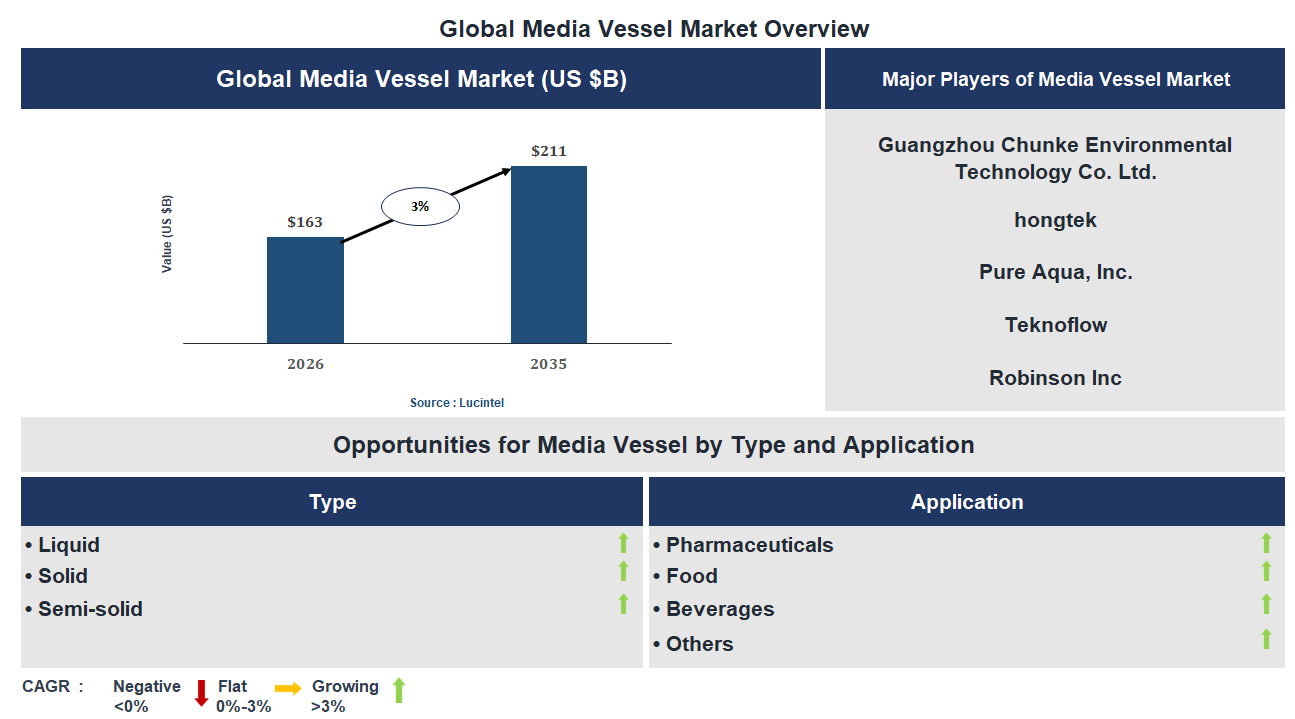
The future of the global media vessel market looks promising with opportunities in the pharmaceutical, food, and beverage markets. The global media vessel market is expected to reach an estimated $211 billion by 2035 with a CAGR of 3% from 2026 to 2035. The major drivers for this market are the increasing demand for efficient storage solutions, the rising adoption of advanced vessel technologies, and the growing focus on sustainable media handling.• Lucintel forecasts that, within the type category, liquid is expected to witness higher growth over the forecast period.
• Within the application category, pharmaceutical is expected to witness the highest growth.
• In terms of region, APAC is expected to witness the highest growth over the forecast period. Gain valuable insights for your business decisions with our comprehensive 150+ page report. Sample figures with some insights are shown below.
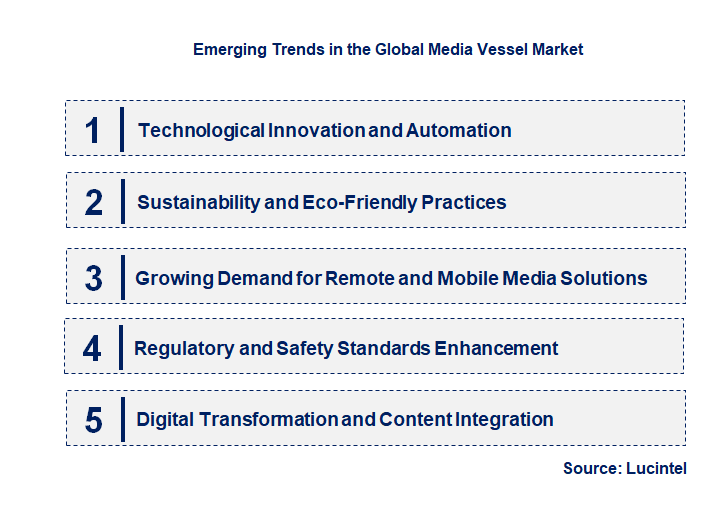
Emerging Trends in the Media Vessel Market
The media vessel market is experiencing rapid evolution driven by technological advancements, changing consumer preferences, and increasing demand for innovative media delivery solutions. As digital transformation accelerates, traditional media vessels are being reimagined to meet new operational, environmental, and content distribution needs. These developments are not only enhancing efficiency and sustainability but also expanding the scope of media services globally. Stakeholders are focusing on integrating cutting-edge technologies, improving safety standards, and adopting sustainable practices to stay competitive. The following key trends highlight the major shifts shaping the future of the media vessel market.• Technological Innovation and Automation: The integration of advanced technologies such as AI, IoT, and automation is transforming media vessels. These innovations enable real-time monitoring, predictive maintenance, and enhanced operational efficiency. Automated systems reduce human error, lower operational costs, and improve safety standards. Additionally, smart vessels equipped with IoT sensors facilitate better data collection and analysis, leading to optimized media delivery and resource management. This trend is making media vessels more intelligent, reliable, and capable of supporting complex media operations in diverse environments.
• Sustainability and Eco-Friendly Practices: Environmental concerns are prompting the adoption of sustainable practices within the media vessel industry. Companies are investing in green technologies such as hybrid propulsion systems, energy-efficient engines, and waste reduction measures. The shift towards eco-friendly vessels aims to minimize carbon footprints and comply with stricter environmental regulations. This trend not only enhances corporate social responsibility but also reduces long-term operational costs. As sustainability becomes a key differentiator, the market is witnessing increased innovation in eco-conscious vessel design and operation.
• Growing Demand for Remote and Mobile Media Solutions: The increasing need for flexible and mobile media delivery is driving demand for specialized media vessels. These vessels support remote broadcasting, live event coverage, and on-demand media services across various locations. The ability to deploy media vessels quickly to different sites offers broadcasters and content providers greater agility and reach. This trend is particularly prominent in live sports, news coverage, and disaster response scenarios, where rapid deployment and mobility are critical. It is expanding the market scope and creating new opportunities for service providers.
• Regulatory and Safety Standards Enhancement: Stricter safety and regulatory standards are shaping vessel design and operation protocols. Governments and industry bodies are implementing rigorous safety measures, environmental regulations, and certification requirements. These standards ensure safer working conditions, environmental protection, and compliance with international laws. As a result, media vessel operators are investing in advanced safety equipment, crew training, and compliance management systems. This trend promotes a safer, more sustainable industry but also increases operational costs and complexity, prompting innovation in safety technology and procedures.
• Digital Transformation and Content Integration: The shift towards digital content and integrated media solutions is significantly impacting the market. Media vessels are now equipped with high-speed connectivity, cloud integration, and advanced broadcasting equipment to support seamless content delivery. This digital transformation enables real-time editing, remote collaboration, and multi-platform distribution. It enhances viewer engagement and operational flexibility. As content consumption continues to evolve rapidly, media vessels are becoming more versatile, supporting diverse media formats and interactive experiences, thus reshaping traditional broadcasting paradigms. These trends are collectively reshaping the media vessel market by fostering innovation, promoting sustainability, enhancing safety, and enabling greater flexibility in media content delivery. They are driving the industry towards more efficient, environmentally responsible, and technologically advanced solutions, ensuring its relevance and growth in a rapidly changing digital landscape.
Recent Development in the Media Vessel Market
The media vessel market is experiencing rapid growth driven by technological advancements, increasing demand for specialized vessels, and expanding media and entertainment industries worldwide. Innovations in vessel design, environmental regulations, and operational efficiencies are shaping the market landscape. Stakeholders are investing heavily to capitalize on emerging opportunities, which are transforming how media content is produced, transported, and managed at sea. These developments are creating new avenues for growth, competition, and technological integration within the industry.• Growing Demand for Specialized Media Vessels: The need for vessels equipped with advanced broadcasting and communication systems is rising. This growth is driven by the expansion of live broadcasting, remote media production, and offshore media services. As media companies seek reliable, high-capacity vessels to support their operations, manufacturers are innovating to meet these requirements. This trend enhances operational efficiency, reduces latency, and improves content delivery, ultimately expanding the market for specialized media vessels and attracting new investments.
• Technological Innovations in Vessel Design: Recent developments include the integration of AI, IoT, and automation in vessel operations. These innovations improve navigation, safety, and energy efficiency, reducing operational costs. Enhanced vessel design allows for better stabilization, noise reduction, and environmental compliance. Such technological advancements enable vessels to operate in diverse conditions, increasing their versatility and appeal. This progress is attracting stakeholders seeking sustainable, cost-effective solutions, thereby expanding the market and encouraging further R&D investments.
• Increasing Focus on Environmental Regulations: Stricter environmental standards are prompting vessel manufacturers to adopt greener technologies, such as hybrid propulsion and emission control systems. These measures reduce carbon footprints and comply with international regulations, making vessels more sustainable. The shift towards eco-friendly vessels is also driven by client demand for corporate responsibility. This focus on sustainability is fostering innovation, opening new market segments, and encouraging regulatory support, which collectively boost the growth prospects of the media vessel industry.
• Expansion of Media and Entertainment Industries: The global rise in media consumption, live events, and remote broadcasting is fueling demand for media vessels. As content delivery becomes more complex and geographically dispersed, vessels serve as mobile studios and transmission hubs. This expansion is particularly prominent in emerging markets, where infrastructure development is ongoing. The increased media activity enhances revenue opportunities for vessel operators and manufacturers, fostering market growth and encouraging strategic partnerships within the industry.
• Investment in Fleet Modernization and Capacity Expansion: Companies are investing heavily in upgrading existing vessels and expanding their fleets to meet rising demand. Modernization includes installing state-of-the-art communication systems, energy-efficient engines, and enhanced safety features. Capacity expansion allows operators to serve larger projects and more clients simultaneously. These investments improve operational flexibility, reduce downtime, and increase market competitiveness. As a result, the industry is witnessing a surge in new vessel orders, consolidations, and strategic alliances, driving overall market growth. These recent developments are significantly transforming the media vessel market by enhancing technological capabilities, sustainability, and operational efficiency. The focus on innovation and environmental compliance is attracting new investments and expanding market opportunities. Growing media demands and fleet modernization efforts are further fueling industry growth. Collectively, these trends are positioning the media vessel market for sustained expansion, increased competitiveness, and technological leadership in the global media and entertainment infrastructure sector.
Strategic Growth Opportunities in the Media Vessel Market
The media vessel market is experiencing rapid expansion driven by technological advancements, increasing demand for specialized media transport solutions, and the need for efficient content delivery across various platforms. Growing media consumption, the rise of live broadcasting, and the integration of innovative materials are creating new opportunities for market players. Strategic investments and collaborations are essential to capitalize on these trends, ensuring enhanced performance, safety, and sustainability in media vessel operations. This evolving landscape offers significant potential for growth and competitive advantage.• Increasing Demand for Specialized Media Transport Solutions: The rising need for efficient, reliable media transport vessels to support live broadcasting, event coverage, and content distribution is a key growth driver. As media companies expand their reach and diversify content delivery channels, the demand for vessels equipped with advanced technology and safety features grows. This creates opportunities for manufacturers to develop customized vessels that meet specific operational requirements, ensuring seamless media transmission and operational efficiency.
• Technological Innovations Enhancing Vessel Capabilities: Advancements in navigation, communication, and media transmission technologies are transforming media vessels. Integration of satellite communication, real-time data transfer, and automation systems improves operational efficiency and safety. These innovations enable vessels to operate in challenging environments, support high-quality content delivery, and reduce downtime. Companies investing in cutting-edge technology can differentiate their offerings and capture a larger market share.
• Growing Focus on Sustainability and Eco-Friendly Vessels: Environmental concerns and regulatory pressures are pushing the industry toward sustainable solutions. The development of eco-friendly media vessels utilizing alternative fuels, energy-efficient designs, and green materials is gaining momentum. This shift not only reduces carbon footprints but also aligns with corporate social responsibility goals. Market players adopting sustainable practices can access new customer segments and benefit from government incentives and favorable regulations.
• Expansion of Media Content Delivery in Remote and Underdeveloped Areas: The need to reach audiences in remote or underserved regions presents significant growth opportunities. Media vessels equipped with satellite connectivity and portable broadcasting equipment can deliver content where traditional infrastructure is lacking. This expansion supports global media coverage, disaster response, and humanitarian efforts, opening avenues for specialized vessel designs and services tailored to challenging environments.
• Strategic Collaborations and Partnerships for Market Penetration: Collaborations between vessel manufacturers, media companies, and technology providers are crucial for innovation and market expansion. Strategic alliances facilitate the development of integrated solutions, shared expertise, and access to new markets. These partnerships enable faster adoption of advanced media vessel technologies, improve service offerings, and strengthen competitive positioning in a rapidly evolving industry landscape. The media vessel markets growth opportunities are poised to significantly influence industry dynamics, fostering innovation, sustainability, and expanded global reach. Embracing these opportunities will enable market participants to enhance their offerings, meet evolving customer demands, and secure a competitive edge in this expanding sector.
Media Vessel Market Driver and Challenges
The media vessel market is influenced by a complex interplay of technological advancements, economic shifts, and regulatory frameworks. As industries evolve, the demand for innovative media vessels that support broadcasting, communication, and data transmission continues to grow. Rapid technological innovations such as automation, digitalization, and enhanced connectivity are transforming operational capabilities. Economic factors like increasing investments in media infrastructure and rising consumer demand for high-quality content further propel market growth. However, regulatory challenges related to safety standards, environmental concerns, and international compliance pose significant hurdles. Navigating these drivers and challenges is crucial for stakeholders aiming to capitalize on emerging opportunities while mitigating risks in this dynamic market. The factors responsible for driving the media vessel market include:• Technological Innovation: The rapid development of digital broadcasting, automation, and IoT integration enhances media vessel efficiency and capabilities. These innovations enable faster data transmission, improved reliability, and expanded service offerings, making media vessels more adaptable to evolving industry needs. As technology continues to advance, media vessels can support higher bandwidths, better remote management, and enhanced safety features, which collectively drive market growth and competitiveness.
• Increasing Demand for Content Delivery: The surge in digital content consumption globally has heightened the need for reliable, high-capacity media vessels. Broadcasters, streaming services, and telecom providers require robust infrastructure to deliver live events, on-demand content, and real-time communications. This demand fuels investments in specialized vessels capable of supporting large-scale media operations, thereby expanding the market and encouraging technological upgrades.
• Economic Growth and Infrastructure Investment: Rising economic activity, especially in emerging markets, leads to increased investments in media infrastructure. Governments and private enterprises are funding projects to enhance communication networks, which include deploying advanced media vessels. These investments not only boost market size but also promote innovation in vessel design and functionality, ensuring the industry keeps pace with global connectivity needs.
• Regulatory and Environmental Standards: Stricter safety, environmental, and operational regulations influence vessel design and deployment strategies. Compliance with international standards such as IMO regulations and environmental protocols necessitates technological adaptations, which can increase costs but also drive innovation. Navigating these regulatory landscapes is essential for market players to operate legally and sustainably, impacting overall market dynamics. The challenges facing the media vessel market include:
• High Capital and Operational Costs: The construction, maintenance, and operation of media vessels require significant financial investment. Advanced technology integration, compliance with safety standards, and crew training contribute to high costs, which can limit market entry for smaller players and slow down expansion. Managing these expenses while maintaining profitability remains a key challenge for industry stakeholders.
• Regulatory Compliance and Environmental Concerns: Stringent regulations related to safety, emissions, and environmental impact pose operational challenges. Adapting vessels to meet evolving standards often involves costly retrofits and technological upgrades. Non-compliance can lead to legal penalties and reputational damage, making regulatory navigation a critical aspect of market sustainability.
• Technological Obsolescence and Competition: Rapid technological changes can render existing vessels obsolete quickly. Staying ahead requires continuous innovation and investment, which can be resource-intensive. Additionally, intense competition among vessel providers pushes for differentiation through technology, further increasing R&D costs and operational risks. The media vessel market is shaped by significant technological advancements, increasing demand for media content, and supportive economic investments. However, it faces challenges such as high costs, regulatory hurdles, and rapid technological obsolescence. These drivers propel growth and innovation, while the challenges necessitate strategic planning and adaptation. Overall, the markets future depends on balancing technological progress with regulatory compliance and cost management, ensuring sustainable expansion amid evolving industry demands.
List of Media Vessel Companies
Companies in the market compete on the basis of product quality offered. Major players in this market focus on expanding their manufacturing facilities, R&D investments, infrastructural development, and leverage integration opportunities across the value chain. With these strategies media vessel companies cater increasing demand, ensure competitive effectiveness, develop innovative products & technologies, reduce production costs, and expand their customer base. Some of the media vessel companies profiled in this report include-• Guangzhou Chunke Environmental Technology Co. Ltd.
• hongtek
• Pure Aqua, Inc.
• Teknoflow
• Robinson Inc
• Rexarc
• Hebei Chengda Water Technology Co., Ltd.
• Halvorsen Company
• EML Manufacturing, LLC
• Forsyths Ltd
Media Vessel Market by Segment
The study includes a forecast for the global media vessel market by type, application, and region.Media Vessel Market by Type [Value from 2019 to 2035]:
• Liquid
• Solid
• Semi-solid
Media Vessel Market by Application [Value from 2019 to 2035]:
• Pharmaceuticals
• Food
• Beverages
• Others
Media Vessel Market by Region [Value from 2019 to 2035]:
• North America
• Europe
• Asia Pacific
• The Rest of the World
Country Wise Outlook for the Media Vessel Market
The media vessel market has experienced significant growth driven by technological advancements, increasing demand for media broadcasting, and expanding infrastructure globally. Countries are investing heavily in modernizing their media and communication capabilities to meet rising consumer expectations and digital transformation trends. Innovations in vessel design, eco-friendly technologies, and enhanced connectivity are shaping the future of this industry. Governments and the private sectors are collaborating to develop more efficient, sustainable, and versatile media vessels. These developments reflect a broader shift towards digital media, remote broadcasting, and global content distribution, making the media vessel market a critical component of the global media landscape.• United States: The US market has seen substantial investments in high-capacity, eco-friendly media vessels equipped with advanced broadcasting technology. Major companies are focusing on sustainable solutions, including hybrid propulsion systems, to reduce environmental impact. There is also a growing trend toward integrating 5G connectivity for seamless live broadcasting and remote operations. Regulatory frameworks are evolving to support innovative vessel designs, and partnerships between tech firms and media companies are driving new service offerings.
• China: China is rapidly expanding its media vessel fleet to support its growing media and broadcasting industry. The focus is on developing large, multifunctional vessels capable of supporting 4K and 8K broadcasting standards. The government is promoting green technologies, including solar-powered vessels, to align with environmental policies. Domestic manufacturers are investing in advanced navigation and stabilization systems to enhance operational efficiency and safety, positioning China as a key player in the global market.
• Germany: Germany emphasizes sustainable and technologically advanced media vessels, with a strong focus on energy efficiency and environmental compliance. The market is characterized by innovations in hybrid propulsion and noise reduction technologies to minimize ecological footprints. German companies are also pioneering in integrating AI-driven automation systems for improved vessel management and broadcasting capabilities. The country’s strategic location in Europe makes it a hub for cross-border media operations and vessel servicing.
• India: India’s media vessel market is experiencing rapid growth driven by expanding media infrastructure and digital content consumption. The focus is on cost-effective, versatile vessels capable of supporting multiple media formats. There is increasing adoption of eco-friendly technologies, such as solar and hybrid power systems, to reduce operational costs. The government’s push for digital India and regional broadcasting expansion is fueling demand for modern vessels equipped with advanced communication and broadcasting equipment.
• Japan: Japan is advancing its media vessel technology with a focus on resilience and innovation. The market features vessels with enhanced stabilization and seismic-resistant designs, suitable for Japan’s geophysical conditions. Japan is also investing in eco-friendly propulsion systems and energy-efficient equipment. The integration of AI and IoT for real-time monitoring and remote operation is a key trend. The country’s expertise in precision engineering supports the development of highly specialized media vessels for diverse broadcasting needs.

Features of the Global Media Vessel Market
Market Size Estimates: Media vessel market size estimation in terms of value ($B). Trend and Forecast Analysis: Market trends (2019 to 2025) and forecast (2026 to 2035) by various segments and regions. Segmentation Analysis: Media vessel market size by type, application, and region in terms of value ($B). Regional Analysis: Media vessel market breakdown by North America, Europe, Asia Pacific, and Rest of the World. Growth Opportunities: Analysis of growth opportunities in different types, applications, and regions for the media vessel market. Strategic Analysis: This includes M&A, new product development, and competitive landscape of the media vessel market. Analysis of competitive intensity of the industry based on Porter’s Five Forces model.
FAQ
Q1. What is the market size and growth forecast for media vessel market? Answer: The global media vessel market is expected to reach an estimated $211 billion by 2035 and grow with a CAGR of 3% from 2026 to 2035. Q2. What are the major drivers influencing the growth of the media vessel market? Answer: The major drivers for this market are the increasing demand for efficient storage solutions, the rising adoption of advanced vessel technologies, and the growing focus on sustainable media handling. Q3. What are the major segments for media vessel market? Answer: The future of the media vessel market looks promising with opportunities in the pharmaceutical, food, and beverage markets. Q4. Who are the key media vessel market companies? Answer: Some of the key media vessel companies are as follows:• Guangzhou Chunke Environmental Technology Co. Ltd.
• hongtek
• Pure Aqua, Inc.
• Teknoflow
• Robinson Inc
• Rexarc
• Hebei Chengda Water Technology Co., Ltd.
• Halvorsen Company
• EML Manufacturing, LLC
• Forsyths Ltd Q5. Which media vessel market segment will be the largest in future? Answer: Lucintel forecasts that, within the type category, liquid is expected to witness higher growth over the forecast period. Q6. In media vessel market, which region is expected to be the largest in next 5 years? Answer: In terms of region, APAC is expected to witness the highest growth over the forecast period. Q7. Do we receive customization in this report? Answer: Yes, Lucintel provides 10% customization without any additional cost.
Table of Contents
List of Figures
List of Tables
Methodology
- In-depth interviews of the major players in this market
- Detailed secondary research from competitors’ financial statements and published data
- Extensive searches of published works, market, and database information pertaining to industry news, company press releases, and customer intentions
- A compilation of the experiences, judgments, and insights of Lucintel’s professionals, who have analyzed and tracked this market over the years.


Buy Now
Choose a license that fits your team. Instant PDF delivery.
Prices exclude taxes. Instant delivery. Custom licensing available on request.
Key Questions
- • What are some of the most promising, high-growth opportunities for the media vessel market by type (liquid, solid, and semi-solid), application (pharmaceuticals, food, beverages, and others), and region (North America, Europe, Asia Pacific, and the Rest of the World)?
- • Which segments will grow at a faster pace and why?
- • Which region will grow at a faster pace and why?
- • What are the key factors affecting market dynamics? What are the key challenges and business risks in this market?
- • What are the business risks and competitive threats in this market?
- • What are the emerging trends in this market and the reasons behind them?
- • What are some of the changing demands of customers in the market?
- • What are the new developments in the market? Which companies are leading these developments?
- • Who are the major players in this market? What strategic initiatives are key players pursuing for business growth?
- • What are some of the competing products in this market and how big of a threat do they pose for loss of market share by material or product substitution?
- • What M&A activity has occurred in the last 7 years and what has its impact been on the industry? For any questions related to Media Vessel Market, Media Vessel Market Size, Media Vessel Market Growth, Media Vessel Market Analysis, Media Vessel Market Report, Media Vessel Market Share, Media Vessel Market Trends, Media Vessel Market Forecast, Media Vessel Companies, write Lucintel analyst at email: helpdesk@lucintel.com. We will be glad to get back to you soon.


