
Report Feature
Mechanical Ventilator Market Trends and Forecast
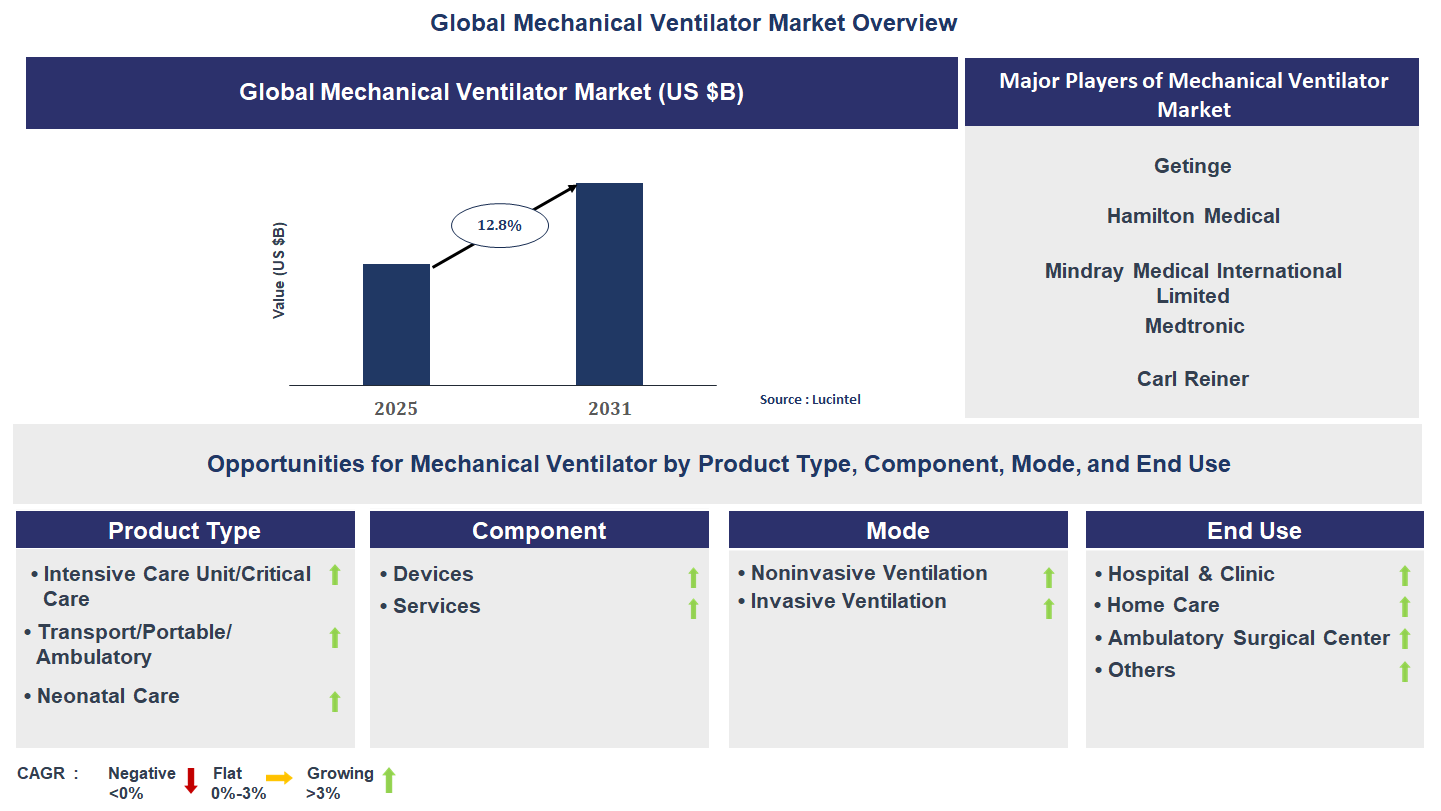
The future of the global mechanical ventilator market looks promising with opportunities in the hospital & clinic, home care, and ambulatory surgical center markets. The global mechanical ventilator market is expected to grow with a CAGR of 12.8% from 2025 to 2031. The major drivers for this market are the increasing incidence of respiratory disorders, the rising demand for critical care equipment, and the growing adoption of advanced ventilation technologies.• Lucintel forecasts that, within the product type category, intensive care unit/critical care is expected to witness the highest growth over the forecast period.
• Within the end use category, hospital & clinic is expected to witness the highest growth.
• In terms of region, North America is expected to witness the highest growth over the forecast period. Gain valuable insights for your business decisions with our comprehensive 150+ page report. Sample figures with some insights are shown below.
Emerging Trends in the Mechanical Ventilator Market
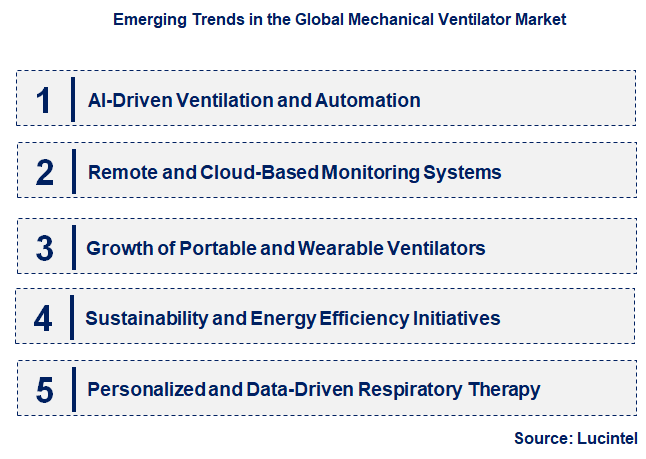
The mechanical ventilator market is undergoing technological transformation driven by automation, connectivity, and patient-centric design. Hospitals and homecare facilities are increasingly adopting intelligent ventilators with adaptive algorithms and data-driven controls. Integration of AI, IoT, and cloud platforms is improving clinical decision-making and device efficiency. The growing focus on sustainability, portability, and user-friendly design is reshaping ventilator manufacturing.• AI-Driven Ventilation and Automation: AI-powered ventilators optimize airflow, pressure, and oxygen levels according to patient-specific needs. Automation minimizes manual intervention, enhances safety, and reduces clinical workload, resulting in improved accuracy and real-time adjustment of respiratory support.
• Remote and Cloud-Based Monitoring Systems: Integration of IoT and cloud connectivity enables remote ventilator management and patient monitoring. This trend enhances care delivery for patients in remote locations and allows healthcare professionals to track performance and intervene promptly when needed.
• Growth of Portable and Wearable Ventilators: Rising demand for mobility and homecare solutions is boosting the development of compact, lightweight, and battery-powered ventilators. These devices provide convenience and improve the quality of life for patients with chronic respiratory conditions.
• Sustainability and Energy Efficiency Initiatives: Manufacturers are focusing on recyclable materials, low-energy systems, and durable components to reduce environmental impact. Sustainable design and energy efficiency improve operational longevity and align with global green healthcare initiatives.
• Personalized and Data-Driven Respiratory Therapy: Advanced ventilators equipped with data analytics and adaptive algorithms deliver customized treatment. This trend ensures patient comfort, reduces ventilator-associated complications, and supports precision medicine approaches in respiratory care. These emerging trends are transforming the mechanical ventilator market toward intelligent, efficient, and patient-focused care. Automation and AI enhance precision, while remote connectivity improves accessibility. The shift toward portable and sustainable designs reflects growing patient mobility needs and environmental awareness. Personalized therapy powered by data analytics represents the next stage in respiratory innovation. Collectively, these trends are creating a more connected, efficient, and sustainable respiratory care ecosystem worldwide.
Recent Development in the Mechanical Ventilator Market
Recent developments in the mechanical ventilator market demonstrate significant progress in automation, digital monitoring, and design innovation. Manufacturers are focusing on user-friendly, portable, and high-performance ventilators to meet growing demand across hospital and homecare settings. Partnerships between Medtech companies and research institutions have accelerated advancements in AI integration, predictive analytics, and remote connectivity. The market is also seeing new government initiatives promoting local production and supply chain resilience.• Launch of AI-Integrated Ventilator Systems: Several manufacturers have introduced ventilators with adaptive control systems that automatically adjust airflow and oxygen delivery based on patient data.
• Expansion of Local Production and Supply Chain Resilience: Countries are investing in domestic manufacturing to ensure steady supply during emergencies and reduce reliance on imports.
• Development of Portable Homecare Ventilators: Growing demand for non-invasive and lightweight devices has led to innovation in compact ventilators designed for personal and home use.
• Integration of Cloud and Remote Monitoring Platforms: Ventilators are now linked to cloud systems for continuous data tracking and remote medical supervision, improving patient management efficiency.
• Focus on Sustainability and Low Power Consumption: Manufacturers are emphasizing eco-friendly designs that reduce energy consumption and extend device lifespan, supporting global sustainability goals. These developments reflect the industry’s commitment to innovation, accessibility, and sustainability. AI and digital connectivity are enhancing performance and safety, while domestic manufacturing initiatives strengthen supply resilience. Portable ventilators expand access to home-based care, and sustainable production aligns with global environmental targets. Together, these advancements are creating a modern, efficient, and patient-focused ventilator market capable of addressing evolving healthcare needs.
Strategic Growth Opportunities in the Mechanical Ventilator Market
The mechanical ventilator market presents strong growth opportunities across applications such as critical care, transport, emergency, homecare, and neonatal ventilation. Technological advancements, aging populations, and the increasing prevalence of chronic respiratory diseases are driving adoption. Healthcare providers are prioritizing reliable, energy-efficient, and user-friendly systems. Digital monitoring and remote connectivity are expanding homecare applications, while hospitals continue to invest in advanced ICU ventilators.• Critical Care and Intensive Care Units: Rising cases of severe respiratory illnesses are increasing demand for advanced, high-performance ventilators in hospital ICUs.
• Emergency and Transport Ventilation: Portable and durable ventilators designed for ambulances and emergency care support life-saving interventions in transit and critical conditions.
• Homecare and Long-Term Therapy Applications: Growing chronic disease prevalence fuels demand for compact, easy-to-use ventilators that improve homecare convenience and patient comfort.
• Neonatal and Pediatric Ventilation: Specialized ventilators with gentle airflow and precise control are supporting newborn and child care in hospitals and neonatal units.
• Anesthesia and Surgical Applications: Integration of ventilators in anesthesia machines improves patient safety and breathing support during surgical procedures. Strategic growth opportunities in the mechanical ventilator market lie in specialized and portable applications across clinical and homecare settings. Expanding demand in ICUs, neonatal care, and emergency transport highlights the need for reliability and innovation. Home-based ventilators and integrated anesthesia systems are widening accessibility and efficiency. These opportunities collectively enhance patient care quality, operational flexibility, and long-term market growth worldwide.
Mechanical Ventilator Market Driver and Challenges
The mechanical ventilator market is influenced by technological innovation, rising healthcare expenditures, and regulatory dynamics. Increasing cases of respiratory diseases, aging populations, and post-pandemic preparedness continue to drive demand. At the same time, cost constraints, supply chain disruptions, and maintenance challenges pose obstacles. Understanding these factors helps stakeholders plan strategies that promote growth, resilience, and operational excellence across healthcare systems. The factors responsible for driving the mechanical ventilator market include: 1. Rising Prevalence of Respiratory Diseases: Increasing incidences of COPD, asthma, and other respiratory illnesses are boosting ventilator demand globally. 2. Technological Advancements and AI Integration: Smart ventilators with automation and remote monitoring improve efficiency, accuracy, and clinical outcomes. 3. Growing Adoption of Homecare Ventilation: Demand for portable ventilators is rising as patients prefer home-based treatment for chronic respiratory conditions. 4. Government Support and Emergency Preparedness Programs: Public health investments in ventilator stockpiling and domestic production strengthen market growth. 5. Aging Population and Long-Term Care Demand: The global rise in elderly populations drives consistent demand for ventilation support in hospitals and homecare facilities. Challenges in the mechanical ventilator market are: 1. High Device Costs and Maintenance Expenses: Advanced ventilators require significant investment, limiting access in low-income regions. 2. Shortage of Skilled Professionals: Lack of trained respiratory therapists and technicians affects proper device operation and patient management. 3. Regulatory and Compliance Barriers: Stringent approval processes and regional variations in certification can delay product launches. The mechanical ventilator market continues to evolve under the influence of technological innovation, demographic change, and healthcare expansion. Drivers such as AI integration, aging populations, and government support enhance growth, while challenges like cost and workforce shortages hinder accessibility. Overall, continued investment in affordable, smart, and sustainable ventilators will strengthen the global response to respiratory care needs, ensuring efficient and equitable healthcare delivery.List of Mechanical Ventilator Companies
Companies in the market compete on the basis of product quality offered. Major players in this market focus on expanding their manufacturing facilities, R&D investments, infrastructural development, and leverage integration opportunities across the value chain. With these strategies mechanical ventilator companies cater increasing demand, ensure competitive effectiveness, develop innovative products & technologies, reduce production costs, and expand their customer base. Some of the mechanical ventilator companies profiled in this report include-• Getinge
• Hamilton Medical
• Mindray Medical International Limited
• Medtronic
• Carl Reiner
• Smith’s Group
• General Electric Company
• Koninklijke Philips
• Asahi Kasei Corporation
• DRAEGERWERK
Mechanical Ventilator Market by Segment
The study includes a forecast for the global mechanical ventilator market by product type, component, mode, end use, and region.Mechanical Ventilator Market by Product Type [Value from 2019 to 2031]:
• Intensive Care Unit/Critical Care
• Transport/Portable/Ambulatory
• Neonatal Care
Mechanical Ventilator Market by Component [Value from 2019 to 2031]:
• Devices
• Services
Mechanical Ventilator Market by Mode [Value from 2019 to 2031]:
• Noninvasive Ventilation
• Invasive Ventilation
Mechanical Ventilator Market by End Use [Value from 2019 to 2031]:
• Hospital & Clinic
• Home Care
• Ambulatory Surgical Center
• Others
Mechanical Ventilator Market by Region [Value from 2019 to 2031]:
• North America
• Europe
• Asia Pacific
• The Rest of the World
Country Wise Outlook for the Mechanical Ventilator Market
The global mechanical ventilator market has evolved rapidly due to advancements in respiratory care technologies, growing chronic respiratory diseases, and heightened preparedness following the COVID-19 pandemic. Increasing demand for non-invasive and portable ventilators, coupled with automation and AI integration, is transforming patient management in hospitals and homecare settings. Governments and healthcare institutions are emphasizing capacity expansion, local production, and improved critical care infrastructure. Countries such as the United States, China, Germany, India, and Japan are leading these developments, investing in innovative designs, smart monitoring systems, and cost-effective ventilator models to strengthen critical care services globally.• United States: In the United States, the mechanical ventilator market has witnessed significant technological advancement and production scale-up. Manufacturers are focusing on AI-driven ventilation systems that offer personalized care and better monitoring capabilities. The increased adoption of portable and non-invasive ventilators supports homecare treatment for chronic respiratory conditions. Federal initiatives and funding programs encourage domestic manufacturing to reduce import dependency and ensure emergency preparedness.
• China: China’s mechanical ventilator market has expanded rapidly through government-backed healthcare modernization and domestic innovation. The country is focusing on self-reliance by strengthening local production and reducing dependence on foreign ventilator suppliers. Chinese manufacturers are developing cost-effective, high-quality ventilators with digital monitoring and telemedicine compatibility. Growing investments in healthcare infrastructure and critical care units are fueling market growth. China’s emphasis on technology localization and export expansion has positioned its ventilator industry as a competitive force globally.
• Germany: Germany’s mechanical ventilator market is advancing through innovations in design precision, energy efficiency, and patient safety. German companies are developing hybrid ventilators capable of both invasive and non-invasive operations to address diverse patient needs. The country’s strong regulatory framework ensures high manufacturing standards and product reliability. Integration of smart sensors and data analytics supports real-time monitoring in ICUs. Collaboration between medical device manufacturers and research institutes is promoting the development of automated ventilation control systems.
• India: India’s mechanical ventilator market is witnessing substantial growth, supported by government initiatives to strengthen healthcare infrastructure and promote local manufacturing. The Make in India program has encouraged domestic production of affordable ventilators to meet rising hospital demand. Indian startups are introducing portable and low-cost models suitable for rural and homecare use. The increasing burden of respiratory diseases and growing investments in hospital modernization are driving demand. Public-private collaborations have enhanced access to ventilator technologies across tier-2 and tier-3 cities.
• Japan: Japan’s mechanical ventilator market is advancing through automation, miniaturization, and digital connectivity. Japanese manufacturers are incorporating AI and IoT technologies into ventilators to enable real-time monitoring, predictive maintenance, and remote operation. The country’s aging population and rising prevalence of respiratory disorders have increased the need for home-based and portable ventilators. Collaboration between medical device companies and healthcare institutions promotes innovation in non-invasive respiratory support.

Features of the Global Mechanical Ventilator Market
Market Size Estimates: Mechanical ventilator market size estimation in terms of value ($B). Trend and Forecast Analysis: Market trends (2019 to 2024) and forecast (2025 to 2031) by various segments and regions. Segmentation Analysis: Mechanical ventilator market size by various segments, such as by product type, component, mode, end use, and region in terms of value ($B). Regional Analysis: Mechanical ventilator market breakdown by North America, Europe, Asia Pacific, and Rest of the World. Growth Opportunities: Analysis of growth opportunities in different product types, components, modes, end uses, and regions for the mechanical ventilator market. Strategic Analysis: This includes M&A, new product development, and competitive landscape of the mechanical ventilator market. Analysis of competitive intensity of the industry based on Porter’s Five Forces model.
FAQ
Q1. What is the growth forecast for mechanical ventilator market? Answer: The global mechanical ventilator market is expected to grow with a CAGR of 12.8% from 2025 to 2031. Q2. What are the major drivers influencing the growth of the mechanical ventilator market? Answer: The major drivers for this market are the increasing incidence of respiratory disorders, the rising demand for critical care equipment, and the growing adoption of advanced ventilation technologies. Q3. What are the major segments for mechanical ventilator market? Answer: The future of the mechanical ventilator market looks promising with opportunities in the hospital & clinic, home care, and ambulatory surgical center markets. Q4. Who are the key mechanical ventilator market companies? Answer: Some of the key mechanical ventilator companies are as follows:• Getinge
• Hamilton Medical
• Mindray Medical International Limited
• Medtronic
• Carl Reiner
• Smith’s Group
• General Electric Company
• Koninklijke Philips
• Asahi Kasei Corporation
• DRAEGERWERK Q5. Which mechanical ventilator market segment will be the largest in future? Answer: Lucintel forecasts that, within the product type category, intensive care unit/critical care is expected to witness the highest growth over the forecast period. Q6. In mechanical ventilator market, which region is expected to be the largest in next 5 years? Answer: In terms of region, North America is expected to witness the highest growth over the forecast period. Q7. Do we receive customization in this report? Answer: Yes, Lucintel provides 10% customization without any additional cost.
Table of Contents
List of Figures
List of Tables
Methodology
- In-depth interviews of the major players in this market
- Detailed secondary research from competitors’ financial statements and published data
- Extensive searches of published works, market, and database information pertaining to industry news, company press releases, and customer intentions
- A compilation of the experiences, judgments, and insights of Lucintel’s professionals, who have analyzed and tracked this market over the years.


Buy Now
Choose a license that fits your team. Instant PDF delivery.
Prices exclude taxes. Instant delivery. Custom licensing available on request.
Key Questions
- • What are some of the most promising, high-growth opportunities for the mechanical ventilator market by product type (intensive care unit/critical care, transport/portable/ambulatory, and neonatal care), component (devices and services), mode (noninvasive ventilation and invasive ventilation), end use (hospital & clinic, home care, ambulatory surgical center, and others), and region (North America, Europe, Asia Pacific, and the Rest of the World)?
- • Which segments will grow at a faster pace and why?
- • Which region will grow at a faster pace and why?
- • What are the key factors affecting market dynamics? What are the key challenges and business risks in this market?
- • What are the business risks and competitive threats in this market?
- • What are the emerging trends in this market and the reasons behind them?
- • What are some of the changing demands of customers in the market?
- • What are the new developments in the market? Which companies are leading these developments?
- • Who are the major players in this market? What strategic initiatives are key players pursuing for business growth?
- • What are some of the competing products in this market and how big of a threat do they pose for loss of market share by material or product substitution?
- • What M&A activity has occurred in the last 5 years and what has its impact been on the industry? For any questions related to Mechanical Ventilator Market, Mechanical Ventilator Market Size, Mechanical Ventilator Market Growth, Mechanical Ventilator Market Analysis, Mechanical Ventilator Market Report, Mechanical Ventilator Market Share, Mechanical Ventilator Market Trends, Mechanical Ventilator Market Forecast, Mechanical Ventilator Companies, write Lucintel analyst at email: helpdesk@lucintel.com. We will be glad to get back to you soon.


