
Market Report · July 31, 2026

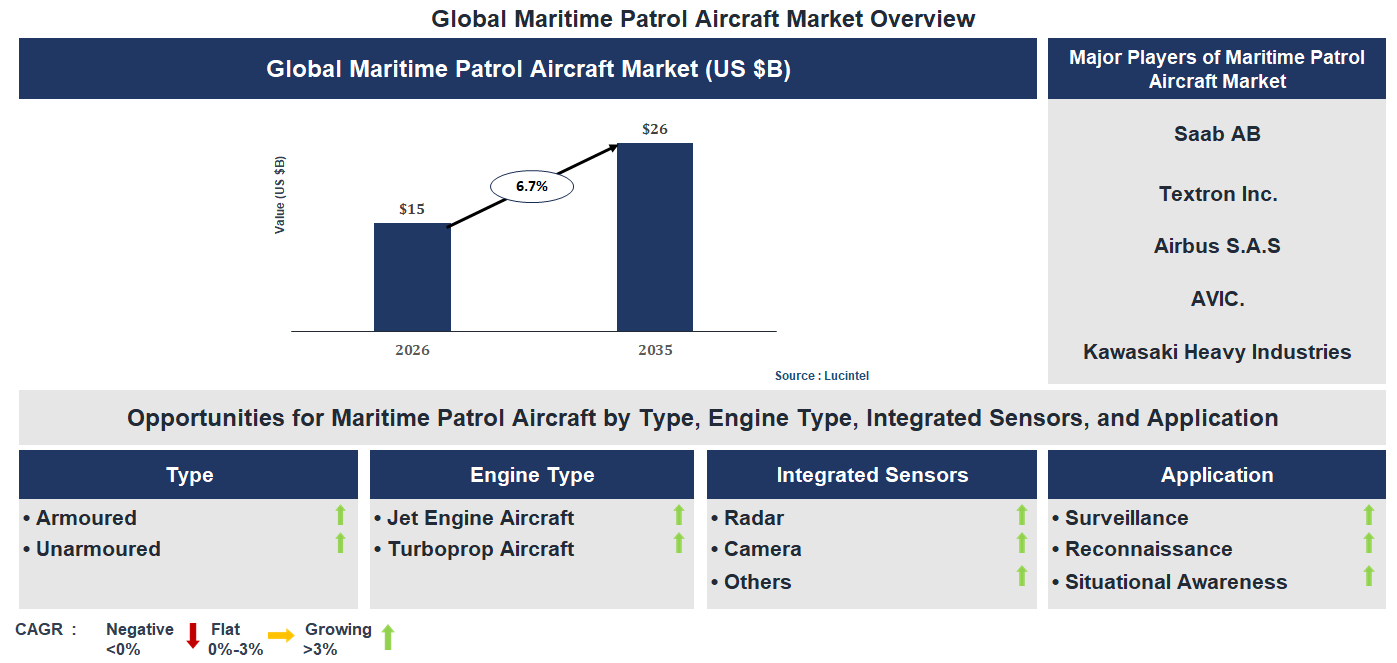
Key data points: The market size in 2035 = $26 billion, growth forecast = 6.7% annually for the next 8 years. Scroll below to get more insights. This market report covers trends, opportunities and forecasts in maritime patrol aircraft market to 2035 by type (armoured and unarmoured), engine type (jet engine aircraft and turboprop aircraft), integrated sensors (radar, camera, and others), application (surveillance, reconnaissance, and situational awareness), and region (North America, Europe, Asia Pacific, and the Rest of the World)
We'll send your sample report shortly.
• Lucintel forecasts that, within the type category, armoured is expected to witness higher growth over the forecast period.
• Within the application category, reconnaissance is expected to witness the highest growth.
• In terms of region, APAC is expected to witness the highest growth over the forecast period. Gain valuable insights for your business decisions with our comprehensive 150+ page report. Sample figures with some insights are shown below.
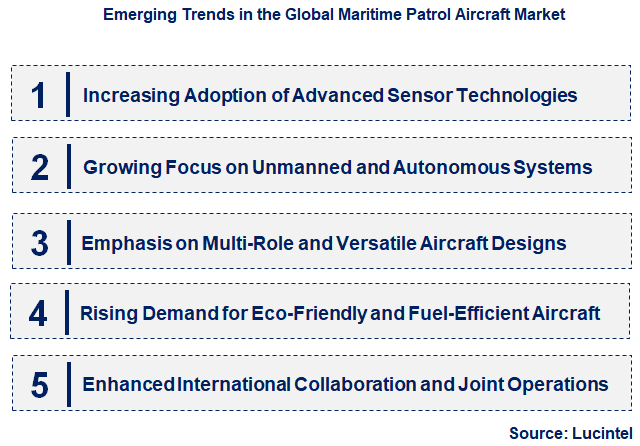
• Increasing Adoption of Advanced Sensor Technologies: The integration of cutting-edge sensors such as radar, sonar, and electro-optical/infrared systems enhances detection and tracking capabilities. These sensors improve situational awareness, enabling aircraft to identify and monitor vessels, submarines, and surface threats more accurately. The deployment of multi-sensor suites allows for real-time data collection and analysis, which is crucial for maritime security and search-and-rescue operations. This trend is driven by the need for more effective surveillance in complex maritime environments and is expected to continue expanding as sensor technology advances.
• Growing Focus on Unmanned and Autonomous Systems: The development and deployment of unmanned aerial vehicles (UAVs) and autonomous maritime patrol aircraft are transforming traditional surveillance paradigms. These systems offer extended operational endurance, reduced risk to personnel, and cost efficiencies. They can operate in hazardous or remote areas, providing persistent surveillance without the limitations of crewed aircraft. The integration of AI and machine learning further enhances their capabilities, enabling autonomous decision-making and data processing. This trend is reshaping the market by expanding operational scope and reducing reliance on manned aircraft.
• Emphasis on Multi-Role and Versatile Aircraft Designs: Modern maritime patrol aircraft are increasingly designed to serve multiple functions, including surveillance, anti-submarine warfare, and search-and-rescue. Multi-role platforms provide flexibility and cost savings by consolidating capabilities into a single aircraft. Innovations in modular design allow for quick reconfiguration based on mission requirements. This versatility enhances operational efficiency and responsiveness, especially in complex maritime scenarios. The trend reflects a strategic shift towards adaptable platforms capable of addressing diverse threats and operational needs within a single platform.
• Rising Demand for Eco-Friendly and Fuel-Efficient Aircraft: Environmental concerns and rising fuel costs are prompting manufacturers to develop greener maritime patrol aircraft. Innovations include the adoption of lightweight materials, more efficient engines, and alternative fuels. These advancements reduce carbon emissions and operational costs, aligning with global sustainability goals. Additionally, quieter engines minimize acoustic signatures, which is vital for anti-submarine operations. This trend is influencing market offerings, encouraging manufacturers to prioritize eco-friendly designs that meet both operational and environmental standards, thereby expanding market appeal and compliance.
• Enhanced International Collaboration and Joint Operations: Countries are increasingly engaging in joint patrols, training, and technology sharing to strengthen maritime security. This collaborative approach fosters interoperability and standardization across different nations fleets. It also drives demand for aircraft capable of operating seamlessly in multinational environments. International partnerships facilitate access to advanced technologies and shared intelligence, improving overall maritime domain awareness. This trend is reshaping the market by encouraging the development of versatile, interoperable aircraft systems and fostering a more integrated global maritime security framework. These emerging trends are collectively transforming the maritime patrol aircraft market by enhancing technological capabilities, promoting sustainability, and fostering international cooperation. They are enabling more effective, versatile, and environmentally conscious maritime surveillance solutions, which are crucial for addressing modern maritime security challenges and environmental concerns.
• Growing Demand for Advanced Surveillance Capabilities: The need for enhanced maritime surveillance is driving the adoption of next-generation patrol aircraft equipped with sophisticated sensors, radar systems, and communication tools. This demand is fueled by rising maritime security threats, illegal activities, and the need for better situational awareness. Countries are investing in aircraft that can operate in diverse environments, providing real-time data and improving response times. This trend is expected to boost market growth significantly over the coming years.
• Integration of Unmanned Aerial Vehicles (UAVs): The incorporation of UAVs into maritime patrol operations is revolutionizing surveillance strategies. UAVs offer extended operational ranges, reduced costs, and increased safety by performing risky missions without risking human lives. Their integration with manned aircraft enhances coverage and data collection capabilities. This development is enabling more efficient monitoring of vast maritime areas, supporting search and rescue missions, and improving threat detection, thereby expanding the market scope for innovative solutions.
• Technological Advancements in Sensor and Communication Systems: Recent innovations in sensor technology, including synthetic aperture radar (SAR), electro-optical/infrared (EO/IR) sensors, and advanced communication systems, are transforming maritime patrol aircraft. These upgrades enable real-time data sharing, improved target identification, and better coordination among various maritime security agencies. Enhanced sensor capabilities are crucial for countering emerging threats like piracy, smuggling, and illegal fishing, making these aircraft more effective and versatile, which in turn drives market expansion.
• Increased Focus on Multi-Role Capabilities: Modern maritime patrol aircraft are increasingly designed to serve multiple functions, such as surveillance, anti-submarine warfare, and search and rescue. This multi-role flexibility allows defense agencies to optimize resources and respond swiftly to diverse operational needs. The development of adaptable platforms with modular systems is a key trend, providing cost-effective solutions that can be customized for specific missions. This versatility is attracting more buyers and expanding the market for multi-purpose maritime patrol aircraft.
• Rising Investments in Regional and National Security: Governments worldwide are prioritizing maritime security due to geopolitical tensions, territorial disputes, and the need to safeguard maritime trade routes. Increased defense budgets are allocated toward acquiring advanced patrol aircraft, upgrading existing fleets, and developing indigenous capabilities. This investment surge is fostering innovation, encouraging partnerships, and expanding the market for maritime patrol aircraft globally. The focus on regional security initiatives is expected to sustain market growth in the foreseeable future. The overall impact of these developments is a robust expansion of the maritime patrol aircraft market, driven by technological innovation, strategic security needs, and operational versatility. These factors are fostering increased competition, encouraging R&D investments, and creating new opportunities for industry players. As a result, the market is poised for sustained growth, with enhanced capabilities meeting the evolving demands of maritime security worldwide.
• Growing Demand for Enhanced Maritime Surveillance Capabilities: Increasing maritime security threats such as piracy, smuggling, and illegal fishing are driving the need for advanced patrol aircraft equipped with sophisticated sensors and long-range capabilities. Governments are investing in modernizing their fleets to improve surveillance, reconnaissance, and response times. The demand for aircraft with superior endurance, real-time data transmission, and multi-mission flexibility is expanding, creating opportunities for manufacturers to develop tailored solutions that meet these evolving security needs.
• Technological Advancements in Sensor and Communication Systems: Innovations in radar, electro-optical/infrared sensors, and communication systems are transforming maritime patrol aircraft. These advancements enable real-time data sharing, improved target detection, and enhanced situational awareness. The integration of AI and machine learning further boosts operational efficiency. Companies investing in cutting-edge sensor technology and seamless communication networks can differentiate their offerings, meet increasing customer expectations, and capture a larger market share in this competitive landscape.
• Rising Adoption of Unmanned Aerial Vehicles and Autonomous Systems: The incorporation of UAVs and autonomous systems into maritime patrol operations is revolutionizing surveillance strategies. These systems offer extended endurance, reduced operational costs, and increased safety by performing risky missions. The synergy between manned aircraft and unmanned systems provides comprehensive coverage and persistent monitoring. Market players focusing on developing integrated manned-unmanned platforms can capitalize on this trend, opening new revenue streams and enhancing operational effectiveness.
• Expansion of Defense Budgets and International Collaborations: Governments worldwide are increasing defense spending to strengthen maritime security infrastructure. International collaborations and joint exercises are fostering technology sharing and procurement of advanced patrol aircraft. This financial backing and strategic cooperation create opportunities for market expansion, especially in emerging economies. Companies that establish strong government relationships and participate in international defense programs can secure long-term contracts and expand their global footprint.
• Increasing Focus on Multi-Mission and Versatile Aircraft Designs: The demand for multi-mission maritime patrol aircraft capable of performing surveillance, search and rescue, anti-submarine warfare, and environmental monitoring is rising. Versatile aircraft designs that can be easily reconfigured for different missions offer operational flexibility and cost efficiency. Manufacturers investing in adaptable platforms with modular systems can meet diverse customer needs, gain competitive advantage, and tap into a broader range of applications across military and civilian sectors. The overall market outlook is positively influenced by these growth opportunities, encouraging innovation, strategic partnerships, and regional expansion. As technological and operational demands evolve, market players that adapt swiftly and invest in advanced, versatile solutions will be well-positioned to capitalize on the expanding maritime patrol aircraft market, ensuring enhanced security and operational efficiency worldwide.
• Technological Innovation: The continuous development of advanced radar, surveillance, and communication systems enhances aircraft capabilities, enabling better detection, tracking, and interception of maritime threats. These innovations improve operational efficiency and safety, making patrol aircraft more effective in complex maritime environments. Governments and defense agencies prioritize upgrading their fleets with cutting-edge technology to maintain strategic superiority, fueling market growth.
• Rising Maritime Security Concerns: Increasing piracy, smuggling, illegal fishing, and territorial disputes have heightened the need for robust maritime surveillance. Countries are investing heavily in patrol aircraft to safeguard their maritime borders and economic interests. The growing importance of maritime domain awareness directly correlates with increased procurement and modernization of patrol aircraft, expanding market opportunities.
• Defense Budget Allocations: Governments worldwide are allocating substantial funds toward defense modernization, including maritime patrol capabilities. These budgets enable procurement of new aircraft and upgrades to existing fleets. As defense spending rises, especially in regions with heightened maritime threats, the market experiences significant growth driven by government investments.
• Geopolitical Tensions and Territorial Disputes: Ongoing conflicts and disputes over maritime boundaries compel nations to enhance their surveillance and patrol capabilities. Maritime patrol aircraft are vital for asserting sovereignty and conducting surveillance in disputed waters. This geopolitical landscape sustains demand for advanced patrol aircraft, influencing market expansion.
• International Collaboration and Procurement Programs: Multinational defense alliances and joint procurement initiatives facilitate technology sharing and cost reduction. Such collaborations promote the adoption of advanced maritime patrol aircraft across multiple countries, broadening market reach and fostering innovation through shared expertise. The challenges facing the maritime patrol aircraft market include:
• High Procurement and Maintenance Costs: The acquisition of advanced maritime patrol aircraft involves significant capital expenditure, including costs for procurement, customization, and ongoing maintenance. These financial burdens can limit adoption, especially for smaller nations or those with constrained defense budgets, hindering market growth.
• Technological Complexity and Integration: Developing and integrating sophisticated systems such as radar, sensors, and communication networks pose technical challenges. Ensuring seamless interoperability with existing military infrastructure requires substantial R&D investment and expertise, which can delay deployment and increase costs.
• Regulatory and Export Restrictions: International regulations governing defense exports and technology transfer can restrict market access and collaboration. Compliance with export controls and licensing procedures may slow down procurement processes and limit the availability of certain advanced technologies, impacting market expansion. The maritime patrol aircraft market is shaped by rapid technological advancements, increasing maritime security concerns, and substantial defense investments. However, high costs, technological complexities, and regulatory hurdles present significant challenges. These factors collectively influence market growth, requiring stakeholders to navigate a dynamic environment characterized by innovation and geopolitical considerations. Strategic adaptation to these drivers and challenges will be essential for sustained success in this evolving sector.
• Saab AB
• Textron Inc.
• Airbus S.A.S
• AVIC.
• Kawasaki Heavy Industries
• RUAG Group
• Embraer S.A.
• Boeing
• BAE Systems plc
• Thales Group
• Armoured
• Unarmoured
• Jet Engine Aircraft
• Turboprop Aircraft
• Radar
• Camera
• Others
• Surveillance
• Reconnaissance
• Situational Awareness
• North America
• Europe
• Asia Pacific
• The Rest of the World
• United States: The United States has made substantial investments in upgrading its maritime patrol aircraft fleet, including the deployment of P-8 Poseidon aircraft equipped with advanced sensors and weapons systems. The focus is on enhancing anti-submarine warfare capabilities and maritime surveillance, with increased integration of drone technology for extended operational reach. The U.S. Navy is also exploring next-generation aircraft to maintain technological superiority in maritime security.
• China: China has accelerated its maritime patrol aircraft development, focusing on indigenous designs like the Y-8 and Y-9 platforms, equipped with sophisticated radar and surveillance systems. The country aims to bolster its maritime domain awareness, especially in the South China Sea and beyond. China’s strategic emphasis on expanding its naval capabilities is reflected in its increased procurement and deployment of advanced patrol aircraft.
• Germany: Germany has prioritized modernization of its maritime patrol fleet, primarily through the upgrade of its P-3 Orion aircraft and the acquisition of Airbus A319-based maritime patrol aircraft. The country emphasizes enhanced surveillance, anti-submarine warfare, and maritime security within NATO frameworks. Germany is also investing in sensor technology and data-sharing capabilities to improve operational efficiency.
• India: India has focused on expanding and modernizing its maritime patrol fleet, including the induction of P-8I Poseidon aircraft from the United States. The country is also developing indigenous platforms like the Indian Multi-Role Maritime Aircraft (MMRCA) to reduce dependency on foreign technology. Strengthening maritime security in the Indian Ocean region remains a key priority for India.
• Japan: Japan continues to enhance its maritime patrol capabilities through the procurement of P-1 aircraft, which feature advanced radar and sensor systems for anti-submarine and maritime surveillance missions. The country is also investing in drone technology and sensor upgrades to improve situational awareness amid regional security challenges. Japan’s efforts aim to safeguard its maritime interests and contribute to regional stability.


• Saab AB
• Textron Inc.
• Airbus S.A.S
• AVIC.
• Kawasaki Heavy Industries
• RUAG Group
• Embraer S.A.
• Boeing
• BAE Systems plc
• Thales Group Q6. Which maritime patrol aircraft market segment will be the largest in future? Answer: Lucintel forecasts that, within the type category, armoured is expected to witness higher growth over the forecast period. Q7. In maritime patrol aircraft market, which region is expected to be the largest in next 8 years? Answer: In terms of region, APAC is expected to witness the highest growth over the forecast period. Q8. Do we receive customization in this report? Answer: Yes, Lucintel provides 10% customization without any additional cost.


Choose a license that fits your team. Instant PDF delivery.
Prices exclude taxes. Instant delivery. Custom licensing available on request.
Market Report · July 31, 2026
Market Report · July 31, 2026
Market Report · July 22, 2026
Trusted partner for strategic intelligence and business growth


Receive a complimentary market analysis tailored to your industry. Our analysts will identify key growth opportunities and competitive dynamics specific to your business.

Market size, growth rate, and key trend analysis for your specific sector.

Top competitor positioning and market share analysis.

Strategic recommendations backed by data-driven insights.
Get curated market intelligence and competitive moves straight to your inbox.
By subscribing, you agree to receive our monthly insights. Unsubscribe anytime.
Receive a complimentary market analysis tailored to your industry. Our analysts will identify key growth opportunities and competitive dynamics specific to your business.
Market size, growth rate, and key trend analysis for your specific sector.
Top competitor positioning and market share analysis.
Strategic recommendations backed by data-driven insights.
Get curated market intelligence, emerging trends, and competitive moves straight to your inbox each month.
By subscribing, you agree to receive our monthly insights. Unsubscribe anytime.
We'll send your sample report shortly.