
Market Report · July 31, 2026

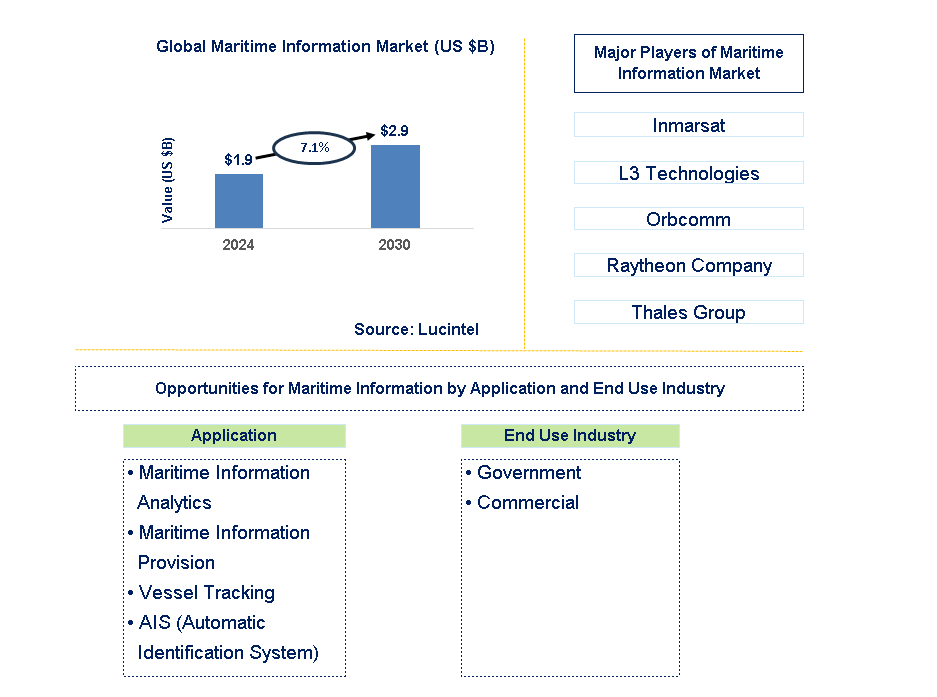
Key data points: The market size in 2030 = $2.9 billion, growth forecasts = 7.1% annually for the next 6 years. Scroll below to get more insights. This market report covers trends, opportunities, and forecasts in the global maritime information market to 2030 by application (maritime information analytics, maritime information provision, vessel tracking, and AIS (automatic identification system)), end use industry (government and commercial), and region (North America, Europe, Asia Pacific, and the Rest of the World)
We'll send your sample report shortly.
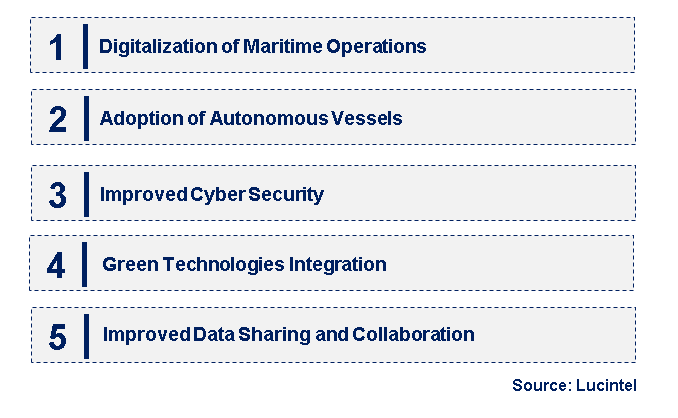
• Digitalization of Maritime Operations: Advanced analytics of data, IoT, and cloud computing fast-digitize maritime operations, enabling real-time monitoring, predictive maintenance, and enhanced decision-making for an overall topping of operational efficiency and safety in maritime activities.
• Adoption of Autonomous Vessels: Probably the most important area of interest is that of autonomous vessels that are equipped with advanced navigation and control systems. These vessels utilize AI and machine learning to enable themselves to navigate and function independently, with limited human intervention, with the aim of improving safety, reducing human error, and ensuring efficiency in operations.
• Improved Cyber Security: In this regard, cybersecurity has become a core feature of highly digitalized maritime systems. Improved measures on cybersecurity have been put in place to protect the data and communication systems in maritime from cyber threats. This trend is great in protecting integrity in maritime operations and guaranteeing secured data exchanges.
• Green Technologies Integration: Green technologies are a growing trend in the integration of reduced environmental impact within maritime information. These include fuel-efficient technologies, emission monitoring systems, and eco-friendly navigation solutions to meet stringent environmental regulations and sustainability goals.
• Improved Data Sharing and Collaboration: More developed data-sharing platforms are emerging that enable collaboration and thus better coordination among the various maritime stakeholders. Such a platform allows seamless information exchange amongst ports, shipping companies, and regulatory bodies-a factor that is likely to enhance efficiency and bring about transparency in general to the conduct of maritime operations. All these, in turn, influence the shape of digitalization, vessel autonomy, and cybersecurity in the Maritime Information market. Better data sharing and integration of green technologies are also contributing to maritime operations in an efficient and sustainable manner. All these collectively present new standards of the industry and address evolving challenges.
• Advanced Navigation Systems: Advanced navigation systems are being redeveloped using AI-driven tools, with an added component of real-time data analytics. Improved safety of life at sea and better operational efficiency are thus possible. Advanced navigation systems provide for precise route planning and subsequent monitoring to minimize accident risks and improve overall navigation accuracy.
• Innovations in Satellite Communication Satellite communication innovations are increasing connectivity and facilitating data transmission maritime. Advances in satellite systems enable real-time tracking, better comms between ships and shore-based facilities, and more reliable data exchange that underpin efficient maritime operations.
• Autonomous Ships Implementation: For this reason, autonomous vessels can already start to revolutionize maritime operations and facilitate completely unmanned ships. Advanced sensors, artificial intelligence, and automation make it possible for these vessels to perform their tasks with reduced human interference for better safety and efficacy.
• Stricter Environmental Regulations: Some of the most influential factors that drive this trend include the adoption of technologies that reduce emissions and environmental impact because of new, stricter environmental regulations. This is a fact because these days, many maritime information systems have functions like emission monitoring, fuel efficiency optimization, and ascertaining that international environmental standards are duly met.
• Improved Port Management Systems: The advance in port management systems has been an operational smoothening and efficiency in operations. These modern systems use digital tools and data analytics on the best handling of cargo, reducing congestion, and generally working to improve a port's performance for easier maritime logistics. These factors are surging the growth of the Maritime Information market due to increased accuracy in navigation, enhanced communication, and unleashing innovation in autonomous shipping. Attention to environmental regulation and port management also fosters improvements in operations and sustainability within the shipping industry.
• Development of Advanced Navigation Technologies: One avenue of growth is the development of advanced navigation technologies, including AI-driven systems and enhanced sensors. Such technologies enhance route optimization, safety, and efficiency related to the growing demand for more accurate and reliable navigation solutions
• Satellite Communication Network Development: The rise in the development and expansion of satellite communication networks has opened up avenues for growth, improvement in connectivity, and facilitation in data transmission capabilities. Better satellite systems provide improved real-time tracking, communication, and data exchange, which, in turn, offer efficient and reliable maritime operations.
• Growth of Autonomous Shipping Solutions: The emergence of autonomous shipping solutions tends to be a great growth opportunity. In its development and deployment, an autonomous vessel could improve safety, decrease operational cost further, and also contribute to answering the shortage of skilled maritime manpower for onboard operations, driving innovation in the industry.
• Environmental Monitoring Systems Adoption: The introduction of environmental monitoring systems will be widely required to meet stringent regulations and sustainability objectives, while enabling observation of emissions, optimization of fuel use, and reduced environmental impact-opening perspectives for green maritime technologies.
• Development of Port Management Systems: Digitalization and data analytics foster growth opportunities in port management systems and, hence, ease operations by being more effective. Advanced systems can optimize cargo handling, reduce congestion, and further improve the overall performance of ports, thus supporting the growth in the maritime logistics sector. These emerging strategic growth opportunities capture key areas of emphasis on expansion and innovation in the field of Maritime Information. Advanced navigation, satellite communication, autonomous shipping, environmental monitoring, and port management are considerable areas wherein stakeholders can stimulate progress and respond to emerging challenges in this industry.
• Technological Advancements: Technological advancements in real-time data analytics, AI-driven navigation systems, and satellite communication drive much growth in the market for Maritime Information. These technologies advance maritime operations by increasing their accuracy, efficiency, and safety. They enable better decision-making, optimized route planning, and more reliable communication-everything that is necessary for modern shipping and port management.
• Increasing Efficiency Demand: There is an increasing demand to render the maritime operation more efficient. The demand acts as a driver for adopting advanced information systems that can streamline processes and reduce operational costs, hence improving productivity. In fact, improved efficiency not only helps the operator but also optimizes global supply chains and reduces transit times.
• Evolving Regulatory Standards: The regulatory environment is becoming increasingly strict, especially in terms of concern for the environment and safety. The compulsion to adhere to such regulations forms one of the major propelling forces for adopting advanced maritime information systems. Such systems support the owners for observing international standards related to emission controls and safety protocols and ensure smooth interaction with regulatory bodies.
• Increased Safety and Security Requirements: Safety and security concerns in maritime operations are driving the adoption of advanced information technologies. There is, therefore, an increasing demand for systems that have real-time monitoring, threat detection, and emergency response. This reduces risks, improves vessel and cargo security, and ensures safety during maritime operations.
• Growth in Global Trade: The expansion of world trade consequently fosters the desire for sophisticated maritime information systems. In fact, as volumes increased, so did the need for more systematic tracking to manage and optimize shipping routes and port operations. Better information systems will enable the efficient handling of increased cargo volumes and more complex logistics networks, which is crucial to maintaining competitiveness in the global market. Challenges in the maritime information market are:
• Implementation Costs: Advanced information maritime systems demand heavy investment in the form of investment within the technology itself, integration of the system, and staff training. Such high initial investments may present a barrier to adoption for smaller operators or those of meager budgets, and this may hamper the general growth in the uptake of such technologies.
• Cybersecurity Risks: Not only are maritime systems becoming increasingly digital, but so also is the awareness of the elements of cybersecurity risk. It is extremely challenging to protect this critical information and communication against cyber threats. Disruptions to operations, data integrity breaches, and other major often financially crippling reputational damages make continued investment in stringent security controls highly relevant.
• Complex Compliance with Regulations: This thus brings immense challenge in navigating through the complex and often evolving regulatory landscape. Various regulations, most stringent in nature, do call for sophisticated information systems and may involve considerable administrative effort. It could also be resource-intensive and complex to adapt continuously to new regulations and ensure further compliance. It is technologies, demands for efficiency, and regulatory imperatives that assure its wide adoption, driving high development and growth of the market in sophistication. However, high implementation costs, cybersecurity risks, and compliance with complex regulations are threatening to further retard the progress. It is on these drivers and challenges that maritime information technologies shall progress and be effectively integrated within global maritime operations.
• Inmarsat
• L3 Technologies
• Orbcomm
• Raytheon Company
• Thales Group
• L3 Technologies
• Garmin International
• Intelsat
• Kongsberg
• Maritec
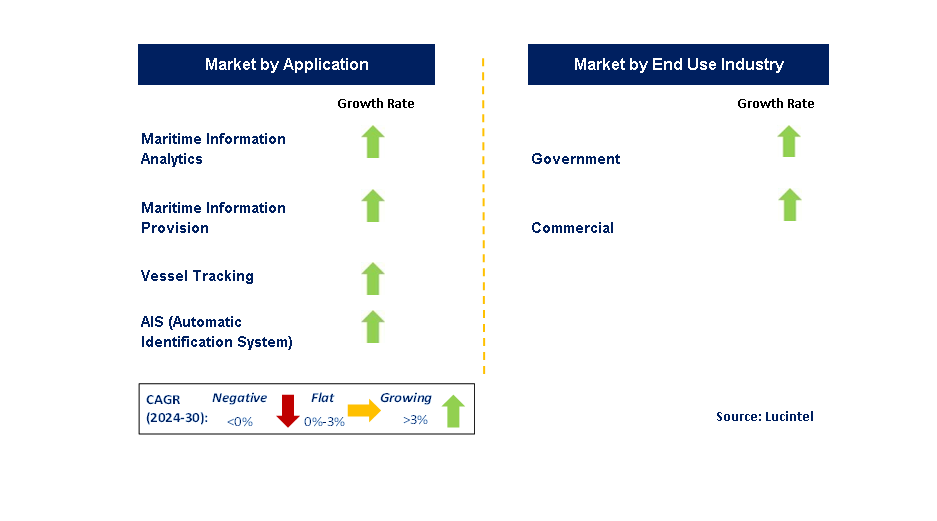
• Maritime Information Analytics
• Maritime Information Provision
• Vessel Tracking
• AIS (Automatic Identification System)
• Government
• Commercial
• North America
• Europe
• Asia Pacific
• The Rest of the World
• United States: Recent developments here include the integration of Artificial Intelligence and machine learning in navigation systems to optimize routes and improve the safety of shipping in the U.S. Another developing area of maritime data analytics for improving the operation of ports and reducing congestion is the U.S. The adoption of cybersecurity measures is also being done to keep maritime data and communication systems safe from potential threats.
• China: The country is also making remarkable development in the field of maritime information, with especial interest in developing advanced satellite communication systems and real-time monitoring technologies. For enhanced ship tracking and port management, the country is heavily investing in heavy investment in maritime data centers. This will enhance the efficiency and safety of its maritime operations and its capabilities in shipping across the world.
• Germany: Germany is also well-focused on the integration of digital technologies within its maritime infrastructure, such as automated port operations and smart shipping solutions. The country is laying emphasis on developing eco-friendly maritime technologies and data-sharing platforms that would improve operational efficiency and reduce environmental impacts. Initiatives being taken up by Germany align with broader European maritime safety and environmental regulations.
• India: India moves forward, taking help from maritime information technology through enhanced navigation systems and port management solutions. India is also working on data integration for better fleet management and operational efficiency. Further modernization of maritime infrastructure and increased adoption of digital tools will be supported in developing India's shipping industry.
• Japan: Japan is still developing the maritime information industry, building autonomous ships and high-tech systems for maritime surveillance. Besides, the country invests in different technologies contributing to the disaster responses of better quality and safety during the maritime operations. Now Japanese development is directed at enhancing the efficiency, safety, and environmental performance of the Japanese maritime industry.


• Inmarsat
• L3 Technologies
• Orbcomm
• Raytheon Company
• Thales Group
• L3 Technologies
• Garmin International
• Intelsat
• Kongsberg
• Maritec Q6. Which maritime information market segment will be the largest in future? Answer: Lucintel forecasts that maritime information analytics will remain the largest segment over the forecast period because of extensive use in many nations to evaluate crucial marine data and present a broad picture of shipping activity worldwide, as well as, quick digitization and simple user accessibility. Q7. In maritime information market, which region is expected to be the largest in next 5 years? Answer: Europe is expected to witness highest growth over the forecast period due to increasing volume of international trade, the creation of pro-business laws, and ongoing technological developments in the marine information system. Q.8 Do we receive customization in this report? Answer: Yes, Lucintel provides 10% customization without any additional cost.


Choose a license that fits your team. Instant PDF delivery.
Prices exclude taxes. Instant delivery. Custom licensing available on request.
Market Report · July 31, 2026
Market Report · July 31, 2026
Market Report · July 31, 2026
Trusted partner for strategic intelligence and business growth


Receive a complimentary market analysis tailored to your industry. Our analysts will identify key growth opportunities and competitive dynamics specific to your business.

Market size, growth rate, and key trend analysis for your specific sector.

Top competitor positioning and market share analysis.

Strategic recommendations backed by data-driven insights.
Get curated market intelligence and competitive moves straight to your inbox.
By subscribing, you agree to receive our monthly insights. Unsubscribe anytime.
Receive a complimentary market analysis tailored to your industry. Our analysts will identify key growth opportunities and competitive dynamics specific to your business.
Market size, growth rate, and key trend analysis for your specific sector.
Top competitor positioning and market share analysis.
Strategic recommendations backed by data-driven insights.
Get curated market intelligence, emerging trends, and competitive moves straight to your inbox each month.
By subscribing, you agree to receive our monthly insights. Unsubscribe anytime.
We'll send your sample report shortly.