
Market Report · May 18, 2026

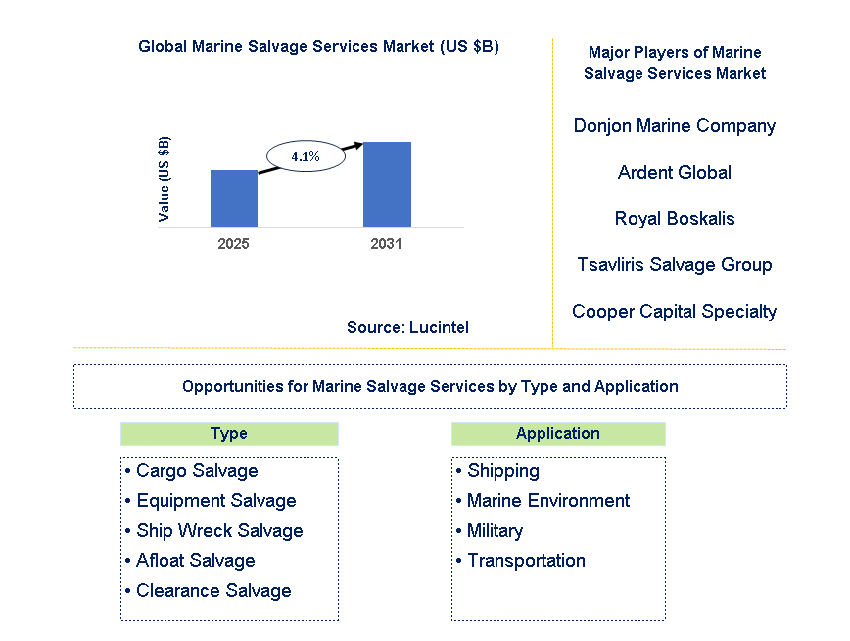
Key data points: The growth forecast = 4.1% annually for the next 7 years. Scroll below to get more insights. This market report covers Trends, opportunities and forecasts in marine salvage services market to 2031 by type (cargo salvage, equipment salvage, ship wreck salvage, afloat salvage, and clearance salvage), application (shipping, marine environment, military, and transportation), and region (North America, Europe, Asia Pacific, and the Rest of the World)
We'll send your sample report shortly.
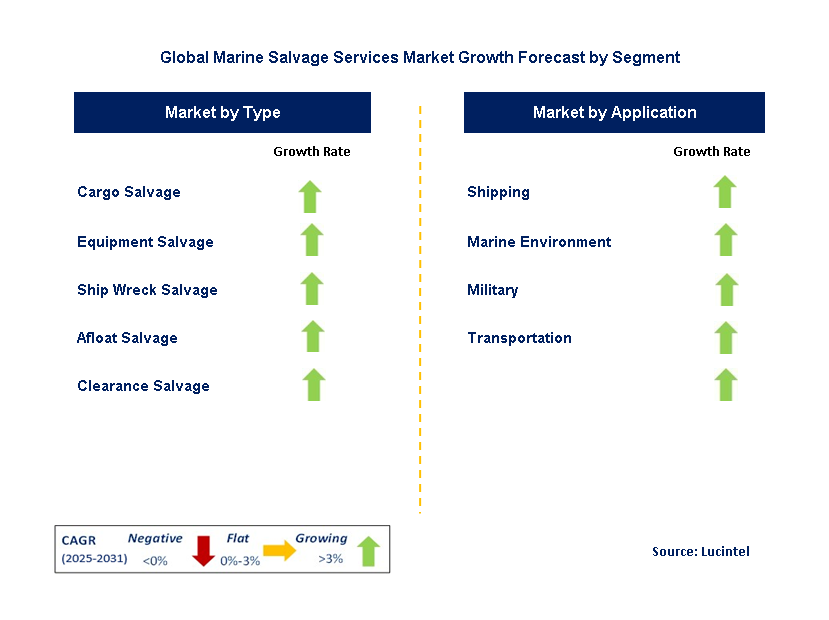
• Lucintel forecasts that, within the type category, shipwreck salvage is expected to witness the highest growth over the forecast period.
• Within the application category, shipping is expected to witness the highest growth.
• In terms of region, APAC is expected to witness the highest growth over the forecast period.
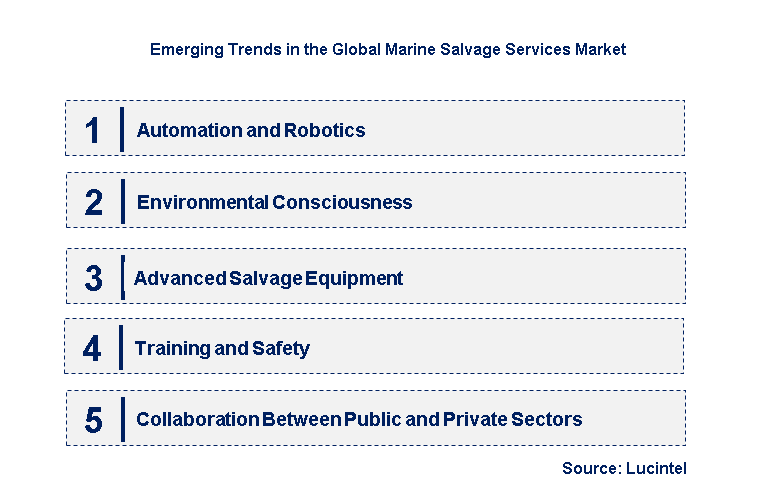
• Automation and Robotics: One of the most crucial emerging trends of the marine salvage services market includes the increasing incorporation of automation and robotics. Drone, remotely operated vehicle (ROV), and autonomous underwater vehicle (AUV) inspections and salvage operations are being carried out to minimize human interference in such hazardous environments. They were facilitating faster and safer operations with higher precision. Automated deployment and recovery also supported a more efficient salvage mission and quick response to emergencies.
• Environmental Consciousness: Reckoning the increasing popularity of environmental awareness, marine salvage services are incorporating pollution protection and preservation of marine ecosystems. "Green" technologies for oil spill recovery, waste disposal, and wreck removal are becoming more popular. More environmentally conscious practices to prevent further environmental degradation are being embraced by salvage companies. Increasingly, equipment is being designed to recover hazardous material, including chemical and oil recovery. The growing environmental regulations and global sustainability goals are forcing companies to invest in green technologies that ensure minimal ecological harm during salvage operations.
• Advanced Salvage Equipment: The development and use of advanced salvage equipment are transforming the market. New technologies such as high-capacity cranes, cutting-edge lifting systems, and powerful pumps are enabling quicker and more efficient salvage operations. Companies are also investing in specialized tools for specific tasks like hull cutting and debris removal. All these improvements in the equipment will make the entire salvage much safer and more efficient, thereby cutting down on down time and the cost of recovery. Further improvements in equipment are to be expected, tackling the rising demands of complex salvage operations in deeper water, and including more-challenging environments.
• Training and Safety: As salvage operations become more complex, there is an increasing focus on improving the safety and training of personnel. Training programs are being enhanced to ensure that workers are skilled in using advanced equipment, responding to environmental emergencies, and adhering to safety standards. In addition, the implementation of safety measures for workers involved in high-risk operations is gaining prominence. Enhanced safety protocols, such as real-time monitoring of operations and better protective gear, are improving the overall safety of marine salvage crews and ensuring that recovery operations are conducted without compromising worker welfare.
• Collaboration Between Public and Private Sectors: Collaboration between governments and private salvage companies is becoming a more common trend. Public-private partnerships will be established, especially in addressing large-scale accidents at sea; these partnerships could provide the adequate resources, necessary expertise, and funding to cover extensive salvage efforts. Governments shall also offer private salvage companies attractive incentives and favorable support to assist in responding efficiently to emergencies. This trend is making the overall strength of the marine salvage industry stronger, and there is an immediate and coordinated response to the maritime accident. All these emerging trends in automation, environmental considerations, advanced equipment, training, and public-private collaborations are redefining the marine salvage services market. It is responding positively to greater efficiencies, safety standards, and sustainability, addressing a common need felt for more effective safety in the world of maritime and adequate environmental protection.
• Adoption of Remotely Operated Vehicles (ROVs): ROVs are transforming marine salvage services because it offers remote inspection, exploration, and recovery operations within deep water environments. ROVs are provided with high definition cameras, sensors, and manipulators to provide for the most accurate and safe operations without having a human diver inside. Adoption of ROVs increases the speed, safety, and efficiency of the salvage operations. These vehicles significantly contribute to better performance in salvage and recovery, especially for oil spill in deep waters. With advancing ROV technology, salvage operations are becoming more versatile and capable of handling more complex underwater tasks.
• Application of Drones in Salvage Operations: The use of drones in marine salvage services is now increasingly being adopted for aerial surveillance, damage assessment, and monitoring during salvage operations. Equipped with high-resolution cameras, drones can rapidly assess the damage to ships, oil rigs, and other structures, thus offering real-time data to operators. This technology would allow for more efficient salvage site assessment without requiring time-consuming and dangerous manual inspections. Further expansion of drone use in the marine salvage industry will improve overall efficiency in recovery operations and support more rapid response to emergencies.
• Green Salvage Technologies: As environmental concerns grow, green salvage technologies to reduce the ecological footprint of salvage operations are being spent on by salvage companies. This has seen low emission vessels, eco-friendly oil recovery techniques, and responsible handling of waste become rampant. This is research that will give salvage operations minimal disturbance to marine life. Governments and international organizations are also imposing more stringent regulations on environmental sustainability, compelling companies to opt for greener technologies. The development of green technologies is essential not only for the protection of the environment but also for meeting the changing global environmental standards.
• Offshore Salvage Capabilities: As offshore activities, such as oil drilling and shipping, continue to expand, so has the need for offshore salvage services. Companies are investing in more advanced salvage technologies that can withstand the harshest environments of offshore environments, including deep-sea areas and extreme weather conditions. These include high-powered lifting systems, advanced cranes, and remotely operated salvage tools that operate in several kilometers. Offshore salvage capabilities must be expanded to respond appropriately to accidents in such challenging environments. Companies should be prepared for complex and high-stakes recovery missions.
• Increased Collaboration Among Salvage Companies: The marine salvage industry, once very competitive, is changing towards collaboration among different salvage companies, especially for large-scale operations. Companies are collaborating in an effort to pool resources, expertise, and technology to grapple with bigger challenges like large shipwrecks or oil spill mishaps. Through such a cooperation, efficiency is enhanced, costs reduced, and a quicker response can be made during emergencies. Pooling resources and capabilities, salvage companies have improved their ability in handling bigger and wider maritime accidents and benefiting from greater unity and coordination in salvage. These new technologies, such as ROVs, drones, green technologies, offshore salvage capabilities, and enhancing collaboration, are revolutionizing the marine salvage services market. They allow the services to be more efficient and safer with reduced environmental impact with respect to the salvage operations and ensure better responses to maritime accidents and safety for the entire maritime sector.
• Growth in Green Salvage Solutions: In line with increasingly stringent environmental regulations, there is a great demand for green salvage solutions. Companies are concentrating on the development of green technologies in order to reduce the ecological impact of their operations. This encompasses low-emission vessels, biodegradable oil recovery systems, and environmentally safe waste disposal. Sustainable practices enable companies to achieve environmental standards and offer a competitive edge in the market. In this regard, this is an enormous growth opportunity for the marine salvage services industry as demand for sustainable solutions grows.
• Offshore Salvage and Deepwater Operations: As the practice of offshore drilling and shipping is becoming increasingly more prevalent, so too is the need for special salvage services in deepwater. Companies with more advanced equipment and expertise in offshore salvage, such as remotely operated vehicles and deep-water cranes, will continue to thrive. Expanding capabilities for handling deep-sea wrecks, oil spills, and other offshore accidents is a significant growth opportunity in a rapidly developing sector. This trend reflects the expansion of the marine salvage industry into more challenging and high-risk environments.
• Technological Integration in Salvage Operations: The integration of advanced technologies such as automation, robotics, and artificial intelligence (AI) in salvage operations presents a significant growth opportunity. Predictive analysis with AI-powered systems, autonomous underwater vehicles, and advanced data analytics are all bringing salvage processes more into line. Salvage is being made much more efficient and cost-effective due to these innovative technologies. This will bring more efficient response times, higher safety levels, and better precision to salvage operations. Companies that take up cutting-edge technologies will lead the market, offering faster, safer, and more effective services.
• More partnership with shipping lines, oil companies, and oil and gas operators: Strategic collaborations with shipping lines, oil companies, and oil and gas companies, as well as other partners in the maritime industry, give salvage companies excellent growth opportunities. Through cooperation with key players, salvage companies are able to negotiate long-term contracts and grow market share. Shipping and oil companies increasingly recognize the value of partnering with experienced salvage firms to mitigate risks associated with accidents and environmental disasters. These partnerships will enable salvage companies to expand their client base and access more lucrative projects.
• Focus on Training and Safety Standards: As the marine salvage industry becomes more complex, there is an increasing focus on workforce training and safety. Companies can guarantee better safety standards and operational efficiency by providing special training programs and certifications for salvage personnel. Increasing safety and skill development is the major growth opportunity for training and consultancy services. Furthermore, the qualifications and skills of marine salvage crews are also being emphasized more and more by regulatory bodies and organizations, hence raising the demand for training services. The growth opportunities in the marine salvage services market include strategies like eco-friendly solutions, offshore salvage, technology integration, collaborative improvement, and workforce training that will determine the future of this industry. This is because it will enable these companies to answer the rising calls for efficient, sustainable, and effective salvage services worldwide.
• Donjon Marine Company
• Ardent Global
• Royal Boskalis Westminster
• Tsavliris Salvage Group
• Cooper Capital Specialty Salvage
• LLC
• Plan B Marine Solutions
• Lloyd'S
• Leask Marine
• Abl Group
• Cargo Salvage
• Equipment Salvage
• Ship Wreck Salvage
• Afloat Salvage
• Clearance Salvage
• Shipping
• Marine Environment
• Military
• Transportation
• North America
• Europe
• Asia Pacific
• The Rest of the World
• United States: The United States has continued to see growth in the marine salvage services market due largely to increasing regulation and burgeoning concerns about the risks of damage to the maritime environment. Salvage operations in the U.S. have become more efficient with the help of advanced technologies, such as remotely operated vehicles (ROVs) and aerial drones, for locating and recovering sunken vessels and hazardous materials. In addition, the U.S. Coast Guard continues to improve its response capabilities to oil spills and other environmental disasters. Companies like Titan Salvage and Donjon Marine are at the forefront, offering specialized services for both commercial and government needs.
• China: In China, the marine salvage services market has seen rapid development due to the country’s expanding shipping industry and increasing investment in maritime infrastructure. Chinese firms have focused on developing cutting-edge technologies for wreck removal, ship refloating, and underwater salvage operations. Companies such as COSCO Shipping and Sinopec have advanced quite significantly in their deep-water salvage capabilities. Additionally, the government of China has introduced tougher regulations on environmental conditions, making way for green salvage solutions. A greater concern about maritime safety and sustainability by the Chinese government leads to more modern salvage systems, which are increasingly capable of addressing large-scale maritime accidents.
• Germany: It is a country in the world, which leads as a great salvager, as Smit Salvage and Hamburg-based Marine Services GmbH deliver top-quality salvage operations worldwide. It has also spent a lot on the high-end technologies of the world like computer simulations, ROVs, and autonomous systems for the effective operation of salvage activities. In the marine salvage services, the Germans are giving importance to environmental protection, avoiding pollution during the salvage operation. In addition, the German government has strict maritime regulations that ensure high standards in salvage operations, making the country one of the most reliable players in the industry.
• India: India's marine salvage services market is growing as the country strengthens its maritime safety infrastructure and enhances its disaster response capabilities. The Indian government has focused on increasing its focus on coastal security, pollution control, and salvage operations. Indian companies have been enhancing their capabilities in ship refloating, underwater recovery, and oil spill management with the support from major ports like Mumbai and Kolkata. Increasing uses of advanced technologies such as drones and robotic systems in carrying out underwater operations ensure quicker and efficient recovery during maritime accidents in Indian marine salvage industries.
• Japan: Japan is one of the most dominant in the marine salvage services market, mainly due to the muscle power and advancements offered in maritime industry, the technological infrastructure being developed further. Nippon Salvage is a leader in this market, offering salvage services that include removing shipwrecks, underwater repairs, and oil spill response. The Japanese government coordinates with the private sector to adhere to the global maritime safety and environmental standards. More recently, technological advancements in the form of autonomous marine salvage vehicles and robotic systems are also gaining entry in Japan. This increases its capabilities to counter various environmental protection and shipwreck recovery challenges


• Donjon Marine Company
• Ardent Global
• Royal Boskalis Westminster
• Tsavliris Salvage Group
• Cooper Capital Specialty Salvage
• LLC
• Plan B Marine Solutions
• Lloyd'S
• Leask Marine
• Abl Group Q5. Which marine salvage services market segment will be the largest in future? Answer: Lucintel forecasts that, within the type category, shipwreck salvage is expected to witness the highest growth over the forecast period. Q6. In marine salvage services market, which region is expected to be the largest in next 5 years? Answer: In terms of region, APAC is expected to witness the highest growth over the forecast period. Q7. Do we receive customization in this report? Answer: Yes, Lucintel provides 10% customization without any additional cost.


Choose a license that fits your team. Instant PDF delivery.
Prices exclude taxes. Instant delivery. Custom licensing available on request.
Market Report · May 18, 2026
Market Report · May 18, 2026
Market Report · May 18, 2026
Trusted partner for strategic intelligence and business growth


Receive a complimentary market analysis tailored to your industry. Our analysts will identify key growth opportunities and competitive dynamics specific to your business.

Market size, growth rate, and key trend analysis for your specific sector.

Top competitor positioning and market share analysis.

Strategic recommendations backed by data-driven insights.
Get curated market intelligence and competitive moves straight to your inbox.
By subscribing, you agree to receive our monthly insights. Unsubscribe anytime.
Receive a complimentary market analysis tailored to your industry. Our analysts will identify key growth opportunities and competitive dynamics specific to your business.
Market size, growth rate, and key trend analysis for your specific sector.
Top competitor positioning and market share analysis.
Strategic recommendations backed by data-driven insights.
Get curated market intelligence, emerging trends, and competitive moves straight to your inbox each month.
By subscribing, you agree to receive our monthly insights. Unsubscribe anytime.
We'll send your sample report shortly.