
Report Feature
Manned Security Service Market Trends and Forecast
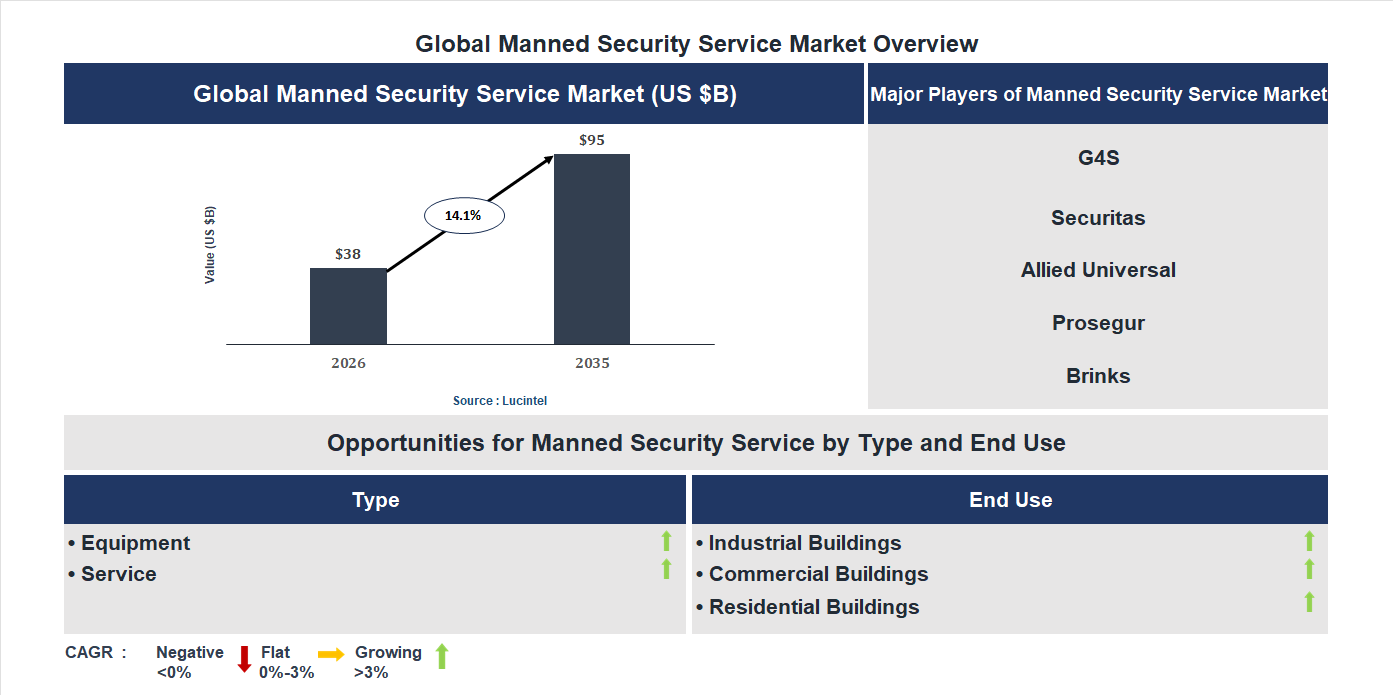
The future of the global manned security service market looks promising with opportunities in the industrial building, commercial building, and residential building markets. The global manned security service market is expected to reach an estimated $95 billion by 2035 with a CAGR of 14.1% from 2026 to 2035. The major drivers for this market are the increasing demand for on site security personnel, the rising crime rates, and the growing need for corporate facility protection.• Lucintel forecasts that, within the type category, service is expected to witness higher growth over the forecast period.
• Within the end use category, industrial building is expected to witness the highest growth.
• In terms of region, APAC is expected to witness the highest growth over the forecast period. Gain valuable insights for your business decisions with our comprehensive 150+ page report. Sample figures with some insights are shown below.
Emerging Trends in the Manned Security Service Market
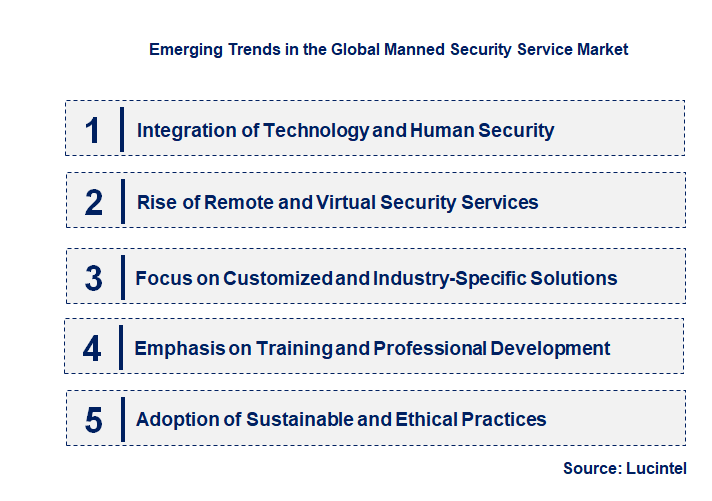
The manned security service market is experiencing significant transformation driven by technological advancements, changing client needs, and evolving security threats. As organizations seek more comprehensive and efficient security solutions, industry players are adopting innovative strategies to stay competitive. These emerging trends are reshaping the landscape, influencing service delivery, customer expectations, and operational models. Understanding these developments is crucial for stakeholders aiming to capitalize on new opportunities and address future challenges effectively. The following key trends highlight the dynamic nature of this market and its trajectory toward more integrated, technology-driven, and customer-centric security solutions.• Integration of Technology and Human Security: The market is increasingly blending traditional manned security with advanced technologies such as surveillance cameras, AI, and biometric systems. This integration enhances threat detection, reduces response times, and improves overall security effectiveness. Clients now expect security personnel to operate alongside sophisticated tools, creating a hybrid approach that maximizes safety while optimizing resource allocation. This trend also allows for real-time monitoring and data-driven decision-making, making security services more proactive and efficient.
• Rise of Remote and Virtual Security Services: Remote monitoring and virtual security services are gaining popularity, especially in high-risk or large-scale environments. These services utilize CCTV, sensors, and AI analytics to oversee premises without constant physical presence. This trend reduces operational costs and provides 24/7 surveillance capabilities. It also enables security firms to serve multiple clients simultaneously, offering scalable solutions that adapt to various needs. As technology advances, remote security is becoming a vital component of comprehensive security strategies.
• Focus on Customized and Industry-Specific Solutions: Security providers are increasingly tailoring their services to meet the unique needs of different industries such as healthcare, retail, banking, and manufacturing. Customized solutions address specific vulnerabilities, compliance requirements, and operational challenges. This trend enhances client satisfaction and security effectiveness by providing targeted protection. Industry-specific training for security personnel and specialized equipment further improve service quality, making security solutions more relevant and impactful across diverse sectors.
• Emphasis on Training and Professional Development: As security threats become more sophisticated, there is a growing emphasis on the training and certification of security personnel. Enhanced training programs focus on crisis management, cybersecurity awareness, and customer service skills. This trend ensures that security staff are well-equipped to handle complex situations, improve client interactions, and adhere to regulatory standards. Continuous professional development also helps in reducing turnover rates and maintaining high service standards, ultimately strengthening the credibility and reliability of security providers.
• Adoption of Sustainable and Ethical Practices: Environmental sustainability and ethical considerations are increasingly influencing the security industry. Companies are adopting eco-friendly equipment, energy-efficient operations, and responsible staffing practices. This trend aligns with broader corporate social responsibility goals and appeals to environmentally conscious clients. Ethical practices also include fair employment policies and transparent operations, which enhance brand reputation and client trust. As sustainability becomes a key decision factor, security firms that prioritize ethical and eco-friendly solutions are gaining a competitive edge. These trends are fundamentally reshaping the manned security service market by fostering a more integrated, technologically advanced, and customer-focused industry. They are driving innovation, improving service quality, and aligning security solutions with broader societal values, ultimately creating a more resilient and adaptable security landscape.
Recent Developments in the Manned Security Service Market
The manned security service market is experiencing rapid growth driven by increasing security concerns across various sectors. Technological advancements, rising crime rates, and the need for personalized security solutions are fueling demand. Governments and private organizations are investing heavily in security personnel to safeguard assets, personnel, and information. This evolving landscape presents numerous opportunities for service providers to innovate and expand their offerings, ultimately shaping the future of security services worldwide.• Growing Demand for Corporate Security: The corporate sector is increasingly investing in manned security to protect assets, employees, and confidential information. As cyber threats and physical security risks rise, companies seek trained security personnel for surveillance, access control, and emergency response. This demand is particularly high in financial institutions, data centers, and manufacturing plants, creating significant growth opportunities for security firms to expand their workforce and service portfolios.
• Expansion in Residential Security Services: Rising urbanization and safety concerns are driving the demand for residential security services. Homeowners are increasingly opting for trained security guards and patrol services to prevent burglaries and ensure safety. This trend is prominent in high-income neighborhoods and gated communities. Service providers are developing customized security packages, integrating technology with manned guarding, and expanding their presence in suburban and urban areas to meet this growing need.
• Increasing Adoption in Government and Public Sector: Governments worldwide are investing in manned security to safeguard critical infrastructure, public events, and government buildings. The need for highly trained personnel to manage large crowds, prevent terrorism, and ensure public safety is boosting demand. This sector offers lucrative opportunities for security companies to secure long-term contracts, develop specialized training programs, and deploy advanced security solutions tailored to public sector requirements.
• Technological Integration Enhancing Security Services: The integration of advanced technologies such as AI, facial recognition, and real-time monitoring is transforming traditional manned security. These innovations improve efficiency, response times, and threat detection capabilities. Security firms adopting these technologies can offer smarter, more effective services, attracting clients seeking high-tech security solutions. This integration is creating a competitive edge and opening avenues for collaboration with tech providers to develop innovative security systems.
• Rise of Specialized Security Services: The market is witnessing a shift towards specialized security services, including executive protection, cybersecurity, and event security. These niche services cater to high-net-worth individuals, corporations, and large-scale events. The demand for highly trained personnel with specific skill sets is increasing, prompting security firms to invest in specialized training and certifications. This trend enhances service differentiation and allows providers to command premium pricing in a competitive market. The overall impact of these developments is a dynamic, expanding market characterized by technological innovation, increased demand across sectors, and a focus on specialized, high-quality security solutions. These trends are driving growth, creating new opportunities, and shaping the future landscape of the manned security service industry.
Strategic Growth Opportunities in the Manned Security Service Market
The manned security service market is experiencing significant growth driven by increasing security concerns across various sectors. As threats evolve, demand for trained personnel and comprehensive security solutions rises. Technological integration, regulatory changes, and expanding commercial and residential developments further fuel this expansion. Companies are focusing on innovative service offerings and geographic expansion to capture new opportunities. This dynamic environment presents numerous avenues for strategic growth, enabling providers to enhance market share and meet diverse client needs effectively.• Expansion Into Commercial and Residential Sectors: The increasing need for security in commercial complexes, residential communities, and public spaces offers substantial growth opportunities. Customized security solutions, including access control, patrol services, and surveillance, are in high demand. Urbanization and infrastructure development drive this trend, prompting security firms to expand their service portfolios. Strategic partnerships with property developers and real estate firms can facilitate market penetration, ensuring safety and compliance with evolving regulations.
• Adoption of Advanced Security Technologies: Integrating technologies like CCTV, biometric access, and AI-powered surveillance enhances service efficiency and effectiveness. These innovations enable real-time monitoring, threat detection, and data analytics, providing a competitive edge. Security providers investing in technology can offer smarter, more responsive services, appealing to tech-savvy clients. The convergence of manned security with automation and IoT devices opens new revenue streams and improves operational scalability.
• Focus on Specialized Security Services: Growing threats necessitate specialized security solutions such as cybersecurity, executive protection, and event security. These niche services command premium pricing and cater to high-net-worth individuals, corporations, and government agencies. Developing expertise in these areas allows providers to differentiate themselves and build long-term client relationships. Continuous training and certification are essential to meet industry standards and address complex security challenges effectively.
• Geographic Expansion into Emerging Markets: Developing regions present untapped opportunities due to rising urbanization and infrastructure projects. Security firms expanding into these markets can capitalize on increasing demand for professional security services. Local partnerships, understanding regional regulations, and tailoring services to cultural contexts are critical success factors. This expansion not only diversifies revenue streams but also positions companies as key players in emerging economies security landscapes.
• Regulatory Compliance and Certification Standards: Adhering to evolving legal frameworks and obtaining industry certifications enhances credibility and market access. Governments and industry bodies are implementing stricter standards, requiring security providers to demonstrate quality and reliability. Compliance ensures eligibility for large contracts and government tenders, fostering trust with clients. Investing in staff training, background checks, and quality management systems supports sustainable growth and mitigates legal and operational risks. These strategic growth opportunities collectively strengthen the market by expanding service offerings, leveraging technological advancements, and entering new geographic regions. Embracing specialized services and maintaining high compliance standards will enable providers to differentiate themselves and meet the increasing security demands across sectors. Overall, these initiatives will drive sustainable growth, innovation, and competitive advantage in the manned security service industry.
Manned Security Service Market Driver and Challenges
The manned security service market is influenced by a variety of technological, economic, and regulatory factors that shape its growth and development. Advances in security technology, economic fluctuations, and evolving regulatory standards significantly impact market dynamics. Increasing security concerns across sectors such as commercial, residential, and government create a demand for reliable security personnel. Additionally, technological innovations like surveillance systems and access control influence service offerings. Regulatory frameworks and compliance requirements also play a crucial role in shaping operational standards. Understanding these drivers and challenges is essential for stakeholders to navigate the market effectively and capitalize on emerging opportunities while addressing potential risks. The factors responsible for driving the manned security service market include:-• Growing Security Concerns: The increasing incidence of crime, terrorism, and vandalism worldwide has heightened the need for physical security. Businesses, government agencies, and residential complexes seek reliable security personnel to safeguard assets and ensure safety. This rising threat perception directly boosts demand for manned security services, especially in high-risk areas. The need for a visible security presence acts as a deterrent to criminal activities, making these services indispensable. As urbanization accelerates and security threats evolve, the demand for trained security personnel continues to grow, supporting market expansion.
• Technological Advancements: Innovations such as surveillance cameras, biometric access controls, and alarm systems have transformed security services. These technologies complement manned security, making it more effective and efficient. Security firms are increasingly integrating technology with physical security personnel to provide comprehensive solutions. This integration enhances the capabilities of security staff, allowing for better monitoring and rapid response. As technology becomes more affordable and accessible, security companies are investing in advanced tools, which in turn drives the demand for skilled security personnel capable of managing these systems.
• Economic Growth and Urbanization: Rapid economic development and urbanization lead to increased construction of commercial, residential, and industrial infrastructure. This growth necessitates enhanced security measures to protect assets and ensure safety. As cities expand, the demand for security personnel rises correspondingly across various sectors. Economic prosperity also enables organizations to allocate larger budgets for security services, fostering market growth. Moreover, urban environments with dense populations require more security personnel to manage crowd control and access, further fueling the markets expansion.
• Regulatory and Compliance Standards: Governments and regulatory bodies are implementing stricter security standards to ensure safety and compliance across industries. These regulations often mandate the presence of trained security personnel in sensitive areas such as airports, government buildings, and financial institutions. Compliance with these standards compels organizations to hire professional security services, thereby increasing market demand. Additionally, licensing and certification requirements for security personnel ensure quality and accountability, which encourages clients to prefer reputable service providers, further stimulating market growth.
• Increasing Outsourcing of Security Services: Organizations are increasingly outsourcing security functions to specialized service providers to reduce costs and focus on core activities. This trend is driven by the desire for cost-effective, scalable, and flexible security solutions. Outsourcing also allows organizations to access a broader pool of trained security personnel without the burden of recruitment and management. The shift towards outsourcing has expanded the market for security service providers, encouraging innovation and competitive pricing. As companies seek reliable and comprehensive security solutions, the demand for outsourced manned security services continues to rise. The challenges facing the manned security service market include:-
• High Operational Costs: Maintaining a trained security workforce involves significant expenses, including salaries, training, uniforms, and equipment. These costs can be a barrier for smaller security firms or organizations with limited budgets. Additionally, fluctuations in wages and the need for ongoing training to keep up with evolving threats increase operational expenses. High costs may limit the ability of some organizations to hire adequate security personnel, potentially compromising safety standards. For service providers, managing these costs while maintaining profitability remains a critical challenge, especially in highly competitive markets.
• Skilled Workforce Shortage: The market faces a shortage of qualified and trained security personnel, which hampers service quality and operational efficiency. The demanding nature of security jobs, coupled with relatively low wages in some regions, discourages potential candidates. This shortage leads to increased recruitment costs and turnover rates, affecting service consistency. Moreover, the lack of specialized training in areas such as cybersecurity integration or emergency response limits the effectiveness of security personnel. Addressing this challenge requires investment in training programs and attractive employment packages to attract and retain skilled staff.
• Regulatory and Legal Challenges: Evolving regulations and legal requirements can pose compliance difficulties for security service providers. Variations in licensing, certification, and operational standards across regions complicate service delivery. Non-compliance can result in penalties, legal liabilities, and damage to reputation. Additionally, changes in laws related to privacy, data protection, and use of surveillance technologies require constant adaptation. Navigating these complex regulatory landscapes demands significant resources and expertise, which can be burdensome for smaller firms and may slow down market growth. The manned security service market is driven by increasing security concerns, technological innovations, economic growth, regulatory standards, and outsourcing trends. However, high operational costs, workforce shortages, and regulatory complexities present notable challenges. These factors collectively influence market dynamics, requiring stakeholders to innovate and adapt to sustain growth. The overall impact is a market that is poised for expansion but must address these hurdles to realize its full potential, ensuring safety and security in an increasingly complex environment.
List of Manned Security Service Companies
Companies in the market compete on the basis of product quality offered. Major players in this market focus on expanding their manufacturing facilities, R&D investments, infrastructural development, and leverage integration opportunities across the value chain. With these strategies manned security service companies cater increasing demand, ensure competitive effectiveness, develop innovative products & technologies, reduce production costs, and expand their customer base. Some of the manned security service companies profiled in this report include-• G4S
• Securitas
• Allied Universal
• Prosegur
• Brinks
• ADT
• Boon Edam
Manned Security Service Market by Segment
The study includes a forecast for the global manned security service market by type, end use, and region.Manned Security Service Market by Type [Value from 2019 to 2035]:
• Equipment
• Service
Manned Security Service Market by End Use [Value from 2019 to 2035]:
• Industrial Buildings
• Commercial Buildings
• Residential Buildings
Manned Security Service Market by Region [Value from 2019 to 2035]:
• North America
• Europe
• Asia Pacific
• The Rest of the World
Country Wise Outlook for the Manned Security Service Market
The manned security service market has experienced significant shifts driven by technological advancements, evolving security threats, and changing regulatory landscapes across the globe. Countries are investing heavily in enhancing their security infrastructure to address rising concerns related to terrorism, cyber threats, and urban safety. The United States, China, Germany, India, and Japan are at the forefront of these developments, each adapting their strategies to meet unique national security needs. These countries are integrating innovative technologies, expanding service offerings, and strengthening regulatory frameworks to ensure comprehensive security solutions for their citizens and critical infrastructure.• United States: The US market has seen increased adoption of integrated security solutions combining manned services with advanced surveillance technologies. There is a focus on cybersecurity integration, with private security firms partnering with tech companies to enhance threat detection and response capabilities. Regulatory standards are tightening, emphasizing personnel training and background checks. The demand for specialized security services, such as executive protection and event security, continues to grow, driven by rising security concerns in urban areas and high-profile events.
• China: China’s security market is rapidly expanding, driven by government initiatives to modernize urban security infrastructure. The country is investing heavily in smart security systems that combine manned guarding with AI-powered surveillance. There is a significant push toward integrating security services with smart city projects, emphasizing real-time monitoring and rapid response. Private security firms are increasingly collaborating with government agencies to secure critical infrastructure, transportation hubs, and public spaces, reflecting a focus on national security and social stability.
• Germany: Germany’s security market emphasizes high standards of professionalism and regulatory compliance. The country is adopting advanced training programs for security personnel and implementing strict licensing requirements. There is a growing trend toward integrating manned security with technological solutions such as biometric access controls and CCTV systems. The focus is on securing critical infrastructure, financial institutions, and public events, with an emphasis on privacy and data protection. The market also sees increased demand for security consulting and risk management services.
• India: India’s security market is experiencing rapid growth due to increasing urbanization and security concerns related to terrorism and insurgency. The country is expanding its security infrastructure, including deploying more trained security personnel in public spaces, transportation, and industrial sectors. There is a rising demand for integrated security solutions that combine manned guarding with electronic surveillance and access control systems. Government initiatives to improve urban safety and the privatization of security services are fueling market expansion, alongside a focus on capacity building and personnel training.
• Japan: Japan’s security market is characterized by a focus on technological integration and disaster preparedness. The country is investing in advanced security personnel training and deploying high-tech surveillance systems in urban centers and critical infrastructure. There is an emphasis on securing public transportation, government buildings, and event venues. Japan is also enhancing its security protocols to address cyber threats and natural disasters, integrating manned security with technological solutions to ensure comprehensive safety. The market is driven by a need for reliable, high-quality security services in a densely populated and technologically advanced society.

Features of the Global Manned Security Service Market
Market Size Estimates: Manned security service market size estimation in terms of value ($B). Trend and Forecast Analysis: Market trends (2019 to 2025) and forecast (2026 to 2035) by various segments and regions. Segmentation Analysis: Manned security service market size by type, end use, and region in terms of value ($B). Regional Analysis: Manned security service market breakdown by North America, Europe, Asia Pacific, and Rest of the World. Growth Opportunities: Analysis of growth opportunities in different types, end uses, and regions for the manned security service market. Strategic Analysis: This includes M&A, new product development, and competitive landscape of the manned security service market. Analysis of competitive intensity of the industry based on Porter’s Five Forces model.
FAQ
Q1. What is the manned security service market size? Answer: The global manned security service market is expected to reach an estimated $95 billion by 2035. Q2. What is the growth forecast for manned security service market? Answer: The global manned security service market is expected to grow with a CAGR of 14.1% from 2026 to 2035. Q3. What are the major drivers influencing the growth of the manned security service market? Answer: The major drivers for this market are the increasing demand for on site security personnel, the rising crime rates, and the growing need for corporate facility protection. Q4. What are the major segments for manned security service market? Answer: The future of the manned security service market looks promising with opportunities in the industrial building, commercial building, and residential building markets. Q5. Who are the key manned security service market companies? Answer: Some of the key manned security service companies are as follows:• G4S
• Securitas
• Allied Universal
• Prosegur
• Brinks
• ADT
• Boon Edam Q6. Which manned security service market segment will be the largest in future? Answer: Lucintel forecasts that, within the type category, service is expected to witness higher growth over the forecast period. Q7. In manned security service market, which region is expected to be the largest in next 8 years? Answer: In terms of region, APAC is expected to witness the highest growth over the forecast period. Q8. Do we receive customization in this report? Answer: Yes, Lucintel provides 10% customization without any additional cost.
Table of Contents
List of Figures
List of Tables
Methodology
- In-depth interviews of the major players in this market
- Detailed secondary research from competitors’ financial statements and published data
- Extensive searches of published works, market, and database information pertaining to industry news, company press releases, and customer intentions
- A compilation of the experiences, judgments, and insights of Lucintel’s professionals, who have analyzed and tracked this market over the years.


Buy Now
Choose a license that fits your team. Instant PDF delivery.
Prices exclude taxes. Instant delivery. Custom licensing available on request.
Key Questions
- • What are some of the most promising, high-growth opportunities for the manned security service market by type (equipment and service), end use (industrial buildings, commercial buildings, and residential buildings), and region (North America, Europe, Asia Pacific, and the Rest of the World)?
- • Which segments will grow at a faster pace and why?
- • Which region will grow at a faster pace and why?
- • What are the key factors affecting market dynamics? What are the key challenges and business risks in this market?
- • What are the business risks and competitive threats in this market?
- • What are the emerging trends in this market and the reasons behind them?
- • What are some of the changing demands of customers in the market?
- • What are the new developments in the market? Which companies are leading these developments?
- • Who are the major players in this market? What strategic initiatives are key players pursuing for business growth?
- • What are some of the competing products in this market and how big of a threat do they pose for loss of market share by material or product substitution?
- • What M&A activity has occurred in the last 5 years and what has its impact been on the industry? For any questions related to Manned Security Service Market, Manned Security Service Market Size, Manned Security Service Market Growth, Manned Security Service Market Analysis, Manned Security Service Market Report, Manned Security Service Market Share, Manned Security Service Market Trends, Manned Security Service Market Forecast, Manned Security Service Companies, write Lucintel analyst at email: helpdesk@lucintel.com. We will be glad to get back to you soon.


