
Market Report · July 31, 2026

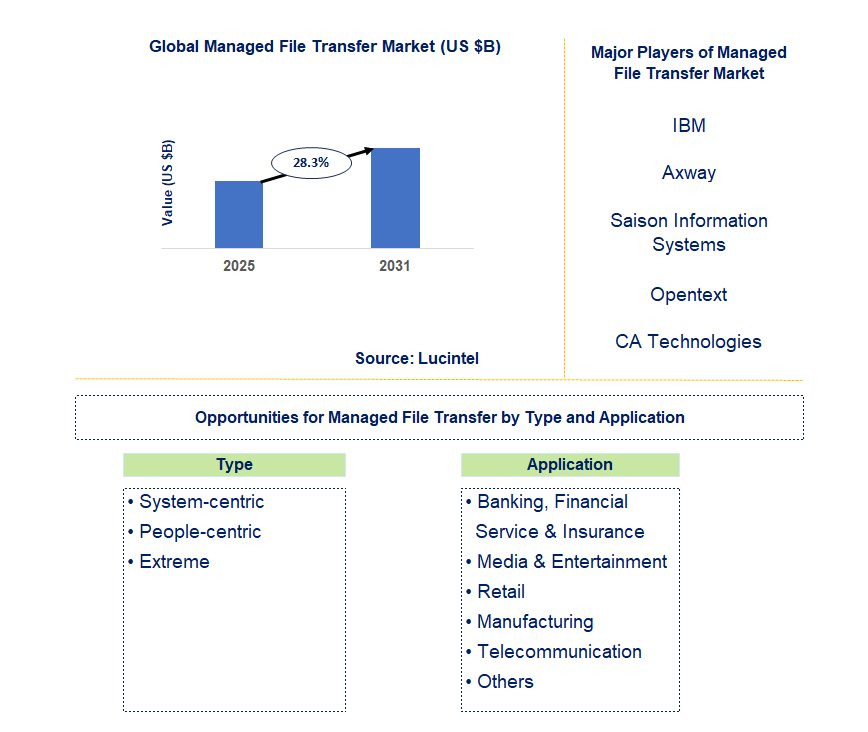
Key data points: The growth forecast = 28.3% annually for the next 7 years. Scroll below to get more insights. This market report covers Trends, opportunities and forecasts in managed file transfer market to 2031 by type (system-centric, people-centric, and extreme), application (banking, financial service & insurance, media & entertainment, retail, manufacturing, telecommunication, and others), and region (North America, Europe, Asia Pacific, and the Rest of the World)
We'll send your sample report shortly.
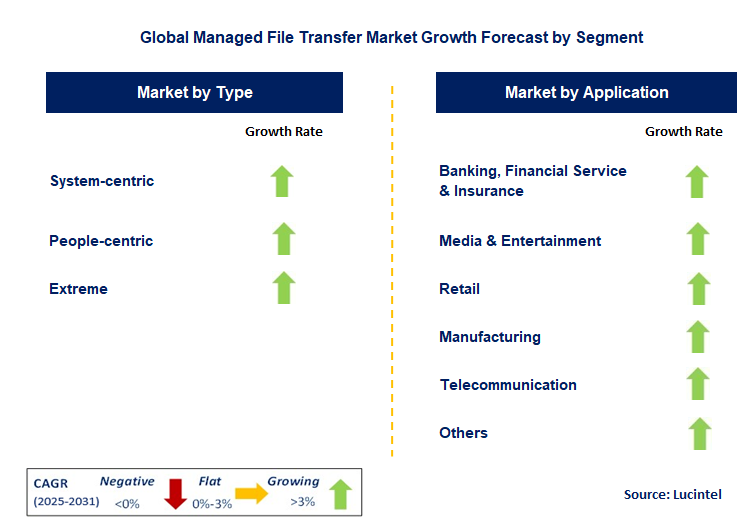
• Lucintel forecasts that, within the type category, system-centric is expected to witness the highest growth over the forecast period.
• Within the application category, banking, financial service & insurance is expected to witness the highest growth.
• In terms of region, APAC is expected to witness the highest growth over the forecast period.
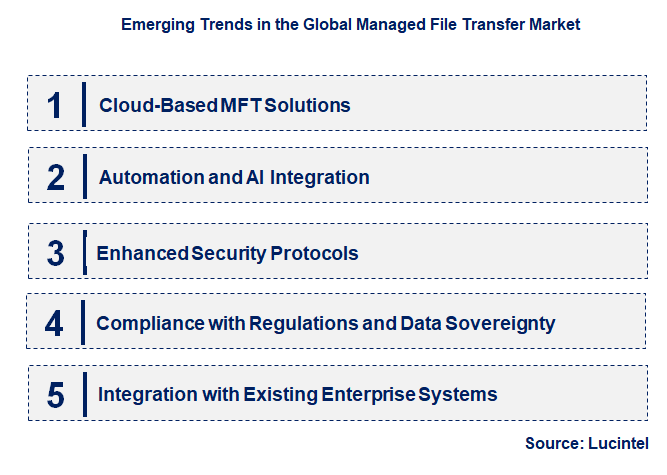
• Cloud-Based MFT Solutions: Cloud adoption is also accelerating in the MFT space as companies move toward more scalable, cost-effective file transfer systems. Cloud MFT solutions provide businesses with greater flexibility in securely transferring files without being limited by on-premises infrastructure. They also make it easier for companies to scale, making it simpler for companies to handle massive amounts of data and support global operations. Cloud MFT solutions are also simple to integrate with other cloud offerings, making them all the more appealing to today's businesses looking to maximize their data processes.
• Automation and AI Integration: Automation and artificial intelligence (AI) are becoming ever more prevalent in the MFT marketplace as firms look to automate their file transfers. Artificial intelligence is used to perform routine work, such as exception handling and watching for file transfers, to enable organizations to work on higher-value tasks. Automation decreases errors by human personnel and streamlines the process of data movement for quicker and more accurate transfers. As advancements occur in AI technology, future prospects should reveal more about improving the process of transferring with less dependency on security regulations.
• Enhanced Security Protocols: As the frequency of cyberattacks, data breaches, and the significance of data privacy increase, stronger security measures are a priority in the MFT market. Advanced encryption techniques, multi-factor authentication, and secure file transfer protocols like SFTP and FTPS are becoming the norm in MFT solutions. Blockchain technology is also being implemented by companies to further secure and provide tamper-proof records of file transfers. With ongoing security threats rising, MFT vendors are continuously under pressure to create solutions with the maximum degree of protection available for sensitive data.
• Compliance with Regulations and Data Sovereignty: Compliance with regulations is still a dominant force in the MFT marketplace, with enterprises under mounting pressure to comply with the demands of regulations like GDPR, HIPAA, and CCPA. Also, data sovereignty issues are accelerating the need for MFT solutions that keep data within geographical boundaries. Organizations want solutions that provide the flexibility of deployment choices in terms of on-premises, hybrid, and cloud models so that local data protection regulations are complied with. Solutions that enable businesses to automate compliance reporting and auditing activities are also being developed by MFT vendors.
• Integration with Existing Enterprise Systems: With organizations increasingly embracing a vast variety of enterprise systems, the possibility of integrating MFT solutions into current IT infrastructure has become an important factor to consider. Integration with platforms like Enterprise Resource Planning (ERP), Customer Relationship Management (CRM), and supply chain management systems makes file transfers possible across different business units and partners seamlessly. This unification not only enhances the efficiency of operations but also facilitates data movement seamlessly between different systems, minimizing the potential for errors and delays in vital business processes. These emerging trends are transforming the managed file transfer market by fueling greater use of cloud-based technology, automation, and AI, while focusing more on security and regulatory compliance. As companies try to handle increased amounts of data with greater efficiency, MFT solutions will have to adapt to the needs of a digital-first business landscape. These trends will continue to define the future of the MFT market, allowing companies to transfer files securely and efficiently with compliance in mind.
• Integration with Cloud Technologies: The combination of MFT solutions with cloud platforms is a key evolution in the market. Cloud-based MFT solutions are designed with greater scalability, flexibility, and cost savings in mind, making them perfect for organizations that want to automate their processes. Cloud-based MFT solutions enable businesses to transfer large amounts of information between various platforms safely, providing for effortless collaboration. Cloud-based MFT solutions are also simple to deploy, offering them as a preferred choice for all sizes of organizations.
• Emphasis on Real-Time Data Transfer: Real-time data transfer features are emerging as a prime requirement in the MFT market due to the need for businesses to exchange data quicker and with greater reliability. Real-time MFT enables organizations to exchange data in real-time, enhancing operational effectiveness and eliminating business process delays. The feature is of particular significance in industries that use time-sensitive data, including finance and healthcare. As there is an increasing need for timely access to data, MFT solutions are undergoing changes to make file transfers quicker and more secure.
• Utilizing Blockchain for Greater Security: Blockchain technology is entering the MFT marketplace as a method for adding security and protecting the integrity of file transfers. Through the creation of immutable, tamper-proof records for file transfers, blockchain can greatly lower the threat of data breaches and fraud. Blockchain technology delivers a transparent, auditable history of all file transfers, building trust and accountability. As companies become increasingly focused on protecting data, blockchain adoption in MFT solutions will increase dramatically.
• File Transfer Workflow Automation: Another major advance in the MFT space is the automation of file transfer processes. Automating processes like monitoring, exception handling, and file routing can help companies decrease the amount of manual intervention required and increase efficiency. Automated MFT solutions can help automate processes, eliminate human intervention, and facilitate quicker file transfers. Automation enables companies to implement more advanced workflows, allowing flawless transfers between multiple stakeholders and systems without having to constantly monitor them.
• Greater Emphasis on Data Privacy Laws: With stricter data privacy laws, greater emphasis has been placed on MFT solutions that adhere to laws like GDPR, HIPAA, and CCPA. The law mandates companies to have rigorous data protection practices in place and offer transparent auditing capabilities. MFT solutions are changing to integrate compliance characteristics within themselves, including encryption, access control, and automated reporting. This evolution enables enterprises to comply with regulations while confirming that sensitive information is transferred and kept securely. These critical advancements are greatly influencing the managed file transfer industry by enhancing the speed, security, and compliance of file transfer operations. With businesses increasingly embracing more sophisticated technologies and regulatory needs changing, MFT solutions will remain critical for secure and efficient information exchange.
• Cloud-Based MFT Solutions: Cloud MFT solutions are one of the biggest growth opportunities in the marketplace. As more enterprises embrace cloud infrastructure, they need scalable and secure solutions to transfer files between different platforms. Cloud MFT systems provide businesses with the flexibility, security, and cost savings they need to automate their operations. This opportunity is quite robust in markets such as finance, healthcare, and technology, where data protection and compliance are critical.
• Regulatory Compliance Solutions: In light of increasing data protection legislation in different regions of the world, companies are looking for MFT solutions that enable them to stay in compliance with regulations like GDPR, HIPAA, and CCPA. Compliance reporting, monitoring, and auditing solutions, when automated, are becoming imperative. With features that guarantee regulatory compliance, MFT vendors have the chance to serve sectors with strict compliance needs, including finance, healthcare, and law firms.
• Integration of AI and Automation: The incorporation of AI and automation into MFT solutions presents a tremendous growth prospect. Automation has the ability to automate file transfer processes, minimize human intervention, and enhance overall efficiency. AI-based insights can also assist companies in streamlining their file transfer procedures and anticipating potential problems before they arise. This prospect is especially applicable to big companies with intricate data transfer requirements, as automation and AI provide them with the capability to expand their operations while diminishing the possibility of human error.
• Security-First MFT Solutions: As threats online keep growing, companies are turning to security-first MFT solutions. These solutions lead with advanced encryption, multi-factor authentication, and blockchain technology to provide secure file transfers. Providing these strong security features is an opportunity for MFT providers to grow, particularly in sectors where data security is paramount, like banking, healthcare, and government.
• Mobile MFT Solutions: The heightened use of mobile devices for business processes creates a potential for mobile MFT solution development. The solutions enable employees to move files securely from remote locations, boosting productivity and collaboration. With the growing mobility and dispersion of the workforce, mobile-enabled MFT systems will be in greater demand, particularly in finance, media, and manufacturing sectors. These opportunities for growth are accelerating the evolution of the MFT market, with companies increasingly deploying solutions focused on cloud capabilities, regulatory compliance, security, and automation. As companies seek to simplify their file transfer process while addressing regulatory and security requirements, the MFT market will grow substantially, with new opportunities for innovation and market growth.
• IBM
• Axway
• Saison Information Systems
• Opentext
• CA Technologies
• Accellion
• Globalscape
• Primeur
• Jscape
• Ipswitch
• System-centric
• People-centric
• Extreme
• Banking, Financial Service & Insurance
• Media & Entertainment
• Retail
• Manufacturing
• Telecommunication
• Others
• North America
• Europe
• Asia Pacific
• The Rest of the World
• United States: United States is dominating the managed file transfer market, fueled by strong demand from sectors like finance, healthcare, and technology. There has been strong trending towards cloud-based solutions for MFT, with players concentrating on improving security and regulatory compliance like HIPAA and GDPR. Moreover, the American market has experienced the adoption of artificial intelligence (AI) for automating file transfer operations and streamlining data workflows, enabling businesses to have a competitive advantage. These advancements have transformed MFT into an essential element of secure business practices.
• China: The MFT market in China has been transforming at a very fast pace as the nation strengthens its digital backbone. The rise in cloud computing and data security regulations, including the Cybersecurity Law, has fueled the need for managed file transfer solutions. Organizations are increasingly going for hybrid cloud models, featuring local data centers to ensure compliance with regulations while leveraging global cloud platforms for scaling. With heightened emphasis on data sovereignty, China is also looking at MFT solutions that serve local-specific domestic compliance needs.
• Germany: Germany's robust data protection legislation and adherence to GDPR compliance have driven the demand for MFT solutions within the country. German businesses are increasingly implementing MFT systems to facilitate secure cross-border file transfers while ensuring privacy and security. Cloud adoption is also gaining momentum, but German firms are still hesitant about cloud security, resulting in the implementation of hybrid MFT solutions that offer on-premises and cloud capabilities. These solutions ensure that businesses can meet local regulatory requirements while benefiting from global scalability.
• India: India’s rapidly growing digital economy is fueling the expansion of the MFT market. As the country continues to embrace digital transformation, businesses across sectors such as IT, manufacturing, and finance are adopting MFT solutions to securely manage data transfers. Regulatory advancements, including the Personal Data Protection Bill, have led to increased requirements for secure file transfer technologies. Indian companies are most interested in solutions that are geared to handle large amounts of data as well as low-cost, scalable solutions to enable their growth.
• Japan: MFT solutions are emerging as a necessity in Japan, as companies need to ensure data security and adhere to strict regulations. The emphasis lies in automation and integration with other enterprise systems and cloud-based MFT adoption. The country's robust focus on technology innovation is pushing the market, with manufacturing, automotive, and electronics firms spending heavily in secure file transfer systems. There is also increased demand for real-time access to data and safe file sharing within the region.


• IBM
• Axway
• Saison Information Systems
• Opentext
• CA Technologies
• Accellion
• Globalscape
• Primeur
• Jscape
• Ipswitch Q5. Which managed file transfer market segment will be the largest in future? Answer: Lucintel forecasts that, within the type category, system-centric is expected to witness the highest growth over the forecast period. Q6. In managed file transfer market, which region is expected to be the largest in next 5 years? Answer: In terms of region, APAC is expected to witness the highest growth over the forecast period. Q7. Do we receive customization in this report? Answer: Yes, Lucintel provides 10% customization without any additional cost.


Choose a license that fits your team. Instant PDF delivery.
Prices exclude taxes. Instant delivery. Custom licensing available on request.
Market Report · July 31, 2026
Market Report · July 31, 2026
Market Report · July 31, 2026
Trusted partner for strategic intelligence and business growth


Receive a complimentary market analysis tailored to your industry. Our analysts will identify key growth opportunities and competitive dynamics specific to your business.

Market size, growth rate, and key trend analysis for your specific sector.

Top competitor positioning and market share analysis.

Strategic recommendations backed by data-driven insights.
Get curated market intelligence and competitive moves straight to your inbox.
By subscribing, you agree to receive our monthly insights. Unsubscribe anytime.
Receive a complimentary market analysis tailored to your industry. Our analysts will identify key growth opportunities and competitive dynamics specific to your business.
Market size, growth rate, and key trend analysis for your specific sector.
Top competitor positioning and market share analysis.
Strategic recommendations backed by data-driven insights.
Get curated market intelligence, emerging trends, and competitive moves straight to your inbox each month.
By subscribing, you agree to receive our monthly insights. Unsubscribe anytime.
We'll send your sample report shortly.