
Market Report · July 22, 2026

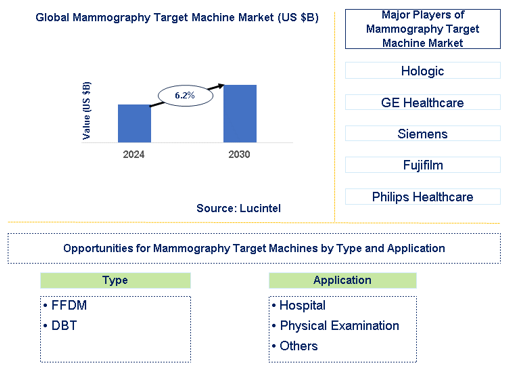
Key data points: The growth forecast = 6.2% annually for the next 6 years. Scroll below to get more insights. This market report covers trends, opportunities, and forecasts in the global mammography target machine market to 2030 by type (FFDM and DBT), application (hospital, physical examination, and others), and region (North America, Europe, Asia Pacific, and the Rest of the World)
We'll send your sample report shortly.
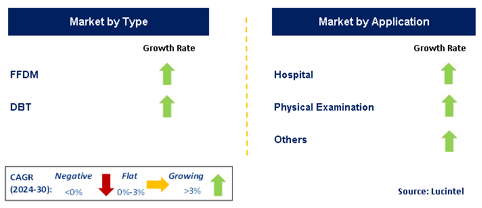
• Lucintel forecasts that, within the type category, within the type category FFDM is expected to witness higher growth over the forecast period.
• Within the application category, hospital is expected to witness higher growth.
• In terms of regions, APAC is expected to witness the highest growth over the forecast period. Gain valuable insights for your business decisions with our comprehensive 150+ page report.
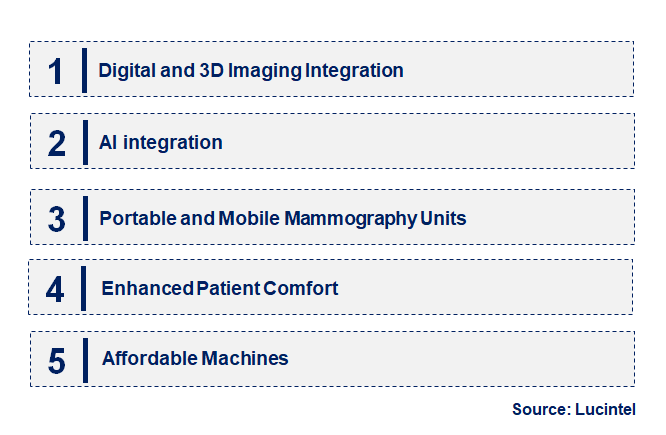
• Digital and 3D Imaging Integration: Digital and 3D imaging technologies are being integrated, providing improved resolution and diagnostic accuracy. This integration promotes early detection of breast cancer and enhances patient outcomes.
• AI Integration: Mammography systems are now incorporating AI to aid in image analysis and result interpretation. AI algorithms enhance diagnostic precision by identifying patterns that may be overlooked by human vision, thereby improving early detection rates.
• Portable and Mobile Mammography Units: Portable and mobile mammography units are gaining traction, especially in underserved and remote areas. These units offer flexibility and accessibility, facilitating widespread screening and early detection in locations with limited healthcare facilities.
• Enhanced Patient Comfort: There is a growing focus on patient comfort, leading to the development of more ergonomic designs and softer padding, as well as advanced imaging techniques that reduce discomfort during screenings.
• Affordable Machines: Mammography target machines are becoming increasingly affordable. Efforts are being made to create cost-effective solutions for breast cancer screening, particularly in developing regions facing resource scarcity. These emerging trends are reshaping the mammography target machine market, making machines more innovative, accessible, and effective for early detection and diagnosis of breast cancer.
• Advanced Imaging Technologies: Digital and 3D mammography systems have been developed to enhance imaging quality and diagnostic capabilities. These technologies provide advanced images and better detection of abnormalities, leading to earlier diagnoses and more accurate treatments.
• AI Integration: Artificial Intelligence algorithms are now integrated with mammography machines to enhance image review and analysis. AI helps diagnose subtle patterns and abnormalities that may not be easily detected by human radiologists, improving diagnostic accuracy and reducing false positives.
• Portable and Mobile Units: The development of portable and mobile units expands screening capabilities, particularly in rural and underserved areas. These units offer flexibility and ease of deployment, making breast cancer screening more accessible to diverse populations.
• Enhancing Patient Comfort: New mammography machines are being designed with features that enhance patient comfort, such as softer compression paddies and ergonomic designs. These improvements aim to make the screening process less painful and more comfortable.
• Cost-Effective Solutions: There is a growing emphasis on developing cost-effective mammography systems to make breast cancer screening economically feasible, particularly in low-resource settings. These trends are fostering market growth in mammography target machines through technological improvements, increased accessibility, and a focus on patient comfort, leading to positive outcomes in breast cancer detection.
• Expansion of Screening Programs: There is a significant opportunity to expand mammography programs for breast cancer diagnosis, particularly in areas where such facilities are scarce. Increased access to mammography units, including portable and mobile units, can significantly enhance early detection services.
• Artificial Intelligence Integration: AI will continue to create growth opportunities in mammography systems by improving diagnostic accuracy and efficiency. AI-powered solutions can help radiologists interpret images more effectively, facilitating earlier diagnoses.
• Patient-Centric Design: Developing mammography machines with improved features for patient comfort presents another growth opportunity. Innovations aimed at reducing discomfort and enhancing the overall patient experience could drive higher adoption rates and increase screening participation.
• Affordable Solutions for Low-Resource Settings: There is a growing demand for cost-effective mammography systems in low-resource environments. Creating affordable, high-quality solutions can expand access to breast cancer screening in developing regions.
• Technological Advancements in Imaging: Ongoing innovations in imaging modalities, such as 3D mammography and high-resolution digital platforms, continue to create growth opportunities. These systems offer enhanced image quality and diagnostic performance, thereby increasing market demand. These strategic growth opportunities are positively influencing the mammography target machine market by addressing key challenges and enhancing access and diagnostic capabilities for screening.
• Technology advancements: Growing interest in mammography technology advancements such as digital and 3D imaging drives the market because of increased diagnostic accuracy, consequently leading to better patient outcomes. These advancements come with improved image quality and early detection of abnormalities.
• Increased Awareness and Screening Programs: Growing awareness related to breast cancer and the expansion of screening programs have increased demand for mammography machines. Some of the factors contributing to growth in the market include efforts toward increasing early detection and improving survival rates.
• Integration of AI: The integration of AI in mammography systems is one of the major factors driving market development. AI enhances image analysis and interpretation, thus enhancing diagnostic accuracy and efficiency that supports early detection and better patient care.
• Patient Comfort-Oriented Approach: Invention to increase comfort during mammography diagnoses propels demand for innovative machine design. Features reducing discomfort and increasing patient experience are observed as drivers in market expansion. Challenges in the mammography target machine market are:
• High Costs: One of the major cost barriers to very widespread adoption is the high cost of the advanced mammography machines. For whatever new technology there might be, partial budget allocation in some health care systems may limit its access to those facilities.
• Regulatory: The compliance with regulatory requirements relating to mammography machines often raises a challenge for the manufacturers. Safety and performance standards result in an increase in development and production costs.
• Training and Implementation: The integration of advanced mammography systems is quite complex into the existing healthcare setup. Proper training and support can help in ensuring that new technology is utilized and effectively maintained. These drivers and challenges can reflect technological advances, market demand, and regulatory compliance, hence shaping the mammography target machine market. Understanding these elements is quite vital for advancements in the industry and the improvement of diagnosis and management of breast cancers.
• Hologic
• GE Healthcare
• Siemens
• Fujifilm
• Philips Healthcare
• Canon Medical
• IMS Giotto
• Planmed
• Wandong Medical
• Shenzhen Anke
• FFDM
• DBT
• Hospital
• Physical Examination
• Others
• North America
• Europe
• Asia Pacific
• The Rest of the World
• United States: The U.S. is witnessing significant developments, from the introduction of mammography target machines with digital and 3D imaging capabilities to enhancements in image resolution and AI integration for early detection. Innovations aimed at improving patient comfort are also driving trends toward more user-friendly and efficient screening solutions.
• China: China is rapidly expanding its mammography target machine market by improving accessibility and affordability. Recent developments include high-resolution digital systems and portable mammography units, enhancing screening capabilities in remote and underserved areas, driven by government initiatives to broaden breast cancer screening programs.
• Germany: Germany places great importance on precision and innovation. Recent advancements have led to the development of high-definition mammography machines with advanced imaging algorithms, delivering superior image quality and diagnostic accuracy. Ongoing research focuses on integrating AI into mammography systems to enhance early detection and predictive capabilities.
• India: The mammography target machine market in India is gaining momentum due to investments in healthcare infrastructure. Key developments include cost-effective mammography solutions, the introduction of mobile units to reach rural areas, and a strong focus on educating healthcare professionals to improve screening rates in the fight against breast cancer.
• Japan: Japan is advancing mammography technology by developing high-performance machines that offer excellent imaging and faster treatment times. Recent advancements include the incorporation of AI for diagnostic analysis and the design of compact, efficient units suitable for various clinical settings, with an emphasis on patient comfort and reduced radiation exposure.


• Hologic
• GE Healthcare
• Siemens
• Fujifilm
• Philips Healthcare
• Canon Medical
• IMS Giotto
• Planmed
• Wandong Medical
• Shenzhen Anke Q5. Which mammography target machine market segment will be the largest in future? Answer: Lucintel forecasts that, within the type category FFDM is expected to witness higher growth over the forecast period. Q6. In mammography target machine market, which region is expected to be the largest in next 5 years? Answer: In terms of regions, APAC is expected to witness the highest growth over the forecast period. Q.7 Do we receive customization in this report? Answer: Yes, Lucintel provides 10% customization without any additional cost.


Choose a license that fits your team. Instant PDF delivery.
Prices exclude taxes. Instant delivery. Custom licensing available on request.
Market Report · July 22, 2026
Market Report · July 22, 2026
Market Report · July 22, 2026
Trusted partner for strategic intelligence and business growth


Receive a complimentary market analysis tailored to your industry. Our analysts will identify key growth opportunities and competitive dynamics specific to your business.

Market size, growth rate, and key trend analysis for your specific sector.

Top competitor positioning and market share analysis.

Strategic recommendations backed by data-driven insights.
Get curated market intelligence and competitive moves straight to your inbox.
By subscribing, you agree to receive our monthly insights. Unsubscribe anytime.
Receive a complimentary market analysis tailored to your industry. Our analysts will identify key growth opportunities and competitive dynamics specific to your business.
Market size, growth rate, and key trend analysis for your specific sector.
Top competitor positioning and market share analysis.
Strategic recommendations backed by data-driven insights.
Get curated market intelligence, emerging trends, and competitive moves straight to your inbox each month.
By subscribing, you agree to receive our monthly insights. Unsubscribe anytime.
We'll send your sample report shortly.