
Magnesium Hydroxide Market Trends and Forecast
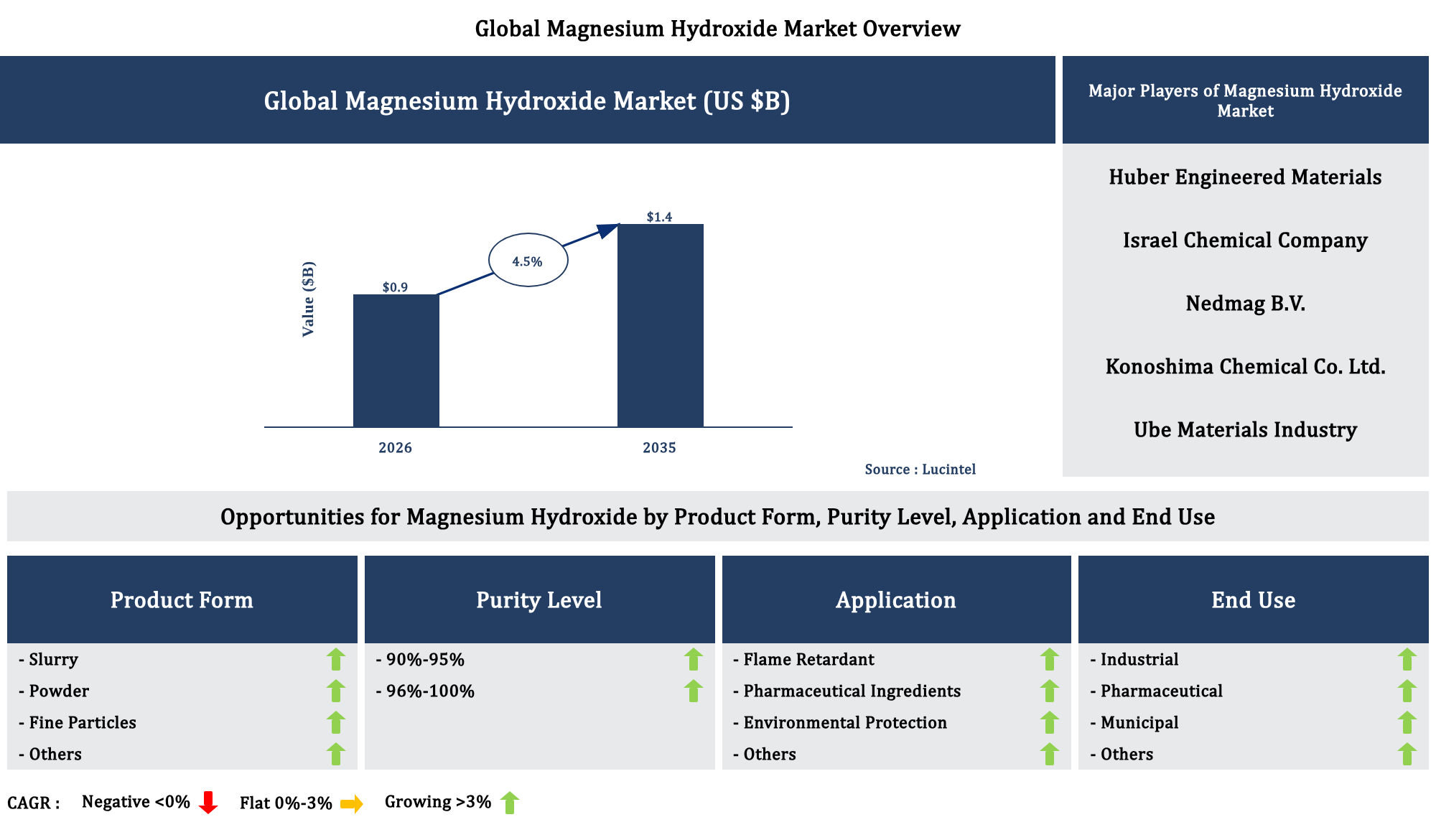
The future of the global magnesium hydroxide market looks promising with opportunities in the industrial, pharmaceutical, and municipal markets. The global magnesium hydroxide market is expected to reach an estimated $1,465 million by 2035 with a CAGR of 4.5% from 2026 to 2035. The major drivers for this market are the rising demand in wastewater treatment for ph neutralization, the increasing demand for consumption in electronics & battery industries, and the growing demand for applications in construction materials.
• Lucintel forecasts that, within the product form category, slurry is expected to witness the highest growth over the forecast period.
• Within the end use category, industrial is expected to witness the highest growth.
• In terms of region, APAC is expected to witness the highest growth over the forecast period.
Gain valuable insights for your business decisions with our comprehensive 150+ page report. Sample figures with some insights are shown below.
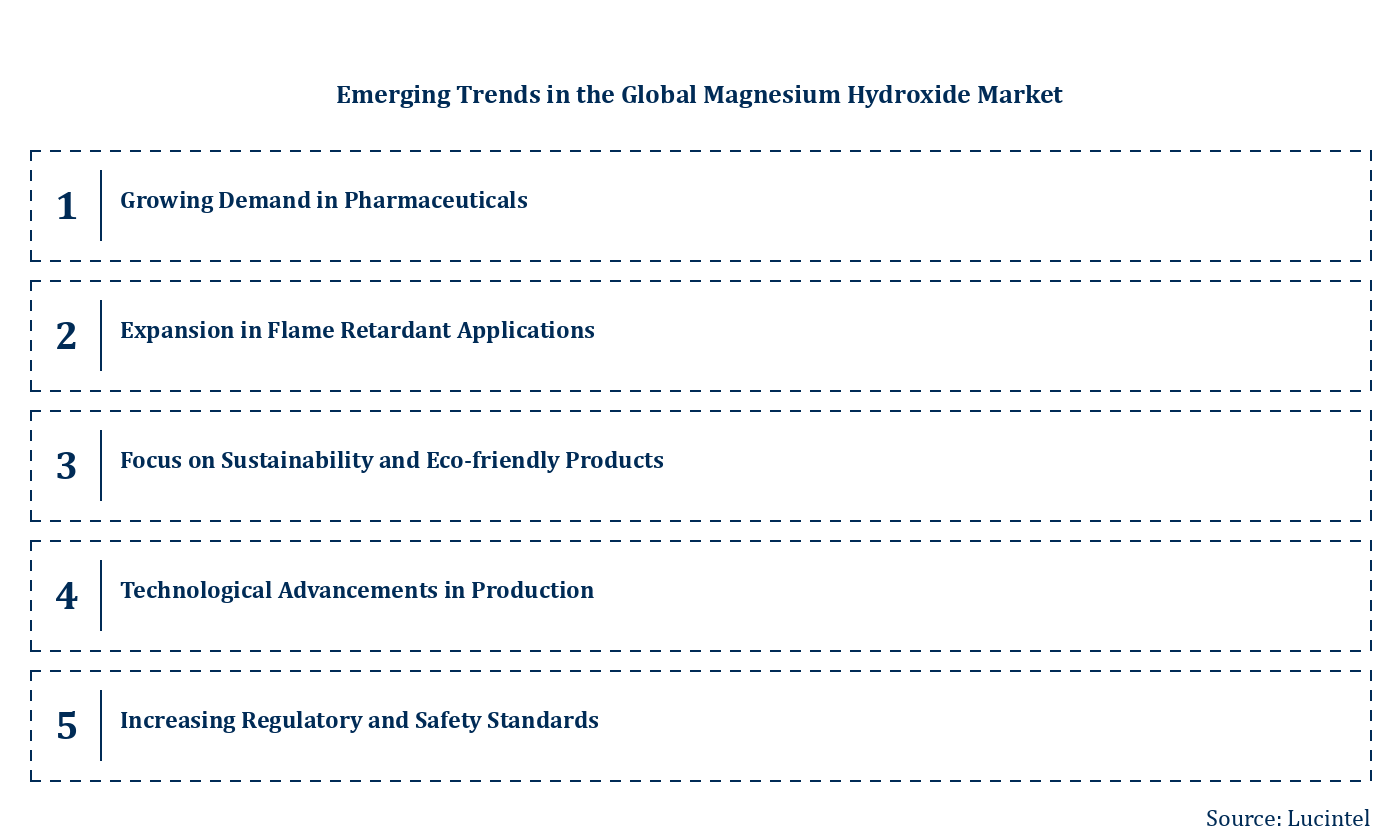
Emerging Trends in the Magnesium Hydroxide Market
The magnesium hydroxide market is experiencing rapid evolution driven by technological advancements, increasing demand across various industries, and shifting regulatory landscapes. As industries such as pharmaceuticals, flame retardants, and environmental management expand, the market is adapting to meet new challenges and opportunities. Emerging trends are shaping the future landscape, influencing production methods, application scopes, and sustainability practices. These developments are not only expanding market size but also enhancing product innovation and competitive dynamics. Understanding these key trends is essential for stakeholders aiming to capitalize on growth opportunities and navigate the complexities of this dynamic market environment.
• Growing Demand in Pharmaceuticals: The increasing use of magnesium hydroxide as an antacid and laxative is driving market growth. The rising prevalence of gastrointestinal disorders and the shift towards over-the-counter medications are boosting demand. Additionally, its role in pharmaceutical formulations for neutralizing stomach acid and as a buffering agent enhances its importance. This trend is expected to continue as healthcare awareness improves and aging populations grow, making magnesium hydroxide a critical component in pharmaceutical manufacturing.
• Expansion in Flame Retardant Applications: Magnesium hydroxide is increasingly used as a flame retardant in plastics, rubber, and textiles due to its environmentally friendly properties. The global push for safer, non-halogenated flame retardants is fueling this trend. Its ability to release water when heated helps suppress flames, making it a preferred choice for fire safety standards. This application expansion is prompting manufacturers to develop higher purity grades and tailored formulations, thereby broadening market scope and encouraging innovation in fire safety solutions.
• Focus on Sustainability and Eco-Friendly Products: Environmental regulations and consumer preferences are pushing the market toward sustainable practices. Magnesium hydroxide, being a naturally occurring mineral, is gaining favor over synthetic flame retardants and chemicals. Companies are investing in eco-friendly extraction and production processes to meet regulatory standards and reduce environmental impact. This trend is fostering the development of biodegradable and non-toxic products, aligning market growth with sustainability goals and opening new avenues in green chemistry and eco-conscious applications.
• Technological Advancements in Production: Innovations in extraction and manufacturing processes are improving product quality and reducing costs. Techniques such as improved calcination and purification methods enhance purity levels, which are critical for pharmaceutical and high-performance applications. Automation and process optimization are also increasing efficiency and scalability. These technological advancements are enabling manufacturers to meet rising demand, diversify product offerings, and maintain competitive advantages in a rapidly evolving market landscape.
• Increasing Regulatory and Safety Standards: Stricter regulations concerning chemical safety, environmental impact, and product labeling are shaping the market. Compliance with international standards such as REACH and EPA regulations is becoming mandatory, influencing production and marketing strategies. This trend encourages companies to adopt safer, more sustainable practices and innovate within regulatory frameworks. It also creates barriers to entry for new players but offers opportunities for established firms to differentiate through compliance and safety assurances, ultimately fostering a more responsible and transparent market environment.
These emerging trends are collectively reshaping the magnesium hydroxide market by fostering innovation, emphasizing sustainability, and responding to regulatory demands. They are expanding application scopes, improving product quality, and driving market growth while encouraging environmentally responsible practices. As these trends continue to evolve, stakeholders must adapt strategically to capitalize on new opportunities and navigate the changing landscape effectively.
Recent Development in the Magnesium Hydroxide Market
The magnesium hydroxide market has experienced significant advancements driven by increasing demand across various industries such as pharmaceuticals, construction, and environmental management. Innovations in production processes, rising applications in flame retardants, and growing environmental concerns are shaping the market landscape. These developments are creating new opportunities for manufacturers and stakeholders, fostering sustainable growth, and expanding market reach globally. The following key developments highlight the recent trends and their implications for the industry.
• Expansion of Pharmaceutical Applications: Magnesium hydroxide is increasingly used as an antacid and laxative, boosting healthcare sector growth. The rising prevalence of gastrointestinal disorders and the demand for over-the-counter remedies are driving production. This expansion enhances market revenue, encourages innovation in formulations, and attracts investments in pharmaceutical manufacturing. It also promotes the development of specialized grades tailored for medical use, strengthening the overall market position.
• Adoption in Flame Retardant Materials: The use of magnesium hydroxide as a flame retardant additive in plastics and textiles is expanding due to stringent safety regulations. Its eco-friendly and non-toxic nature makes it a preferred choice over traditional flame retardants. This trend boosts demand in construction, electronics, and automotive industries, leading to increased production and technological advancements. It also encourages research into more efficient and cost-effective flame retardant formulations, fostering sustainable industry growth.
• Growth in Environmental Remediation Applications: Magnesium hydroxide is increasingly employed in wastewater treatment and soil stabilization to neutralize acidity and remove contaminants. Rising environmental concerns and stricter regulations are propelling this application. The market benefits from increased adoption in industrial effluent treatment and pollution control projects. This development promotes sustainable practices, reduces environmental impact, and opens new revenue streams for companies involved in environmental management solutions.
• Innovations in Production Technology: Advances in manufacturing processes, such as energy-efficient synthesis and eco-friendly methods, are reducing costs and improving product quality. These innovations enable higher purity grades and customized solutions for specific applications. The improved production efficiency supports larger-scale deployment and market expansion. Additionally, sustainable manufacturing practices align with global environmental goals, enhancing corporate responsibility and market competitiveness.
• Rising Demand from Construction and Rubber Industries: Magnesium hydroxide is increasingly used as a fire-resistant additive in construction materials and rubber products. The growth of infrastructure projects and automotive manufacturing drives this demand. Its properties improve safety standards and material performance, encouraging industry adoption. This trend stimulates innovation in composite formulations and expands market share. It also supports the development of lightweight, durable, and fire-safe construction and automotive components, contributing to overall industry growth.
The overall impact of these developments is a robust expansion of the magnesium hydroxide market, driven by diverse applications, technological innovations, and environmental considerations. These trends are fostering sustainable growth, increasing market competitiveness, and opening new avenues for investment and research, ultimately shaping a resilient and dynamic industry landscape.
Strategic Growth Opportunities in the Magnesium Hydroxide Market
The magnesium hydroxide market is experiencing significant growth driven by increasing demand across various industries such as pharmaceuticals, construction, and environmental management. Innovations in production processes and expanding applications are creating new opportunities for market players. Rising awareness of health benefits and regulatory support further bolster growth prospects. As industries seek sustainable and effective solutions, magnesium hydroxide‘s versatility positions it as a key material for future development. Strategic investments and technological advancements are expected to accelerate market expansion globally.
• Expansion of Pharmaceutical Applications for Antacids and Laxatives: Magnesium hydroxide is widely used in the pharmaceutical industry as an antacid and laxative, addressing gastrointestinal issues. Growing consumer awareness and the prevalence of digestive disorders are boosting demand. Additionally, its use in formulations for neutralizing stomach acid and managing constipation supports market growth. Ongoing research into new medicinal applications and improved delivery systems further enhance its market potential, making it a vital component in healthcare products.
• Increasing use in Flame Retardants and Fireproofing Materials: Magnesium hydroxide serves as an environmentally friendly flame retardant in plastics, rubber, and textiles. Rising safety regulations and the need for sustainable fireproofing solutions are driving demand. Its ability to release water when heated helps suppress flames, making it an effective additive. The shift towards non-halogenated flame retardants due to environmental concerns is expected to expand its application scope, encouraging manufacturers to develop advanced formulations for various industrial uses.
• Growing Demand in Water Treatment and Environmental Applications: Magnesium hydroxide is used to neutralize acidic wastewater and control pH levels in water treatment plants. Its eco-friendly nature and effectiveness in precipitating heavy metals make it ideal for environmental remediation. Increasing industrial pollution and stricter environmental regulations are fueling its adoption. The ability to treat industrial effluents and reduce environmental impact positions magnesium hydroxide as a critical component in sustainable water management strategies.
• Rising Adoption in Construction and Cement Industries: Magnesium hydroxide is utilized as a fire-resistant additive and a stabilizer in construction materials. Its properties improve the fire safety and durability of building components. The construction sector‘s focus on safety standards and green building practices is boosting demand. Innovations in lightweight and high-performance materials incorporating magnesium hydroxide are expanding its use in modern construction projects, especially in regions emphasizing sustainable and resilient infrastructure.
• Advancements in Production Technologies and Regional Market Expansion: Innovations in manufacturing processes are reducing costs and improving product quality, making magnesium hydroxide more accessible. Emerging markets in Asia-Pacific and Latin America present significant growth opportunities due to rapid industrialization and infrastructure development. Strategic collaborations and investments are facilitating regional market penetration. Enhanced supply chain efficiencies and technological progress are expected to sustain long-term growth, enabling market players to meet increasing global demand effectively.
The overall impact of these opportunities is set to significantly accelerate the growth trajectory of the magnesium hydroxide market, fostering innovation and expanding its application base across multiple industries worldwide.
Magnesium Hydroxide Market Driver and Challenges
The magnesium hydroxide market is influenced by a variety of technological, economic, and regulatory factors that shape its growth trajectory. Advances in manufacturing processes, increasing demand across multiple industries, and evolving regulatory standards are key drivers. Conversely, challenges such as environmental concerns, fluctuating raw material prices, and stringent regulations pose significant hurdles. Understanding these drivers and challenges is essential for stakeholders to navigate the market effectively and capitalize on emerging opportunities while mitigating risks.
The factors responsible for driving the magnesium hydroxide market include:-
• Technological Advancements: The development of innovative production techniques has enhanced the efficiency and purity of magnesium hydroxide, enabling its use in diverse applications such as pharmaceuticals, flame retardants, and water treatment. These technological improvements reduce costs and improve product quality, fostering market expansion. Additionally, automation and process optimization have further streamlined manufacturing, making magnesium hydroxide more accessible and cost-effective for end-users. As industries seek sustainable and high-quality solutions, technological progress remains a critical driver for market growth.
• Growing Industrial Applications: The expanding use of magnesium hydroxide in various sectors such as pharmaceuticals, flame retardants, environmental remediation, and construction significantly propels market demand. Its role as an antacid and laxative in healthcare, combined with its fire-resistant properties, makes it indispensable. The increasing emphasis on safety standards and environmental regulations has boosted demand for flame retardant materials, where magnesium hydroxide is a preferred choice. Moreover, the rising infrastructure development and urbanization in emerging economies further contribute to the expanding application base, supporting sustained market growth.
• Rising Environmental and Safety Regulations: Governments worldwide are implementing stricter environmental and safety standards, which favor the adoption of magnesium hydroxide. Its eco-friendly nature and non-toxic profile make it a preferred alternative to hazardous chemicals in various applications. Regulations aimed at reducing the use of harmful flame retardants and chemicals in water treatment and construction drive manufacturers to adopt magnesium hydroxide. These regulatory pressures encourage innovation and investment in safer, sustainable products, thereby fueling market expansion and encouraging industry players to develop compliant solutions.
• Increasing Demand from Healthcare Sector: The pharmaceutical industry’s growing reliance on magnesium hydroxide as an antacid and laxative significantly impacts market growth. The rising prevalence of gastrointestinal disorders and the aging population worldwide increase demand for effective, safe, and affordable treatments. Additionally, the expanding use of magnesium hydroxide in personal care products and dietary supplements further boosts its market presence. The healthcare sector’s continuous innovation and demand for high-quality ingredients ensure a steady growth trajectory for magnesium hydroxide, making it a vital component in medical and wellness applications.
The challenges in the magnesium hydroxide market are:
• Environmental Concerns and Waste Management: Despite its eco-friendly reputation, the production and disposal of magnesium hydroxide pose environmental challenges. Mining and processing activities can lead to habitat disruption, waste generation, and water pollution if not managed properly. Additionally, the disposal of large quantities of magnesium hydroxide in industrial applications raises concerns about environmental impact. Stricter environmental regulations and the need for sustainable waste management practices require companies to invest in cleaner production methods, which can increase costs and complicate supply chains, potentially hindering market growth.
• Raw Material Price Volatility: The market‘s reliance on magnesium sources, such as seawater and mineral deposits, exposes it to price fluctuations driven by geopolitical tensions, supply-demand imbalances, and extraction costs. Volatility in raw material prices directly impacts manufacturing costs and profit margins, making it challenging for producers to maintain stable pricing strategies. This unpredictability can deter investment and limit the expansion of production capacities, thereby constraining overall market growth and affecting end-user pricing.
• Stringent Regulatory Environment: The increasing stringency of safety, environmental, and quality regulations across different regions presents a significant challenge. Compliance with diverse standards requires substantial investment in testing, certification, and process modifications, which can be resource-intensive. Regulatory delays and uncertainties may hinder product launches and market entry for new applications. Moreover, evolving regulations necessitate continuous adaptation, increasing operational costs and complicating international trade, which could slow down overall market development.
The magnesium hydroxide market is driven by technological innovations, expanding applications, regulatory support, and healthcare demand. However, environmental concerns, raw material price fluctuations, and regulatory complexities pose notable challenges. These factors collectively influence market dynamics, requiring stakeholders to adopt sustainable practices, innovate continuously, and navigate regulatory landscapes effectively. Overall, the market‘s growth prospects remain promising, provided that companies can address these challenges proactively and leverage emerging opportunities efficiently.
List of Magnesium Hydroxide Companies
Companies in the market compete on the basis of product quality offered. Major players in this market focus on expanding their manufacturing facilities, R&D investments, infrastructural development, and leverage integration opportunities across the value chain. With these strategies magnesium hydroxide companies cater increasing demand, ensure competitive effectiveness, develop innovative products & technologies, reduce production costs, and expand their customer base. Some of the magnesium hydroxide companies profiled in this report include-
• Huber Engineered Materials
• Israel Chemical Company
• Nedmag B.V.
• Konoshima Chemical Co. Ltd.
• Ube Materials Industry
• Martin Marietta Materials
• Kyowa Chemical Industry Ltd.
Magnesium Hydroxide Market by Segment
The study includes a forecast for the global magnesium hydroxide market by product form, purity level, application, end use, and region.
Magnesium Hydroxide Market by Product Form [Value from 2019 to 2035]:
• Slurry
• Powder
• Fine Particles
• Others
Magnesium Hydroxide Market by Purity Level [Value from 2019 to 2035]:
• 90%-95%
• 96%-100%
Magnesium Hydroxide Market by Application [Value from 2019 to 2035]:
• Flame Retardant
• Pharmaceutical Ingredients
• Environmental Protection
• Others
Magnesium Hydroxide Market by End Use [Value from 2019 to 2035]:
• Industrial
• Pharmaceutical
• Municipal
• Others
Magnesium Hydroxide Market by Region [Value from 2019 to 2035]:
• North America
• Europe
• Asia Pacific
• The Rest of the World
Country Wise Outlook for the Magnesium Hydroxide Market
The magnesium hydroxide market has experienced significant shifts driven by technological advancements, regulatory changes, and increasing demand across various sectors such as pharmaceuticals, flame retardants, and water treatment. Countries are focusing on innovation, sustainable practices, and expanding production capacities to meet rising global needs. These developments reflect broader economic trends and environmental considerations, shaping the competitive landscape and influencing market growth trajectories. As the market evolves, key players are investing in research and development to enhance product quality and diversify applications, ensuring resilience amid fluctuating raw material prices and regulatory frameworks.
• United States: The U.S. market has seen increased adoption of magnesium hydroxide in water treatment and pharmaceutical applications. Innovations in eco-friendly production methods are gaining traction, alongside regulatory efforts to reduce environmental impact. Major companies are expanding manufacturing capacities and investing in R&D to develop high-purity grades, supporting growth in healthcare and industrial sectors. The demand for flame retardants in construction and electronics has also contributed to market expansion, with a focus on sustainable and compliant products.
• China: China remains the largest producer and consumer of magnesium hydroxide, driven by rapid industrialization and infrastructure development. Recent developments include the establishment of large-scale manufacturing plants utilizing advanced extraction technologies, which improve efficiency and reduce costs. The government’s emphasis on environmental regulations has prompted shifts toward greener production processes. The domestic market is expanding in sectors like flame retardants, water treatment, and rubber, with exports increasing to meet global demand. Innovation in product formulations is also enhancing application versatility.
• Germany: Germany’s market is characterized by a focus on high-quality, specialty magnesium hydroxide products for pharmaceutical and cosmetic applications. Recent advancements include the integration of sustainable practices in manufacturing and increased R&D investments to develop customized solutions. The country’s strict regulatory environment has driven innovation in eco-friendly and non-toxic products. Additionally, Germany is expanding its presence in the flame retardant sector, emphasizing safety standards and environmental compliance, which has led to the development of advanced, sustainable formulations.
• India: India’s magnesium hydroxide market is witnessing rapid growth due to expanding infrastructure, automotive, and pharmaceutical industries. Recent developments include the establishment of new production facilities and the adoption of cost-effective extraction techniques. The government’s focus on environmental sustainability and pollution control has increased demand for magnesium hydroxide in water treatment and waste management. Market players are also exploring value-added applications such as flame retardants and antacids, with a growing emphasis on local sourcing and reducing import dependency to support economic growth.
• Japan: Japan’s market is characterized by innovation in high-purity magnesium hydroxide for pharmaceutical and electronic applications. Recent developments include advancements in purification technologies and environmentally friendly manufacturing processes. The country’s stringent safety and quality standards have driven the development of specialized products. Japan is also investing in research to improve flame retardant formulations, aligning with its focus on safety and sustainability. The market is witnessing increased collaboration between industry and academia to develop next-generation materials with enhanced performance and environmental profiles.
Features of the Global Magnesium Hydroxide Market
Market Size Estimates: Magnesium hydroxide market size estimation in terms of value ($M).
Trend and Forecast Analysis: Market trends (2019 to 2025) and forecast (2026 to 2035) by various segments and regions.
Segmentation Analysis: Magnesium hydroxide market size by various segments, such as by product form, purity level, application, end use, and region in terms of value ($M).
Regional Analysis: Magnesium hydroxide market breakdown by North America, Europe, Asia Pacific, and Rest of the World.
Growth Opportunities: Analysis of growth opportunities in different product form, purity level, application, end use, and regions for the magnesium hydroxide market.
Strategic Analysis: This includes M&A, new product development, and competitive landscape of the magnesium hydroxide market.
Analysis of competitive intensity of the industry based on Porter’s Five Forces model.
FAQ
Q1. What is the magnesium hydroxide market size?
Answer: The global magnesium hydroxide market is expected to reach an estimated $1,465 million by 2035.
Q2. What is the growth forecast for magnesium hydroxide market?
Answer: The global magnesium hydroxide market is expected to grow with a CAGR of 4.5% from 2026 to 2035.
Q3. What are the major drivers influencing the growth of the magnesium hydroxide market?
Answer: The major drivers for this market are the rising demand in wastewater treatment for ph neutralization, the increasing demand for consumption in electronics & battery industries, and the growing demand for applications in construction materials.
Q4. What are the major segments for magnesium hydroxide market?
Answer: The future of the magnesium hydroxide market looks promising with opportunities in the industrial, pharmaceutical, and municipal markets.
Q5. Who are the key magnesium hydroxide market companies?
Answer: Some of the key magnesium hydroxide companies are as follows:
• Huber Engineered Materials
• Israel Chemical Company
• Nedmag B.V.
• Konoshima Chemical Co. Ltd.
• Ube Materials Industry
• Martin Marietta Materials
• Kyowa Chemical Industry Ltd.
Q6. Which magnesium hydroxide market segment will be the largest in future?
Answer: Lucintel forecasts that, within the product form category, slurry is expected to witness the highest growth over the forecast period.
Q7. In magnesium hydroxide market, which region is expected to be the largest in next 8 years?
Answer: In terms of region, APAC is expected to witness the highest growth over the forecast period.
Q8. Do we receive customization in this report?
Answer: Yes, Lucintel provides 10% customization without any additional cost.
This report answers following 11 key questions:
Q.1. What are some of the most promising, high-growth opportunities for the magnesium hydroxide market by product form (slurry, powder, fine particles, and others), purity level (90%-95% and 96%-100%), application (flame retardant, pharmaceutical ingredients , environmental protection, and others), end use (industrial, pharmaceutical, municipal, and others ), and region (North America, Europe, Asia Pacific, and the Rest of the World)?
Q.2. Which segments will grow at a faster pace and why?
Q.3. Which region will grow at a faster pace and why?
Q.4. What are the key factors affecting market dynamics? What are the key challenges and business risks in this market?
Q.5. What are the business risks and competitive threats in this market?
Q.6. What are the emerging trends in this market and the reasons behind them?
Q.7. What are some of the changing demands of customers in the market?
Q.8. What are the new developments in the market? Which companies are leading these developments?
Q.9. Who are the major players in this market? What strategic initiatives are key players pursuing for business growth?
Q.10. What are some of the competing products in this market and how big of a threat do they pose for loss of market share by material or product substitution?
Q.11. What M&A activity has occurred in the last 7 years and what has its impact been on the industry?
For any questions related to Magnesium Hydroxide Market, Magnesium Hydroxide Market Size, Magnesium Hydroxide Market Growth, Magnesium Hydroxide Market Analysis, Magnesium Hydroxide Market Report, Magnesium Hydroxide Market Share, Magnesium Hydroxide Market Trends, Magnesium Hydroxide Market Forecast, Magnesium Hydroxide Companies, write Lucintel analyst at email: helpdesk@lucintel.com. We will be glad to get back to you soon.