
Report Feature
Machine Vision Hardware Market Trends and Forecast
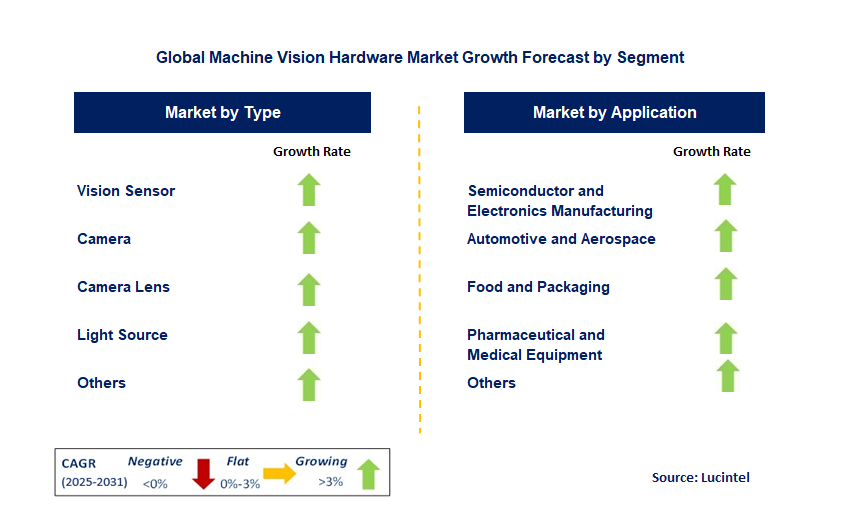
The future of the global machine vision hardware market looks promising with opportunities in the semiconductor and electronics manufacturing, automotive and aerospace, food and packaging, and pharmaceutical and medical equipment markets. The global machine vision hardware market is expected to grow with a CAGR of 11.9% from 2025 to 2031. The major drivers for this market are increasing demand for automation and precision in manufacturing processes, growth in the adoption of ai and machine learning for image processing, and rising need for quality control and inspection in industries like automotive and electronics. Lucintel forecasts that, within the type category, camera is expected to witness the highest growth over the forecast period due to their prominence in various industries, such as manufacturing and robotics. Within the application category, semiconductor and electronics manufacturing is expected to witness the highest growth due to machine vision is crucial for high-precision tasks such as component inspection, assembly, and quality control. In terms of region, APAC is expected to witness the highest growth over the forecast period due to the region is a global manufacturing hub, with significant demand for automation and quality control in industries. Gain valuable insights for your business decisions with our comprehensive 150+ page report. Sample figures with some insights are shown below.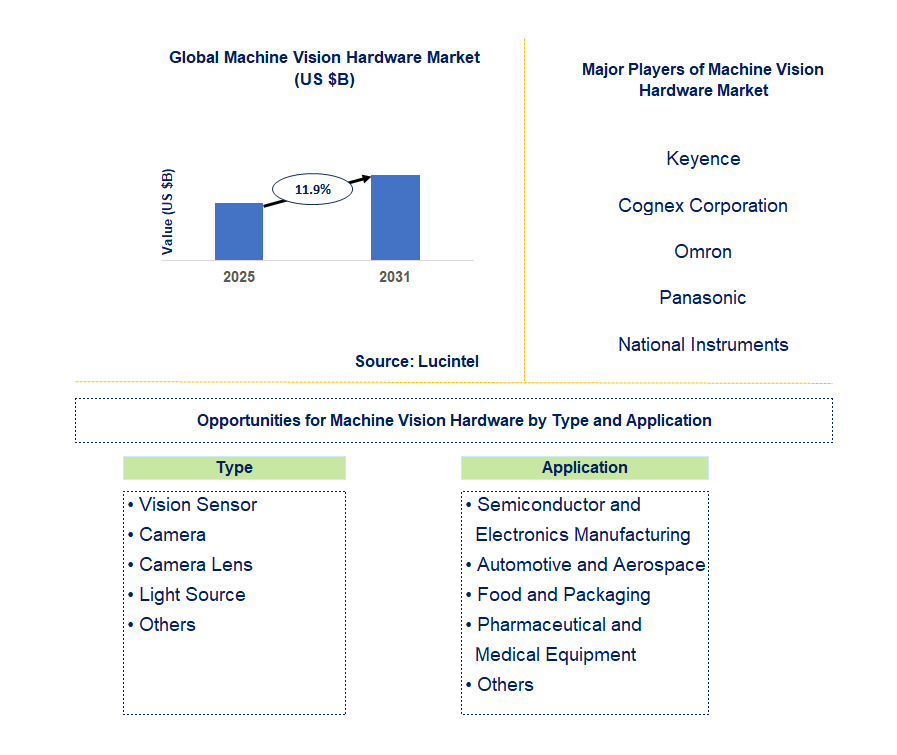
Emerging Trends in the Machine Vision Hardware Market
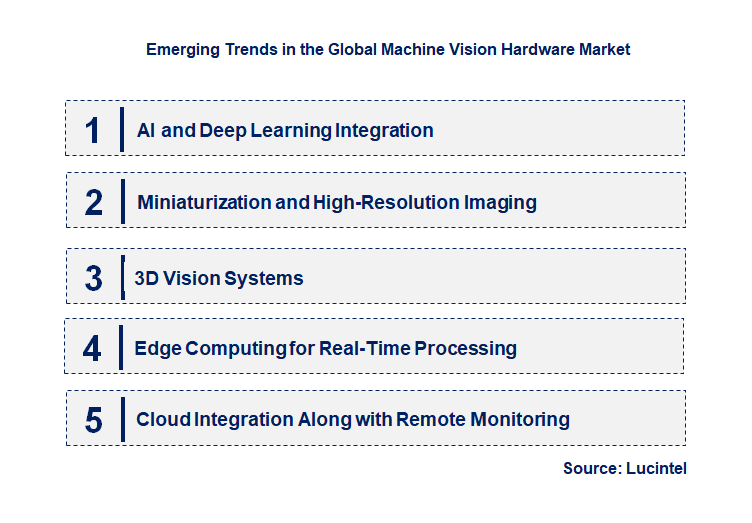
The machine vision hardware market is changing rapidly, with several key trends shaping its future. These trends are driven by advancements in AI, automation, and the increasing demand for high-precision vision systems across industries. As companies look to optimize production processes, reduce human error, and enhance operational efficiency, the following trends are emerging as critical drivers of the market‘s evolution.• AI and Deep Learning Integration: AI and deep learning are being integrated into machine vision systems to enhance performance. These technologies enable vision systems to learn from data and make smarter decisions, which improves quality control, defect detection, and predictive maintenance. AI enables machine vision hardware to process complex visual data faster and more accurately than traditional systems, allowing for real-time insights and enhanced automation.
• Miniaturization and High-Resolution Imaging: The miniaturization of cameras and sensors has been a big trend as more compact, powerful vision systems are needed. High-resolution imaging technology permits much better inspections. This is crucial to the electronics and medical device manufacturing industries. The smaller, more efficient components make machine vision systems more accessible and easier to integrate with existing manufacturing processes.
• 3D Vision Systems: 3D vision systems are changing the way machine vision hardware is applied to complex inspections and measurements. Depth information is added by 3D imaging, which enhances the accuracy of robot guidance, packaging, and quality control applications. With the capacity to capture more detailed visual data, 3D vision systems enable higher precision in tasks that were previously difficult or impossible to automate.
• Edge Computing for Real-Time Processing: There has also been an edge computing trend where data is to be processed directly at the source in real-time. This brings down latency by processing data on the local area and improves vision systems‘ performance in applications which require rapid decisions, such as for autonomous vehicles and industrial robots for smart manufacturing.
• Cloud Integration Along with Remote Monitoring: Cloud computing is now being integrated into machine vision systems to allow remote monitoring, data storage, and analysis. This allows businesses to track production processes in real-time and analyze data across multiple locations. Scalability is also greater with cloud-based solutions, as manufacturers can expand their systems without on-premises hardware upgrades. Access to machine vision data from remote locations is revolutionizing how manufacturers think about operational efficiency and maintenance. The emerging trends in the machine vision hardware market are significantly changing and driving innovation to provide new capabilities for industries. The incorporation of AI, miniaturization, 3D systems, edge computing, and cloud technology makes machine vision systems smarter, faster, and more accessible, and these are applied to wider industries such as automotive, healthcare, electronics, and logistics. As these trends evolve, the market will witness further advancements in automation and data analysis, which will contribute to improved productivity and operational efficiency.
Recent Development in the Machine Vision Hardware Market
The machine vision hardware market is experiencing a fundamental shift due to technological advancements, increased automation, and the requirement for higher precision. These trends range from the hardware components to cameras and sensors to software-based solutions that increase image processing and analysis. Five such developments are summarized below, changing the face of the machine vision hardware landscape and impacting growth in different sectors.• AI-Powered Vision Systems: The integration of AI technologies into machine vision hardware has increased the capabilities of vision systems. AI algorithms allow for faster and more accurate image analysis, resulting in higher precision defect detection and quality control in manufacturing. This can be useful during high-precision industries such as semiconductor production and electronics, where even minor defects can lead to major failures. AI-based systems also facilitate predictive maintenance through the analysis of patterns in visual data and identification of potential equipment failures before they happen.
• Smart Cameras with Integrated Processing: Smart cameras have changed the game in machine vision systems, which combine imaging sensors with integrated processing capabilities. Such cameras can process images locally and, therefore, reduce the use of external processing units and allow for real-time data analysis. Integrating processing directly into the camera will enable manufacturers to achieve faster and more efficient image analysis in high-speed production environments. It has made machine vision more scalable and cost-effective, especially for small and medium-sized businesses.
• High-speed cameras for real-time analysis: High-speed cameras are in increasing demand, especially in automotive and electronics manufacturing where there is a need for faster production lines that require real-time analysis. This type of camera can take high-resolution images at rapid speeds, allowing vision systems to check products as they are in motion. High-speed cameras are critical components in applications where the requirement is to inspect moving objects within a short time for good product quality and efficient processes such as automated inspection, assembly line quality control, and robotics.
• 3D Vision and Laser Profiling: 3D vision systems have become popular as it allows doing more accurate inspections through a combination with laser profiling. These systems provide depth information, important for situations like general robot guidance, precision measurements, and the recognition of defects in complex geometries. Laser profiling further adds to the details being achieved by such systems, making them very useful for making accuracies mainly in industries that require manufacturing applications to be highly accurate, such as the automotive and aerospace industries.
• Cloud-Based Vision Systems: Integration in the cloud is making it possible for remote monitoring and data analysis to be accessed with machine vision systems. Now, manufacturers can store visual data in the cloud so that this access and analysis of data could be centralized for multi-site locations. Predictive analytics, along with fast decision-making, are made possible because production processes can be monitored in real-time from anywhere through the operation. Scalability in cloud-based vision systems makes it easy for companies to scale up machine vision capabilities without any major investments in hardware infrastructure. These new developments are pushing the boundaries of what machine vision systems can achieve, offering enhanced capabilities in areas such as AI-powered analysis, real-time processing, high-speed inspection, and 3D imaging. As these technologies evolve, the market will continue to see significant advancements, improving automation and precision across industries like manufacturing, robotics, and healthcare.
Strategic Growth Opportunites in the Machine Vision Hardware Market
The machine vision hardware market has several strategic growth opportunities through applications. Industries that adopt automation will need to invest in higher-precision systems, thus businesses can ride emerging trends and capture additional market share. The five application growth opportunities that have shaped this section focus on the specific area contributing to the general development of machine vision hardware.• Automated inspection and quality control: Automated inspection is the largest growth opportunity in the machine vision market. Vision systems are increasingly applied in the automotive, electronics, and pharmaceutical industries for quality control purposes. These systems can detect defects and ensure the product meets quality standards without human intervention, hence reducing errors and production costs. As industries transition to fully automated manufacturing processes, more advanced automated inspection systems will be in demand.
• Robotics and Automation: Machine vision hardware in robotics has revolutionized several industries, from automotive to electronics to warehousing. Vision systems form the backbone for robot navigation and object recognition; they are a critical aspect for precise handling of materials. Increasingly advanced robots and their higher adoption will ensure that the requirement for high-performance machine vision hardware that supports autonomous systems will increase even further. Here lies an opportunity for companies that develop vision solutions which enhance the abilities of robots for efficient automation.
• Healthcare and Medical Imaging: Application of machine vision systems in the health care area is rapidly gaining pace, mainly in medical imaging and diagnostic equipment. The increasing research and development activities in AI and image processing will improve the precision and speed of MRI, X-ray, and endoscopy in medical imaging techniques. Significant growth prospects lie in this area as there is an ever-increasing requirement for precise diagnostic tools in hospitals and healthcare locations worldwide.
• Logistics and Warehouse Automation: In the logistics and warehouse automation space, machine vision hardware is assuming the critical role of ensuring that package scanning, sorting, and real-time tracking of goods are executed for enhanced operational efficiency and minimization of human errors. With an increase in demand for e-commerce and fast delivery services, adoption in warehouses has gained momentum, presenting a sizeable growth opportunity given the increasing number of fully automated distribution centers.
• Smart Manufacturing and Industry 4.0: The crux of the development of smart manufacturing and Industry 4.0 initiatives is machine vision. Vision systems facilitate the real-time monitoring of production processes, predictive maintenance, and automatic quality assurance. As manufacturers move toward digital and automated technologies, machine vision hardware becomes indispensable to achieve higher efficiency, reduced downtime, and better product quality. This market will experience significant growth as more industries embrace the principles of Industry 4.0. Strategic growth opportunities in machine vision hardware span a diverse range of applications, which also include automated inspection, robotics, healthcare, logistics, and smart manufacturing. All these applications are individually driving the need for more advanced machine vision systems and present additional growth avenues for business. As industries continue to evolve, the role of machine vision hardware will only become more critical, thus fostering innovation and growth within the market.
Machine Vision Hardware Market Driver and Challenges
The machine vision hardware market is influenced by a whole range of drivers and challenges that shape its development. Technological advancements, economic shifts, and regulatory changes play a significant role in determining the trajectory of the market. Understanding these drivers and challenges is essential for businesses looking to capitalize on the market‘s growth while working on potential obstacles. The factors responsible for driving the machine vision hardware market include: 1. Advancements in AI and Machine Learning: The capabilities of machine vision systems have significantly improved due to the development of AI and machine learning technologies. The technology has made it possible for systems to process visual data much faster and with more accuracy, hence better performance in defect detection, quality control, and automation. This growth is primarily because of the increased demand for automation in different sectors, such as automotive and food and beverages. 2. Increased Demand for Automation: Demand for machine vision systems is also driven by the push for increased automation across industries. Vision systems are crucial to the automation of tasks such as quality inspection, assembly, and packaging. As companies seek to become more efficient, cost-effective, and minimize human error, demand for machine vision hardware will continue to grow in manufacturing and logistics. 3. Smart Manufacturing and Industry 4.0: Manufacturing Industry 4.0 initiatives are pushing automation at the level of manufacturing by increasing adoption in advanced technologies, such as machine vision. The need for real-time data, automated processes, and predictive maintenance is driving the growth of machine vision hardware in smart manufacturing environments. The demand for machine vision systems is growing with increased adoption by more manufacturers. 4. Technological Advances in Imaging Sensors and Cameras: High resolution and better performance by advanced imaging sensors and cameras drive the innovation in the machine vision market. This improves accuracy and details, especially in the high-precision industries such as electronics, automotive, and pharmaceuticals. 5. Increased Quality Assurance Requirements for Production: The demand for high-quality production standards is one of the most important drivers for the adoption of machine vision. Vision systems enable the quality check in production with very high precision so that the product will meet the standards and not contain defects. The demand for quality assurance is strong in the automotive and electronics industries, which require precision. Challenges in the machine vision hardware market are: 1. High Initial Investment Costs: High initial costs of machine vision hardware and implementation are a significant barrier for small and medium-sized businesses. Even though the return on investment is usually strong, the capital needed to invest in adopting machine vision systems is quite high for some companies, preventing them from incorporating these systems into their operations. 2. Integration with Existing Systems: The integration of machine vision hardware can be difficult when it comes to legacy systems. In many old industries, the need for production equipment hampers innovation. Compatibility problems and the degree of complexity related to integration hinder the adoption of machine vision systems, especially within established manufacturing environments. 3. Data Security and Privacy Concerns: With growing adoption of cloud-based systems and the processing of real-time data, security and privacy in data have become serious issues. Manufacturer and other business enterprises should take proper measures to ensure that even the sensitive information gathered through machine vision systems is protected against cyber threats. For wide acceptance of advanced machine vision technologies, solving these security-related issues are compulsory. The machine vision hardware market is influenced by strong drivers, including the advancement of AI, demand for automation, and growth in smart manufacturing. However, high initial investment costs, integration difficulties, and data security concerns are some of the challenges that affect the market. Understanding these drivers and challenges is important for companies looking to navigate this dynamic market and capitalize on its growth potential.List of Machine Vision Hardware Companies
Companies in the market compete on the basis of product quality offered. Major players in this market focus on expanding their manufacturing facilities, R&D investments, infrastructural development, and leverage integration opportunities across the value chain. With these strategies machine vision hardware companies cater increasing demand, ensure competitive effectiveness, develop innovative products & technologies, reduce production costs, and expand their customer base. Some of the machine vision hardware companies profiled in this report include-• Keyence
• Cognex Corporation
• Omron
• Panasonic
• National Instruments
• Teledyne Dalsa
• Baumer Gmbh
• Banner Engineering Corp.
• Stemmer Imaging
• Delta Electronics Inc.
Machine Vision Hardware Market by Segment
The study includes a forecast for the global machine vision hardware market by type, application, and region.Machine Vision Hardware Market by Type [Value from 2019 to 2031]:
• Vision Sensor
• Camera
• Camera Lens
• Light Source
• Others
Machine Vision Hardware Market by Application [Value from 2019 to 2031]:
• Semiconductor and Electronics Manufacturing
• Automotive and Aerospace
• Food and Packaging
• Pharmaceutical and Medical Equipment
• Others
Machine Vision Hardware Market by Region [Value from 2019 to 2031]:
• North America
• Europe
• Asia Pacific
• The Rest of the World
Country Wise Outlook for the Machine Vision Hardware Market
The machine vision hardware market has grown at a rapid pace in the last few years due to technological advancement, increasing industrial automation, and the need for high-precision imaging systems across various sectors. The United States, China, Germany, India, and Japan are leading countries in these developments, each contributing uniquely to the evolution of machine vision hardware. These developments are changing the face of industries such as automotive manufacturing, electronics, and healthcare. The next section will discuss recent developments in the machine vision hardware market across these five key countries.• United States: The United States is a leader in the machine vision hardware market, with advancements driven by innovation in AI, robotics, and autonomous systems. Key developments include the integration of high-resolution cameras, advanced sensors, and AI-powered software for real-time data analysis. Companies such as Cognex and Keyence are increasing their reach in the industrial automation arena, especially concerning quality control and defect detection. Smart factories and Industry 4.0-related technologies are increasingly in demand because of their ability to improve productivity while lowering costs in manufacturing.
• China: China‘s hardware market for machine vision is growing strongly, driven by a strong base of manufacturing as well as AI and automation-related investments. The Chinese government has made tremendous efforts in promoting automation technologies, ranging from industrial inspection to autonomous vehicles. Companies like Hikvision and Dahua Technology are leading the way with innovations in camera technology, machine learning algorithms, and AI systems for improved accuracy and speed. China‘s promise to smart cities is opening opportunities for machine vision systems in security, surveillance, and urban management.
• Germany: Germany is one of the world‘s largest centers for high-tech manufacturing and industrial automation, and machine vision has played a key role in this success. The country has experienced rapid growth in machine vision system applications in automotive production, quality control, and robotics. The notable trends are the introduction of high-performance imaging sensors and the application of deep learning techniques for more accurate visual inspection processes. Companies like Siemens and Zeiss continue to innovate, ensuring that Germany remains at the forefront of automation and precision manufacturing on the global stage.
• India: India‘s machine vision hardware market is emerging, driven by rapid industrialization and the need for greater efficiency in manufacturing. Developments include the integration of low-cost, high-performance vision systems especially for SMEs in sectors such as electronics, pharmaceutical, and packaging. Already, with India‘s shift towards digital manufacturing, machine vision systems are being utilized for quality assurance, defect detection, and process automation. AI-powered vision systems are also being invested in by local companies to keep India at the pinnacle of a now increasingly automation and precision-focused market.
• Japan: With robotics and high-end manufacturing technology, Japan has remained the pace-setter for innovation in machine vision. Its recent innovations involve high-speed cameras, AI-based image processing, and highly sophisticated optical technologies in robotics and automation. Its manufacturers are incorporating machine vision systems in quality control and assembly line inspection in automotive and electronics. Companies like Fanuc and Omron are working to expand the machine vision hardware to the next level with the focus on less human intervention and efficient production by automating and using real-time analytics.

Features of the Global Machine Vision Hardware Market
Market Size Estimates: Machine vision hardware market size estimation in terms of value ($B). Trend and Forecast Analysis: Market trends (2019 to 2024) and forecast (2025 to 2031) by various segments and regions. Segmentation Analysis: Machine vision hardware market size by type, application, and region in terms of value ($B). Regional Analysis: Machine vision hardware market breakdown by North America, Europe, Asia Pacific, and Rest of the World. Growth Opportunities: Analysis of growth opportunities in different type, application, and regions for the machine vision hardware market. Strategic Analysis: This includes M&A, new product development, and competitive landscape of the machine vision hardware market. Analysis of competitive intensity of the industry based on Porter’s Five Forces model.
FAQ
Q1. What is the growth forecast for machine vision hardware market? Answer: The global machine vision hardware market is expected to grow with a CAGR of 11.9% from 2025 to 2031. Q2. What are the major drivers influencing the growth of the machine vision hardware market? Answer: The major drivers for this market are increasing demand for automation and precision in manufacturing processes, growth in the adoption of ai and machine learning for image processing, and rising need for quality control and inspection in industries like automotive and electronics. Q3. What are the major segments for machine vision hardware market? Answer: The future of the machine vision hardware market looks promising with opportunities in the semiconductor and electronics manufacturing, automotive and aerospace, food and packaging, and pharmaceutical and medical equipment markets. Q4. Who are the key machine vision hardware market companies? Answer: Some of the key machine vision hardware companies are as follows:• Keyence
• Cognex Corporation
• Omron
• Panasonic
• National Instruments
• Teledyne Dalsa
• Baumer Gmbh
• Banner Engineering Corp.
• Stemmer Imaging
• Delta Electronics Inc. Q5. Which machine vision hardware market segment will be the largest in future? Answer: Lucintel forecasts that camera is expected to witness the highest growth over the forecast period due to their prominence in various industries, such as manufacturing and robotics. Q6. In machine vision hardware market, which region is expected to be the largest in next 5 years? Answer: APAC is expected to witness the highest growth over the forecast period due to the region is a global manufacturing hub, with significant demand for automation and quality control in industries. Q7. Do we receive customization in this report? Answer: Yes, Lucintel provides 10% customization without any additional cost.
Table of Contents
Methodology
- In-depth interviews of the major players in this market
- Detailed secondary research from competitors’ financial statements and published data
- Extensive searches of published works, market, and database information pertaining to industry news, company press releases, and customer intentions
- A compilation of the experiences, judgments, and insights of Lucintel’s professionals, who have analyzed and tracked this market over the years.


Buy Now
Choose a license that fits your team. Instant PDF delivery.
Prices exclude taxes. Instant delivery. Custom licensing available on request.
Key Questions
- • What are some of the most promising, high-growth opportunities for the machine vision hardware market by type (vision sensor, camera, camera lens, light source, and others), application (semiconductor and electronics manufacturing, automotive and aerospace, food and packaging, pharmaceutical and medical equipment, and others), and region (North America, Europe, Asia Pacific, and the Rest of the World)?
- • Which segments will grow at a faster pace and why?
- • Which region will grow at a faster pace and why?
- • What are the key factors affecting market dynamics? What are the key challenges and business risks in this market?
- • What are the business risks and competitive threats in this market?
- • What are the emerging trends in this market and the reasons behind them?
- • What are some of the changing demands of customers in the market?
- • What are the new developments in the market? Which companies are leading these developments?
- • Who are the major players in this market? What strategic initiatives are key players pursuing for business growth?
- • What are some of the competing products in this market and how big of a threat do they pose for loss of market share by material or product substitution?
- • What M&A activity has occurred in the last 5 years and what has its impact been on the industry? For any questions related to Machine Vision Hardware Market, Machine Vision Hardware Market Size, Machine Vision Hardware Market Growth, Machine Vision Hardware Market Analysis, Machine Vision Hardware Market Report, Machine Vision Hardware Market Share, Machine Vision Hardware Market Trends, Machine Vision Hardware Market Forecast, Machine Vision Hardware Companies, write Lucintel analyst at email: helpdesk@lucintel.com. We will be glad to get back to you soon.


