
Close Lucintel Chat
Didn't Find What You're Looking for?
Call us at +1972 636 5056 or write at helpdesk@Lucintel.com
Ask an Expert Provide Custom Requirements Download Sample Report Search Available Reports
  • helpdesk@Lucintel.com
  • |
  • Call Lucintel +1 972 636 5056
  • |
  • Login
  • |
  • Register
  • |
  • Search
  • |
'
...

The Impact of COVID-19 is included in Machine Automation Controller Market Report. Buy it today to get an advantage.

Request the impact of COVID-19 on your product or industry


Machine Automation Controller Market Trends and Forecast

The future of the global machine automation controller market looks promising with opportunities in the oil & gas, energy & power, food & beverage, chemical, and automotive markets. The global machine automation controller market is expected to grow with a CAGR of 2.4% from 2025 to 2031. The major drivers for this market are the increasing demand for efficiency, the rising adoption of smart factories, and the growing need for process optimization.

• Lucintel forecasts that, within the type category, PLC is expected to witness the highest growth over the forecast period.
• Within the application category, energy & power is expected to witness the highest growth.
• In terms of region, APAC is expected to witness the highest growth over the forecast period.
Gain valuable insights for your business decisions with our comprehensive 150+ page report. Sample figures with some insights are shown below.
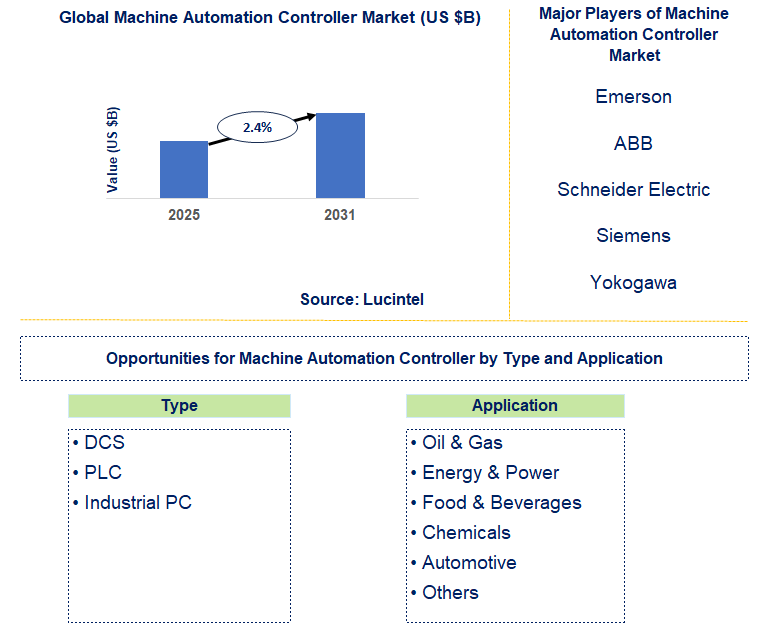
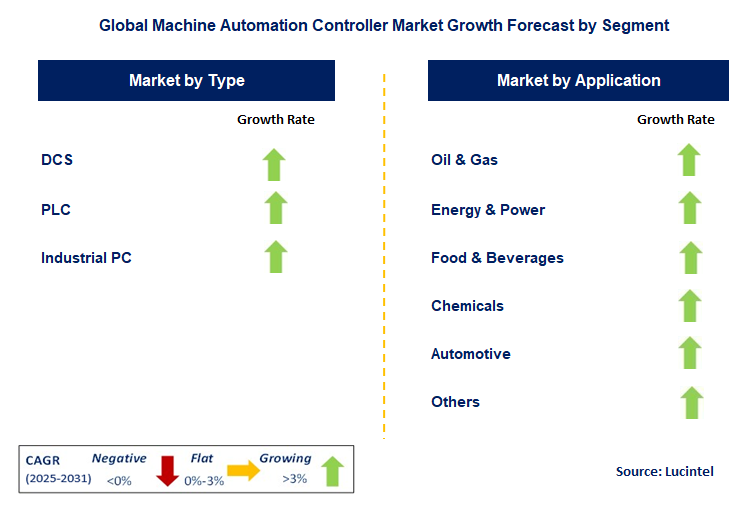
Machine Automation Controller Market Trends and Forecast

Machine Automation Controller Market by Segment

Emerging Trends in the Machine Automation Controller Market

The machine automation controller market is at a phase of transition, making the shift from basic control units to advanced, smart centers of a contemporary manufacturing ecosystem. This transformation is fueled by the convergence of industrial technologies, the necessity of improved operational efficiency, and a global initiative towards data-driven decision making. The new trends are not merely about processors running faster, but about building an entire system that is smarter, interconnected, and able to learn to address a vast array of tasks and environments. The industry is shifting towards a future where automation is not a distinct function but a part of the overall production process.
• Artificial Intelligence and Machine Learning Integration: The big trend is integrating AI and machine learning into machine automation controllers. These technologies are being employed to streamline manufacturing operations, forecast equipment breakdown, and allow for self-correcting automation systems. AI-based controllers are able to process sensor data in real time and make parameter adjustments in the field for enhanced product quality and minimized waste. This trend is shifting the market towards a future in which factories are able to "think" for themselves, taking smarter decisions.
• Migration towards Edge and Cloud Computing: There is an enormous trend towards the application of edge and cloud computing for machine automation. Edge computing deals with data near the source for real-time control, and cloud computing offers a robust platform for big data analysis and long-term storage. It enables quicker response on the factory floor and offers valuable insights into plant-level performance. It is also facilitating remote monitoring and control, which is essential for decentralized operations.
• Open and Interoperable Platform Adoption: The industry is experiencing a trend of increasing adoption of open and interoperable platforms. This makes it simpler to integrate hardware and software of different types from multiple vendors. The application of standard communication protocols and open-source software is eroding proprietary walls, providing customers with greater flexibility and choice. This trend is in direct response to the need for more nimble and flexible automation solutions that can be quickly customized and scaled up or down on demand.
• Emphasis on Cybersecurity: As industrial systems become more connected, cybersecurity has become an imperative trend. Manufacturers are now designing security functionality right into their controllers to shield against cyber-attacks and data breaches. These include security features such as secure boot, encrypted communication, and user access control. Emphasis on cybersecurity reflects a direct response to an increased threat of cyberattacks on industrial control systems, which can have a catastrophic effect on production and vital infrastructure.
• Modular and Scalable Controllers: The trend in the market is moving towards modular and scalable controller configurations. This makes it simple for customers to add or delete control modules and input/output (I/O) points as their requirements evolve without having to replace the entire system. This design is more flexible and cost-effective, especially for small and medium-sized businesses (SMEs) that can increase their operations incrementally. It is bringing sophisticated automation within the reach of a broader spectrum of enterprises.
These trends are actually transforming the machine automation controller market by making technology more intelligent, secure, and flexible. AI and cloud computing together are allowing a new era of smart factories, while interoperability and cybersecurity focus is solving critical issues for contemporary manufacturing. The conversion to modular designs is making it easier for firms of all sizes to enter, so that the growth in the market remains linked to some of the most exciting and progressive industries within the world economy.
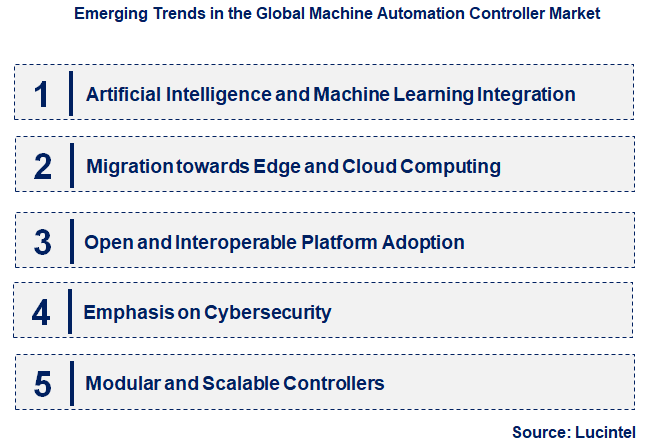
Emerging Trends in the Machine Automation Controller Market

Recent Development in the Machine Automation Controller Market

Recent trends in the machine automation controller industry are focused on a combination of technological advances and an increasing emphasis on sustainability. The sector is shifting from a conventional manufacturing model to one that focuses on digital integration, material science, and high-performance design. These trends are keeping machine automation controllers at the center of industrial, transportation, and power generation industries. The developments are influencing the market by making products efficient, dependable, and smart, addressing specifically new issues like climate change and energy saving.
• Introduction of Integrated Motion and Logic Controllers: One of the most significant recent developments is the launch of controllers which combine motion and logic control under one package. Earlier, they were usually contained in individual controllers, which resulted in more complicated and expensive systems. The integrated controllers make system architecture easier, minimize wiring, and improve communication among various elements, which translates to faster and more efficient machine operation. This innovation is especially significant for processes that need accurate, synchronized motion, like robotics and packaging.
• Emergence of Software-Defined and Virtualized Controllers: Major development has occurred in the employment of software-defined and virtualized controllers. This technology enables a single hardware controller to execute numerous virtual controllers, each controlling a different segment of a machine or even a different machine. This innovation is contributing toward higher hardware utilization, lower hardware costs, and more versatile and scalable systems. It is also facilitating a more software-defined model of automation, wherein functions can be changed and refashioned with a mere software update.
• Industrial Communication Protocol Advancements: One of the major advancements is the development in industrial communication protocols, including TSN (Time-Sensitive Networking) and OPC UA (Open Platform Communications Unified Architecture). Such protocols make it easier for various machines and controllers to share information with one another in real-time, irrespective of the manufacturer. This is vital to obtaining real interoperability and facilitating the free flow of data in a smart factory scenario. This innovation is a significant step towards dismantling proprietary barriers.
• Energy Efficiency and Sustainability Focus: There is increased development in producing energy-efficient machine automation controllers. Manufacturers are making controllers with reduced power consumption and creating software to optimize machine cycles to minimize energy consumption. This innovation follows increased pressure from companies to be environmentally friendly by lowering their carbon footprint and reducing operational expenses. It is making automation easier for machines and enabling them to achieve their sustainability objectives.
• Machine Vision and AI Integration Proliferation: One of the major developments is proliferation of machine vision and AI integration into automation controllers. Controllers are now being equipped with specific vision system processors so that they are capable of handling tasks such as quality inspection and robotic guidance at high rates. This integration is making it possible to have a new generation of machines that can "see" and "think" by themselves, which is essential for those applications that demand high precision and flexibility.
These advancements are significantly driving the machine automation controller market to make solutions smarter, integrated, and available. The growth of integrated motion and logic controllers is solving long-pending power and range issues. The emphasis on software-defined and virtualized controllers is improving the equipment’s productivity and safety. The cooperation on new communication protocols is shaping the required ecosystem for mass adoption. Overall, these transformations are pushing the market toward a future where automation is the norm, rather than the exception.

Strategic Growth Opportunities in the Machine Automation Controller Market

Strategic growth opportunities within the machine automation controller market are growing in key applications as industries around the world trend towards greater efficiency and electrification. The market is growing beyond conventional industrial applications to high-growth areas like electric mobility, renewable energy, and advanced manufacturing. These prospects are empowering firms to expand their product offerings and reach new clients. The emphasis is on utilizing technological acumen to offer specialist, high-value solutions that are tailored to meet the unique demands of contemporary applications, ensuring market growth and innovation.
• Manufacturing and Assembly: The automobile and electric vehicle (EV) industry offers a significant growth prospect. The market opportunity is in offering controllers to the highly automated assembly and manufacturing lines of EVs and their parts, especially batteries and electronics. High-speed and high-precision assembly and quality control in this industry is an ideal application for advanced machine automation controllers. The fast expansion of the EV market is a prime inducement for this opportunity.
• Semiconductor and Electronics: The semiconductor and electronics sector presents a special growth opportunity. The opportunity lies in offering high-precision motion and process controllers for the production of microchips, circuit boards, and other electrical components. This is a sector where the level of precision and speed can only be met by advanced automation. The ongoing innovation of consumer electronics and the need for smaller, faster chips are driving this growth.
• Traceability and Hygiene: Food and beverage is an important growth sector. The opportunity lies in delivering controllers to automate packaging, sorting, and processing lines required to meet rigorous hygiene and safety regulations. Traceability and quality control, farm to plate, are creating the demand for smart automation controllers. These controllers will be able to monitor and record production information, important to guaranteeing food safety and regulations compliance.
• Pharmaceuticals and Medical Devices: The pharmaceutical and medical device industry is a huge growth market. The potential lies in offering controllers for drug manufacturing, packaging, and quality control automation systems that have to comply with stringent regulatory and validation requirements. These controllers will have to be extremely reliable and offer detailed data logs to guarantee compliance with standards such as FDA’s Good Manufacturing Practices (GMP). It is a high-value market with high growth potential.
• Automated Warehousing: The e-commerce and logistics market is a new opportunity area for growth. The opportunity is in supplying controllers for automated warehousing and material handling equipment. The explosive rise in online purchasing and the demands for quicker, more efficient filling of orders are spurring demand for automated storage, retrieval, and sorting systems. These systems depend on sophisticated machine automation controllers to manage intricate robotic and conveyor systems.
These opportunities are influencing the machine automation controller market by widening its scope and enhancing its value proposition. The emphasis is shifting from mere machine sales to offering integrated, intelligent, and application-aware solutions. The expansion into fields such as automotive, semiconductors, and logistics is broadening the market and generating new avenues for revenue. These chances are stimulating innovation, with providers creating more advanced and specialized software that responds to the complex issues and specific needs of contemporary industries.

Machine Automation Controller Market Driver and Challenges

The machine automation controller market is influenced by a complicated nexus of strong drivers and key challenges. The key drivers are compelling fast adoption, while the challenges necessitate innovation and strategic thinking to prevail over. Technological innovation, a worldwide drive for sustainability, and cost pressures are main drivers. Alternatively, intense competition from other technologies, high capital expense, and an uncertain raw material supply chain present significant challenges.
The factors responsible for driving the machine automation controller market include:
1. Rising Labor Costs and Skilled Labor Shortage: The single most potent force is rising labor costs and a dearth of skilled labor across numerous countries. Firms are adopting automation as a means of minimizing operational expenses, maximizing productivity, and making up for a shortage of available manpower. Machine automation controllers are at the center of this shift, as they allow companies to mechanize activities that were otherwise carried out by humans, thus enhancing efficiency and quality.
2. Industry 4.0 and Smart Factory Adoption: The worldwide push for Industry 4.0 and intelligent manufacturing is a prime motivator. This entails the embedding of technologies such as the Internet of Things (IoT), big data, and cloud computing in factory systems. Machine automation controllers are the building block of digitalization, since they gather, process, and send data from the factory floor to advanced-level systems, allowing for real-time monitoring and analysis.
3. Need for Greater Productivity and Quality: One of the main economic drivers is the ongoing requirement for businesses to increase productivity and product quality. Automation controllers assist businesses in doing this by allowing for quicker, more accurate, and more repeatable processes than can be accomplished with people. This results in greater throughput, fewer defects, and a more competitive marketplace. The need for quality and efficiency is a strong driving force behind companies investing in automation.
4. Hardware and Software Technological Innovations: Ongoing innovations in controller hardware and software are a primary driver. New controllers are more powerful, smaller, and less power-hungry compared to their predecessors. New software platforms are also simpler to program and provide more advanced features such as AI-based diagnostics and predictive maintenance. These advances in technology are making automation more practical and beneficial for an expanding set of applications.
5. Attention to Worker Safety: Rising attention to worker safety is one of the biggest driving factors. Automation controllers can be employed to automate hazardous or repetitive operations, minimizing workplace accidents and injuries. This is especially crucial in industries such as mining, construction, and heavy industry. By eliminating humans from the dangerous environment, automation is making the workplace safer and healthier for workers.
Challenges in the machine automation controller market are:
1. High Initial Investment and Integration Challenges: The biggest challenge lies in the high initial investment for automated systems, such as controllers, sensors, and robots. Such an entry price can be very high for small and medium-sized businesses (SMEs). Furthermore, it is challenging and time-consuming to integrate new automated systems with existing legacy machines, which needs extensive technical skills and effort, escalating the total cost again.
2. Cybersecurity Threats: With more automation systems being connected to the internet, cybersecurity threats are now a significant challenge. Industrial control systems are emerging as a favorite target for cyber-attacks that can cause production disruption, theft of intellectual property, or even physical damage. Manufacturers and users are henceforth obliged to spend on strong security solutions and keep pace with new threats that enhance cost and complexity in automation.
3. Interoperability and Standardization Deficit: One of the greatest challenges is the deficit in standardization and interoperability between products from various manufacturers. Most controllers and devices employ proprietary communication protocols, making it challenging to combine components from various vendors. This can cause vendor lock-in and make it more challenging for companies to design flexible and scalable automation systems. This challenge needs collective action by the industry to create and implement open standards.
The net effect of these drivers and challenges is a market in the midst of very fast evolution. The drivers are advocating for increased automation, intelligence, and integration, while the challenges are compelling providers and buyers to be more strategic and reflective in their strategy. Market champions will be those who are able to create solutions that are not only strong and effective but also cost-effective, with a potential road to fulfilling integration and cybersecurity constraints. Walking the tightrope between achieving high-performance requirements and redressing these restraints will be instrumental in releasing the full potential of the market and spurring the next generation of innovation.

List of Machine Automation Controller Companies

Companies in the market compete on the basis of product quality offered. Major players in this market focus on expanding their manufacturing facilities, R&D investments, infrastructural development, and leverage integration opportunities across the value chain. With these strategies machine automation controller companies cater increasing demand, ensure competitive effectiveness, develop innovative products & technologies, reduce production costs, and expand their customer base. Some of the machine automation controller companies profiled in this report include-
• Emerson
• ABB
• Schneider Electric
• Siemens
• Yokogawa
• Advantech
• Omron
• Delta Electronics
• Mitsubishi Electric
• Rockwell Automation

Machine Automation Controller Market by Segment

The study includes a forecast for the global machine automation controller market by type, application, and region.

Machine Automation Controller Market by Type [Value from 2019 to 2031]:


• DCS
• PLC
• Industrial PC

Machine Automation Controller Market by Application [Value from 2019 to 2031]:


• Oil & Gas
• Energy & Power
• Food & Beverages
• Chemicals
• Automotive
• Others

Machine Automation Controller Market by Region [Value from 2019 to 2031]:


• North America
• Europe
• Asia Pacific
• The Rest of the World

Country Wise Outlook for the Machine Automation Controller Market

The market for machine automation controller is undergoing a dramatic transformation, fueled by the worldwide drive towards smart manufacturing and Industry 4.0. Machine automation controllers are the intelligence behind automated systems, controlling everything from robotics to process control. The market is evolving beyond basic control systems to provide more advanced, integrated solutions that include artificial intelligence, machine learning, and IoT connectivity. This development is critical for businesses that aim to enhance productivity, lower expenses, and make their operations more flexible. The advancements mirror a general pattern towards establishing entirely autonomous and data-based factory environments.
• United States: The American market is concentrating on high-tech industries such as aerospace, pharma, and data centers. The nation’s focus on technological advancement is propelling the use of advanced, integrated controllers that enable AI-driven analytics and cybersecurity. There’s an increasing need for controllers that easily integrate with cloud-based systems for remote monitoring and data analysis to ensure operational efficiency and security in such important industries. The direction is toward more intelligent, secure, and highly networked systems.
• China: China’s market is a major force, fueled by rapid industrialization and government initiatives like "Made in China 2025." The country is seeing a massive deployment of machine automation controllers in automotive, electronics, and general manufacturing to boost production efficiency and quality. Domestic companies are rapidly developing cost-effective and scalable controllers. The market is also being driven by a move to replace older manufacturing plants with newer automation in an effort to lower the cost of labor and overall productivity.
• Germany: Germany’s market is characterized by engineering superiority and leadership in Industry 4.0. The major developments are centered around high-reliability and high-precision controllers for sophisticated manufacturing operations in the industrial machinery and automotive industries. German producers are leading the way in the production of open-platform controllers that are based on interoperability and the bringing together of various systems. It is market-led on the back of a demand for efficiency, quality, and a move toward a decentralized, smart-factory system.
• India: India’s market is in a high growth phase, fueled by growing industrialization and initiatives such as "Make in India" by the government. The major developments are an expanding use of automation controllers in the automobile, consumer, and food and beverage industries. The market is witnessing a rise in the use of economical automation solutions for small and medium-sized businesses (SMEs) and upgrading old infrastructure. There is also a strong focus on building indigenous technologies and local supply chains.
• Japan: The Japanese market is marked by a strong focus on robotics, precision manufacturing, and quality control. Main developments include integrating very advanced controllers with advanced robotics to attain very high levels of precision and speed. The industry is a pioneer in creating compact, high-performance controllers that find application in the manufacture of electronics and medical devices. The focus is on stress-free integration, reliability, and non-stop process improvement to uphold the nation’s image for high-quality products.

Lucintel Analytics Dashboard

Features of the Global Machine Automation Controller Market

Market Size Estimates: Machine automation controller market size estimation in terms of value ($B).
Trend and Forecast Analysis: Market trends (2019 to 2024) and forecast (2025 to 2031) by various segments and regions.
Segmentation Analysis: Machine automation controller market size by type, application, and region in terms of value ($B).
Regional Analysis: Machine automation controller market breakdown by North America, Europe, Asia Pacific, and Rest of the World.
Growth Opportunities: Analysis of growth opportunities in different types, applications, and regions for the machine automation controller market.
Strategic Analysis: This includes M&A, new product development, and competitive landscape of the machine automation controller market.
Analysis of competitive intensity of the industry based on Porter’s Five Forces model.

Lucintel Consulting Services

FAQ

Q1. What is the growth forecast for machine automation controller market?
Answer: The global machine automation controller market is expected to grow with a CAGR of 2.4% from 2025 to 2031.
Q2. What are the major drivers influencing the growth of the machine automation controller market?
Answer: The major drivers for this market are the increasing demand for efficiency, the rising adoption of smart factories, and the growing need for process optimization.
Q3. What are the major segments for machine automation controller market?
Answer: The future of the machine automation controller market looks promising with opportunities in the oil & gas, energy & power, food & beverage, chemical, and automotive markets.
Q4. Who are the key machine automation controller market companies?
Answer: Some of the key machine automation controller companies are as follows:
• Emerson
• ABB
• Schneider Electric
• Siemens
• Yokogawa
• Advantech
• Omron
• Delta Electronics
• Mitsubishi Electric
• Rockwell Automation
Q5. Which machine automation controller market segment will be the largest in future?
Answer: Lucintel forecasts that, within the type category, PLC is expected to witness the highest growth over the forecast period.
Q6. In machine automation controller market, which region is expected to be the largest in next 5 years?
Answer: In terms of region, APAC is expected to witness the highest growth over the forecast period.
Q7. Do we receive customization in this report?
Answer: Yes, Lucintel provides 10% customization without any additional cost.

This report answers following 11 key questions:

Q.1. What are some of the most promising, high-growth opportunities for the machine automation controller market by type (DCS, PLC, and industrial PC), application (oil & gas, energy & power, food & beverages, chemicals, automotive, and others), and region (North America, Europe, Asia Pacific, and the Rest of the World)?
Q.2. Which segments will grow at a faster pace and why?
Q.3. Which region will grow at a faster pace and why?
Q.4. What are the key factors affecting market dynamics? What are the key challenges and business risks in this market?
Q.5. What are the business risks and competitive threats in this market?
Q.6. What are the emerging trends in this market and the reasons behind them?
Q.7. What are some of the changing demands of customers in the market?
Q.8. What are the new developments in the market? Which companies are leading these developments?
Q.9. Who are the major players in this market? What strategic initiatives are key players pursuing for business growth?
Q.10. What are some of the competing products in this market and how big of a threat do they pose for loss of market share by material or product substitution?
Q.11. What M&A activity has occurred in the last 5 years and what has its impact been on the industry?

For any questions related to Machine Automation Controller Market, Machine Automation Controller Market Size, Machine Automation Controller Market Growth, Machine Automation Controller Market Analysis, Machine Automation Controller Market Report, Machine Automation Controller Market Share, Machine Automation Controller Market Trends, Machine Automation Controller Market Forecast, Machine Automation Controller Companies, write Lucintel analyst at email: helpdesk@lucintel.com. We will be glad to get back to you soon.
                                           Table of Contents

            1. Executive Summary

            2. Market Overview

                        2.1 Background and Classifications
                        2.2 Supply Chain

            3. Market Trends & Forecast Analysis

                        3.1 Macroeconomic Trends and Forecasts
                        3.2 Industry Drivers and Challenges
                        3.3 PESTLE Analysis
                        3.4 Patent Analysis
                        3.5 Regulatory Environment
                        3.6 Global Machine Automation Controller Market Trends and Forecast

            4. Global Machine Automation Controller Market by Type

                        4.1 Overview
                        4.2 Attractiveness Analysis by Type
                        4.3 DCS : Trends and Forecast 2025 to 2031
                        4.4 PLC : Trends and Forecast 2025 to 2031
                        4.5 Industrial PC : Trends and Forecast 2025 to 2031

            5. Global Machine Automation Controller Market by Application

                        5.1 Overview
                        5.2 Attractiveness Analysis by Application
                        5.3 Oil & Gas : Trends and Forecast 2025 to 2031
                        5.4 Energy & Power : Trends and Forecast 2025 to 2031
                        5.5 Food & Beverages : Trends and Forecast 2025 to 2031
                        5.6 Chemicals : Trends and Forecast 2025 to 2031
                        5.7 Automotive : Trends and Forecast 2025 to 2031
                        5.8 Others : Trends and Forecast 2025 to 2031

            6. Regional Analysis

                        6.1 Overview
                        6.2 Global Machine Automation Controller Market by Region

            7. North American Machine Automation Controller Market

                        7.1 Overview
                        7.2 North American Machine Automation Controller Market by Type
                        7.3 North American Machine Automation Controller Market by Application
                        7.4 The United States Machine Automation Controller Market
                        7.5 Canadian Machine Automation Controller Market
                        7.6 Mexican Machine Automation Controller Market

            8. European Machine Automation Controller Market

                        8.1 Overview
                        8.2 European Machine Automation Controller Market by Type
                        8.3 European Machine Automation Controller Market by Application
                        8.4 German Machine Automation Controller Market
                        8.5 French Machine Automation Controller Market
                        8.6 Italian Machine Automation Controller Market
                        8.7 Spanish Machine Automation Controller Market
                        8.8 The United Kingdom Machine Automation Controller Market

            9. APAC Machine Automation Controller Market

                        9.1 Overview
                        9.2 APAC Machine Automation Controller Market by Type
                        9.3 APAC Machine Automation Controller Market by Application
                        9.4 Chinese Machine Automation Controller Market
                        9.5 Indian Machine Automation Controller Market
                        9.6 Japanese Machine Automation Controller Market
                        9.7 South Korean Machine Automation Controller Market
                        9.8 Indonesian Machine Automation Controller Market

            10. ROW Machine Automation Controller Market

                        10.1 Overview
                        10.2 ROW Machine Automation Controller Market by Type
                        10.3 ROW Machine Automation Controller Market by Application
                        10.4 Middle Eastern Machine Automation Controller Market
                        10.5 South American Machine Automation Controller Market
                        10.6 African Machine Automation Controller Market

            11. Competitor Analysis

                        11.1 Product Portfolio Analysis
                        11.2 Operational Integration
                        11.3 Porter’s Five Forces Analysis
                                    • Competitive Rivalry
                                    • Bargaining Power of Buyers
                                    • Bargaining Power of Suppliers
                                    • Threat of Substitutes
                                    • Threat of New Entrants
                        11.4 Market Share Analysis

            12. Opportunities & Strategic Analysis

                        12.1 Value Chain Analysis
                        12.2 Growth Opportunity Analysis
                                    12.2.1 Growth Opportunity by Type
                                    12.2.2 Growth Opportunity by Application
                        12.3 Emerging Trends in the Global Machine Automation Controller Market
                        12.4 Strategic Analysis
                                    12.4.1 New Product Development
                                    12.4.2 Certification and Licensing
                                    12.4.3 Mergers, Acquisitions, Agreements, Collaborations, and Joint Ventures

            13. Company Profiles of the Leading Players Across the Value Chain

                        13.1 Competitive Analysis
                        13.2 Emerson
                                    • Company Overview
                                    • Machine Automation Controller Market Business Overview
                                    • New Product Development
                                    • Merger, Acquisition, and Collaboration
                                    • Certification and Licensing
                        13.3 ABB
                                    • Company Overview
                                    • Machine Automation Controller Market Business Overview
                                    • New Product Development
                                    • Merger, Acquisition, and Collaboration
                                    • Certification and Licensing
                        13.4 Schneider Electric
                                    • Company Overview
                                    • Machine Automation Controller Market Business Overview
                                    • New Product Development
                                    • Merger, Acquisition, and Collaboration
                                    • Certification and Licensing
                        13.5 Siemens
                                    • Company Overview
                                    • Machine Automation Controller Market Business Overview
                                    • New Product Development
                                    • Merger, Acquisition, and Collaboration
                                    • Certification and Licensing
                        13.6 Yokogawa
                                    • Company Overview
                                    • Machine Automation Controller Market Business Overview
                                    • New Product Development
                                    • Merger, Acquisition, and Collaboration
                                    • Certification and Licensing
                        13.7 Advantech
                                    • Company Overview
                                    • Machine Automation Controller Market Business Overview
                                    • New Product Development
                                    • Merger, Acquisition, and Collaboration
                                    • Certification and Licensing
                        13.8 Omron
                                    • Company Overview
                                    • Machine Automation Controller Market Business Overview
                                    • New Product Development
                                    • Merger, Acquisition, and Collaboration
                                    • Certification and Licensing
                        13.9 Delta Electronics
                                    • Company Overview
                                    • Machine Automation Controller Market Business Overview
                                    • New Product Development
                                    • Merger, Acquisition, and Collaboration
                                    • Certification and Licensing
                        13.10 Mitsubishi Electric
                                    • Company Overview
                                    • Machine Automation Controller Market Business Overview
                                    • New Product Development
                                    • Merger, Acquisition, and Collaboration
                                    • Certification and Licensing
                        13.11 Rockwell Automation
                                    • Company Overview
                                    • Machine Automation Controller Market Business Overview
                                    • New Product Development
                                    • Merger, Acquisition, and Collaboration
                                    • Certification and Licensing

            14. Appendix

                        14.1 List of Figures
                        14.2 List of Tables
                        14.3 Research Methodology
                        14.4 Disclaimer
                        14.5 Copyright
                        14.6 Abbreviations and Technical Units
                        14.7 About Us
                        14.8 Contact Us

                                               List of Figures


            Chapter 1

                        Figure 1.1: Trends and Forecast for the Global Machine Automation Controller Market

            Chapter 2

                        Figure 2.1: Usage of Machine Automation Controller Market
                        Figure 2.2: Classification of the Global Machine Automation Controller Market
                        Figure 2.3: Supply Chain of the Global Machine Automation Controller Market
                        Figure 2.4: Driver and Challenges of the Machine Automation Controller Market

            Chapter 3

                        Figure 3.1: Trends of the Global GDP Growth Rate
                        Figure 3.2: Trends of the Global Population Growth Rate
                        Figure 3.3: Trends of the Global Inflation Rate
                        Figure 3.4: Trends of the Global Unemployment Rate
                        Figure 3.5: Trends of the Regional GDP Growth Rate
                        Figure 3.6: Trends of the Regional Population Growth Rate
                        Figure 3.7: Trends of the Regional Inflation Rate
                        Figure 3.8: Trends of the Regional Unemployment Rate
                        Figure 3.9: Trends of Regional Per Capita Income
                        Figure 3.10: Forecast for the Global GDP Growth Rate
                        Figure 3.11: Forecast for the Global Population Growth Rate
                        Figure 3.12: Forecast for the Global Inflation Rate
                        Figure 3.13: Forecast for the Global Unemployment Rate
                        Figure 3.14: Forecast for the Regional GDP Growth Rate
                        Figure 3.15: Forecast for the Regional Population Growth Rate
                        Figure 3.16: Forecast for the Regional Inflation Rate
                        Figure 3.17: Forecast for the Regional Unemployment Rate
                        Figure 3.18: Forecast for Regional Per Capita Income

            Chapter 4

                        Figure 4.1: Global Machine Automation Controller Market by Type in 2019, 2024, and 2031
                        Figure 4.2: Trends of the Global Machine Automation Controller Market ($B) by Type
                        Figure 4.3: Forecast for the Global Machine Automation Controller Market ($B) by Type
                        Figure 4.4: Trends and Forecast for DCS in the Global Machine Automation Controller Market (2019-2031)
                        Figure 4.5: Trends and Forecast for PLC in the Global Machine Automation Controller Market (2019-2031)
                        Figure 4.6: Trends and Forecast for Industrial PC in the Global Machine Automation Controller Market (2019-2031)

            Chapter 5

                        Figure 5.1: Global Machine Automation Controller Market by Application in 2019, 2024, and 2031
                        Figure 5.2: Trends of the Global Machine Automation Controller Market ($B) by Application
                        Figure 5.3: Forecast for the Global Machine Automation Controller Market ($B) by Application
                        Figure 5.4: Trends and Forecast for Oil & Gas in the Global Machine Automation Controller Market (2019-2031)
                        Figure 5.5: Trends and Forecast for Energy & Power in the Global Machine Automation Controller Market (2019-2031)
                        Figure 5.6: Trends and Forecast for Food & Beverages in the Global Machine Automation Controller Market (2019-2031)
                        Figure 5.7: Trends and Forecast for Chemicals in the Global Machine Automation Controller Market (2019-2031)
                        Figure 5.8: Trends and Forecast for Automotive in the Global Machine Automation Controller Market (2019-2031)
                        Figure 5.9: Trends and Forecast for Others in the Global Machine Automation Controller Market (2019-2031)

            Chapter 6

                        Figure 6.1: Trends of the Global Machine Automation Controller Market ($B) by Region (2019-2024)
                        Figure 6.2: Forecast for the Global Machine Automation Controller Market ($B) by Region (2025-2031)

            Chapter 7

                        Figure 7.1: Trends and Forecast for the North American Machine Automation Controller Market (2019-2031)
                        Figure 7.2: North American Machine Automation Controller Market by Type in 2019, 2024, and 2031
                        Figure 7.3: Trends of the North American Machine Automation Controller Market ($B) by Type (2019-2024)
                        Figure 7.4: Forecast for the North American Machine Automation Controller Market ($B) by Type (2025-2031)
                        Figure 7.5: North American Machine Automation Controller Market by Application in 2019, 2024, and 2031
                        Figure 7.6: Trends of the North American Machine Automation Controller Market ($B) by Application (2019-2024)
                        Figure 7.7: Forecast for the North American Machine Automation Controller Market ($B) by Application (2025-2031)
                        Figure 7.8: Trends and Forecast for the United States Machine Automation Controller Market ($B) (2019-2031)
                        Figure 7.9: Trends and Forecast for the Mexican Machine Automation Controller Market ($B) (2019-2031)
                        Figure 7.10: Trends and Forecast for the Canadian Machine Automation Controller Market ($B) (2019-2031)

            Chapter 8

                        Figure 8.1: Trends and Forecast for the European Machine Automation Controller Market (2019-2031)
                        Figure 8.2: European Machine Automation Controller Market by Type in 2019, 2024, and 2031
                        Figure 8.3: Trends of the European Machine Automation Controller Market ($B) by Type (2019-2024)
                        Figure 8.4: Forecast for the European Machine Automation Controller Market ($B) by Type (2025-2031)
                        Figure 8.5: European Machine Automation Controller Market by Application in 2019, 2024, and 2031
                        Figure 8.6: Trends of the European Machine Automation Controller Market ($B) by Application (2019-2024)
                        Figure 8.7: Forecast for the European Machine Automation Controller Market ($B) by Application (2025-2031)
                        Figure 8.8: Trends and Forecast for the German Machine Automation Controller Market ($B) (2019-2031)
                        Figure 8.9: Trends and Forecast for the French Machine Automation Controller Market ($B) (2019-2031)
                        Figure 8.10: Trends and Forecast for the Spanish Machine Automation Controller Market ($B) (2019-2031)
                        Figure 8.11: Trends and Forecast for the Italian Machine Automation Controller Market ($B) (2019-2031)
                        Figure 8.12: Trends and Forecast for the United Kingdom Machine Automation Controller Market ($B) (2019-2031)

            Chapter 9

                        Figure 9.1: Trends and Forecast for the APAC Machine Automation Controller Market (2019-2031)
                        Figure 9.2: APAC Machine Automation Controller Market by Type in 2019, 2024, and 2031
                        Figure 9.3: Trends of the APAC Machine Automation Controller Market ($B) by Type (2019-2024)
                        Figure 9.4: Forecast for the APAC Machine Automation Controller Market ($B) by Type (2025-2031)
                        Figure 9.5: APAC Machine Automation Controller Market by Application in 2019, 2024, and 2031
                        Figure 9.6: Trends of the APAC Machine Automation Controller Market ($B) by Application (2019-2024)
                        Figure 9.7: Forecast for the APAC Machine Automation Controller Market ($B) by Application (2025-2031)
                        Figure 9.8: Trends and Forecast for the Japanese Machine Automation Controller Market ($B) (2019-2031)
                        Figure 9.9: Trends and Forecast for the Indian Machine Automation Controller Market ($B) (2019-2031)
                        Figure 9.10: Trends and Forecast for the Chinese Machine Automation Controller Market ($B) (2019-2031)
                        Figure 9.11: Trends and Forecast for the South Korean Machine Automation Controller Market ($B) (2019-2031)
                        Figure 9.12: Trends and Forecast for the Indonesian Machine Automation Controller Market ($B) (2019-2031)

            Chapter 10

                        Figure 10.1: Trends and Forecast for the ROW Machine Automation Controller Market (2019-2031)
                        Figure 10.2: ROW Machine Automation Controller Market by Type in 2019, 2024, and 2031
                        Figure 10.3: Trends of the ROW Machine Automation Controller Market ($B) by Type (2019-2024)
                        Figure 10.4: Forecast for the ROW Machine Automation Controller Market ($B) by Type (2025-2031)
                        Figure 10.5: ROW Machine Automation Controller Market by Application in 2019, 2024, and 2031
                        Figure 10.6: Trends of the ROW Machine Automation Controller Market ($B) by Application (2019-2024)
                        Figure 10.7: Forecast for the ROW Machine Automation Controller Market ($B) by Application (2025-2031)
                        Figure 10.8: Trends and Forecast for the Middle Eastern Machine Automation Controller Market ($B) (2019-2031)
                        Figure 10.9: Trends and Forecast for the South American Machine Automation Controller Market ($B) (2019-2031)
                        Figure 10.10: Trends and Forecast for the African Machine Automation Controller Market ($B) (2019-2031)

            Chapter 11

                        Figure 11.1: Porter’s Five Forces Analysis of the Global Machine Automation Controller Market
                        Figure 11.2: Market Share (%) of Top Players in the Global Machine Automation Controller Market (2024)

            Chapter 12

                        Figure 12.1: Growth Opportunities for the Global Machine Automation Controller Market by Type
                        Figure 12.2: Growth Opportunities for the Global Machine Automation Controller Market by Application
                        Figure 12.3: Growth Opportunities for the Global Machine Automation Controller Market by Region
                        Figure 12.4: Emerging Trends in the Global Machine Automation Controller Market

                                               List of Tables


            Chapter 1

                        Table 1.1: Growth Rate (%, 2023-2024) and CAGR (%, 2025-2031) of the Machine Automation Controller Market by Type and Application
                        Table 1.2: Attractiveness Analysis for the Machine Automation Controller Market by Region
                        Table 1.3: Global Machine Automation Controller Market Parameters and Attributes

            Chapter 3

                        Table 3.1: Trends of the Global Machine Automation Controller Market (2019-2024)
                        Table 3.2: Forecast for the Global Machine Automation Controller Market (2025-2031)

            Chapter 4

                        Table 4.1: Attractiveness Analysis for the Global Machine Automation Controller Market by Type
                        Table 4.2: Market Size and CAGR of Various Type in the Global Machine Automation Controller Market (2019-2024)
                        Table 4.3: Market Size and CAGR of Various Type in the Global Machine Automation Controller Market (2025-2031)
                        Table 4.4: Trends of DCS in the Global Machine Automation Controller Market (2019-2024)
                        Table 4.5: Forecast for DCS in the Global Machine Automation Controller Market (2025-2031)
                        Table 4.6: Trends of PLC in the Global Machine Automation Controller Market (2019-2024)
                        Table 4.7: Forecast for PLC in the Global Machine Automation Controller Market (2025-2031)
                        Table 4.8: Trends of Industrial PC in the Global Machine Automation Controller Market (2019-2024)
                        Table 4.9: Forecast for Industrial PC in the Global Machine Automation Controller Market (2025-2031)

            Chapter 5

                        Table 5.1: Attractiveness Analysis for the Global Machine Automation Controller Market by Application
                        Table 5.2: Market Size and CAGR of Various Application in the Global Machine Automation Controller Market (2019-2024)
                        Table 5.3: Market Size and CAGR of Various Application in the Global Machine Automation Controller Market (2025-2031)
                        Table 5.4: Trends of Oil & Gas in the Global Machine Automation Controller Market (2019-2024)
                        Table 5.5: Forecast for Oil & Gas in the Global Machine Automation Controller Market (2025-2031)
                        Table 5.6: Trends of Energy & Power in the Global Machine Automation Controller Market (2019-2024)
                        Table 5.7: Forecast for Energy & Power in the Global Machine Automation Controller Market (2025-2031)
                        Table 5.8: Trends of Food & Beverages in the Global Machine Automation Controller Market (2019-2024)
                        Table 5.9: Forecast for Food & Beverages in the Global Machine Automation Controller Market (2025-2031)
                        Table 5.10: Trends of Chemicals in the Global Machine Automation Controller Market (2019-2024)
                        Table 5.11: Forecast for Chemicals in the Global Machine Automation Controller Market (2025-2031)
                        Table 5.12: Trends of Automotive in the Global Machine Automation Controller Market (2019-2024)
                        Table 5.13: Forecast for Automotive in the Global Machine Automation Controller Market (2025-2031)
                        Table 5.14: Trends of Others in the Global Machine Automation Controller Market (2019-2024)
                        Table 5.15: Forecast for Others in the Global Machine Automation Controller Market (2025-2031)

            Chapter 6

                        Table 6.1: Market Size and CAGR of Various Regions in the Global Machine Automation Controller Market (2019-2024)
                        Table 6.2: Market Size and CAGR of Various Regions in the Global Machine Automation Controller Market (2025-2031)

            Chapter 7

                        Table 7.1: Trends of the North American Machine Automation Controller Market (2019-2024)
                        Table 7.2: Forecast for the North American Machine Automation Controller Market (2025-2031)
                        Table 7.3: Market Size and CAGR of Various Type in the North American Machine Automation Controller Market (2019-2024)
                        Table 7.4: Market Size and CAGR of Various Type in the North American Machine Automation Controller Market (2025-2031)
                        Table 7.5: Market Size and CAGR of Various Application in the North American Machine Automation Controller Market (2019-2024)
                        Table 7.6: Market Size and CAGR of Various Application in the North American Machine Automation Controller Market (2025-2031)
                        Table 7.7: Trends and Forecast for the United States Machine Automation Controller Market (2019-2031)
                        Table 7.8: Trends and Forecast for the Mexican Machine Automation Controller Market (2019-2031)
                        Table 7.9: Trends and Forecast for the Canadian Machine Automation Controller Market (2019-2031)

            Chapter 8

                        Table 8.1: Trends of the European Machine Automation Controller Market (2019-2024)
                        Table 8.2: Forecast for the European Machine Automation Controller Market (2025-2031)
                        Table 8.3: Market Size and CAGR of Various Type in the European Machine Automation Controller Market (2019-2024)
                        Table 8.4: Market Size and CAGR of Various Type in the European Machine Automation Controller Market (2025-2031)
                        Table 8.5: Market Size and CAGR of Various Application in the European Machine Automation Controller Market (2019-2024)
                        Table 8.6: Market Size and CAGR of Various Application in the European Machine Automation Controller Market (2025-2031)
                        Table 8.7: Trends and Forecast for the German Machine Automation Controller Market (2019-2031)
                        Table 8.8: Trends and Forecast for the French Machine Automation Controller Market (2019-2031)
                        Table 8.9: Trends and Forecast for the Spanish Machine Automation Controller Market (2019-2031)
                        Table 8.10: Trends and Forecast for the Italian Machine Automation Controller Market (2019-2031)
                        Table 8.11: Trends and Forecast for the United Kingdom Machine Automation Controller Market (2019-2031)

            Chapter 9

                        Table 9.1: Trends of the APAC Machine Automation Controller Market (2019-2024)
                        Table 9.2: Forecast for the APAC Machine Automation Controller Market (2025-2031)
                        Table 9.3: Market Size and CAGR of Various Type in the APAC Machine Automation Controller Market (2019-2024)
                        Table 9.4: Market Size and CAGR of Various Type in the APAC Machine Automation Controller Market (2025-2031)
                        Table 9.5: Market Size and CAGR of Various Application in the APAC Machine Automation Controller Market (2019-2024)
                        Table 9.6: Market Size and CAGR of Various Application in the APAC Machine Automation Controller Market (2025-2031)
                        Table 9.7: Trends and Forecast for the Japanese Machine Automation Controller Market (2019-2031)
                        Table 9.8: Trends and Forecast for the Indian Machine Automation Controller Market (2019-2031)
                        Table 9.9: Trends and Forecast for the Chinese Machine Automation Controller Market (2019-2031)
                        Table 9.10: Trends and Forecast for the South Korean Machine Automation Controller Market (2019-2031)
                        Table 9.11: Trends and Forecast for the Indonesian Machine Automation Controller Market (2019-2031)

            Chapter 10

                        Table 10.1: Trends of the ROW Machine Automation Controller Market (2019-2024)
                        Table 10.2: Forecast for the ROW Machine Automation Controller Market (2025-2031)
                        Table 10.3: Market Size and CAGR of Various Type in the ROW Machine Automation Controller Market (2019-2024)
                        Table 10.4: Market Size and CAGR of Various Type in the ROW Machine Automation Controller Market (2025-2031)
                        Table 10.5: Market Size and CAGR of Various Application in the ROW Machine Automation Controller Market (2019-2024)
                        Table 10.6: Market Size and CAGR of Various Application in the ROW Machine Automation Controller Market (2025-2031)
                        Table 10.7: Trends and Forecast for the Middle Eastern Machine Automation Controller Market (2019-2031)
                        Table 10.8: Trends and Forecast for the South American Machine Automation Controller Market (2019-2031)
                        Table 10.9: Trends and Forecast for the African Machine Automation Controller Market (2019-2031)

            Chapter 11

                        Table 11.1: Product Mapping of Machine Automation Controller Suppliers Based on Segments
                        Table 11.2: Operational Integration of Machine Automation Controller Manufacturers
                        Table 11.3: Rankings of Suppliers Based on Machine Automation Controller Revenue

            Chapter 12

                        Table 12.1: New Product Launches by Major Machine Automation Controller Producers (2019-2024)
                        Table 12.2: Certification Acquired by Major Competitor in the Global Machine Automation Controller Market

.

Buy full report or by chapter as follows

Limited Time Offer

Price by License Type:
[-] Hide Chapter Details
[Chapter Number] [Chapter Name] [Chapter Number Of Pages] [Chapter Price]
Title/Chapter Name Pages Price
Full Report: Machine Automation Controller Market Report: Trends, Forecast and Competitive Analysis to 2031 Full Report $ 2,990
A 150 Page Report
Lucintel has been in the business of market research and management consulting since 2000 and has published over 1000 market intelligence reports in various markets / applications and served over 1,000 clients worldwide. This study is a culmination of four months of full-time effort performed by Lucintel's analyst team. The analysts used the following sources for the creation and completion of this valuable report:
  • In-depth interviews of the major players in this market
  • Detailed secondary research from competitors’ financial statements and published data 
  • Extensive searches of published works, market, and database information pertaining to industry news, company press releases, and customer intentions
  • A compilation of the experiences, judgments, and insights of Lucintel’s professionals, who have analyzed and tracked this market over the years.
Extensive research and interviews are conducted across the supply chain of this market to estimate market share, market size, trends, drivers, challenges, and forecasts. Below is a brief summary of the primary interviews that were conducted by job function for this report.
 
Thus, Lucintel compiles vast amounts of data from numerous sources, validates the integrity of that data, and performs a comprehensive analysis. Lucintel then organizes the data, its findings, and insights into a concise report designed to support the strategic decision-making process. The figure below is a graphical representation of Lucintel’s research process. 
 

Please sign in below to get report brochure - Machine Automation Controller Market Report.

At Lucintel, we respect your privacy and maintain the confidentiality of information / data provided by you
(Please enter your corporate email. * These fields are mandatory )

Follow us on