
Report Feature
Lupus Anticoagulant Testing Market Trends and Forecast
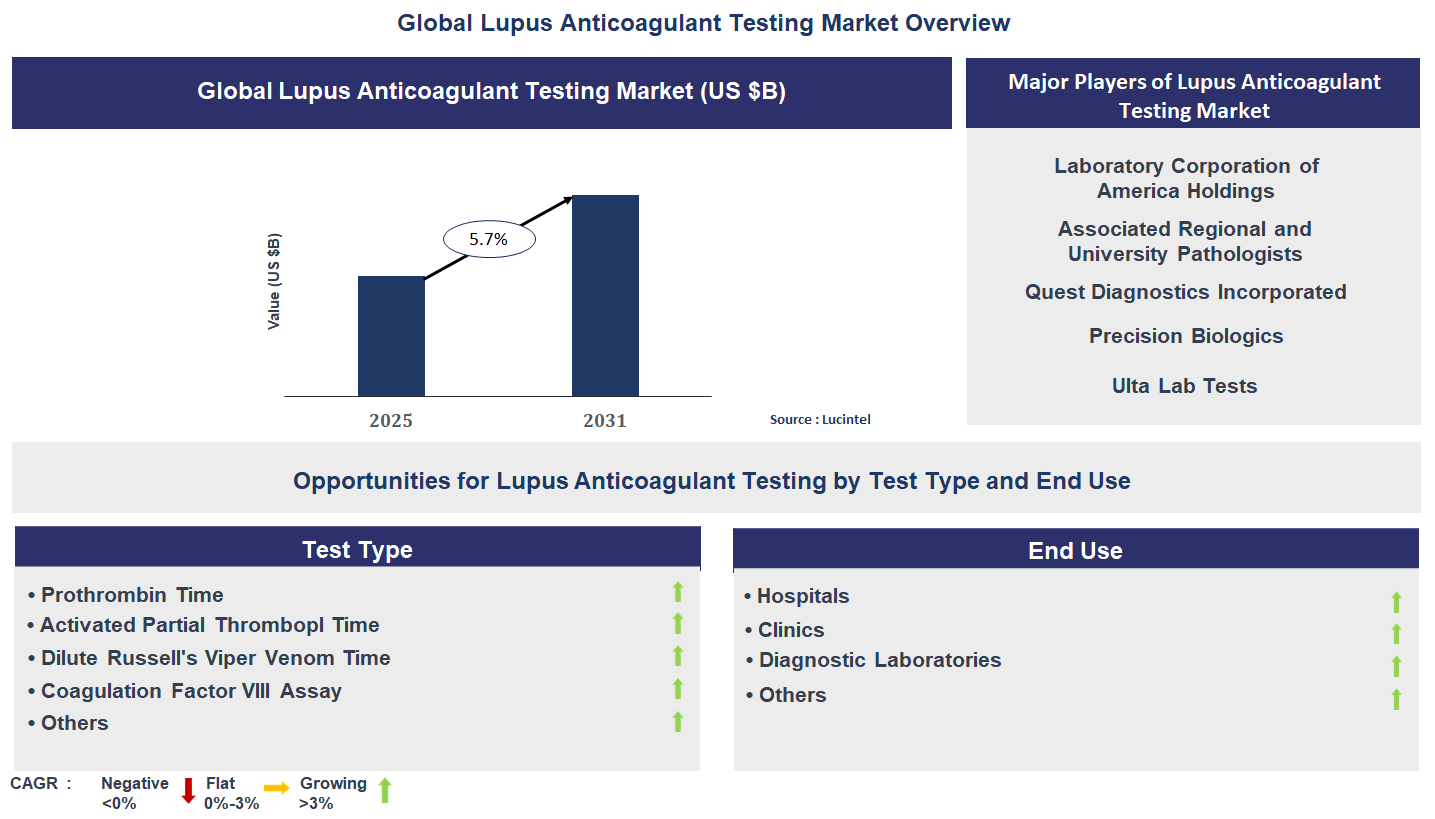
The future of the global lupus anticoagulant testing market looks promising with opportunities in the hospital, clinic, and diagnostic laboratory markets. The global lupus anticoagulant testing market is expected to grow with a CAGR of 5.7% from 2025 to 2031. The major drivers for this market are the increasing incidence of autoimmune disorders, the rising awareness about coagulation testing, and the growing adoption of advanced diagnostic techniques.• Lucintel forecasts that, within the test type category, dilute russells viper venom time is expected to witness the highest growth over the forecast period.
• Within the end use category, diagnostic laboratory is expected to witness the highest growth.
• In terms of region, APAC is expected to witness the highest growth over the forecast period. Gain valuable insights for your business decisions with our comprehensive 150+ page report. Sample figures with some insights are shown below.
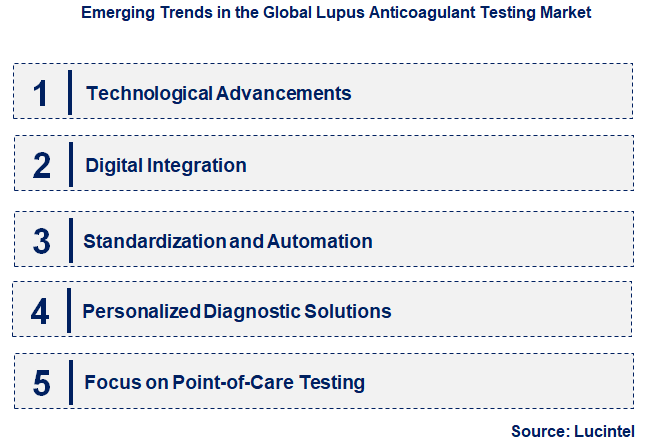
Emerging Trends in the Lupus Anticoagulant Testing Market
The lupus anticoagulant testing market are driven by technological innovation, rising autoimmune disease prevalence, and shifting healthcare paradigms towards early diagnosis and personalized medicine.• Technological Advancements: The introduction of highly automated, sensitive, and specific testing platforms enhances diagnostic accuracy and speeds up results, which is crucial for managing autoimmune disorders effectively.
• Digital Integration: Incorporation of digital tools such as AI and telemedicine in testing and diagnosis allows remote monitoring, faster data analysis, and improved patient management, especially in remote areas.
• Standardization and Automation: Efforts to standardize tests and automate processes reduce variability, improve reproducibility, and facilitate large-scale screening programs crucial for early diagnosis.
• Personalized Diagnostic Solutions: Development of tailored testing panels based on patient profiles and disease subtype improves clinical decision-making and treatment outcomes.
• Focus on Point-of-care Testing: The trend towards portable, rapid testing devices enables timely diagnosis and treatment initiation, particularly in resource-limited settings, expanding market reach. These trends are fundamentally transforming the market by improving diagnostic precision, efficiency, and accessibility, ultimately supporting better patient care.
Recent Development in the Lupus Anticoagulant Testing Market
The lupus anticoagulant testing market adoption of advanced immunoassays and automation, the expanding use of digital health tools, increased R&D investment, improved test standardization, and the development of portable point-of-care devices. These innovations are driving the market toward greater efficiency, accuracy, and accessibility, thereby supporting early diagnosis and improved disease management on a global scale.• Advanced Immunoassays and Automation: Leading companies are launching highly sensitive assays with automation capabilities that reduce manual errors and turnaround times, improving laboratory efficiency.
• Digital Health Tools: Integration of AI and telehealth platforms enhances remote diagnosis, patient monitoring, and large-scale clinical studies, especially in underserved regions.
• Increased R&D Investments: Major companies are investing in research to develop novel diagnostic markers and assay technologies, enhancing sensitivity and specificity.
• Standardization and Quality Control: Efforts to harmonize testing protocols and establish international standards are improving test reliability and comparability across laboratories.
• Portable Point-of-care Devices: Development of rapid, handheld testing devices enables immediate diagnosis in clinics, emergency settings, and remote locations. These developments are significantly shaping the future of lupus anticoagulant testing, emphasizing speed, accuracy, and widespread accessibility.
Strategic Growth Opportunities in the Lupus Anticoagulant Testing Market
The lupus anticoagulant testing market presents multiple strategic growth opportunities across clinical, research, and diagnostic applications. Increasing prevalence of autoimmune and thrombotic disorders has expanded the demand for accurate testing solutions across hospitals, diagnostic laboratories, and research centers. Rapid adoption of automated testing platforms and standardized coagulation panels is enhancing diagnostic precision and efficiency. Furthermore, the integration of artificial intelligence and digital health systems is creating new possibilities for data interpretation and patient monitoring.• Clinical Diagnostics and Hospital-Based Testing: Hospitals and specialty clinics represent one of the largest growth opportunities for lupus anticoagulant testing. The increasing need for accurate diagnosis of thrombotic and autoimmune disorders has led to greater test adoption within clinical laboratories. Implementation of standardized coagulation panels and automated instruments enhances diagnostic turnaround and reliability. Hospitals are also integrating lupus anticoagulant testing with broader hematology and immunology diagnostics, improving patient outcomes through early disease detection.
• Reference and Independent Diagnostic Laboratories: Independent laboratories are expanding their lupus anticoagulant testing portfolios to meet growing demand from hospitals and outpatient centers. These facilities often provide specialized testing services with advanced analytical capabilities and faster reporting. Collaboration with reagent manufacturers enables access to high-quality assay kits and customized testing solutions. The increasing outsourcing of diagnostic services by smaller healthcare facilities is fueling steady revenue growth in this segment.
• Academic and Clinical Research Institutions: Research-focused organizations play a crucial role in advancing lupus anticoagulant testing through clinical studies and assay development. Ongoing academic research on coagulation pathways, autoimmune mechanisms, and antiphospholipid antibodies is driving innovation in diagnostic assay design. Partnerships between universities, hospitals, and biotechnology firms are supporting the creation of novel biomarkers and improved testing methodologies. Research institutions also contribute to establishing standard testing protocols and evaluating test performance under varied clinical conditions.
• Pharmaceutical and Clinical Trial Applications: The pharmaceutical sector presents growing opportunities for lupus anticoagulant testing, particularly in the development of anticoagulant therapies and autoimmune disease treatments. Clinical trials increasingly require coagulation and antibody monitoring as part of patient safety assessments. The integration of lupus anticoagulant assays in drug development processes supports evaluation of treatment efficacy and adverse event risk. Pharmaceutical companies are collaborating with diagnostic firms to develop companion diagnostics that enhance therapeutic decision-making.
• Point-of-Care and Rapid Testing Solutions: The development of rapid and point-of-care lupus anticoagulant testing technologies offers a promising growth avenue, particularly for emergency and outpatient settings. Portable testing devices and simplified assay formats enable quicker diagnosis of clotting abnormalities without the need for complex laboratory infrastructure. These solutions improve access to testing in remote areas and reduce patient turnaround time. Strategic growth in the lupus anticoagulant testing market is being driven by expanded applications across hospital diagnostics, independent laboratories, research institutions, pharmaceutical studies, and emerging point-of-care platforms. Each segment presents unique opportunities for innovation, collaboration, and technology integration. The increasing focus on automation, assay standardization, and digital diagnostics is enhancing accuracy and accessibility.
Lupus Anticoagulant Testing Market Driver and Challenges
The lupus anticoagulant testing market is influenced by multiple technological, clinical, and regulatory factors driving demand for advanced diagnostic solutions. Increasing awareness of autoimmune disorders, improvements in coagulation testing platforms, and growing adoption of laboratory automation are fueling market growth. Rising incidences of antiphospholipid syndrome and related thrombotic conditions have intensified the need for accurate lupus anticoagulant assays. However, challenges such as the complexity of test interpretation, lack of standardization, and high testing costs persist. The factors responsible for driving the lupus anticoagulant testing market include: 1. Rising Prevalence of Autoimmune and Thrombotic Disorders: The increasing incidence of autoimmune diseases, including lupus and antiphospholipid syndrome, has amplified the demand for precise lupus anticoagulant testing. These disorders are often associated with higher risks of blood clots, pregnancy complications, and cardiovascular conditions, necessitating timely diagnosis. Enhanced clinical awareness and early screening initiatives have led to growing test utilization in both hospital and reference laboratories. 2. Advancements in Coagulation Testing Technologies: Continuous improvements in laboratory automation, immunoassay precision, and reagent stability are significantly enhancing lupus anticoagulant detection. The integration of automated coagulation analyzers enables faster turnaround times, reduced manual error, and greater reproducibility. Modern platforms support standardized test protocols that improve diagnostic accuracy across clinical settings. Advancements in digital data interpretation tools further enable laboratories to deliver reliable results. 3. Growing Awareness and Screening Programs for Thrombophilia: Government-led health initiatives and professional guidelines promoting thrombophilia screening have increased lupus anticoagulant testing volumes worldwide. Awareness campaigns by medical associations and patient advocacy groups have improved early recognition of clotting disorders, especially among high-risk populations such as pregnant women and patients with recurrent miscarriages. Routine inclusion of lupus anticoagulant tests in coagulation panels and prenatal screenings has expanded test accessibility. 4. Expansion of Clinical Research and Diagnostic Infrastructure: Increasing investments in clinical research, along with the development of advanced diagnostic laboratories, are boosting the lupus anticoagulant testing market. Pharmaceutical companies are conducting clinical studies to evaluate lupus anticoagulant presence in relation to novel anticoagulant therapies and autoimmune treatments. The expansion of healthcare infrastructure in emerging economies like India and China has further improved laboratory access. 5. Regulatory Support and Standardization Efforts: International health organizations and regulatory bodies are emphasizing the need for standardized lupus anticoagulant testing procedures. Implementation of uniform testing protocols, quality assurance programs, and validated assay kits has improved result comparability across laboratories. Updated guidelines from bodies such as the International Society on Thrombosis and Haemostasias (ISTH) are promoting consistent testing practices. Challenges in the lupus anticoagulant testing market are: 1. Lack of Standardization Across Testing Protocols: Despite advancements, variability in test reagents, instrument calibration, and interpretation criteria continues to affect result consistency. Different laboratories often use diverse screening and confirmatory assays, leading to discrepancies in lupus anticoagulant detection. This lack of standardization can hinder diagnosis and complicate patient management decisions. Global efforts toward harmonizing protocols are ongoing but remain incomplete. 2. High Cost of Advanced Testing Equipment and Reagents: Lupus anticoagulant testing requires specialized reagents, high-quality control materials, and advanced coagulation analyzers, which are expensive to acquire and maintain. Smaller laboratories, especially in developing countries, often face financial limitations in adopting such technologies. The cost burden affects both healthcare providers and patients, limiting widespread testing availability. Additionally, the need for skilled professionals to operate and interpret test results adds to operational expenses. 3. Complexity in Result Interpretation and False Positives: Interpreting lupus anticoagulant test results is highly complex due to interference from anticoagulant therapies and patient-specific biological factors. False positives or negatives can lead to misdiagnosis and inappropriate clinical decisions. Differentiating lupus anticoagulant from other coagulation abnormalities requires expert analysis and multiple confirmatory tests. This complexity limits testing efficiency and can delay treatment initiation. The lupus anticoagulant testing market is experiencing steady growth driven by technological innovation, growing disease awareness, and improved laboratory infrastructure. However, challenges such as high costs, test variability, and interpretative complexity continue to affect consistency and accessibility. Collaboration among diagnostic manufacturers, regulators, and clinical laboratories will be essential to standardize testing and reduce costs.List of Lupus Anticoagulant Testing Companies
Companies in the market compete on the basis of product quality offered. Major players in this market focus on expanding their manufacturing facilities, R&D investments, infrastructural development, and leverage integration opportunities across the value chain. With these strategies lupus anticoagulant testing companies cater increasing demand, ensure competitive effectiveness, develop innovative products & technologies, reduce production costs, and expand their customer base. Some of the lupus anticoagulant testing companies profiled in this report include-• Laboratory Corporation of America Holdings
• Associated Regional and University Pathologists
• Quest Diagnostics Incorporated
• Precision Biologics
• Ulta Lab Tests
• Diagnostica Stago
• F. Hoffmann-La Roche
Lupus Anticoagulant Testing Market by Segment
The study includes a forecast for the global lupus anticoagulant testing market by test type, end use, and region.Lupus Anticoagulant Testing Market by Test Type [Value from 2019 to 2031]:
• Prothrombin Time
• Activated Partial Thrombopl Time
• Dilute Russells Viper Venom Time
• Coagulation Factor VIII Assay
• Others
Lupus Anticoagulant Testing Market by End Use [Value from 2019 to 2031]:
• Hospitals
• Clinics
• Diagnostic Laboratories
• Others
Lupus Anticoagulant Testing Market by Region [Value from 2019 to 2031]:
• North America
• Europe
• Asia Pacific
• The Rest of the World
Country Wise Outlook for the Lupus Anticoagulant Testing Market
The recent developments in the lupus anticoagulant testing market reveal a dynamic and expanding landscape driven by increasing autoimmune disease prevalence, technological advances, and rising healthcare awareness worldwide. The market size is expected to grow significantly, with a compound annual growth rate (CAGR) of around 5.7% to 6.7% over the next decade. Leading regions include North America, Europe, and Asia-Pacific, where technological innovation, regulatory support, and healthcare infrastructure are accelerating adoption.• United States: The US market is experiencing growth through technological innovations, such as new immunoassays and coagulation analyzers, alongside a rising prevalence of autoimmune diseases like lupus. Regulatory agencies are emphasizing diagnostic accuracy, encouraging the adoption of advanced testing platforms. The presence of major diagnostic companies and increasing investment in research and development support the US market’s leadership in innovation and healthcare infrastructure.
• China: China’s lupus anticoagulant testing market is expanding rapidly, supported by government initiatives, increasing healthcare investments, and a growing awareness of autoimmune conditions. Local companies are developing cost-effective and rapid testing solutions, and the adoption of digital health technologies for remote diagnostics is growing. An increasing middle-class population and expanding healthcare coverage are also facilitating broader access to sophisticated testing services.
• Germany: Germany’s market is driven by its strong research infrastructure and focus on high-quality diagnostics. Advances include the adoption of more sensitive assays and integration of automation in laboratories for faster, more reliable testing. The emphasis on regulatory compliance and safety standards boosts trust and usage among healthcare providers. Germany is also seeing increased collaboration between academia and industry to develop innovative testing solutions.
• India: The Indian market is witnessing rapid growth driven by increasing autoimmune disorder awareness, expanding healthcare infrastructure, and affordability of testing services. International and domestic companies are introducing new, more accessible testing panels, with a focus on portable and easy-to-use diagnostics. The rise in diagnostic laboratories and integration of digital health platforms are further expanding testing reach across urban and semi-urban areas.
• Japan: Japan shows steady growth with a focus on improving diagnostic precision and patient outcomes. Innovations include the development of more refined assays and integration of AI-based data analysis to improve test accuracy. The aging population and the healthcare system’s emphasis on early diagnosis for autoimmune and coagulation disorders are key factors driving the market. Japan invests significantly in R&D, fostering local innovation in lupus anticoagulant diagnostics.

Features of the Global Lupus Anticoagulant Testing Market
Market Size Estimates: Lupus anticoagulant testing market size estimation in terms of value ($B). Trend and Forecast Analysis: Market trends (2019 to 2024) and forecast (2025 to 2031) by various segments and regions. Segmentation Analysis: Lupus anticoagulant testing market size by test type, end use, and region in terms of value ($B). Regional Analysis: Lupus anticoagulant testing market breakdown by North America, Europe, Asia Pacific, and Rest of the World. Growth Opportunities: Analysis of growth opportunities in different test types, end uses, and regions for the lupus anticoagulant testing market. Strategic Analysis: This includes M&A, new product development, and competitive landscape of the lupus anticoagulant testing market. Analysis of competitive intensity of the industry based on Porter’s Five Forces model.
FAQ
Q1. What is the growth forecast for lupus anticoagulant testing market? Answer: The global lupus anticoagulant testing market is expected to grow with a CAGR of 5.7% from 2025 to 2031. Q2. What are the major drivers influencing the growth of the lupus anticoagulant testing market? Answer: The major drivers for this market are the increasing incidence of autoimmune disorders, the rising awareness about coagulation testing, and the growing adoption of advanced diagnostic techniques. Q3. What are the major segments for lupus anticoagulant testing market? Answer: The future of the lupus anticoagulant testing market looks promising with opportunities in the hospital, clinic, and diagnostic laboratory markets. Q4. Who are the key lupus anticoagulant testing market companies? Answer: Some of the key lupus anticoagulant testing companies are as follows:• Laboratory Corporation of America Holdings
• Associated Regional and University Pathologists
• Quest Diagnostics Incorporated
• Precision Biologics
• Ulta Lab Tests
• Diagnostica Stago
• F. Hoffmann-La Roche Q5. Which lupus anticoagulant testing market segment will be the largest in future? Answer: Lucintel forecasts that, within the test type category, dilute russells viper venom time is expected to witness the highest growth over the forecast period. Q6. In lupus anticoagulant testing market, which region is expected to be the largest in next 5 years? Answer: In terms of region, APAC is expected to witness the highest growth over the forecast period. Q7. Do we receive customization in this report? Answer: Yes, Lucintel provides 10% customization without any additional cost.
Table of Contents
List of Figures
List of Tables
Methodology
- In-depth interviews of the major players in this market
- Detailed secondary research from competitors’ financial statements and published data
- Extensive searches of published works, market, and database information pertaining to industry news, company press releases, and customer intentions
- A compilation of the experiences, judgments, and insights of Lucintel’s professionals, who have analyzed and tracked this market over the years.


Buy Now
Choose a license that fits your team. Instant PDF delivery.
Prices exclude taxes. Instant delivery. Custom licensing available on request.
Key Questions
- • What are some of the most promising, high-growth opportunities for the lupus anticoagulant testing market by test type (prothrombin time, activated partial thrombopl time, dilute russells viper venom time, coagulation factor vIII assay, and others), end use (hospitals, clinics, diagnostic laboratories, and others), and region (North America, Europe, Asia Pacific, and the Rest of the World)?
- • Which segments will grow at a faster pace and why?
- • Which region will grow at a faster pace and why?
- • What are the key factors affecting market dynamics? What are the key challenges and business risks in this market?
- • What are the business risks and competitive threats in this market?
- • What are the emerging trends in this market and the reasons behind them?
- • What are some of the changing demands of customers in the market?
- • What are the new developments in the market? Which companies are leading these developments?
- • Who are the major players in this market? What strategic initiatives are key players pursuing for business growth?
- • What are some of the competing products in this market and how big of a threat do they pose for loss of market share by material or product substitution?
- • What M&A activity has occurred in the last 5 years and what has its impact been on the industry? For any questions related to Lupus Anticoagulant Testing Market, Lupus Anticoagulant Testing Market Size, Lupus Anticoagulant Testing Market Growth, Lupus Anticoagulant Testing Market Analysis, Lupus Anticoagulant Testing Market Report, Lupus Anticoagulant Testing Market Share, Lupus Anticoagulant Testing Market Trends, Lupus Anticoagulant Testing Market Forecast, Lupus Anticoagulant Testing Companies, write Lucintel analyst at email: helpdesk@lucintel.com. We will be glad to get back to you soon.


