
Report Feature
Luminol Market Trends and Forecast
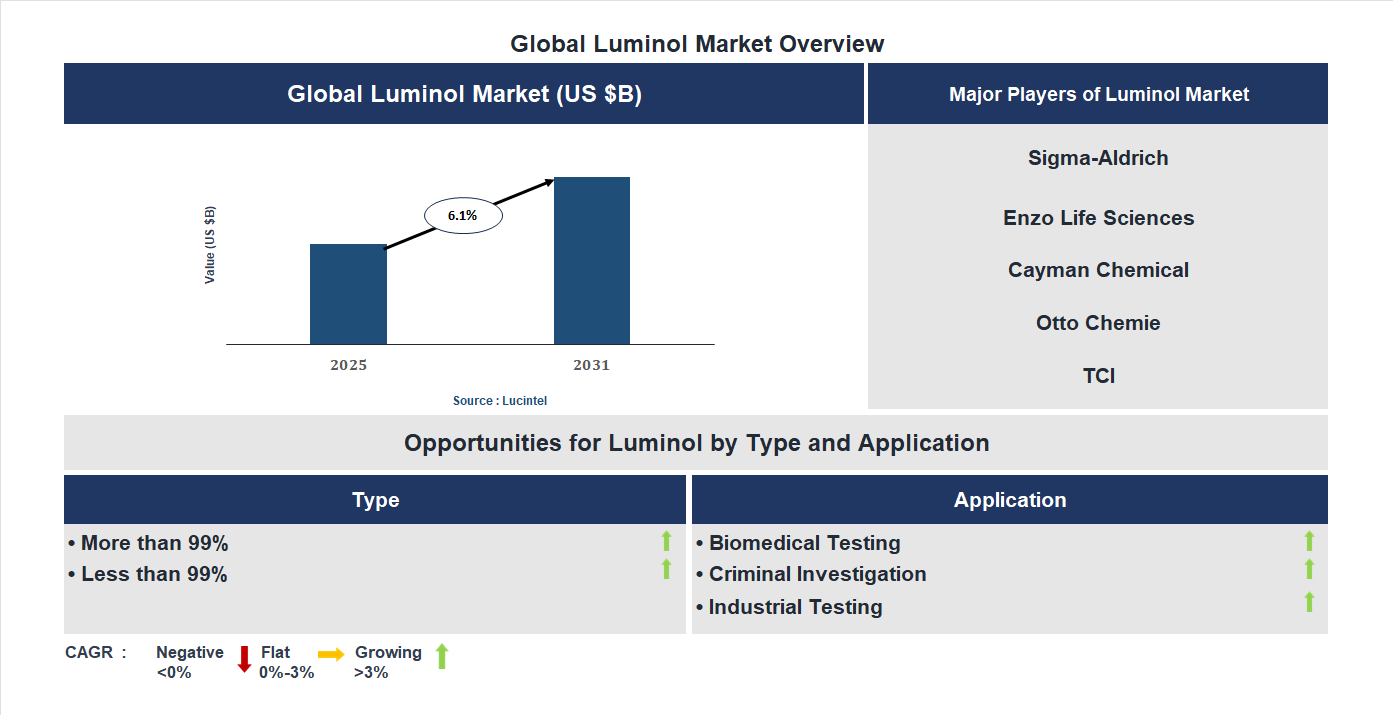
The future of the global luminol market looks promising with opportunities in the biomedical testing, criminal investigation, and industrial testing markets. The global luminol market is expected to grow with a CAGR of 6.1% from 2025 to 2031. The major drivers for this market are the increasing demand for forensic investigation tools, the rising use in crime scene analysis, and the growing adoption in biomedical research applications.• Lucintel forecasts that, within the type category, more than 99% is expected to witness higher growth over the forecast period.
• Within the application category, biomedical testing is expected to witness the highest growth.
• In terms of region, APAC is expected to witness the highest growth over the forecast period. Gain valuable insights for your business decisions with our comprehensive 150+ page report. Sample figures with some insights are shown below.
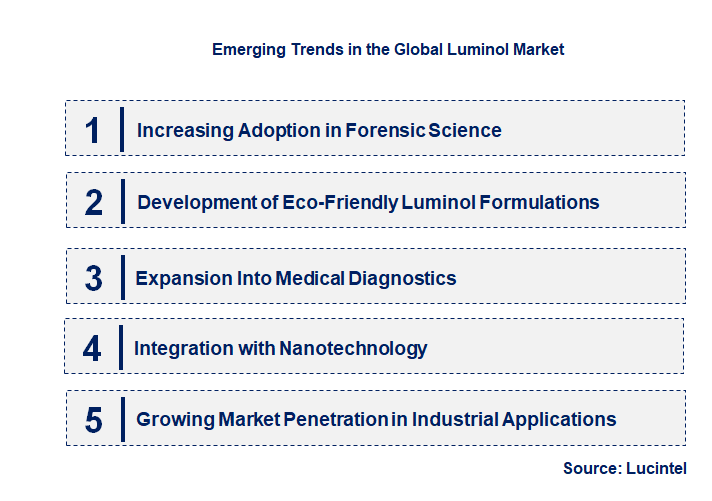
Emerging Trends in the Luminol Market
The luminol market is experiencing significant growth driven by advancements in forensic science, medical diagnostics, and industrial applications. As technology evolves, new uses and improved formulations are emerging, transforming how luminol is utilized across various sectors. These developments are not only expanding market size but also enhancing the efficiency, safety, and environmental sustainability of luminol-based products. Stakeholders are increasingly focusing on innovation, regulatory compliance, and market expansion to capitalize on these opportunities. The following key trends highlight the dynamic nature of the luminol market and its future trajectory.• Increasing Adoption in Forensic Science: The demand for luminol in forensic investigations is rising due to its ability to detect trace amounts of blood. Its high sensitivity and specificity make it a preferred choice for crime scene analysis. Advances in formulation have improved its stability and ease of use, leading to broader adoption by law enforcement agencies worldwide. This trend is expected to continue as forensic techniques become more sophisticated, driving market growth and expanding applications in criminal investigations.
• Development of Eco-Friendly Luminol Formulations: Environmental concerns are prompting manufacturers to develop greener luminol products. These formulations aim to reduce toxicity and environmental impact while maintaining high performance. Innovations include biodegradable solvents and non-toxic catalysts, which appeal to eco-conscious consumers and regulatory bodies. The shift towards sustainable products is likely to open new markets and improve the market image, fostering long-term growth and compliance with environmental standards.
• Expansion into Medical Diagnostics: Luminols chemiluminescent properties are increasingly being utilized in medical diagnostics, particularly in detecting infections and monitoring immune responses. Researchers are developing new assays that leverage luminol for rapid, sensitive, and non-invasive testing. This trend is expected to enhance early disease detection, improve patient outcomes, and stimulate investment in luminol-based diagnostic tools, thereby broadening its application scope beyond traditional forensic uses.
• Integration with Nanotechnology: The incorporation of luminol into nanomaterials is creating innovative solutions for detection and imaging. Nanoparticles enhance luminols sensitivity and stability, enabling more precise and durable applications. This integration is particularly impactful in biomedical imaging, environmental monitoring, and security. As nanotechnology advances, luminol-based nanomaterials are poised to revolutionize detection methods, offering higher efficiency and new functionalities, thus opening avenues for market expansion and technological leadership.
• Growing Market Penetration in Industrial Applications: Beyond forensic and medical uses, luminol is increasingly employed in industrial settings such as leak detection, quality control, and corrosion monitoring. Its ability to reveal hidden defects and monitor processes in real-time makes it valuable for manufacturing and maintenance. Innovations in formulation and application techniques are enhancing its effectiveness in these areas. This trend is expected to diversify the market, increase demand across industries, and promote the development of specialized luminol products tailored to industrial needs. In summary, these emerging trends are reshaping the luminol market by fostering innovation, expanding application areas, and emphasizing sustainability. The integration of advanced technologies and eco-friendly practices is driving growth, making luminol a versatile and essential tool across multiple sectors. As these trends continue to evolve, the market is poised for sustained expansion and increased competitiveness.
Recent Development in the Luminol Market
The luminol market has experienced significant growth driven by advancements in forensic science, increased demand for crime scene investigation tools, and technological innovations. As law enforcement agencies and forensic laboratories seek more sensitive and reliable detection methods, the market is evolving rapidly. Recent developments reflect a focus on improving luminol formulations, expanding application areas, and integrating new detection technologies. These changes are shaping the future landscape of the luminol industry, making it more efficient and accessible. The following key developments highlight the current trajectory of the market and its potential for continued expansion and innovation.• Enhanced Sensitivity of Luminol Formulations: New formulations have been developed to increase detection sensitivity, allowing for the visualization of even trace amounts of blood. This improvement has significantly boosted forensic investigations accuracy, reducing false negatives and enabling law enforcement to solve crimes more effectively. The enhanced sensitivity also broadens luminols application scope, including historical crime scene analysis and environmental testing. Overall, this development strengthens the market by increasing demand for advanced forensic reagents and tools.
• Integration of Digital Imaging Technologies: The incorporation of digital imaging and chemiluminescence detection systems has revolutionized luminol application. High-resolution cameras and software now enable precise documentation and analysis of luminescent reactions, improving evidence interpretation. This integration enhances the reliability and efficiency of crime scene investigations, leading to faster case resolutions. The market benefits from increased adoption of these technologies, as forensic labs seek comprehensive solutions that combine chemical detection with digital analysis, driving growth and innovation.
• Expansion into Non-Forensic Applications: Beyond forensic science, luminol is increasingly used in areas such as leak detection, biomedical research, and industrial testing. Its ability to detect trace amounts of blood or other substances makes it valuable in quality control, environmental monitoring, and medical diagnostics. This diversification broadens the market base, attracting new customers and investment. As these applications grow, they contribute to the overall expansion of the luminol market, fostering cross-industry collaborations and technological advancements.
• Development of Eco-Friendly and Safer Alternatives: Environmental and safety concerns have prompted the development of greener luminol formulations that reduce toxic byproducts and hazards. These eco-friendly options are safer for laboratory personnel and the environment, aligning with global sustainability goals. The adoption of such alternatives enhances market appeal, especially among organizations prioritizing safety and sustainability. This shift not only broadens market reach but also encourages regulatory support and innovation in luminol chemistry.
• Regulatory and Standardization Advances: Recent updates in regulations and standards for forensic reagents have improved product quality and consistency. Governments and international bodies now require rigorous validation and quality control, ensuring reliable results. These standards foster trust among users and facilitate international trade of luminol products. The regulatory landscapes evolution encourages manufacturers to innovate and improve product standards, ultimately strengthening the market by ensuring high-quality, standardized luminol solutions. In summary, these developments are transforming the luminol market by enhancing detection capabilities, integrating advanced technologies, expanding application areas, promoting safety and sustainability, and establishing robust regulatory frameworks. Collectively, they are driving market growth, increasing adoption, and fostering innovation, positioning luminol as a vital tool across multiple industries.
Strategic Growth Opportunities in the Luminol Market
The Luminol market is experiencing significant growth driven by advancements in forensic science, healthcare diagnostics, and industrial applications. As technology evolves, new opportunities are emerging to expand its use across various sectors. These developments are shaping the future landscape of the luminol market, offering innovative solutions for detection, analysis, and safety. Key growth opportunities are emerging across different applications, reflecting the increasing demand for sensitive, reliable, and rapid detection methods. Understanding these opportunities is crucial for stakeholders aiming to capitalize on the markets potential and drive sustainable growth in this dynamic industry.• Forensic Science: Luminols ability to detect trace bloodstains invisible to the naked eye is revolutionizing forensic investigations. Its high sensitivity allows law enforcement agencies to uncover evidence that was previously undetectable, increasing the likelihood of solving crimes. This application is expected to see continued growth as forensic labs adopt more advanced luminol-based detection techniques, improving accuracy and efficiency in criminal investigations.
• Healthcare Diagnostics: Luminols chemiluminescent properties are increasingly utilized in medical diagnostics for detecting blood and infectious agents. Its rapid response and high sensitivity make it ideal for point-of-care testing and laboratory analysis. The expanding healthcare sectors demand for quick, reliable diagnostic tools is driving innovation in luminol-based assays, which are expected to improve disease detection and patient outcomes.
• Industrial Safety and Leak Detection: Luminol is being adopted for detecting leaks and contamination in industrial environments, especially in chemical and manufacturing plants. Its ability to quickly identify hazardous leaks enhances safety protocols and reduces risks. As industries prioritize safety and regulatory compliance, the demand for luminol-based detection systems is projected to grow, supporting safer working environments and minimizing environmental impact.
• Water and Environmental Monitoring: The application of luminol in environmental monitoring is expanding to detect pollutants in water bodies and soil. Its high sensitivity to trace contaminants helps in the early detection of pollution, enabling timely intervention. This growth opportunity is driven by increasing environmental regulations and the need for sustainable practices, positioning luminol as a vital tool in environmental protection efforts.
• Defense and Security: Luminols capabilities are being harnessed for security screening, biothreat detection, and explosive residue identification. Its rapid chemiluminescent response aids in quick threat assessment, crucial for national security. As global security concerns rise, the deployment of luminol-based detection systems is expected to expand, strengthening defense mechanisms and emergency response capabilities. In summary, these growth opportunities are significantly impacting the luminol market by broadening its application scope and enhancing detection capabilities across sectors. The increasing adoption of luminol-based solutions is driving market expansion, fostering innovation, and supporting safety and security initiatives worldwide.
Luminol Market Driver and Challenges
The luminol market is influenced by a variety of technological, economic, and regulatory factors that shape its growth and development. Advances in forensic science and crime scene investigation have increased demand for luminol as a vital reagent for detecting blood traces. Economic factors such as government funding for law enforcement and private sector investments also play a significant role. Additionally, regulatory standards regarding safety and environmental impact influence manufacturing and usage practices. The interplay of these drivers and challenges determines the market’s trajectory, affecting innovation, adoption rates, and overall market stability. Understanding these factors is essential for stakeholders aiming to capitalize on opportunities and mitigate risks within this specialized industry. The factors responsible for driving the luminol market include:-• Technological Advancements: The continuous development of more sensitive and reliable luminol formulations has significantly enhanced forensic investigations. Innovations such as portable detection devices and improved chemical stability allow for faster, more accurate blood detection at crime scenes. These technological improvements increase the efficiency of law enforcement agencies and forensic laboratories, thereby expanding market demand. As research progresses, new applications and integration with digital tools are expected to further propel market growth, making luminol an indispensable reagent in forensic science.
• Rising Crime Rates and Need for Forensic Evidence: Increasing global crime rates, including violent crimes and organized offenses, have heightened the demand for forensic evidence. Luminol’s ability to detect blood traces that are invisible to the naked eye makes it a critical tool for criminal investigations. As law enforcement agencies seek more effective crime scene analysis methods, the reliance on luminol-based detection is expected to grow. This trend is particularly prominent in regions with high crime rates, driving market expansion and encouraging further investment in forensic reagents.
• Regulatory and Safety Standards: Stringent regulations concerning chemical safety, environmental impact, and handling procedures influence the manufacturing and distribution of luminol products. Compliance with these standards ensures market players maintain high-quality and safe products, which can increase production costs but also boost consumer confidence. Regulatory frameworks also encourage innovation in developing eco-friendly and safer luminol formulations, opening new avenues for market growth while ensuring safety and sustainability.
• Growing Investment in Forensic Science: Governments and private organizations are increasing funding for forensic research and crime investigation infrastructure. This financial support facilitates the development and adoption of advanced luminol detection techniques. Enhanced investment leads to increased procurement of luminol reagents by law enforcement agencies and forensic labs, thereby expanding the market. Additionally, collaborations between academia and industry foster innovation, further strengthening the market’s growth prospects.
• Expansion of Forensic Applications: Beyond crime scene investigation, luminol is increasingly used in areas such as disaster victim identification, historical investigations, and quality control in various industries. This diversification broadens the scope of luminol applications, creating new revenue streams and market opportunities. As awareness of luminol’s capabilities grows across different sectors, demand is expected to rise, supporting sustained market growth and technological diversification. The challenges facing this luminol market include:-
• Regulatory and Environmental Constraints: Strict regulations regarding chemical handling, disposal, and environmental safety pose significant hurdles for market players. Compliance often requires substantial investment in safety measures and eco-friendly alternatives, which can increase production costs and limit market entry for smaller companies. Additionally, evolving regulations may lead to product reformulation or withdrawal, impacting supply chains and market stability. Navigating these complex regulatory landscapes is essential but challenging, potentially slowing innovation and market expansion.
• Limited Awareness and Adoption: Despite its importance in forensic investigations, luminol’s usage is not yet widespread in all regions due to a lack of awareness or technical expertise. Limited training and knowledge gaps among law enforcement personnel can hinder adoption, especially in developing countries. This restricts market growth and creates disparities in forensic capabilities globally. Overcoming these barriers requires targeted education, training programs, and awareness campaigns to unlock the full potential of luminol applications.
• Competition from Alternative Technologies: Emerging detection methods, such as fluorescence-based assays and DNA analysis techniques, pose competition to luminol. These alternatives may offer higher sensitivity, faster results, or easier handling, challenging luminol’s market share. The rapid pace of technological innovation necessitates continuous improvement and differentiation of luminol products. Failure to adapt to these competitive pressures could result in reduced market relevance and diminished growth prospects. In summary, the luminol market is driven by technological innovations, increasing crime rates, regulatory compliance, investment in forensic science, and expanding applications. However, it faces challenges from regulatory constraints, limited awareness, and competition from alternative detection technologies. These factors collectively influence the market’s evolution, requiring stakeholders to innovate, educate, and adapt to maintain growth and competitiveness. The overall impact is a dynamic landscape with significant opportunities for growth balanced by regulatory and technological challenges that must be strategically managed.
List of Luminol Companies
Companies in the market compete on the basis of product quality offered. Major players in this market focus on expanding their manufacturing facilities, R&D investments, infrastructural development, and leverage integration opportunities across the value chain. With these strategies luminol companies cater increasing demand, ensure competitive effectiveness, develop innovative products & technologies, reduce production costs, and expand their customer base. Some of the luminol companies profiled in this report include-• Sigma-Aldrich
• Enzo Life Sciences
• Cayman Chemical
• Otto Chemie
• TCI
• Biovision
• Pioneer Forensics
• Wako Chemicals
• Nacalai
• Hubei New Desheng Materials Technology
Luminol Market by Segment
The study includes a forecast for the global luminol market by type, application, and region.Luminol Market by Type [Value from 2019 to 2031]:
• More than 99%
• Less than 99%
Luminol Market by Application [Value from 2019 to 2031]:
• Biomedical Testing
• Criminal Investigation
• Industrial Testing
Luminol Market by Region [Value from 2019 to 2031]:
• North America
• Europe
• Asia Pacific
• The Rest of the World
Country Wise Outlook for the Luminol Market
The luminol market has experienced significant growth driven by advancements in forensic science, medical diagnostics, and industrial applications. As technology evolves, countries are investing in research and development to enhance luminols sensitivity and application scope. The United States, China, Germany, India, and Japan are leading the way, each contributing unique innovations and market strategies. These developments reflect broader trends in healthcare, security, and manufacturing sectors, emphasizing the importance of luminol in various fields. The following summaries highlight recent key advancements and market dynamics in each of these countries.• United States: The US market has seen increased adoption of luminol in forensic investigations, with advancements in chemiluminescent detection techniques. Major research institutions are developing more sensitive formulations for crime scene analysis. Additionally, the integration of luminol with digital imaging systems has improved detection accuracy. The government’s focus on crime prevention and forensic research funding has further propelled market growth. The US also witnesses rising demand in medical diagnostics, especially in cancer detection and blood testing, fostering innovation in luminol-based assays.
• China: China’s luminol market is rapidly expanding due to increased investments in forensic science and security infrastructure. The country has developed cost-effective luminol formulations suitable for large-scale applications. Chinese companies are focusing on improving luminol’s stability and luminescence duration, making it more effective for field use. The government’s emphasis on crime control and public safety has driven demand. Additionally, China is exploring luminol’s potential in industrial inspections and environmental monitoring, broadening its application scope. The market growth is supported by a growing domestic research base and international collaborations.
• Germany: Germany’s market is characterized by high-quality, innovative luminol products used primarily in forensic and industrial applications. German firms are investing in research to enhance luminol’s sensitivity and reduce false positives. The country’s strict regulatory standards ensure the development of safe and reliable luminol-based products. Germany also leads in integrating luminol detection with advanced imaging technologies, improving crime scene analysis. The focus on sustainable and environmentally friendly formulations is gaining momentum. The strong presence of research institutions and collaborations with industry players bolster Germany’s position as a key market player.
• India: India’s luminol market is witnessing rapid growth driven by increasing demand for forensic investigations and security measures. The country is focusing on affordable luminol solutions suitable for widespread use in law enforcement. Recent developments include the enhancement of luminol’s luminescence duration and sensitivity to detect trace amounts of blood. The government’s initiatives to modernize forensic labs and improve crime detection capabilities are significant growth drivers. Additionally, India is exploring luminol applications in healthcare diagnostics and industrial quality control, expanding its market potential. The expanding research infrastructure supports ongoing innovation and market penetration.
• Japan: Japan’s luminol market is characterized by technological innovation and high-quality standards. The country emphasizes the development of advanced luminol formulations with enhanced luminescence and stability. Japan’s forensic agencies utilize luminol extensively for crime scene investigations, integrating it with sophisticated imaging systems. The healthcare sector is also exploring luminol-based diagnostic tools, especially in blood testing and cancer detection. Japanese companies are investing in environmentally friendly and sustainable luminol products. The country’s focus on research and development, coupled with strong regulatory frameworks, sustains its leadership in high-end luminol applications and market growth.

Features of the Global Luminol Market
Market Size Estimates: Luminol market size estimation in terms of value ($B). Trend and Forecast Analysis: Market trends (2019 to 2024) and forecast (2025 to 2031) by various segments and regions. Segmentation Analysis: Luminol market size by type, application, and region in terms of value ($B). Regional Analysis: Luminol market breakdown by North America, Europe, Asia Pacific, and Rest of the World. Growth Opportunities: Analysis of growth opportunities in different types, applications, and regions for the luminol market. Strategic Analysis: This includes M&A, new product development, and competitive landscape of the luminol market. Analysis of competitive intensity of the industry based on Porter’s Five Forces model.
FAQ
Q1. What is the growth forecast for luminol market? Answer: The global luminol market is expected to grow with a CAGR of 6.1% from 2025 to 2031. Q2. What are the major drivers influencing the growth of the luminol market? Answer: The major drivers for this market are the increasing demand for forensic investigation tools, the rising use in crime scene analysis, and the growing adoption in biomedical research applications. Q3. What are the major segments for luminol market? Answer: The future of the luminol market looks promising with opportunities in the biomedical testing, criminal investigation, and industrial testing markets. Q4. Who are the key luminol market companies? Answer: Some of the key luminol companies are as follows:• Sigma-Aldrich
• Enzo Life Sciences
• Cayman Chemical
• Otto Chemie
• TCI
• Biovision
• Pioneer Forensics
• Wako Chemicals
• Nacalai
• Hubei New Desheng Materials Technology Q5. Which luminol market segment will be the largest in future? Answer: Lucintel forecasts that, within the type category, more than 99% is expected to witness higher growth over the forecast period. Q6. In luminol market, which region is expected to be the largest in next 5 years? Answer: In terms of region, APAC is expected to witness the highest growth over the forecast period. Q7. Do we receive customization in this report? Answer: Yes, Lucintel provides 10% customization without any additional cost.
Table of Contents
List of Figures
List of Tables
Methodology
- In-depth interviews of the major players in this market
- Detailed secondary research from competitors’ financial statements and published data
- Extensive searches of published works, market, and database information pertaining to industry news, company press releases, and customer intentions
- A compilation of the experiences, judgments, and insights of Lucintel’s professionals, who have analyzed and tracked this market over the years.


Buy Now
Choose a license that fits your team. Instant PDF delivery.
Prices exclude taxes. Instant delivery. Custom licensing available on request.
Key Questions
- • What are some of the most promising, high-growth opportunities for the luminol market by type (more than 99% and less than 99%), application (biomedical testing, criminal investigation, and industrial testing), and region (North America, Europe, Asia Pacific, and the Rest of the World)?
- • Which segments will grow at a faster pace and why?
- • Which region will grow at a faster pace and why?
- • What are the key factors affecting market dynamics? What are the key challenges and business risks in this market?
- • What are the business risks and competitive threats in this market?
- • What are the emerging trends in this market and the reasons behind them?
- • What are some of the changing demands of customers in the market?
- • What are the new developments in the market? Which companies are leading these developments?
- • Who are the major players in this market? What strategic initiatives are key players pursuing for business growth?
- • What are some of the competing products in this market and how big of a threat do they pose for loss of market share by material or product substitution?
- • What M&A activity has occurred in the last 5 years and what has its impact been on the industry? For any questions related to Luminol Market, Luminol Market Size, Luminol Market Growth, Luminol Market Analysis, Luminol Market Report, Luminol Market Share, Luminol Market Trends, Luminol Market Forecast, Luminol Companies, write Lucintel analyst at email: helpdesk@lucintel.com. We will be glad to get back to you soon.


