
Market Report · September 3, 2026

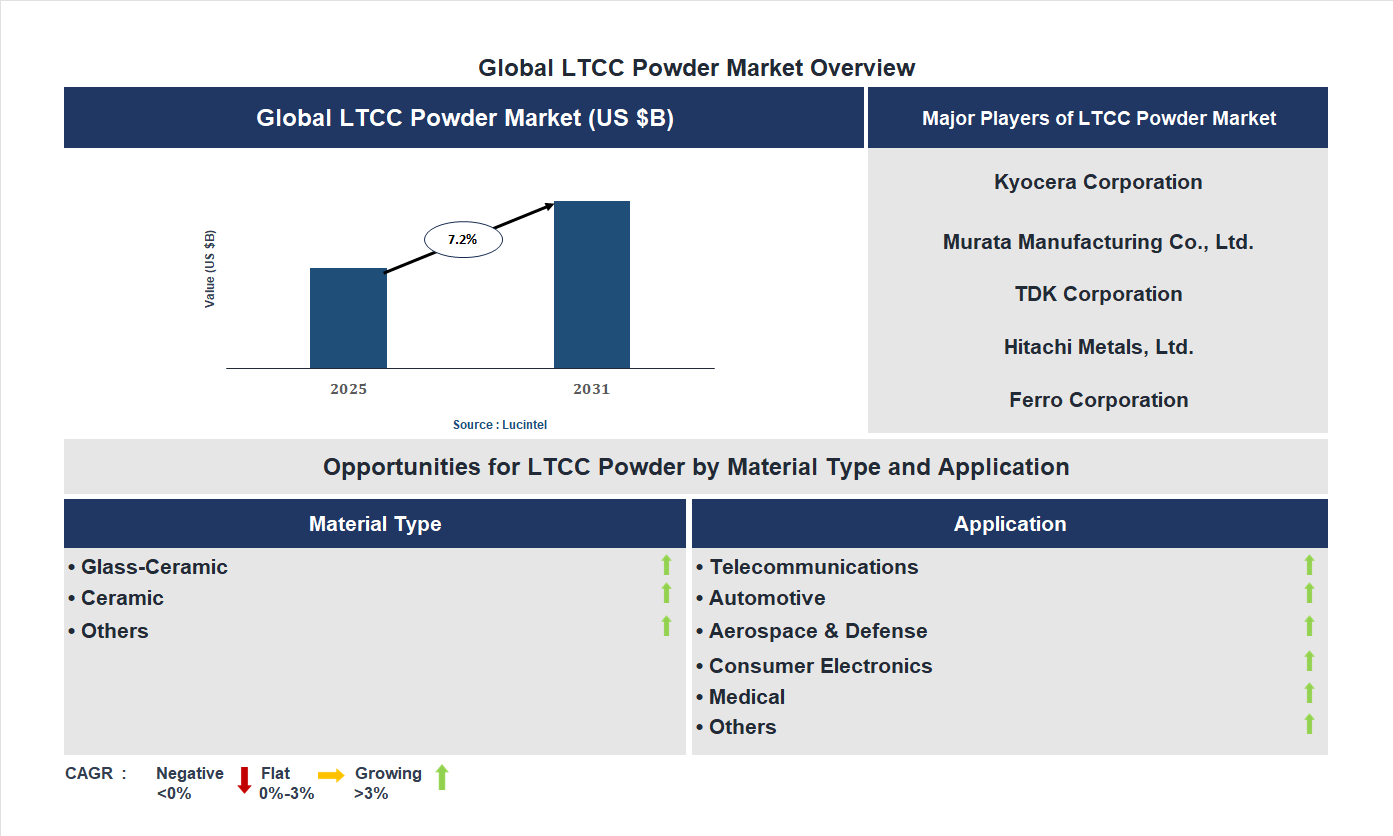
Key data points: The growth forecast = 7.2% annually for the next 7 years. Scroll below to get more insights. This market report covers trends, opportunities and forecasts in LTCC powder market to 2031 by material type (glass-ceramic, ceramic, and others), application (telecommunications, automotive, aerospace & defense, consumer electronics, medical, and others), and region (North America, Europe, Asia Pacific, and the Rest of the World)
We'll send your sample report shortly.
• Lucintel forecasts that, within the material type category, glass-ceramic is expected to witness higher growth over the forecast period.
• Within the application category, consumer electronics is expected to witness the highest growth.
• In terms of region, APAC is expected to witness the highest growth over the forecast period. Gain valuable insights for your business decisions with our comprehensive 150+ page report. Sample figures with some insights are shown below.
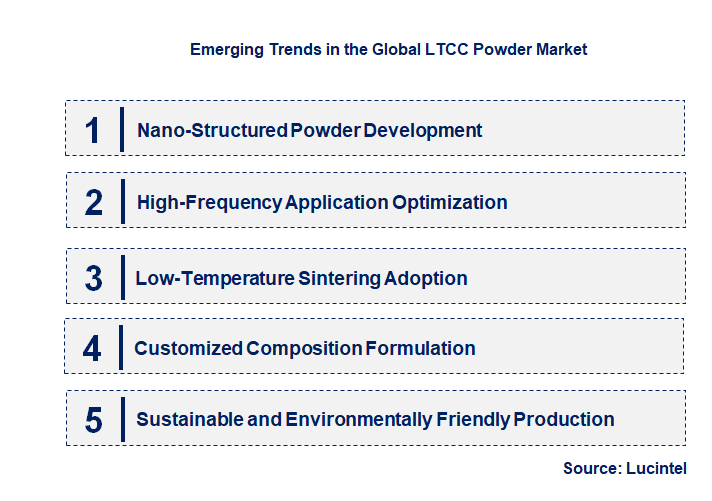
• Nano-Structured Powder Development: Nano-sized LTCC powders are being developed to enhance sintering, densification, and electrical properties. This improves performance for high-frequency and high-density multilayer modules, enabling more compact and efficient electronic devices.
• High-Frequency Application Optimization: Powders are being tailored for high-frequency circuits, minimizing dielectric loss and enhancing signal integrity. This trend supports the growth of 5G, telecommunications, and advanced automotive electronics markets.
• Low-Temperature Sintering Adoption: Development of powders compatible with low-temperature sintering processes reduces energy consumption and enables integration with sensitive components. This facilitates more cost-effective and versatile manufacturing of multilayer ceramic modules.
• Customized Composition Formulation: Manufacturers are designing LTCC powders with specific compositions to meet application-specific requirements. Tailored powders optimize thermal expansion, mechanical strength, and dielectric properties, improving device reliability and performance.
• Sustainable And Environmentally Friendly Production: Focus on eco-friendly LTCC powder synthesis and reduced waste generation is emerging. Sustainable manufacturing practices align with regulatory requirements and industry demand for greener electronics production. These trends are transforming the LTCC powder market toward higher performance, customization, and sustainability. Advanced materials and innovative processing approaches are enabling the development of more reliable, compact, and efficient multilayer ceramic modules.
• High-Purity Powder Advancements: Manufacturers are producing ultra-pure LTCC powders with fewer defects, enhancing sintering uniformity, thermal stability, and dielectric performance. This supports reliable multilayer ceramic module fabrication for high-performance applications.
• Particle Size Control Improvements: Precise control over particle size distribution is improving powder packing, densification, and surface smoothness. Enhanced control enables better layer uniformity and overall device performance in multilayer modules.
• Customized Formulation Development: LTCC powders are being formulated for specific applications, optimizing thermal expansion, dielectric constant, and mechanical properties. Customized powders enhance module reliability and meet stringent industry requirements.
• Low-Temperature Sintering Capabilities: Development of powders suitable for low-temperature sintering allows integration with temperature-sensitive components, reducing processing costs and expanding manufacturing flexibility.
• Collaborative Innovation Initiatives: Partnerships between powder suppliers, electronics manufacturers, and research institutes are accelerating product innovation. Collaborative efforts improve material performance and shorten time-to-market for advanced multilayer modules. Advancements in purity, particle control, customization, and collaboration are strengthening the LTCC powder market. These developments are enhancing device performance, manufacturing efficiency, and adoption across high-demand electronics applications.
• Telecommunications Module Optimization: LTCC powders enhance multilayer ceramic modules used in telecom circuits, improving signal integrity and high-frequency performance. Growth in 5G infrastructure drives sustained demand.
• Automotive Electronics Expansion: Powders tailored for automotive modules improve thermal stability, reliability, and compactness, supporting advanced driver-assistance systems and electric vehicle electronics.
• Consumer Electronics Miniaturization: High-performance LTCC powders enable smaller, more efficient multilayer modules in smartphones, tablets, and wearable devices, driving adoption in consumer electronics.
• Industrial Automation Applications: LTCC powders are used in modules for industrial sensors, actuators, and control systems. Enhanced reliability and thermal resistance support operation in harsh manufacturing environments.
• Defense And Aerospace Module Applications: Powders support high-reliability modules used in defense and aerospace systems. Optimized LTCC powders enhance durability, performance, and long-term stability under extreme conditions. Application-specific opportunities are expanding the LTCC powder market. Tailored material solutions are driving growth in telecom, automotive, consumer, industrial, and defense electronics, increasing adoption and innovation.
• Kyocera Corporation
• Murata Manufacturing Co., Ltd.
• TDK Corporation
• Hitachi Metals, Ltd.
• Ferro Corporation
• CTS Corporation
• Yokowo Co., Ltd.
• KOA Corporation
• Taiyo Yuden Co., Ltd.
• NEO Tech
• Glass-Ceramic
• Ceramic
• Others
• Telecommunications
• Automotive
• Aerospace & Defense
• Consumer Electronics
• Medical
• Others
• North America
• Europe
• Asia Pacific
• The Rest of the World
• United States: U.S. manufacturers are focusing on high-purity LTCC powders with improved sintering and thermal properties. Efforts include collaboration with research institutes to develop powders optimized for high-frequency, high-reliability applications in aerospace, defense, and automotive electronics.
• China: China is expanding domestic LTCC powder production to meet growing demand for consumer electronics and telecom modules. Emphasis is on cost-effective manufacturing, quality consistency, and reducing reliance on imports while fostering innovation through state-supported initiatives.
• Germany: Germany emphasizes precision LTCC powder production for high-performance industrial and automotive electronics. Advanced material engineering ensures reliable multilayer ceramic module fabrication, supporting applications requiring stringent thermal stability and mechanical strength.
• India Emerging Market Development: India is building domestic LTCC powder capabilities through technology transfer and collaborations with global players. Focus is on developing powders suitable for telecom and industrial electronics while gradually improving manufacturing expertise and quality standards.
• Japan: Japan maintains leadership in high-quality LTCC powders, focusing on low-defect, high-purity formulations. Emphasis is on consistent performance for telecommunications, automotive, and defense applications, supporting long-term reliability and integration with advanced multilayer ceramic devices.


• Kyocera Corporation
• Murata Manufacturing Co., Ltd.
• TDK Corporation
• Hitachi Metals, Ltd.
• Ferro Corporation
• CTS Corporation
• Yokowo Co., Ltd.
• KOA Corporation
• Taiyo Yuden Co., Ltd.
• NEO Tech Q5. Which LTCC powder market segment will be the largest in future? Answer: Lucintel forecasts that, within the material type category, glass-ceramic is expected to witness higher growth over the forecast period. Q6. In LTCC powder market, which region is expected to be the largest in next 5 years? Answer: In terms of region, APAC is expected to witness the highest growth over the forecast period. Q7. Do we receive customization in this report? Answer: Yes, Lucintel provides 10% customization without any additional cost.


Choose a license that fits your team. Instant PDF delivery.
Prices exclude taxes. Instant delivery. Custom licensing available on request.
Market Report · September 3, 2026
Market Report · July 22, 2026
Market Report · July 22, 2026
Trusted partner for strategic intelligence and business growth


Receive a complimentary market analysis tailored to your industry. Our analysts will identify key growth opportunities and competitive dynamics specific to your business.

Market size, growth rate, and key trend analysis for your specific sector.

Top competitor positioning and market share analysis.

Strategic recommendations backed by data-driven insights.
Get curated market intelligence and competitive moves straight to your inbox.
By subscribing, you agree to receive our monthly insights. Unsubscribe anytime.
Receive a complimentary market analysis tailored to your industry. Our analysts will identify key growth opportunities and competitive dynamics specific to your business.
Market size, growth rate, and key trend analysis for your specific sector.
Top competitor positioning and market share analysis.
Strategic recommendations backed by data-driven insights.
Get curated market intelligence, emerging trends, and competitive moves straight to your inbox each month.
By subscribing, you agree to receive our monthly insights. Unsubscribe anytime.
We'll send your sample report shortly.