
Report Feature
LTCC Glass Powder Market Trends and Forecast
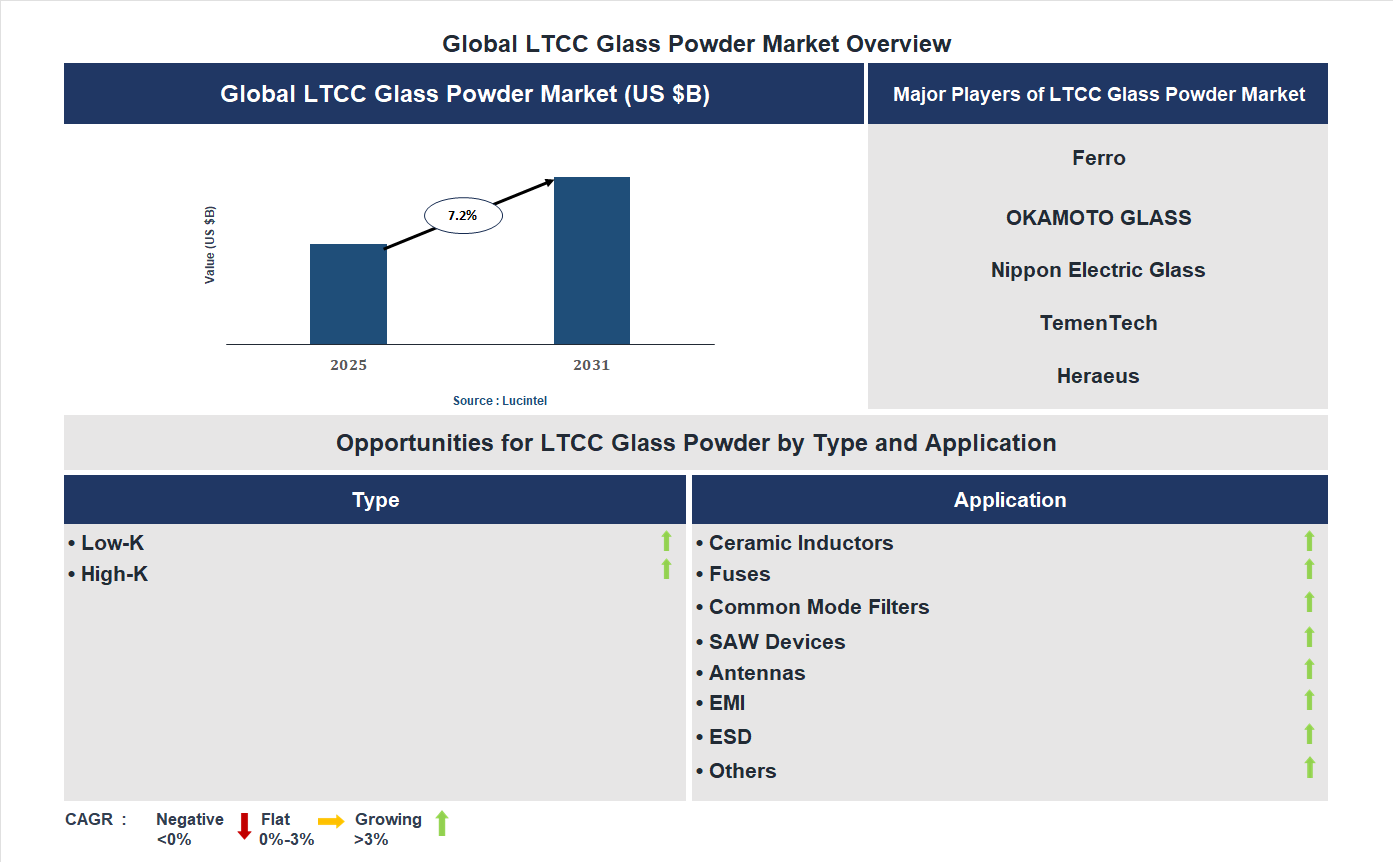
The future of the global LTCC glass powder market looks promising with opportunities in the ceramic inductor, fuse, common mode filter, SAW device, antenna, EMI, and ESD markets. The global LTCC glass powder market is expected to grow with a CAGR of 7.2% from 2025 to 2031. The major drivers for this market are the increasing demand for miniaturized electronic components, the rising use in automotive sensor applications, and the growing adoption in 5G communication devices.• Lucintel forecasts that, within the type category, Low-K is expected to witness higher growth over the forecast period.
• Within the application category, ceramic inductor, fuse, common mode filter, saw device, antenna, EMI, and ESD is expected to witness the highest growth.
• In terms of region, APAC is expected to witness the highest growth over the forecast period. Gain valuable insights for your business decisions with our comprehensive 150+ page report. Sample figures with some insights are shown below.
Emerging Trends in the LTCC Glass Powder Market
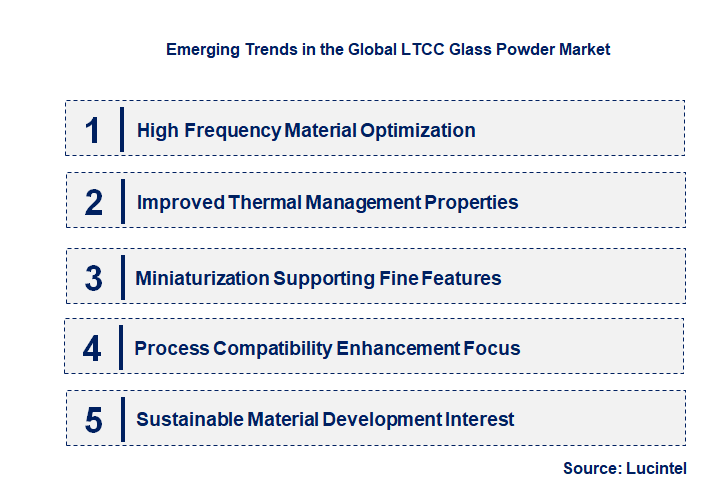
The LTCC glass powder market is adapting to evolving electronic design requirements and increasing performance expectations. Emerging trends focus on material optimization, high-frequency compatibility, and process efficiency to support advanced multilayer ceramic technologies across industries.• High Frequency Material Optimization: LTCC powders are increasingly optimized for stable performance in high-frequency applications, supporting advanced communication systems and signal integrity requirements.
• Improved Thermal Management Properties: Enhanced thermal conductivity and stability are key trends, enabling LTCC materials to handle higher power densities and heat dissipation needs.
• Miniaturization Supporting Fine Features: Demand for finer particle sizes supports miniaturized circuit designs and higher component density in electronic modules.
• Process Compatibility Enhancement Focus: LTCC powders are being refined for better compatibility with multilayer fabrication processes, improving yield and manufacturing efficiency.
• Sustainable Material Development Interest: Growing focus on environmentally responsible material sourcing and processing is influencing LTCC powder development strategies. These trends are reshaping the LTCC glass powder market by enabling higher performance, compact designs, and improved manufacturing efficiency. Material innovation remains central to supporting next-generation electronic applications.
Recent Development in the LTCC Glass Powder Market
Recent developments in the LTCC glass powder market reflect efforts to enhance performance, reliability, and production efficiency. Manufacturers are refining material properties and processing techniques to meet evolving electronics industry requirements.• Advanced Particle Size Control Improvement: Improved control over particle distribution enhances sintering behavior and electrical performance.
• Enhanced Dielectric Property Optimization: Developments focus on achieving stable dielectric constants for reliable circuit performance.
• Improved Sintering Temperature Compatibility: LTCC powders are optimized for lower firing temperatures, improving compatibility with conductive materials.
• Quality Consistency Manufacturing Focus: Enhanced process control ensures uniform material quality across production batches.
• Application Specific Powder Customization: Manufacturers provide tailored LTCC powders to meet specific customer and application needs. These developments are strengthening the LTCC glass powder market by improving material consistency, performance, and adaptability for advanced ceramic electronics manufacturing.
Strategic Growth Opportunities in the LTCC Glass Powder Market
Growth opportunities in the LTCC glass powder market are driven by expanding electronic applications requiring compact, reliable, and high-performance ceramic components. Application-specific demand is creating strong opportunities for material innovation.• Telecommunication Module Manufacturing Growth: LTCC powders support high-frequency modules used in communication infrastructure and devices.
• Automotive Electronics System Expansion: Advanced driver and power modules rely on LTCC materials for reliability and thermal stability.
• Industrial Automation Electronics Demand: LTCC-based circuits support robust industrial control and sensing systems.
• Consumer Electronics Miniaturization Trend: Compact devices benefit from LTCC materials enabling dense multilayer designs.
• Aerospace And Defense Electronics Usage: High-reliability LTCC materials support critical electronic systems in demanding environments. Application-driven opportunities are expanding the LTCC glass powder market across telecom, automotive, industrial, consumer, and aerospace electronics sectors.
LTCC Glass Powder Market Driver and Challenges
The LTCC glass powder market is influenced by technological progress, electronics industry growth, and material performance expectations. While strong drivers support adoption, technical and economic challenges impact material development and market expansion. The factors responsible for driving the LTCC glass powder market include: 1. Growth In Advanced Electronics Demand: Increasing use of compact and high-performance electronic systems drives LTCC powder adoption. 2. Expansion Of Communication Infrastructure: Rising demand for communication modules supports steady LTCC material consumption. 3. Automotive Electronics Complexity Increase: Growing electronic content in vehicles drives demand for reliable ceramic materials. 4. Need For Thermal And Electrical Stability: Performance requirements push demand for advanced LTCC powder formulations. 5. Multilayer Circuit Design Adoption: Increasing use of multilayer ceramic circuits supports long-term market growth. Challenges in the LTCC glass powder market are: 1. High Material Processing Complexity: Achieving consistent particle size and purity requires advanced manufacturing control. 2. Cost Sensitivity In Price Driven Markets: Cost pressures can limit adoption in highly competitive electronics segments. 3. Technical Customization Requirements: Application-specific material needs increase development time and complexity. The LTCC glass powder market benefits from electronics growth, communication expansion, and material innovation needs. However, processing complexity, cost sensitivity, and customization demands highlight the importance of continuous material development and operational efficiency.List of LTCC Glass Powder Companies
Companies in the market compete on the basis of product quality offered. Major players in this market focus on expanding their manufacturing facilities, R&D investments, infrastructural development, and leverage integration opportunities across the value chain. With these strategies LTCC glass powder companies cater increasing demand, ensure competitive effectiveness, develop innovative products & technologies, reduce production costs, and expand their customer base. Some of the LTCC glass powder companies profiled in this report include-• Ferro
• OKAMOTO GLASS
• Nippon Electric Glass
• TemenTech
• Heraeus
LTCC Glass Powder Market by Segment
The study includes a forecast for the global LTCC glass powder market by type, application, and region.LTCC Glass Powder Market by Type [Value from 2019 to 2031]:
• Low-K
• High-K
LTCC Glass Powder Market by Application [Value from 2019 to 2031]:
• Ceramic Inductors
• Fuses
• Common Mode Filters
• SAW Devices
• Antennas
• EMI
• ESD
• Others
LTCC Glass Powder Market by Region [Value from 2019 to 2031]:
• North America
• Europe
• Asia Pacific
• The Rest of the World
Country Wise Outlook for the LTCC Glass Powder Market
The LTCC glass powder market is evolving as demand rises for compact, high-performance electronic components. Growth in telecommunications, automotive electronics, and industrial systems is increasing the need for reliable ceramic materials. Manufacturers are focusing on material purity, thermal performance, and compatibility with advanced circuit designs to support multilayer ceramic applications across global markets.• United States: The United States is strengthening LTCC powder development through innovation in material formulations and processing consistency. Efforts emphasize high-frequency performance, thermal stability, and reliability for defense, aerospace, and advanced communication applications. Collaboration between material suppliers and electronics manufacturers supports tailored LTCC solutions.
• China: China continues to expand large-scale LTCC powder manufacturing to support domestic electronics and telecom industries. Focus areas include cost efficiency, volume scalability, and steady quality improvement. Rising demand from communication infrastructure and consumer electronics is driving rapid capacity expansion.
• Germany: Germany’s LTCC glass powder market emphasizes precision materials for automotive electronics and industrial systems. Developments focus on consistency, reliability, and performance under harsh conditions. Integration with advanced automotive modules supports strong demand for high-quality LTCC materials.
• India: India is gradually increasing LTCC powder adoption driven by electronics manufacturing growth. Focus remains on affordable materials, import substitution, and capability building. Expansion of telecom and industrial electronics supports steady market development.
• Japan: Japan leads in high-purity LTCC powder development with strong emphasis on particle size control and dielectric performance. Advanced material science supports applications in miniaturized electronics, automotive modules, and high-frequency communication systems.

Features of the Global LTCC Glass Powder Market
Market Size Estimates: LTCC glass powder market size estimation in terms of value ($B). Trend and Forecast Analysis: Market trends (2019 to 2024) and forecast (2025 to 2031) by various segments and regions. Segmentation Analysis: LTCC glass powder market size by type, application, and region in terms of value ($B). Regional Analysis: LTCC glass powder market breakdown by North America, Europe, Asia Pacific, and Rest of the World. Growth Opportunities: Analysis of growth opportunities in different type, application, and regions for the LTCC glass powder market. Strategic Analysis: This includes M&A, new product development, and competitive landscape of the LTCC glass powder market. Analysis of competitive intensity of the industry based on Porter’s Five Forces model.
FAQ
Q1. What is the growth forecast for LTCC glass powder market? Answer: The global LTCC glass powder market is expected to grow with a CAGR of 7.2% from 2025 to 2031. Q2. What are the major drivers influencing the growth of the LTCC glass powder market? Answer: The major drivers for this market are the increasing demand for miniaturized electronic components, the rising use in automotive sensor applications, and the growing adoption in 5g communication devices. Q3. What are the major segments for LTCC glass powder market? Answer: The future of the LTCC glass powder market looks promising with opportunities in the ceramic inductor, fuse, common mode filter, SAW device, antenna, EMI, and ESD markets. Q4. Who are the key LTCC glass powder market companies? Answer: Some of the key LTCC glass powder companies are as follows:• Ferro
• OKAMOTO GLASS
• Nippon Electric Glass
• TemenTech
• Heraeus Q5. Which LTCC glass powder market segment will be the largest in future? Answer: Lucintel forecasts that, within the type category, Low-K is expected to witness higher growth over the forecast period. Q6. In LTCC glass powder market, which region is expected to be the largest in next 5 years? Answer: In terms of region, APAC is expected to witness the highest growth over the forecast period. Q7. Do we receive customization in this report? Answer: Yes, Lucintel provides 10% customization without any additional cost.
Table of Contents
List of Figures
List of Tables
Methodology
- In-depth interviews of the major players in this market
- Detailed secondary research from competitors’ financial statements and published data
- Extensive searches of published works, market, and database information pertaining to industry news, company press releases, and customer intentions
- A compilation of the experiences, judgments, and insights of Lucintel’s professionals, who have analyzed and tracked this market over the years.


Buy Now
Choose a license that fits your team. Instant PDF delivery.
Prices exclude taxes. Instant delivery. Custom licensing available on request.
Key Questions
- • What are some of the most promising, high-growth opportunities for the LTCC glass powder market by type (low-K and high-K), application (ceramic inductors, fuses, common mode filters, SAW devices, antennas, EMI, ESD, and others), and region (North America, Europe, Asia Pacific, and the Rest of the World)?
- • Which segments will grow at a faster pace and why?
- • Which region will grow at a faster pace and why?
- • What are the key factors affecting market dynamics? What are the key challenges and business risks in this market?
- • What are the business risks and competitive threats in this market?
- • What are the emerging trends in this market and the reasons behind them?
- • What are some of the changing demands of customers in the market?
- • What are the new developments in the market? Which companies are leading these developments?
- • Who are the major players in this market? What strategic initiatives are key players pursuing for business growth?
- • What are some of the competing products in this market and how big of a threat do they pose for loss of market share by material or product substitution?
- • What M&A activity has occurred in the last 5 years and what has its impact been on the industry? For any questions related to LTCC Glass Powder Market, LTCC Glass Powder Market Size, LTCC Glass Powder Market Growth, LTCC Glass Powder Market Analysis, LTCC Glass Powder Market Report, LTCC Glass Powder Market Share, LTCC Glass Powder Market Trends, LTCC Glass Powder Market Forecast, LTCC Glass Powder Companies, write Lucintel analyst at email: helpdesk@lucintel.com. We will be glad to get back to you soon.


