
Market Report · July 22, 2026

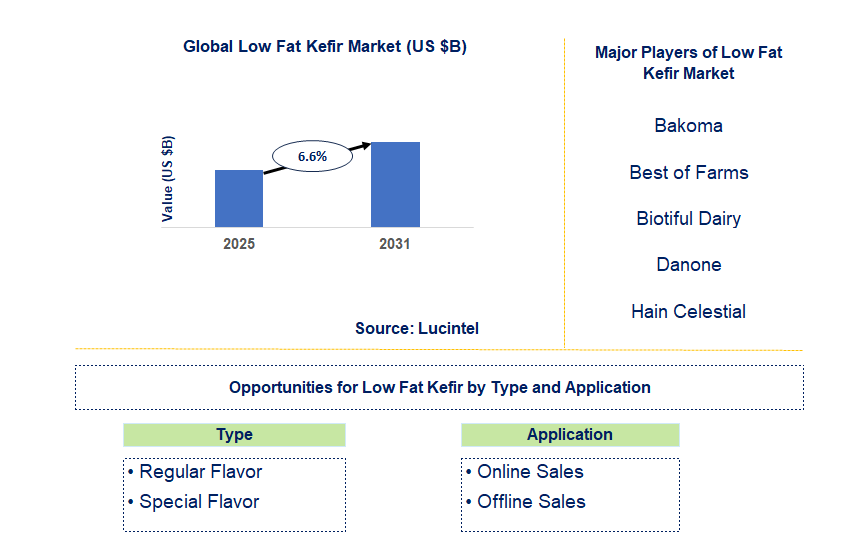
Key data points: The growth forecast = 6.6% annually for the next 7 years. Scroll below to get more insights. This market report covers Trends, opportunities and forecasts in low fat kefir market to 2031 by type (regular flavor and special flavor), application (online sales and offline sales), and region (North America, Europe, Asia Pacific, and the Rest of the World)
We'll send your sample report shortly.
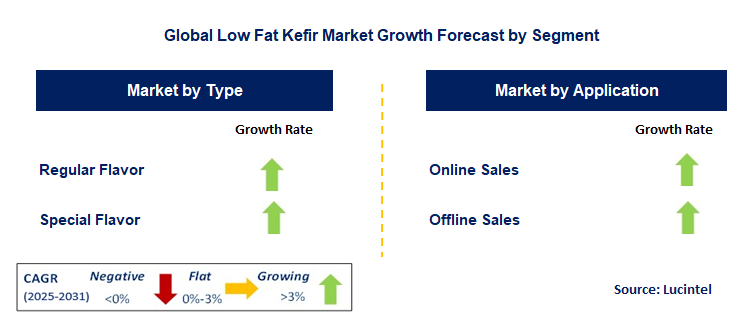
• Lucintel forecasts that, within the type category, special flavor is expected to witness higher growth over the forecast period due to the growing demand for unique taste experiences.
• Within the application category, online sale is expected to witness higher growth.
• In terms of region, APAC is expected to witness the highest growth over the forecast period.
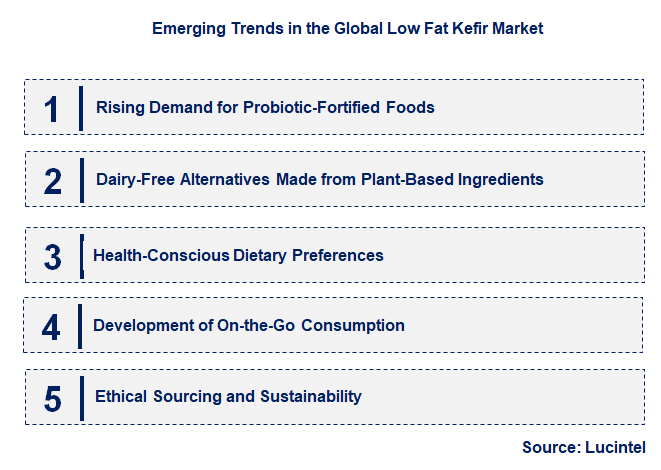
• Rising Demand for Probiotic-Fortified Foods: People are increasingly realizing the importance of probiotics in ensuring a healthy gut and immune system. Therefore, the demand for probiotic-enriched foods such as low fat kefir is increasing. Kefir is viewed as a perfect food because of its high probiotic level, which aids digestion and general health. This trend will persist because more consumers look for functional foods that enhance health beyond nutritional needs.
• Dairy-Free Alternatives Made from Plant-Based Ingredients: As more and more consumers take to plant-based diets, plant-based dairy kefir alternatives created using almond, soy, and coconut milk ingredients are gaining ground. These dairy-free kefirs appeal to consumers who happen to be lactose intolerant, vegan, or simply searching for dairy-free versions. The trend is helping the market to grow by luring in an increasing number of consumers who, by habit, avoid dairy foods.
• Health-Conscious Dietary Preferences: Consumers are increasingly looking for foods that have less fat, sugar, and calories but still provide nutritional value. low fat kefir is perfectly placed to accommodate these preferences since it presents a healthier option compared to high-fat dairy products. As more individuals become health-conscious, they are hunting for foods that fit into their wellness agenda, further propelling the demand for low fat kefir.
• Development of On-the-Go Consumption: As more people have busy lifestyles, there is increasing demand for easy-on-the-go food and beverages. The versatility of low fat kefir makes it a perfect choice for this trend because it can be consumed in a mobile bottle or cup, and consumers can easily take a healthy, probiotic-rich drink or snack anywhere. Convenience is likely to grow as companies create packaging that accommodates this desire.
• Ethical Sourcing and Sustainability: As more consumers make sustainability an important concern, producers face pressure to support ethical sourcing activities and environmentally oriented packaging. Throughout the low fat kefir market, it is exemplified in increased requests for sustainably made or organic kefir as well as by using recyclable or biodegradable containers. Consumers increasingly choose products with personal values associated, and there exists a platform through which businesses may create more sustainable products. Such new trends are transforming the low fat kefir market through innovation, growing awareness among consumers, and affecting purchasing behavior. With changing consumer preferences for healthier, more sustainable, and convenient products, the market is transforming accordingly. The low fat kefir market growth will be impacted by how the manufacturers will respond to such trends and explore opportunities for innovation and differentiation.
• Product Innovation and Flavor Variety: Companies have been innovating to provide a greater range of flavors and formulations for low fat kefir to suit different consumer preferences. This involves the addition of fruit, spices, or herbs to the kefir, as well as the introduction of new flavors like coconut, vanilla, and tropical fruits. These developments are serving to widen kefir's appeal, not least among young consumers and others seeking more innovative, flavorful replacements for conventional dairy products.
• Development of Plant-Based Kefir Variants: The development of the plant-based food industry has led numerous manufacturers to introduce plant-based low fat kefir variants. Based on almond, soy, or coconut milk, these variants provide a dairy-free alternative to kefir while preserving its probiotic value and nutritional benefits. The launch of plant-based kefir is expanding the marketplace, enabling manufacturers to reach the increasing number of lactose-intolerant, vegan, and health-focused consumers.
• Packaging Sustainability Initiatives: With environmental awareness increasing, producers in the low fat kefir market are going green by adopting sustainable packaging solutions. More are turning towards recyclable or biodegradable packaging materials and cutting down on plastic use. The trend is not only prompted by environmental motives but also due to consumer preferences for green products. Firms embracing sustainability are reaping competitive advantages by tapping into environmentally oriented consumers.
• Greater Distribution via Retail and E-commerce: Low fat kefir is now available in both conventional retail outlets and online, making it more accessible to the consumer. With the rise of e-commerce, numerous brands are now going digital to make themselves available to a wider consumer base, enabling consumers to buy kefir products in the comfort of their homes. This trend is particularly critical in reaching health-conscious consumers who value convenience through online shopping.
• Focus on Functional Benefits and Health Positioning: Manufacturers are increasingly positioning low fat kefir as a functional food that supports gut health, immunity, and overall wellness. This health-focused positioning is helping kefir gain recognition as a more than just a beverage but as a health-promoting product. With a focus placed on its probiotic nature, low fat kefir is being sold as an integral element of a lifestyle of health, which is driving more consumers toward the product. These are the key developments that are contributing to the growth and transformation of the low fat kefir market. Companies are taking cues from customers' demands for healthier, sustainable, and more innovative products. By continuing to evolve in sync with these developments, companies are poised to capture new growth possibilities and address the needs of the changing consumer world.
• Expansion in Plant-Based Kefir Alternatives: With the increasing demand for plant-based diets, the low fat kefir market can be increased by creating dairy-free alternatives. Plant-based kefir produced from almond, coconut, and soy milk can appeal to the growing number of lactose-intolerant, vegan, and dairy-free consumers. This segment will expand as more consumers look for dairy alternatives with comparable probiotic benefits.
• Addition of Functional Ingredients: There is also a possibility of adding more functional ingredients, for example, prebiotics, protein, or vitamins, into low fat kefir in order to promote its health benefit. This can enable manufacturers to market kefir as a superfood with further greater health benefits, enabling it to compete as a functional food. By introducing extra benefits such as enhanced immune support or muscle recovery, companies can attract healthy consumers seeking multi-purpose foods.
• On-the-Go Packaging Solutions: Consumers with busy lifestyles are increasingly seeking convenient, portable food and beverage products. There is a potential for manufacturers to develop single-serve, on-the-go packaging for low fat kefir so that consumers can conveniently carry it as a healthy snack or beverage. Demand for convenient packaging will be on the rise, so this will be a profitable opportunity for brands that wish to target busy professionals, students, and health-conscious individuals.
• Health and Wellness Marketing Strategies: Highlighting the health advantages of low fat kefir, including maintaining gut health, enhancing immunity, and overall well-being, can help manufacturers take advantage of the increasing health and wellness trend. Marketing kefir as a functional food with many health benefits provides opportunities to appeal to health-oriented consumers. Brands that effectively convey these benefits in their marketing strategies will be able to grab a greater market share.
• Global Expansion: With rising global awareness of low fat kefir, producers can expand distribution channels and venture into new markets abroad. In nations with a developing interest in probiotic and functional foods, such as India, Japan, and China, there is vast market penetration potential. Firms that are able to successfully launch low fat kefir into new markets, especially in Asia and the Middle East, will be able to capitalize on the increasing demand for health-oriented food products. The low fat kefir market offers several opportunities for growth in different applications, ranging from plant-based substitutes to on-the-go packaging options. By exploiting these opportunities and tapping into increasing demand for healthy, functional foods, manufacturers can gain a competitive edge and increase their market share worldwide.
• Bakoma
• Best of Farms
• Biotiful Dairy
• Danone
• Hain Celestial
• Krasnystaw
• Les Produits De Marque Liberte
• Lifeway Foods
• Nestle
• Valio
• Regular Flavor
• Special Flavor
• Online Sales
• Offline Sales
• North America
• Europe
• Asia Pacific
• The Rest of the World
• United States: In the United States, the low fat kefir market has experienced robust growth due to the increasing demand for probiotic-enriched, low-calorie, and functional foods. The health-aware consumer group is driving the demand for kefir as a healthy substitute to high-fat, sweet dairy foods. The ease of use of kefir in smoothies, snack foods, and as an add-in to other foods is also driving its market growth. With consumers increasingly embracing plant-based lifestyles, kefir alternatives that are made from coconut, almond, and soy milk are also gaining ground. Packaging innovations, including single-serving and environmentally friendly packs, are also propelling market expansion.
• China: Low fat kefir has performed well in China, especially in the urban market where there is expanding interest in Western-style health concepts and dairy products. Growing health awareness about probiotics, particularly for gut health and digestion, is driving kefir demand. Chinese consumers are becoming increasingly open to fermented foods, led by a change in eating habits and growing disposable incomes. Popularity of kefir is also fueled by its image as a healthy snack, commonly sold as a low-calorie drinkable yogurt. Local producers are starting to launch more price-friendly kefir products that can appeal to price-conscious middle-class consumers.
• Germany: Germany, known for its strong dairy culture, has seen low fat kefir gain popularity due to its health benefits, particularly for digestion and immunity. The market has grown with increasing demand for functional foods that are low in fat and rich in probiotics. Kefir is becoming a staple in German households as part of a balanced, healthy diet. In addition, the increasing trend towards natural and organic foods has promoted the creation of organic low fat kefir varieties. Eco-friendliness is also an issue, where manufacturers are beginning to consider green packaging and domestic procurement of ingredients to appeal to green-conscious consumers.
• India: The Indian low fat kefir market remains nascent, but it holds strong promise based on increasing health consciousness and growing demand for probiotic foods. The health-aware middle class is increasingly seeking low-fat dairy foods with functional attributes. Although conventional yogurt is a well-liked product in India, kefir is emerging as a beverage with comparable health benefits but with a distinctive taste and texture. Local dairy companies are beginning to innovate kefir formulations that appeal to Indian tastes, with flavors such as mango and cardamom. Yet consumer education on the value of kefir is required on a broader scale for greater adoption.
• Japan: Low fat kefir is gaining popularity in Japan as a part of the rising demand for gut-wellness products. Japanese consumers are extremely interested in functional foods, especially those with digestive-wellness benefits. Kefir is presented as a beverage dairy food with probiotic value, fitting within the wellness- and longevity-emphasizing culture of Japan. The trend is also being driven by the increasing number of health-aware young consumers who are moving away from sweetened beverages towards healthier options. The versatility of kefir, such as its application in smoothies and desserts, is also contributing to its expansion in the Japanese market.


• Bakoma
• Best of Farms
• Biotiful Dairy
• Danone
• Hain Celestial
• Krasnystaw
• Les Produits De Marque Liberte
• Lifeway Foods
• Nestle
• Valio Q5. Which low fat kefir market segment will be the largest in future? Answer: Lucintel forecasts that, within the type category, special flavor is expected to witness higher growth over the forecast period due to the growing demand for unique taste experiences. Q6. In low fat kefir market, which region is expected to be the largest in next 5 years? Answer: In terms of region, APAC is expected to witness the highest growth over the forecast period. Q7. Do we receive customization in this report? Answer: Yes, Lucintel provides 10% customization without any additional cost.


Choose a license that fits your team. Instant PDF delivery.
Prices exclude taxes. Instant delivery. Custom licensing available on request.
Market Report · July 22, 2026
Market Report · July 22, 2026
Market Report · July 22, 2026
Trusted partner for strategic intelligence and business growth


Receive a complimentary market analysis tailored to your industry. Our analysts will identify key growth opportunities and competitive dynamics specific to your business.

Market size, growth rate, and key trend analysis for your specific sector.

Top competitor positioning and market share analysis.

Strategic recommendations backed by data-driven insights.
Get curated market intelligence and competitive moves straight to your inbox.
By subscribing, you agree to receive our monthly insights. Unsubscribe anytime.
Receive a complimentary market analysis tailored to your industry. Our analysts will identify key growth opportunities and competitive dynamics specific to your business.
Market size, growth rate, and key trend analysis for your specific sector.
Top competitor positioning and market share analysis.
Strategic recommendations backed by data-driven insights.
Get curated market intelligence, emerging trends, and competitive moves straight to your inbox each month.
By subscribing, you agree to receive our monthly insights. Unsubscribe anytime.
We'll send your sample report shortly.