
Market Report · July 31, 2026

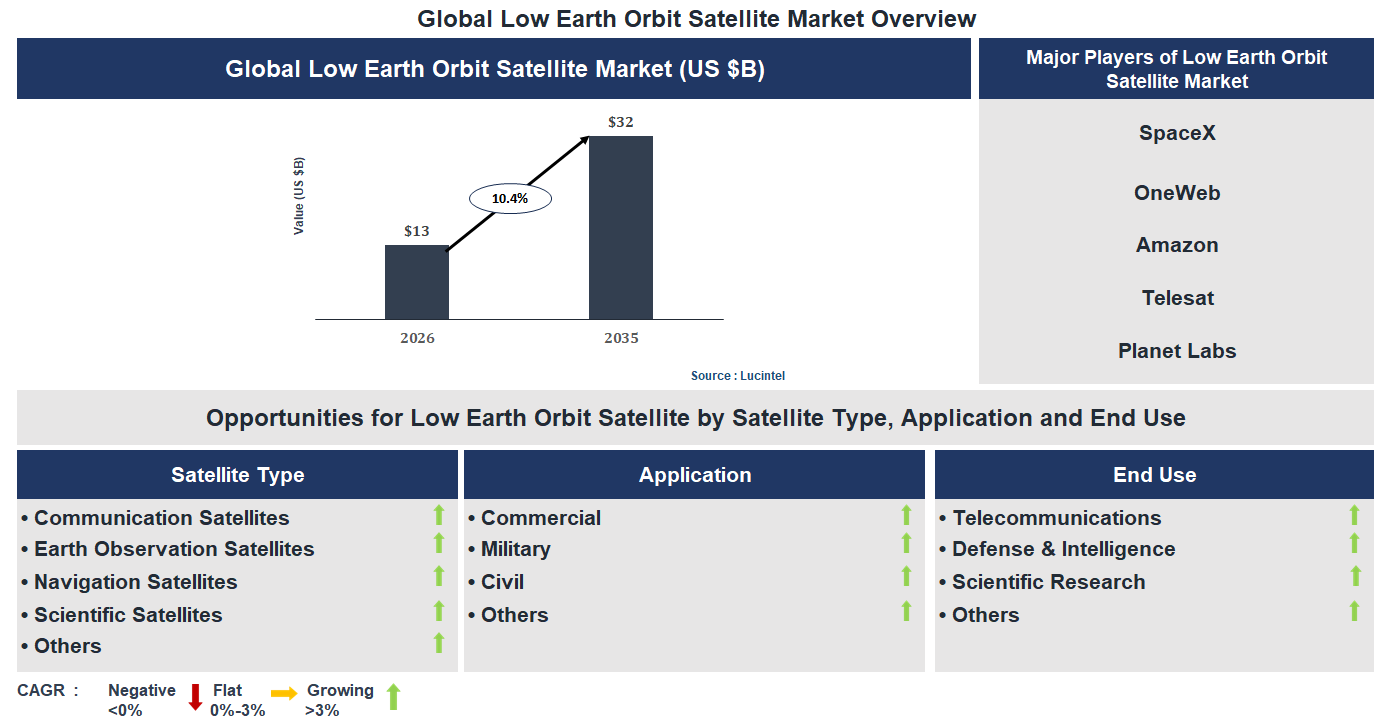
Key data points: The market size in 2035 = $32 billion, growth forecast = 10.4% annually for the next 8 years. Scroll below to get more insights. This market report covers trends, opportunities and forecasts in low earth orbit satellite market to 2035 by satellite type (communication satellites, earth observation satellites, navigation satellites, scientific satellites, and others), application (commercial, military, civil, and others), end use (telecommunications, defense & intelligence, scientific research, and others), and region (North America, Europe, Asia Pacific, and the Rest of the World)
We'll send your sample report shortly.
• Lucintel forecasts that, within the satellite type category, communication satellite is expected to witness the highest growth over the forecast period.
• Within the end use category, telecommunication is expected to witness the highest growth.
• In terms of region, North America is expected to witness the highest growth over the forecast period. Gain valuable insights for your business decisions with our comprehensive 150+ page report. Sample figures with some insights are shown below.
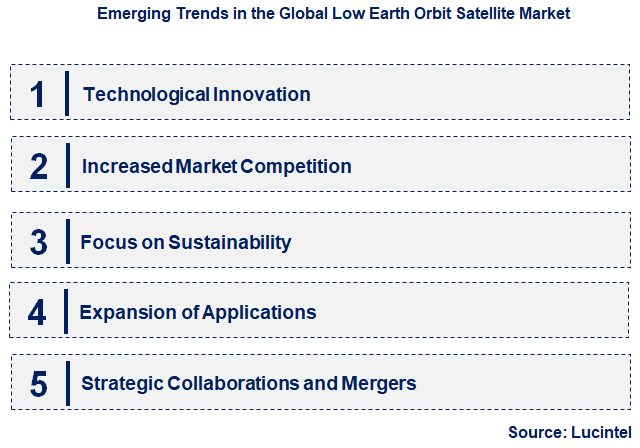
• Technological Innovation: Advancements in miniaturization and propulsion systems are enabling smaller, more efficient satellites. These innovations reduce launch costs and increase deployment flexibility, allowing for larger satellite constellations. Enhanced onboard processing and AI integration improve data handling and operational autonomy. This trend accelerates market growth by making satellite deployment more affordable and scalable, fostering new applications in IoT, remote sensing, and broadband services.
• Increased Market Competition: The entry of new players, including tech giants and startups, intensifies competition. Companies are vying for market share through innovative service offerings and strategic partnerships. This competitive landscape drives price reductions, improves service quality, and accelerates technological development. As a result, consumers benefit from more affordable and diverse satellite-based solutions, fostering market expansion and innovation.
• Focus on Sustainability: Environmental concerns and space debris management are gaining prominence. Companies are adopting sustainable practices such as designing satellites for end-of-life deorbiting and using eco-friendly materials. Regulatory bodies are implementing stricter guidelines to mitigate space debris risks. This trend promotes responsible growth in the industry, ensuring long-term viability and minimizing environmental impact, which is increasingly important to consumers and regulators alike.
• Expansion of Applications: Beyond traditional communications, LEO satellites are increasingly used in sectors like agriculture, disaster management, and urban planning. Real-time data from satellite constellations enhances decision-making and operational efficiency. The diversification of applications broadens market scope, attracting investments and fostering innovation across multiple industries, ultimately transforming how data is collected and utilized globally.
• Strategic Collaborations and Mergers: Partnerships between satellite operators, technology providers, and governments are becoming more common. These collaborations facilitate resource sharing, technological exchange, and market entry. Mergers and acquisitions are consolidating industry players, creating more robust entities capable of large-scale deployment. This trend enhances market stability, accelerates technological progress, and expands service offerings, shaping a more integrated and competitive industry landscape. These trends are collectively reshaping the low earth orbit satellite market by fostering innovation, promoting sustainability, expanding applications, and increasing competition. They are driving the industry toward more efficient, responsible, and versatile satellite solutions, ultimately enabling broader global connectivity and data-driven decision-making.
• Growing Demand for Global Connectivity: The increasing need for reliable, high-speed internet access in remote and underserved areas is driving the deployment of LEO satellites. Governments and private companies are investing heavily to bridge the digital divide, resulting in expanded market opportunities. This demand is fostering innovation in satellite technology, lowering costs, and accelerating deployment timelines, ultimately making global connectivity more accessible and affordable.
• Advancements in Satellite Technology: Recent innovations include miniaturization, improved propulsion systems, and enhanced payload capabilities. These technological improvements are enabling the development of smaller, more efficient satellites with longer lifespans. The impact is significant, as it reduces launch costs and allows for larger satellite constellations, increasing coverage and capacity. This progress is crucial for meeting the growing demand for high-speed internet and data services worldwide.
• Cost Reduction through Reusable Launch Vehicles: The advent of reusable launch vehicles has drastically decreased launch costs for LEO satellites. Companies like SpaceX and Blue Origin are leading this change, making satellite deployment more economical. This cost efficiency encourages more frequent launches and larger satellite constellations, which enhance network coverage and resilience. The reduced costs are also opening opportunities for smaller players and startups to participate in the market, fostering innovation and competition.
• Expansion of Commercial and Government Applications: LEO satellites are increasingly used for diverse applications such as Earth observation, navigation, and military surveillance. The expanding use cases are driven by technological improvements and the need for real-time data. This diversification is boosting market growth, attracting investments, and encouraging collaboration between commercial and government sectors. The increased application scope is also fostering innovation in satellite design and data analytics, further propelling market expansion.
• Integration of Artificial Intelligence and IoT: The integration of AI and IoT with LEO satellite networks is enhancing data processing, analytics, and automation capabilities. This synergy is enabling real-time decision-making for sectors like agriculture, disaster management, and urban planning. The impact includes improved efficiency, reduced operational costs, and new revenue streams. As AI and IoT technologies mature, their incorporation into satellite systems will further expand market applications and drive future growth. The overall impact of these developments is transforming the low earth orbit satellite market into a more dynamic, cost-effective, and versatile industry. Enhanced technological capabilities, reduced costs, and broader application scopes are attracting new entrants and investments. This evolution is accelerating market growth, expanding coverage, and fostering innovation, ultimately making satellite-based connectivity and services more accessible and efficient worldwide.
• Expanding Connectivity in Remote and Underserved Areas: LEO satellites offer affordable, high-speed internet access to remote and rural regions where traditional infrastructure is limited or unavailable. This creates significant opportunities for telecom providers and governments to bridge the digital divide, improve education, healthcare, and economic development. The low latency and high bandwidth capabilities of LEO constellations make them ideal for delivering reliable connectivity in challenging environments, fostering inclusive growth.
• Enhancing Global Internet Coverage and Speed: The deployment of large-scale LEO satellite constellations aims to provide seamless, high-speed internet worldwide. This opportunity addresses the increasing demand for bandwidth driven by streaming, cloud computing, and remote work. Companies like SpaceX and OneWeb are investing heavily to create resilient, low-latency networks that can serve urban and rural areas alike, transforming the landscape of global telecommunications and enabling new digital services.
• Supporting IoT and Smart City Initiatives: LEO satellites are crucial for expanding IoT networks by providing low-latency, reliable connectivity across vast areas. This supports smart city applications such as traffic management, environmental monitoring, and public safety systems. The ability to connect billions of devices in real-time opens new revenue streams for satellite operators and technology firms, fostering innovation in urban planning, agriculture, and resource management.
• Strengthening Defense and Security Capabilities: Governments and defense agencies recognize the strategic importance of LEO satellites for secure communications, surveillance, and reconnaissance. These satellites enable rapid data transmission, real-time monitoring, and resilient networks resistant to terrestrial disruptions. The growing need for national security and military applications drives investments in advanced satellite technologies, creating opportunities for defense contractors and satellite manufacturers to develop specialized solutions.
• Accelerating Environmental Monitoring and Disaster Management: LEO satellites provide critical data for climate change research, natural disaster prediction, and environmental conservation. Their ability to deliver high-resolution imagery and real-time data supports early warning systems and disaster response efforts. This market opportunity encourages collaboration between governments, NGOs, and private firms to develop sustainable solutions for monitoring ecosystems, managing resources, and mitigating the impacts of climate-related events. The overall growth of the low earth orbit satellite market is poised to revolutionize global connectivity, security, and environmental management, driven by these strategic opportunities. As technology advances and investments increase, the market will become more dynamic, fostering innovation and expanding access to vital services worldwide.
• Technological Advancements: The continuous development of miniaturized, efficient satellite components and propulsion systems enhances satellite performance and reduces costs. Innovations like phased array antennas and advanced propulsion enable faster deployment and improved data transmission capabilities. These technological improvements make LEO satellites more accessible and versatile, supporting applications such as broadband internet, Earth observation, and IoT connectivity. As technology evolves, the market benefits from increased reliability, lower manufacturing costs, and expanded service offerings, fostering rapid industry growth.
• Decreasing Launch Costs: The emergence of reusable launch vehicles and competitive launch service providers has significantly reduced the cost of deploying satellites into LEO. Companies like SpaceX and Rocket Lab have pioneered cost-effective launch solutions, enabling smaller firms and startups to participate in satellite deployment. Lower launch costs facilitate the deployment of larger satellite constellations, which are essential for global coverage and high-capacity services. This affordability accelerates market expansion, attracts new entrants, and supports the development of innovative satellite-based applications.
• Growing Demand for Global Connectivity: The increasing need for reliable, high-speed internet access in remote and underserved regions drives demand for LEO satellite constellations. Governments and private companies aim to bridge the digital divide by deploying satellite networks that provide broadband services worldwide. This demand is further fueled by the proliferation of connected devices and the expansion of IoT applications. As a result, the market experiences heightened interest from telecom operators, internet service providers, and technology firms seeking to deliver seamless connectivity, thereby expanding the market scope.
• Government Initiatives and Regulatory Support: Governments worldwide are actively promoting space exploration and satellite deployment through funding, policy frameworks, and regulatory reforms. Initiatives like the U.S. FCCs streamlined licensing process and international cooperation efforts facilitate easier market entry and operational compliance. Regulatory support ensures safety standards, spectrum allocation, and debris mitigation measures are in place, fostering a sustainable growth environment. These supportive policies encourage investment, innovation, and international collaboration, which collectively bolster the expansion of the LEO satellite market. The challenges facing the low earth orbit satellite market include:
• High Deployment and Maintenance Costs: Despite technological advancements, the initial costs of manufacturing, launching, and maintaining LEO satellite constellations remain substantial. The expenses associated with satellite production, ground infrastructure, and frequent replacements pose financial barriers, especially for smaller firms. Additionally, ongoing maintenance and upgrades are required to ensure optimal performance, adding to operational costs. These financial challenges can limit market entry and slow down the deployment of large-scale satellite networks, impacting overall industry growth.
• Regulatory and Spectrum Allocation Challenges: Navigating the complex regulatory landscape across different countries presents significant hurdles. Spectrum allocation conflicts, licensing delays, and compliance requirements can impede satellite deployment and operations. International coordination is necessary to prevent signal interference and ensure fair spectrum sharing, but differing national policies often complicate this process. These regulatory challenges can cause delays, increase costs, and restrict market expansion, especially for global satellite constellations.
• Space Debris and Sustainability Concerns: The proliferation of LEO satellites raises environmental and safety issues related to space debris. Collisions and debris generation threaten operational satellites and future launches, creating a pressing need for debris mitigation strategies. Regulatory bodies are increasingly emphasizing sustainable practices, but implementing effective debris management remains complex and costly. Failure to address these concerns could lead to stricter regulations, operational risks, and reputational damage, hindering long-term market development. The low earth orbit satellite market is driven by rapid technological innovations, decreasing launch costs, increasing demand for global connectivity, and supportive regulatory initiatives. However, high deployment costs, regulatory complexities, and space debris concerns pose significant challenges. These factors collectively influence the pace and scope of market growth, requiring stakeholders to balance innovation with sustainability and regulatory compliance. The markets future will depend on how effectively these drivers are leveraged and challenges mitigated, shaping a dynamic landscape for satellite-based services worldwide.
• SpaceX
• OneWeb
• Amazon
• Telesat
• Planet Labs
• Iridium Communications
• LeoSat Enterprises
• Kepler Communications
• Globalstar
• ICEYE
• Communication Satellites
• Earth Observation Satellites
• Navigation Satellites
• Scientific Satellites
• Others
• Commercial
• Military
• Civil
• Others
• Telecommunications
• Defense & Intelligence
• Scientific Research
• Others
• North America
• Europe
• Asia Pacific
• The Rest of the World
• United States: The US has seen significant investments from private companies like SpaceX and OneWeb, expanding satellite constellations for global internet coverage. NASA and the Department of Defense are also deploying advanced LEO satellites for scientific and security purposes. Regulatory frameworks are evolving to accommodate increased commercial activity, fostering innovation and competition.
• China: China has accelerated its LEO satellite initiatives with the launch of large-scale constellations aimed at enhancing national security and communication infrastructure. The government is promoting domestic satellite manufacturing and fostering international collaborations. Recent launches include the BeiDou navigation systems expansion and new commercial satellite projects.
• Germany: Germany is focusing on integrating LEO satellites into its space infrastructure, emphasizing scientific research and environmental monitoring. The country is investing in satellite technology development and collaborating with European partners to strengthen its position in the European Space Agencys initiatives. Private sector involvement is also increasing, supporting innovative applications.
• India: India has made notable progress with the launch of its own LEO satellite constellations to improve rural connectivity and disaster management. The Indian Space Research Organization (ISRO) is expanding its satellite capabilities, and the government is encouraging private sector participation through policy reforms. Recent launches aim to support both domestic and international markets.
• Japan: Japan is advancing its LEO satellite programs to bolster its communication networks and disaster response systems. The country is investing in high-resolution imaging and IoT applications via satellite. Collaborations with international partners and private companies are driving innovation, with recent launches focusing on enhancing national security and commercial services.


• SpaceX
• OneWeb
• Amazon
• Telesat
• Planet Labs
• Iridium Communications
• LeoSat Enterprises
• Kepler Communications
• Globalstar
• ICEYE Q6. Which low earth orbit satellite market segment will be the largest in future? Answer: Lucintel forecasts that, within the satellite type category, communication satellite is expected to witness the highest growth over the forecast period. Q7. In low earth orbit satellite market, which region is expected to be the largest in next 8 years? Answer: In terms of region, North America is expected to witness the highest growth over the forecast period. Q8. Do we receive customization in this report? Answer: Yes, Lucintel provides 10% customization without any additional cost.


Choose a license that fits your team. Instant PDF delivery.
Prices exclude taxes. Instant delivery. Custom licensing available on request.
Market Report · July 31, 2026
Market Report · July 31, 2026
Market Report · July 31, 2026
Trusted partner for strategic intelligence and business growth


Receive a complimentary market analysis tailored to your industry. Our analysts will identify key growth opportunities and competitive dynamics specific to your business.

Market size, growth rate, and key trend analysis for your specific sector.

Top competitor positioning and market share analysis.

Strategic recommendations backed by data-driven insights.
Get curated market intelligence and competitive moves straight to your inbox.
By subscribing, you agree to receive our monthly insights. Unsubscribe anytime.
Receive a complimentary market analysis tailored to your industry. Our analysts will identify key growth opportunities and competitive dynamics specific to your business.
Market size, growth rate, and key trend analysis for your specific sector.
Top competitor positioning and market share analysis.
Strategic recommendations backed by data-driven insights.
Get curated market intelligence, emerging trends, and competitive moves straight to your inbox each month.
By subscribing, you agree to receive our monthly insights. Unsubscribe anytime.
We'll send your sample report shortly.