
Report Feature
Low-Cost Electronic Warfare Drone Market Trends and Forecast
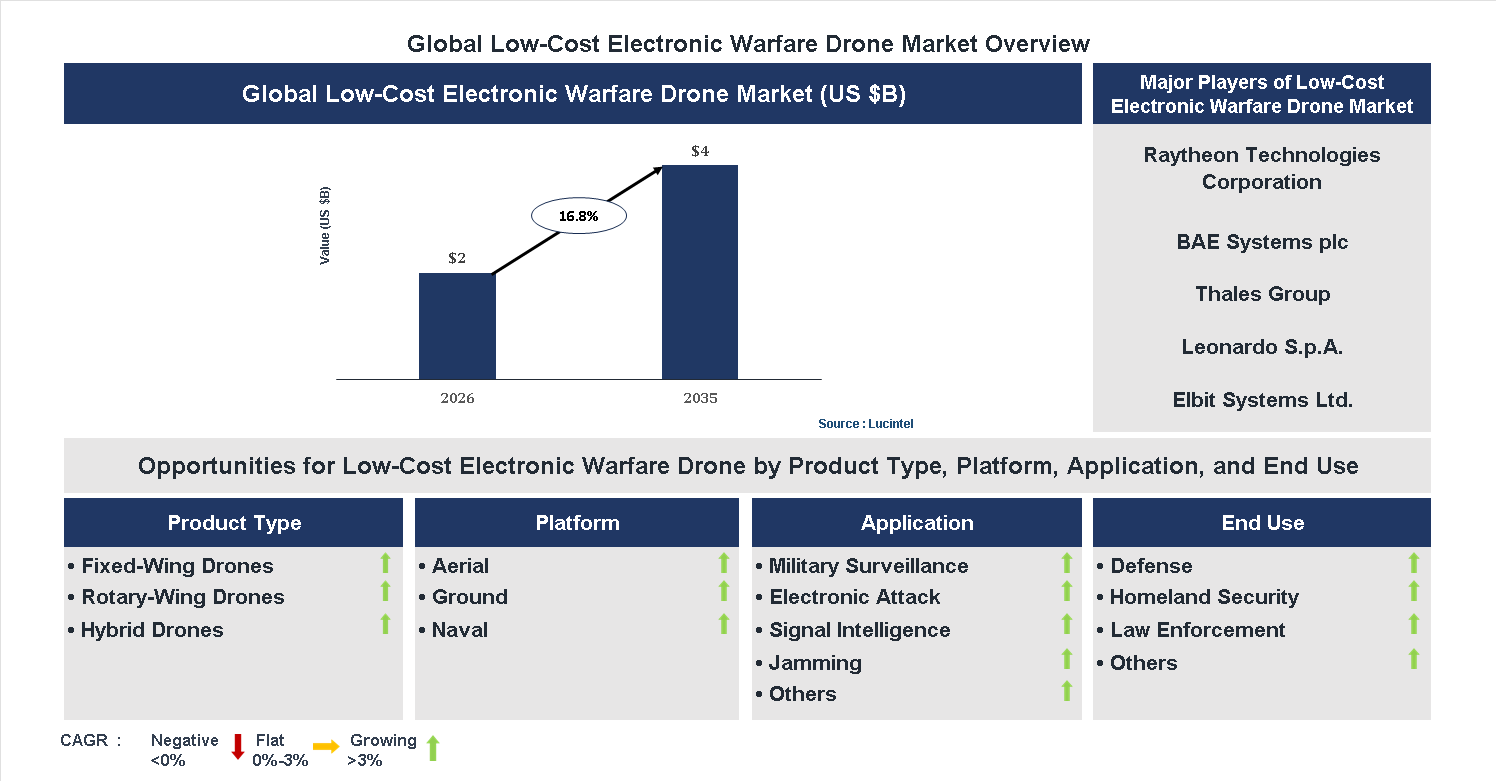
The future of the global low-cost electronic warfare drone market looks promising with opportunities in the defense, homeland security, and law enforcement markets. The global low-cost electronic warfare drone market is expected to reach an estimated $4 billion by 2035 with a CAGR of 16.8% from 2026 to 2035. The major drivers for this market are the increasing adoption of electronic warfare systems, the rising need for advanced defense technologies, and the growing focus on military drone capabilities.• Lucintel forecasts that, within the product type category, hybrid drone is expected to witness the highest growth over the forecast period.
• Within the end use category, defense is expected to witness the highest growth.
• In terms of region, APAC is expected to witness the highest growth over the forecast period. Gain valuable insights for your business decisions with our comprehensive 150+ page report. Sample figures with some insights are shown below.
Emerging Trends in the Low-Cost Electronic Warfare Drone Market
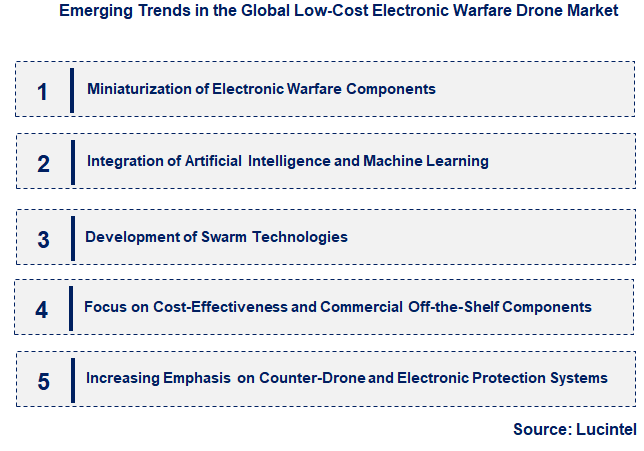
The low-cost electronic warfare drone market is experiencing rapid growth driven by technological advancements, increasing defense budgets, and the need for cost-effective solutions in modern warfare. As nations seek to enhance their electronic warfare capabilities without significant financial burdens, innovative drone technologies are emerging to meet these demands. The market is characterized by a shift towards smaller, more agile, and affordable electronic warfare drones that can be deployed in various operational scenarios. These developments are transforming military strategies, enabling more flexible and responsive electronic attack and defense systems. The following trends highlight the key developments shaping this evolving market landscape.• Miniaturization of Electronic Warfare Components: The trend toward miniaturization involves integrating advanced electronic warfare (EW) systems into smaller drone platforms. This allows for increased mobility, reduced costs, and easier deployment in diverse environments. Miniaturized EW components enable drones to perform complex electronic attack, jamming, and surveillance tasks without the need for large, expensive platforms. This trend enhances operational flexibility and allows for a broader range of tactical applications, making EW drones more accessible to a wider array of military forces.
• Integration of Artificial Intelligence and Machine Learning: AI and ML are increasingly incorporated into electronic warfare drones to improve their autonomous capabilities. These technologies enable drones to identify, classify, and respond to electronic threats in real-time, reducing reliance on human operators. AI-driven EW drones can adapt to evolving electronic environments, optimize jamming techniques, and enhance target accuracy. This integration significantly boosts operational efficiency, survivability, and effectiveness, making electronic warfare more dynamic and responsive in complex combat scenarios.
• Development of Swarm Technologies: Swarm technology involves deploying multiple EW drones that operate collaboratively to overwhelm enemy electronic systems. This trend leverages the power of collective action, allowing for coordinated jamming, deception, and electronic attack strategies. Swarm drones can cover larger areas, increase the probability of mission success, and provide redundancy in operations. The development of swarm capabilities is transforming electronic warfare by enabling more resilient and scalable attack options, which are difficult for adversaries to counter.
• Focus on Cost-Effectiveness and Commercial Off-the-Shelf Components: The market is shifting toward using affordable, commercially available components to develop low-cost EW drones. This approach reduces development time and costs, making electronic warfare capabilities accessible to smaller nations and non-state actors. The use of COTS components also facilitates rapid upgrades and customization, ensuring drones remain effective against evolving electronic threats. This trend democratizes electronic warfare technology, broadening its adoption and fostering innovation within the market.
• Increasing Emphasis on Counter-Drone and Electronic Protection Systems: As electronic warfare drones proliferate, so does the need for countermeasures. The market is witnessing a rise in systems designed to detect, jam, or neutralize hostile EW drones. This includes advanced electronic countermeasures, cyber defenses, and drone mitigation technologies. The focus on protection ensures that electronic warfare assets are safeguarded against adversarial threats, maintaining operational integrity. This trend underscores the importance of a comprehensive approach to electronic warfare, integrating offensive and defensive capabilities to ensure dominance in contested environments. These emerging trends are fundamentally reshaping the low-cost electronic warfare drone market by making EW capabilities more accessible, adaptable, and resilient. The integration of AI, swarm technology, and cost-effective components is driving innovation, while the focus on countermeasures ensures a balanced approach to modern electronic warfare challenges. These developments are enabling militaries worldwide to adopt more flexible, scalable, and effective electronic attack and defense strategies, ultimately transforming the landscape of modern warfare.
Recent Development in the Low-Cost Electronic Warfare Drone Market
The low-cost electronic warfare drone market is experiencing rapid growth driven by technological advancements and increasing demand for affordable defense solutions. Governments and private sectors are investing heavily to enhance their electronic warfare capabilities, leading to innovative product development and strategic partnerships. This evolving landscape presents significant opportunities for market expansion, improved operational efficiency, and enhanced security measures. As the market matures, stakeholders are focusing on cost-effective, versatile, and scalable drone solutions to meet diverse defense and surveillance needs.• Growing Demand for Cost-Effective Defense Solutions: The need for affordable electronic warfare drones is rising globally, driven by budget constraints and the necessity for widespread deployment. Countries seek low-cost options to enhance their defense systems without compromising effectiveness. This demand encourages manufacturers to innovate and develop scalable, easy-to-operate drones that provide strategic advantages at reduced costs. The market's expansion is fueled by government procurement policies favoring economical yet reliable electronic warfare tools, making these drones accessible to a broader range of users.
• Technological Innovations Enhancing Drone Capabilities: Advances in miniaturization, AI, and signal processing are significantly improving drone performance. These innovations enable drones to perform complex electronic warfare tasks such as jamming, spoofing, and signal interception more efficiently. Enhanced sensors and communication systems increase operational range and accuracy. These technological developments make low-cost drones more competitive, versatile, and capable of handling sophisticated electronic threats, thereby expanding their application scope across military and civilian sectors.
• Strategic Collaborations and Partnerships: Key industry players are forming alliances with technology providers, defense agencies, and research institutions to accelerate product development. These collaborations facilitate knowledge sharing, resource pooling, and rapid innovation, leading to more advanced and affordable drone solutions. Partnerships also help in navigating regulatory landscapes and expanding market reach. Such strategic alliances are crucial for staying competitive and addressing evolving electronic warfare challenges effectively, ultimately driving market growth and technological progress.
• Increasing Adoption in Military and Homeland Security: Governments are increasingly deploying low-cost electronic warfare drones for border security, surveillance, and tactical operations. Their affordability allows for widespread deployment, providing real-time intelligence and electronic countermeasures. This adoption enhances national security and operational flexibility while reducing costs. The drones' ability to perform in diverse environments and missions makes them indispensable tools for modern defense strategies, encouraging further investment and development in this segment.
• Regulatory Developments and Standardization: Evolving regulations and standards are shaping the market landscape by establishing safety, interoperability, and operational guidelines. Clear regulatory frameworks facilitate market entry and product acceptance, encouraging manufacturers to innovate within compliant boundaries. Standardization efforts also promote compatibility among different systems, enhancing operational efficiency. These developments reduce market uncertainties, foster trust among users, and accelerate adoption, thereby supporting the sustained growth of low-cost electronic warfare drone solutions. The overall impact of these developments is a dynamic, expanding market characterized by increased innovation, affordability, and strategic deployment. Enhanced technological capabilities and collaborative efforts are making electronic warfare drones more accessible and effective, transforming defense and security operations worldwide. This growth is expected to continue, offering new opportunities for stakeholders and reshaping the landscape of electronic warfare technology.
Strategic Growth Opportunities in the Low-Cost Electronic Warfare Drone Market
The low-cost electronic warfare drone market is experiencing rapid expansion driven by technological advancements, increasing defense budgets, and the need for cost-effective surveillance and combat solutions. Governments and defense agencies seek affordable, versatile drones to enhance battlefield awareness and electronic attack capabilities. This growth is fueled by innovations in miniaturization, AI integration, and the rising demand for autonomous systems. As the market evolves, strategic investments and partnerships will be crucial for capturing emerging opportunities and maintaining competitive advantage in this dynamic sector.• Increasing Adoption of Cost-Effective Electronic Warfare Drones for Defense Operations: The demand for affordable electronic warfare drones is rising among military forces worldwide, seeking to enhance electronic attack, surveillance, and reconnaissance capabilities without significant budget increases. These drones provide a flexible, scalable solution for complex battlefield environments, enabling rapid deployment and real-time electronic countermeasures. The affordability factor encourages widespread adoption, especially among smaller nations, fostering a competitive landscape and driving innovation in low-cost electronic warfare drone technology.
• Integration of Artificial Intelligence to Enhance Drone Autonomy and Effectiveness: Incorporating AI into low-cost electronic warfare drones significantly improves their autonomous operation, target identification, and decision-making capabilities. AI-driven systems enable drones to adapt to dynamic electronic environments, identify threats more accurately, and execute complex electronic attack maneuvers with minimal human intervention. This integration reduces operational costs, increases mission success rates, and expands the potential applications of these drones in diverse combat scenarios, making them more attractive to defense agencies seeking advanced yet affordable solutions.
• Development of Modular and Swarm Capabilities for Enhanced Battlefield Coverage: Modular design approaches allow low-cost electronic warfare drones to be customized for specific missions, increasing their versatility. Swarm technology enables multiple drones to operate collaboratively, covering larger areas and overwhelming enemy electronic defenses. These capabilities improve battlefield situational awareness, electronic attack reach, and resilience against countermeasures. The development of such systems offers strategic advantages, enabling forces to conduct complex electronic warfare operations efficiently and cost-effectively, thus broadening market opportunities.
• Growing Focus on Small, Portable, and Easy-to-Deploy Electronic Warfare Drones: The trend toward miniaturization and portability makes electronic warfare drones more accessible and easier to deploy in various terrains and operational contexts. Small drones can be launched quickly, operate covertly, and be used in confined spaces, providing tactical advantages. Their ease of use and low cost facilitate rapid deployment in diverse scenarios, from border security to urban combat. This focus enhances operational flexibility and expands the market for low-cost electronic warfare drones among a wider range of military and security agencies.
• Expansion of Market Through Strategic Partnerships and Collaborations: Collaborations between drone manufacturers, defense contractors, and technology providers accelerate innovation and reduce development costs. Strategic partnerships enable sharing of expertise, resources, and technological advancements, fostering the creation of more capable and affordable electronic warfare drones. These alliances also facilitate entry into new markets and support customization for specific regional or operational needs. As partnerships grow, they will drive market expansion, improve product offerings, and strengthen the overall competitiveness of low-cost electronic warfare drone solutions. The overall impact of these opportunities is set to significantly shape the low-cost electronic warfare drone market, fostering innovation, increasing adoption, and expanding operational capabilities. Strategic focus on technological integration, modularity, and partnerships will enable market players to capitalize on emerging demands. This evolution will lead to more versatile, affordable, and effective electronic warfare solutions, ultimately transforming modern defense strategies and battlefield management worldwide.
Low-Cost Electronic Warfare Drone Market Driver and Challenges
The low-cost electronic warfare drone market is influenced by a variety of technological, economic, and regulatory factors. Rapid advancements in drone technology and electronic warfare systems are expanding the market's scope, while economic considerations such as defense budgets and cost-efficiency drive demand. Regulatory frameworks and international policies also shape market dynamics, impacting deployment and innovation. Additionally, geopolitical tensions and the need for asymmetric warfare capabilities further propel growth. However, challenges such as technological complexity, regulatory restrictions, and security concerns pose significant hurdles. Understanding these drivers and challenges is essential for stakeholders aiming to capitalize on emerging opportunities within this evolving landscape. The factors responsible for driving the low-cost electronic warfare drone market include:• Technological Innovation: Rapid advancements in miniaturization, AI, and sensor technology enable the development of more capable, affordable electronic warfare drones. These innovations improve operational efficiency, targeting precision, and adaptability, making them attractive to defense agencies seeking cost-effective solutions. As technology continues to evolve, manufacturers can offer enhanced capabilities at lower costs, fueling market growth and expanding applications across various military operations.
• Increasing Defense Budgets and Military Modernization: Many countries are prioritizing modernization of their armed forces, allocating substantial budgets toward electronic warfare and drone technology. Governments recognize the strategic importance of low-cost, versatile drones for surveillance, jamming, and electronic attack missions. This financial commitment accelerates research, development, and procurement activities, creating a robust demand pipeline for affordable electronic warfare drones globally.
• Geopolitical Tensions and Asymmetric Warfare: Rising geopolitical conflicts and asymmetric warfare scenarios necessitate affordable, easily deployable electronic warfare solutions. Low-cost drones provide a strategic advantage by enabling smaller or less-equipped forces to counter technologically superior adversaries. Their affordability allows for widespread deployment, persistent surveillance, and electronic attack capabilities, making them indispensable tools in modern conflict zones.
• Growing Adoption of Unmanned Systems in Defense: The increasing integration of unmanned systems into military operations is a key driver. Drones offer reduced risk to personnel, operational flexibility, and cost savings. The trend toward autonomous and semi-autonomous electronic warfare drones enhances battlefield effectiveness, encouraging defense agencies to invest in low-cost options that can be rapidly deployed and scaled across various missions.
• International Collaboration and Export Opportunities: Countries are engaging in international partnerships to develop and share electronic warfare drone technologies. Export opportunities for low-cost drones are expanding as nations seek affordable solutions to bolster their defense capabilities. This global collaboration fosters innovation, reduces costs through shared R&D, and broadens market reach, further stimulating growth in the low-cost electronic warfare drone sector. The challenges facing the low-cost electronic warfare drone market include:
• Technological Complexity and Integration Difficulties: Developing effective electronic warfare drones involves complex integration of sensors, jamming systems, and autonomous controls. Ensuring reliability, interoperability, and resilience against countermeasures is challenging. Technological limitations can hinder performance, increase costs, and delay deployment, posing significant barriers for manufacturers and end-users seeking affordable yet effective solutions.
• Regulatory and Legal Restrictions: International and national regulations governing drone operations, spectrum usage, and electronic warfare activities can restrict deployment and innovation. Compliance with evolving legal frameworks adds complexity and costs, potentially limiting market growth. Additionally, export controls and restrictions on sensitive electronic warfare technologies can impede international trade and collaboration.
• Security and Countermeasure Risks: Electronic warfare drones are vulnerable to hacking, jamming, and other cyber threats. Adversaries continuously develop countermeasures, which can diminish the effectiveness of low-cost drones. Ensuring cybersecurity, resilience against electronic attacks, and safeguarding sensitive data are critical challenges that impact confidence and adoption rates in the market. The low-cost electronic warfare drone market is driven by technological advancements, defense modernization efforts, geopolitical tensions, and increasing adoption of unmanned systems. However, technological complexities, regulatory hurdles, and security concerns pose significant challenges. These factors collectively influence market growth, requiring stakeholders to innovate continuously, navigate legal landscapes, and address security vulnerabilities. The interplay of these drivers and challenges will shape the future trajectory of this dynamic market, emphasizing the need for strategic planning and technological resilience to capitalize on emerging opportunities.
List of Low-Cost Electronic Warfare Drone Companies
Companies in the market compete on the basis of product quality offered. Major players in this market focus on expanding their manufacturing facilities, R&D investments, infrastructural development, and leverage integration opportunities across the value chain. With these strategies low-cost electronic warfare drone companies cater increasing demand, ensure competitive effectiveness, develop innovative products & technologies, reduce production costs, and expand their customer base. Some of the low-cost electronic warfare drone companies profiled in this report include-• Raytheon Technologies Corporation
• BAE Systems plc
• Thales Group
• Leonardo S.p.A.
• Elbit Systems Ltd.
• Saab AB
• Aselsan A.S.
• General Atomics Aeronautical Systems Inc.
• QinetiQ Group plc
• Kratos Defense and Security Solutions Inc.
Low-Cost Electronic Warfare Drone Market by Segment
The study includes a forecast for the global low-cost electronic warfare drone market by product type, platform, application, end use, and region.Low-Cost Electronic Warfare Drone Market by Product Type [Value from 2019 to 2035]:
• Fixed-Wing Drones
• Rotary-Wing Drones
• Hybrid Drones
Low-Cost Electronic Warfare Drone Market by Platform [Value from 2019 to 2035]:
• Aerial
• Ground
• Naval
Low-Cost Electronic Warfare Drone Market by Application [Value from 2019 to 2035]:
• Military Surveillance
• Electronic Attack
• Signal Intelligence
• Jamming
• Others
Low-Cost Electronic Warfare Drone Market by End Use [Value from 2019 to 2035]:
• Defense
• Homeland Security
• Law Enforcement
• Others
Low-Cost Electronic Warfare Drone Market by Region [Value from 2019 to 2035]:
• North America
• Europe
• Asia Pacific
• The Rest of the World
Country Wise Outlook for the Low-Cost Electronic Warfare Drone Market
The low-cost electronic warfare drone market has experienced significant growth driven by technological advancements, increasing defense budgets, and the need for cost-effective military solutions. Countries are investing in developing and deploying these drones to enhance their electronic warfare capabilities, counter emerging threats, and maintain strategic advantages. The market's evolution reflects a focus on affordability, portability, and advanced electronic countermeasure features, making these drones accessible to a broader range of military forces. As geopolitical tensions rise, nations are prioritizing innovation in this sector to bolster their defense systems and ensure national security.• United States: The US has made substantial progress in developing low-cost electronic warfare drones, integrating AI and machine learning for autonomous operations. The Department of Defense has increased funding for research, leading to the deployment of advanced systems like the RQ-170 Sentinel and emerging prototypes. Collaborations with private firms have accelerated innovation, and the US is focusing on expanding drone swarms for multi-layered electronic attack capabilities. These developments aim to enhance battlefield awareness and electronic countermeasures against sophisticated adversaries.
• China: China has rapidly advanced its electronic warfare drone technology, emphasizing affordability and mass production. The country has launched several domestically developed drones equipped with electronic jamming and signal interception tools. Chinese military modernization efforts include integrating these drones into broader network-centric warfare strategies. The government’s focus on indigenous innovation has resulted in a growing ecosystem of low-cost, versatile electronic warfare drones capable of operating in complex environments and supporting regional security initiatives.
• Germany: Germany is prioritizing the integration of low-cost electronic warfare drones into its NATO commitments and national defense strategies. The country has invested in developing modular drone platforms that can be equipped with various electronic attack and surveillance payloads. German firms are collaborating with international partners to enhance drone capabilities, emphasizing interoperability and cybersecurity. Recent developments include deploying these drones for border security, maritime surveillance, and supporting NATO exercises, reflecting a strategic shift towards cost-effective electronic warfare solutions.
• India: India has accelerated its efforts to develop indigenous low-cost electronic warfare drones amid regional security concerns. The country has tested several prototypes capable of signal jamming, electronic reconnaissance, and target tracking. Indian defense agencies are focusing on creating versatile, portable drones suitable for diverse terrains and operational scenarios. The government’s push for self-reliance has led to increased R&D investments, with collaborations between public and private sectors to produce affordable, effective electronic warfare drone systems for both border security and military applications.
• Japan: Japan is enhancing its electronic warfare drone capabilities to counter regional threats, particularly from neighboring countries. The country has focused on developing lightweight, cost-efficient drones equipped with electronic jamming and surveillance systems. Japan’s defense modernization includes integrating these drones into existing maritime and air defense networks. Recent initiatives involve joint exercises with allied nations to improve interoperability and operational readiness. Japan’s strategic emphasis on affordable, technologically advanced drones aims to strengthen its electronic warfare posture in the Asia-Pacific region.

Features of the Global Low-Cost Electronic Warfare Drone Market
Market Size Estimates: Low-cost electronic warfare drone market size estimation in terms of value ($B). Trend and Forecast Analysis: Market trends (2019 to 2025) and forecast (2026 to 2035) by various segments and regions. Segmentation Analysis: Low-cost electronic warfare drone market size by various segments, such as by product type, platform, application, end use, and region in terms of value ($B). Regional Analysis: Low-cost electronic warfare drone market breakdown by North America, Europe, Asia Pacific, and Rest of the World. Growth Opportunities: Analysis of growth opportunities in different product types, platforms, applications, end uses, and regions for the low-cost electronic warfare drone market. Strategic Analysis: This includes M&A, new product development, and competitive landscape of the low-cost electronic warfare drone market. Analysis of competitive intensity of the industry based on Porter’s Five Forces model.
FAQ
Q1. What is the low-cost electronic warfare drone market size? Answer: The global low-cost electronic warfare drone market is expected to reach an estimated $4 billion by 2035. Q2. What is the growth forecast for low-cost electronic warfare drone market? Answer: The global low-cost electronic warfare drone market is expected to grow with a CAGR of 16.8% from 2026 to 2035. Q3. What are the major drivers influencing the growth of the low-cost electronic warfare drone market? Answer: The major drivers for this market are the increasing adoption of electronic warfare systems, the rising need for advanced defense technologies, and the growing focus on military drone capabilities. Q4. What are the major segments for low-cost electronic warfare drone market? Answer: The future of the low-cost electronic warfare drone market looks promising with opportunities in the defense, homeland security, and law enforcement markets. Q5. Who are the key low-cost electronic warfare drone market companies? Answer: Some of the key low-cost electronic warfare drone companies are as follows:• Raytheon Technologies Corporation
• BAE Systems plc
• Thales Group
• Leonardo S.p.A.
• Elbit Systems Ltd.
• Saab AB
• Aselsan A.S.
• General Atomics Aeronautical Systems Inc.
• QinetiQ Group plc
• Kratos Defense and Security Solutions Inc. Q6. Which low-cost electronic warfare drone market segment will be the largest in future? Answer: Lucintel forecasts that, within the product type category, hybrid drone is expected to witness the highest growth over the forecast period. Q7. In low-cost electronic warfare drone market, which region is expected to be the largest in next 8 years? Answer: In terms of region, APAC is expected to witness the highest growth over the forecast period. Q8. Do we receive customization in this report? Answer: Yes, Lucintel provides 10% customization without any additional cost.
Table of Contents
List of Figures
List of Tables
Methodology
- In-depth interviews of the major players in this market
- Detailed secondary research from competitors’ financial statements and published data
- Extensive searches of published works, market, and database information pertaining to industry news, company press releases, and customer intentions
- A compilation of the experiences, judgments, and insights of Lucintel’s professionals, who have analyzed and tracked this market over the years.


Buy Now
Choose a license that fits your team. Instant PDF delivery.
Prices exclude taxes. Instant delivery. Custom licensing available on request.
Key Questions
- • What are some of the most promising, high-growth opportunities for the low-cost electronic warfare drone market by product type (fixed-wing drones, rotary-wing drones, and hybrid drones), platform (aerial, ground, and naval), application (military surveillance, electronic attack, signal intelligence, jamming, and others), end use (defense, homeland security, law enforcement, and others), and region (North America, Europe, Asia Pacific, and the Rest of the World)?
- • Which segments will grow at a faster pace and why?
- • Which region will grow at a faster pace and why?
- • What are the key factors affecting market dynamics? What are the key challenges and business risks in this market?
- • What are the business risks and competitive threats in this market?
- • What are the emerging trends in this market and the reasons behind them?
- • What are some of the changing demands of customers in the market?
- • What are the new developments in the market? Which companies are leading these developments?
- • Who are the major players in this market? What strategic initiatives are key players pursuing for business growth?
- • What are some of the competing products in this market and how big of a threat do they pose for loss of market share by material or product substitution?
- • What M&A activity has occurred in the last 7 years and what has its impact been on the industry? For any questions related to Low-Cost Electronic Warfare Drone Market, Low-Cost Electronic Warfare Drone Market Size, Low-Cost Electronic Warfare Drone Market Growth, Low-Cost Electronic Warfare Drone Market Analysis, Low-Cost Electronic Warfare Drone Market Report, Low-Cost Electronic Warfare Drone Market Share, Low-Cost Electronic Warfare Drone Market Trends, Low-Cost Electronic Warfare Drone Market Forecast, Low-Cost Electronic Warfare Drone Companies, write Lucintel analyst at email: helpdesk@lucintel.com. We will be glad to get back to you soon.


