
Market Report · July 16, 2026

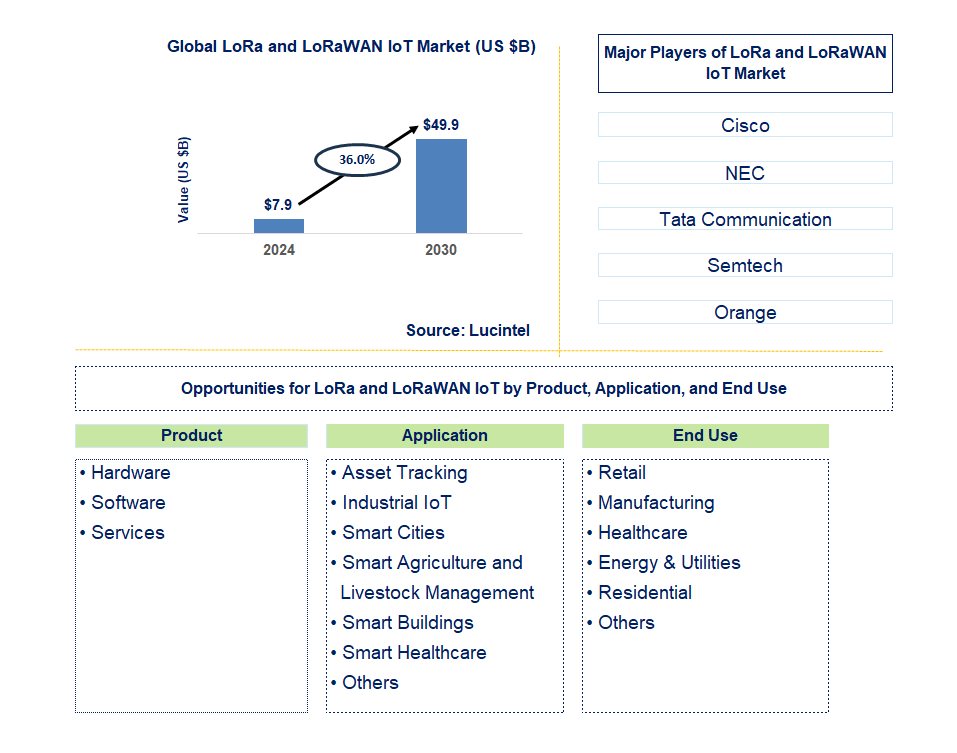
Key data points: The market size in 2030 = $49.9 billion, growth forecast = 36.0% annually for the next 6 years. Scroll below to get more insights. This market report covers trends, opportunities, and forecasts in the global lora and lorawan IoT market to 2030 by product (hardware, software, and services), application (asset tracking, industrial IoT, smart cities, smart agriculture and livestock management, smart buildings, smart healthcare, and others), end use (retail, manufacturing, healthcare, energy & utilities, residential, and others), and region (North America, Europe, Asia Pacific, and the Rest of the World)
We'll send your sample report shortly.
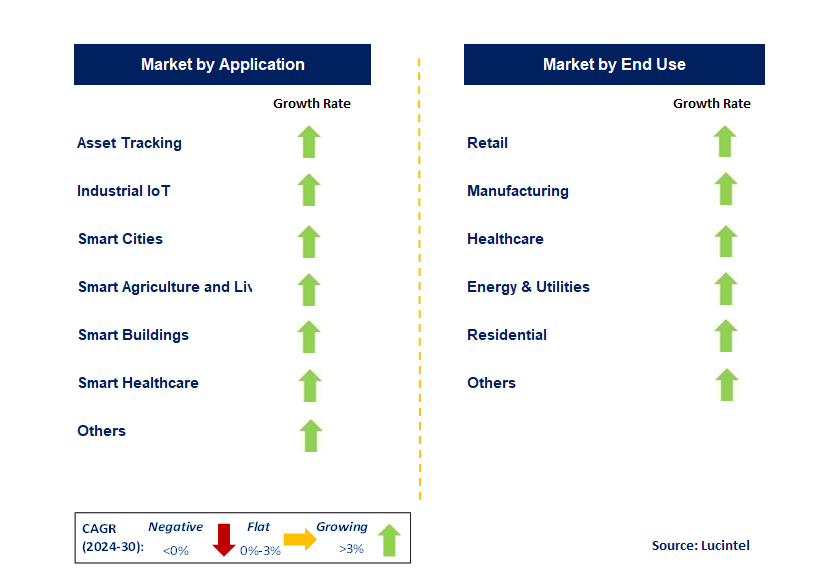
• Lucintel forecasts, within product category market, hardware is expected to witness the highest growth over the forecast period.
• Within the end-use category market, manufacturing is expected to witness the highest growth over the forecast period.
• In terms of regions, North America is expected to witness highest growth over the forecast period. A more than 150-page report is developed to help in your business decisions.
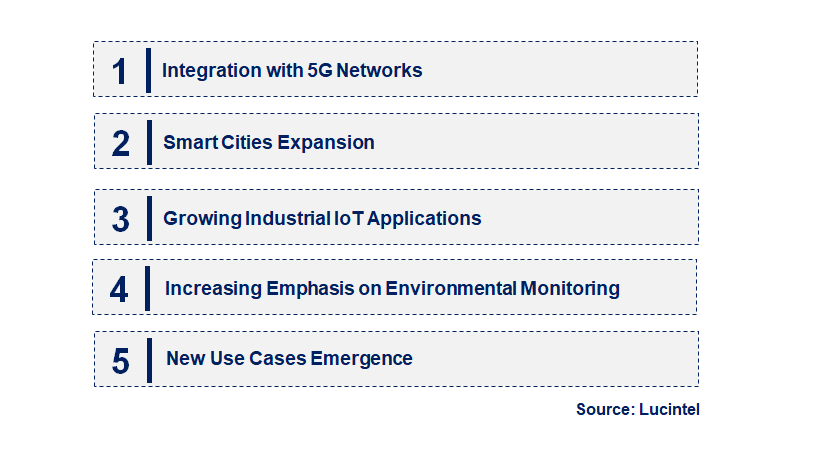
• Integration with 5G Networks: LoRaWAN is increasingly integrated with 5G networks. This convergence allows for higher levels of connectivity and greater data throughput, enabling applications that require both long-range coverage and high-speed data transmission. This integration combines the long-range capability of LoRaWAN with the high speed and low latency of 5G, enhancing enterprise IoT solutions. This trend is encouraging innovation in areas ranging from smart cities to industrial automation and asset tracking.
• Smart Cities Expansion: LoRa and LoRaWAN technologies have seen greater penetration in various smart city initiatives worldwide. The low-power, wide-area connectivity provided by LoRaWAN makes it suitable for various smart city applications, such as environmental monitoring, waste management, and public safety. Municipalities are increasingly utilizing these technologies to enhance operational efficiency and improve urban living. The growing number of smart city projects is driving demand for scalable and cost-effective IoT solutions using LoRaWAN.
• Growing Industrial IoT Applications: LoRaWAN technology is gaining momentum in industrial IoT applications, where it aims to enhance operational efficiency and asset management. Applications include real-time monitoring, predictive maintenance, and process optimization across various industries. LoRaWAN provides long-range connectivity even in challenging environments, making it ideal for industrial applications. It will be a key enabler for the Industrial IoT solutions that industries seek in their modernization and digitization journeys.
• Increasing Emphasis on Environmental Monitoring: Environmental monitoring has become a key application area for both LoRa and LoRaWAN technologies. The ability to deploy low-power sensors over large areas makes LoRaWAN ideal for tracking environmental parameters like air quality, water levels, and weather conditions. Governments and organizations have begun to invest in LoRaWAN-enabled solutions to address environmental challenges and ensure sustainability. This investment contributes to the growth of the LoRaWAN network and its application in environmental conservation.
• New Use Cases Emergence: New use cases for LoRa and LoRaWAN continue to emerge as technology evolves. Innovative applications are developing within smart agriculture, health, and logistics. Its flexibility and scalability make LoRaWAN a suitable solution for various verticals, allowing for different solutions to cater to distinct needs. As these new use cases are explored and validated, they are expanding the horizons of LoRaWAN technology and driving its adoption across diverse industries. The emerging trends in the LoRa and LoRaWAN IoT market signal a transformative phase driven by technological innovation and evolving market demands. The integration of LoRaWAN with 5G networks enhances connectivity, facilitating a new wave of applications that require both long-range coverage and high-speed data transmission.
• Extended Network Coverage: LoRaWAN network coverage is expanding, supporting infrastructural development across the world. This covers wider applications, including smart city projects, agriculture, and industrial IoT. Enhanced network coverage helps service providers offer more comprehensive and reliable connectivity, which is vital for the widespread adoption of LoRaWAN solutions.
• Improved Integration with Other Technologies: LoRaWAN is increasingly being integrated into a growing number of other technologies, including 5G and cloud platforms. This integration improves management, real-time analytics, and seamless connectivity. The convergence with 5G extends LoRaWAN capabilities by adding the advantage of long-range coverage to high-speed data transmission, thereby increasing the number of applications and advantages of IoT solutions.
• Government and Regulatory Support: Government and regulatory support for LoRaWAN is rising. Policies and initiatives have been encouraging the growth of LoRaWAN. Governments in various regions are funding smart city projects and providing regulatory frameworks to simplify the deployment of LoRaWAN networks. This support is essential for accelerating market growth and attracting investment in LoRaWAN technology.
• Technological Advancements and Innovation: Improvements in LoRaWAN technology, such as increased capacity in devices and better network efficiency, drive market growth. Innovations include new chipsets that offer higher performance, low-power sensors, and next-generation network management software. These advancements further ensure scalability and performance for LoRaWAN solutions across a broader range of applications.
• Increased Adoption Across Various Sectors: LoRaWAN is witnessing increased adoption across diverse verticals, including agriculture, logistics, healthcare, and smart cities. This widening adoption suggests versatility and efficiency in addressing the diverse needs of IoT applications. As more industries recognize the benefits of LoRaWAN, its presence in the market continues to grow, fostering further development and investment. Recent movements within the LoRa and LoRaWAN IoT market highlight key developments in network expansion, technological integration, and sector adoption. These factors add significant functionalities to LoRaWAN technology and ensure its usage across diverse applications. The future evolution of these developments will define the direction of the LoRa and LoRaWAN market.
• Smart Agriculture: Smart agriculture presents an excellent growth opportunity for LoRaWAN, providing solutions for precision farming, crop monitoring, and livestock management. LoRaWAN's long-range, low-power capabilities serve rural and remote areas well, where traditional connectivity options may be limited. By installing LoRaWAN-based sensors and devices, farmers can optimize resources and improve yields while reducing operational costs
• Smart Cities: Smart cities are deploying solutions for smart lighting, waste management, and environmental monitoring. LoRaWAN has proven to be scalable and cost-effective for large-scale urban deployments. With the ongoing push for efficiency and sustainability, LoRaWAN-based solutions are increasingly augmenting urban infrastructure and lifestyles.
• Industrial IoT: LoRaWAN is gaining traction in industrial IoT due to its ability to provide reliable connectivity in challenging environments. Key applications include asset tracking, predictive maintenance, and process automation. Its long-range, low-power characteristics make it suitable for industries that often find conventional connectivity methods insufficient. As adoption, innovation, and investment in industrial IoT solutions grow, so does the demand for LoRaWAN.
• Environmental Monitoring: The importance of LoRaWAN applications in environmental monitoring is increasing, covering areas such as air quality measurement, water level monitoring, and weather tracking. Given the technology's capability to deploy sensors over large areas with low power consumption, it is ideal for environmental data collection. Governments and organizations are investing in LoRaWAN solutions to address environmental challenges and promote sustainability, presenting significant growth opportunities in this sector.
• Healthcare and Remote Monitoring: Healthcare and remote monitoring applications represent an emerging growth area for LoRaWAN. The technology enables remote patient monitoring, asset tracking in healthcare facilities, and management of medical devices. LoRaWAN's low-power, long-range capabilities make these applications inherently suitable, offering cost-effective and reliable means to enhance patient care and operational efficiency within healthcare settings. Strategic growth opportunities in LoRa and LoRaWAN IoT markets are expanding in applications related to smart agriculture, smart cities, industrial IoT, environmental monitoring, and healthcare. These opportunities showcase the technology's flexibility and potential to solve a wide range of problems in various industries. By leveraging these opportunities, companies can foster innovation and growth in the IoT market.
• Technological Advancements: Developments in LoRaWAN technology involve changes in chipsets and energy-efficient sensors, driving market growth. These improvements enhance the performance and scalability of LoRaWAN solutions, making them more viable for a wide range of applications. Innovations such as enhanced network management tools and integration with other technologies, like 5G, further expand the potential of LoRaWAN within the IoT ecosystem.
• Government Support and Regulations: Government policies and regulatory frameworks play a crucial role as market drivers for LoRaWAN. Supportive regulations, funding for smart city projects, and spectrum allocation for IoT technologies will pave the way for market growth. Governments worldwide are encouraging the adoption of LoRaWAN through various incentives and initiatives, creating a favorable environment for technology deployment and innovation.
• Growing Demand for IoT Solutions: The surge in demand for IoT solutions in smart cities, agriculture, and industrial applications is driving rapid growth in the LoRaWAN technology market. The increasing demand for cost-effective and reliable connectivity solutions that can handle large numbers of low-cost devices accelerates market growth. This demand for LoRaWAN technology will continue to rise as more industries seek to achieve operational efficiency and data-driven decisions using IoT solutions.
• Network Infrastructure Expansion: The improvement in LoRaWAN network infrastructure deployment is a major factor turbocharging market growth. The increased deployment of base stations and gateways will lead to greater network coverage and reliability in LoRaWAN networks. This development of new applications and use cases further attracts investment and growth in the LoRaWAN market.
• Better Integration with Other Technologies: The growth of the market is also influenced by LoRaWAN's integration with other technologies such as 5G and cloud computing. This convergence will lead to better connectivity, data management, and real-time analytics, enhancing the scale of LoRaWAN solutions. The interoperability with other technologies increases the value proposition for LoRaWAN in various applications, further accelerating its adoption. Challenges in the LoRa and LoRaWAN IoT market include:
• Interoperability Issues: Interoperability between different LoRaWAN networks and devices presents a challenge that may slow market growth. For LoRaWAN solutions to be widely adopted, there needs to be assurance of compatibility and seamless communication. Addressing interoperability issues will require further standardization efforts and industry collaboration.
• Security Concerns: Security concerns for the LoRaWAN market involve data protection and network integrity. The increased deployment of IoT makes securing data transmission and device authentication more relevant. To address security concerns, the deployment of quality encryption and security protocols is necessary to mitigate potential vulnerabilities.
• Limited Bandwidth and Network Capacity: Limited bandwidth and network capacity are significant challenges for deploying LoRaWAN in densely populated areas. Network management must be optimized to accommodate the demands from an ever-expanding range of IoT applications, which may require either additional infrastructure or better optimization. Technological advancements, government support, increasing demand for IoT solutions, expansion of network infrastructure, and integration with various technologies are major drivers in the LoRa and LoRaWAN IoT market. Interoperability issues, security concerns, and bandwidth constraints must be addressed for the LoRa and LoRaWAN IoT market to continue growing. Understanding these drivers and challenges will help stakeholders leverage opportunities for business growth and further develop LoRa and LoRaWAN technologies.
• Cisco
• NEC
• Tata Communication
• Semtech
• Orange
• Hardware
• Software
• Services
• Asset Tracking
• Industrial IoT
• Smart Cities
• Smart Agriculture and Livestock Management
• Smart Buildings
• Smart Healthcare
• Others
• Retail
• Manufacturing
• Healthcare
• Energy & Utilities
• Residential
• Others
• North America
• Europe
• Asia Pacific
• The Rest of the World
• United States: Recent developments in the US LoRa and LoRaWAN market involve network expansion and the adoption of the technology in various industries. Companies like Semtech and The Things Network have further reinforced their structure to better connect smart city projects, agriculture, and industrial IoT on larger scales. Furthermore, technology providers and telecom operators are partnering to enhance LoRaWAN integrations with 5G networks. The FCC has also been active in supporting LoRaWAN spectrum allocation, thus urging its usage in a wide range of IoT applications.
• China: The LoRa and LoRaWAN market in China is one of the fastest-growing, driven by government initiatives and rapid deployment in smart city projects. The government has been encouraging IoT development under its larger "Made in China 2025" plan, which sets the stage for higher investments to develop LoRaWAN infrastructure. Major Chinese technology companies, such as Alibaba and Huawei, are integrating LoRaWAN into their IoT solutions, thus developing smart grid management and urban infrastructure. Additionally, regional deployments are growing to improve connectivity in both rural and urban areas.
• Germany: Germany is developing its LoRa and LoRaWAN ecosystem through key investments in smart city and industrial IoT applications. The country is targeting the deployment of LoRaWAN networks to serve various applications such as environmental monitoring, smart agriculture, and asset tracking. Collaboration in project developments by government entities, research institutions, and private enterprises drives innovation. The German government is also facilitating the adoption of LoRaWAN.
• India: In India, LoRa and LoRaWAN technologies are adopted because they provide a perfect fit for large-scale rural and urban applications. The Indian government is fostering smart cities and digital infrastructure to promote LoRaWAN adoption in smart metering, agriculture, and transportation. However, startups and technology providers have been at the forefront of deploying LoRaWAN solutions to address connectivity issues in remote areas. Collaborations with international technology partners support the development and deployment of LoRaWAN networks across the country.
• Japan: The LoRa and LoRaWAN market in Japan is characterized by recent developments in smart city projects and industrial automation. The country is using LoRaWAN for disaster management and environmental monitoring and is building smart infrastructure. Japanese companies have started working to integrate LoRaWAN into their IoT solutions for more efficiency and connectivity in the region. Moreover, Japan's regulatory framework supports IoT innovations, creating a favorable environment for the development of LoRa and LoRaWAN technologies.


• Cisco
• NEC
• Tata Communication
• Semtech
• Orange Q6. Which LoRa and LoRaWAN IoT market segment will be the largest in future? Answer: Lucintel forecasts that hardware is expected to witness the highest growth over the forecast period. Q7. In LoRa and LoRaWAN IoT market, which region is expected to be the largest in next 5 years? Answer: North America is expected to witness highest growth over the forecast period. Q.8 Do we receive customization in this report? Answer: Yes, Lucintel provides 10% customization without any additional cost.


Choose a license that fits your team. Instant PDF delivery.
Prices exclude taxes. Instant delivery. Custom licensing available on request.
Market Report · July 16, 2026
Market Report · May 18, 2026
Market Report · May 18, 2026
Trusted partner for strategic intelligence and business growth


Receive a complimentary market analysis tailored to your industry. Our analysts will identify key growth opportunities and competitive dynamics specific to your business.

Market size, growth rate, and key trend analysis for your specific sector.

Top competitor positioning and market share analysis.

Strategic recommendations backed by data-driven insights.
Get curated market intelligence and competitive moves straight to your inbox.
By subscribing, you agree to receive our monthly insights. Unsubscribe anytime.
Receive a complimentary market analysis tailored to your industry. Our analysts will identify key growth opportunities and competitive dynamics specific to your business.
Market size, growth rate, and key trend analysis for your specific sector.
Top competitor positioning and market share analysis.
Strategic recommendations backed by data-driven insights.
Get curated market intelligence, emerging trends, and competitive moves straight to your inbox each month.
By subscribing, you agree to receive our monthly insights. Unsubscribe anytime.
We'll send your sample report shortly.