
Report Feature
Logic Probe Market Trends and Forecast
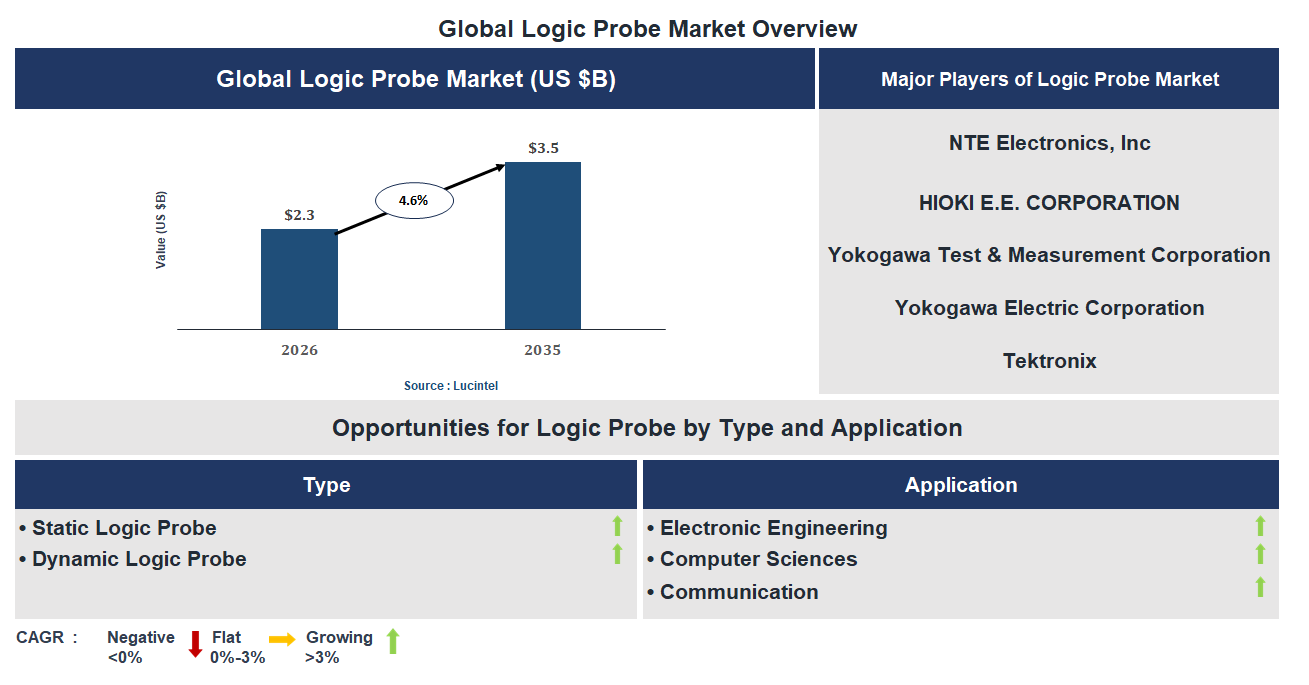
The future of the global logic probe market looks promising with opportunities in the electronic engineering, computer science, and communication markets. The global logic probe market is expected to reach an estimated $3.5 billion by 2035 with a CAGR of 4.6% from 2026 to 2035. The major drivers for this market are the increasing adoption of consumer electronic devices, the rising demand from educational & technical training institutes, and the growing use of embedded systems in industrial equipments.• Lucintel forecasts that, within the type category, dynamic logic probe is expected to witness higher growth over the forecast period.
• Within the application category, electronic engineering is expected to witness the highest growth.
• In terms of region, APAC is expected to witness the highest growth over the forecast period. Gain valuable insights for your business decisions with our comprehensive 150+ page report. Sample figures with some insights are shown below.
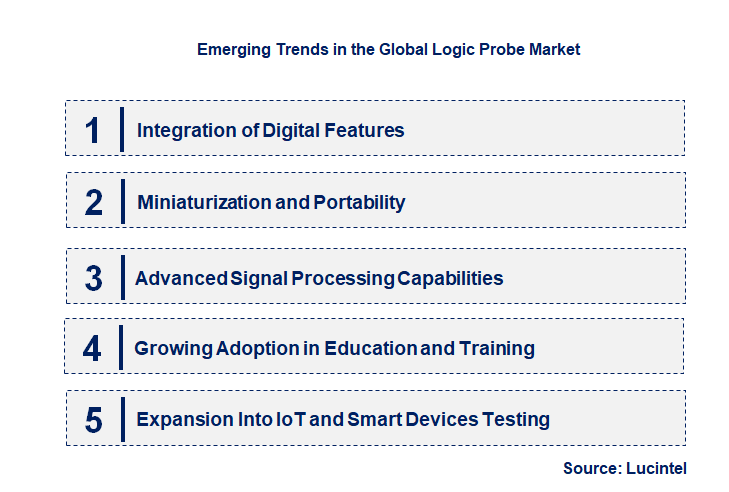
Emerging Trends in the Logic Probe Market
The logic probe market is experiencing rapid evolution driven by technological advancements and increasing demand for efficient diagnostic tools in electronics testing. As electronic devices become more complex and integrated, the need for precise, reliable, and user-friendly testing equipment grows. Market players are innovating to meet these demands, leading to the emergence of new features, improved accuracy, and broader application scopes. These developments are transforming how technicians and engineers diagnose faults, ensuring faster troubleshooting and higher product quality. The following key trends highlight the current trajectory of the logic probe market and its future potential.• Integration of Digital Features: The market is witnessing a shift from traditional analog logic probes to digital-enabled devices. These probes offer enhanced accuracy, data logging, and connectivity options such as USB or Bluetooth. Digital features allow for more detailed analysis, easier troubleshooting, and integration with other testing equipment. This trend improves efficiency, reduces human error, and caters to the needs of modern electronics testing environments, making digital logic probes a preferred choice for professionals.
• Miniaturization and Portability: Increasing demand for compact, lightweight, and portable logic probes is a significant trend. Engineers and technicians require tools that are easy to carry and operate in confined spaces or field conditions. Miniaturized devices do not compromise on performance and often include ergonomic designs for better handling. This trend enhances on-site troubleshooting capabilities, reduces setup time, and broadens the scope of applications, especially in portable and field testing scenarios.
• Advanced Signal Processing Capabilities: Newer logic probes are equipped with sophisticated signal processing features such as noise filtering, auto-calibration, and real-time waveform analysis. These capabilities improve the accuracy of diagnostics, especially in noisy or complex electronic environments. Enhanced signal processing reduces false positives and negatives, enabling technicians to identify faults more reliably. This trend is crucial for testing high-speed digital circuits and complex embedded systems, ensuring precise fault detection.
• Growing Adoption in Education and Training: The market is expanding beyond industrial and professional use into educational sectors. Logic probes are increasingly integrated into electronics training kits and laboratory setups to teach students practical troubleshooting skills. This trend promotes early familiarity with diagnostic tools, fostering a skilled workforce for the electronics industry. It also drives demand for cost-effective, user-friendly devices tailored for educational purposes, broadening the market’s reach.
• Expansion into IoT and Smart Devices Testing: The proliferation of IoT devices and smart electronics is creating new opportunities for logic probe applications. These devices often require specialized testing for connectivity, power management, and data integrity. Logic probes are evolving to include features tailored for IoT applications, such as wireless connectivity and compatibility with various communication protocols. This trend positions the market to support the growing need for reliable diagnostics in connected devices, ensuring their proper functioning and security. These trends are reshaping the logic probe market by making devices more digital, portable, precise, educational, and IoT-compatible. This evolution enhances diagnostic accuracy, broadens application areas, and meets the demands of modern electronics testing, ultimately driving market growth and innovation.
Recent Development in the Logic Probe Market
The logic probe market has experienced significant advancements driven by technological innovation and increasing demand for diagnostic tools in electronics testing. These developments are shaping the industry landscape, offering enhanced accuracy, user-friendly interfaces, and integration with modern testing environments. As electronics become more complex, the need for reliable, efficient, and affordable logic probes is more critical than ever. These trends are expected to influence market growth, competitive dynamics, and product development strategies in the coming years.• Growing Demand for Portable Testing Solutions: The market is witnessing increased adoption of compact, portable logic probes that facilitate on-the-go diagnostics. This trend is driven by the need for quick troubleshooting in field environments, reducing downtime and operational costs. Portable devices offer ease of use, battery-powered operation, and wireless connectivity, making them ideal for technicians and engineers. As electronics become more integrated and mobile, the demand for portable logic probes is expected to rise, expanding market opportunities and encouraging innovation in miniaturization and connectivity features.
• Integration of Advanced Features for Enhanced Accuracy: Recent developments include the incorporation of high-resolution displays, multi-channel analysis, and real-time data logging. These features improve diagnostic precision, enabling users to identify faults more efficiently. Enhanced accuracy reduces troubleshooting time and minimizes errors, which is crucial in complex electronic systems. Manufacturers are investing in smart algorithms and AI-based analysis to further refine diagnostic capabilities. This integration is transforming logic probes into comprehensive diagnostic tools, boosting their value in professional and industrial applications and driving market growth.
• Increasing Adoption in Automation and Industrial Testing: The rise of automation in manufacturing processes has increased the need for reliable testing equipment like logic probes. These devices are now being integrated into automated testing setups to monitor and troubleshoot digital signals efficiently. The industrial sector benefits from robust, high-performance logic probes capable of handling harsh environments and high-speed signals. This trend is expanding the market beyond traditional electronics into industrial automation, robotics, and IoT applications, creating new revenue streams and encouraging product innovation tailored to industrial needs.
• Rising Focus on User-Friendly Interfaces and Training: To cater to a broader user base, manufacturers are emphasizing intuitive interfaces, ergonomic designs, and comprehensive training modules. Simplified operation reduces the learning curve for new users and enhances productivity for experienced technicians. Interactive displays, step-by-step guides, and remote support are becoming standard features. This focus on usability is expanding the market to include educational institutions, hobbyists, and small enterprises, thereby increasing overall demand and fostering a more inclusive ecosystem for logic probe adoption.
• Development of Wireless and IoT-Enabled Logic Probes: The integration of wireless connectivity and IoT capabilities is revolutionizing the logic probe market. These devices enable remote monitoring, data sharing, and real-time analysis via smartphones or cloud platforms. IoT-enabled probes facilitate seamless integration into larger diagnostic and maintenance systems, improving efficiency and data management. This technological shift supports predictive maintenance and remote troubleshooting, reducing downtime and operational costs. As connectivity becomes a standard feature, the market is poised for rapid growth, driven by the need for smarter, connected diagnostic tools. These recent developments are significantly transforming the logic probe market by enhancing portability, accuracy, industrial applicability, user experience, and connectivity. The integration of advanced features and IoT capabilities is expanding the market’s reach across various sectors, including manufacturing, education, and field diagnostics. As these innovations continue to evolve, they are expected to drive market growth, foster competitive differentiation, and meet the increasing demand for efficient, reliable, and user-friendly diagnostic tools in a rapidly advancing technological landscape.
Strategic Growth Opportunities in the Logic Probe Market
The logic probe market is experiencing rapid expansion driven by increasing demand for troubleshooting and diagnostic tools across electronics, telecommunications, and industrial sectors. As devices become more complex, the need for efficient testing solutions grows, creating significant opportunities for innovation and market penetration. Key applications such as consumer electronics, automotive, and aerospace are fueling growth, while technological advancements and rising automation further enhance market potential. Companies focusing on product development and strategic partnerships are well-positioned to capitalize on these expanding opportunities.• Enhanced Diagnostic Capabilities in Consumer Electronics: The rising complexity of consumer devices necessitates advanced diagnostic tools like logic probes to quickly identify faults, reduce downtime, and improve product quality. As smart devices and IoT gadgets proliferate, the demand for precise troubleshooting tools increases, driving market growth. Manufacturers are developing more sophisticated, user-friendly logic probes that cater to both professional technicians and hobbyists, expanding market reach and application scope.
• Growing Adoption in Automotive Electronics Testing: Modern vehicles incorporate numerous electronic systems requiring regular diagnostics. Logic probes are essential for troubleshooting automotive control units, sensors, and wiring issues. The automotive industrys shift toward electric and autonomous vehicles amplifies the need for reliable testing tools. This trend presents a lucrative opportunity for market players to develop specialized logic probes tailored for automotive applications, ensuring safety, compliance, and performance standards are met efficiently.
• Expansion in Industrial Automation and Manufacturing: The industrial sector increasingly relies on automation and robotics, which depend heavily on electronic control systems. Logic probes facilitate quick troubleshooting of complex circuits, minimizing downtime and maintenance costs. As industries adopt Industry 4.0 practices, the demand for portable, accurate, and easy-to-use diagnostic tools like logic probes is expected to surge. This growth supports the development of rugged, high-performance probes suited for harsh industrial environments.
• Rising Demand in Aerospace and Defense Sectors: The aerospace and defense industries require precise electronic diagnostics to ensure the safety and reliability of critical systems. Logic probes are vital for testing avionics, communication systems, and navigation equipment. The increasing complexity of aerospace electronics and stringent safety standards create a significant market opportunity. Companies investing in specialized, high-precision logic probes can capitalize on this niche, supporting the ongoing modernization and safety initiatives within these sectors.
• Technological Innovations and Integration with Digital Tools: Advancements in digital technology enable the integration of logic probes with software analytics, remote monitoring, and automation systems. This enhances diagnostic accuracy and speeds up troubleshooting processes. The development of smart logic probes with connectivity features opens new avenues for real-time data analysis and remote diagnostics. Such innovations are expected to significantly boost market growth by offering more efficient, versatile, and user-centric solutions across various applications. These growth opportunities are poised to significantly influence the logic probe market by fostering innovation, expanding application areas, and meeting the evolving needs of diverse industries. Companies that leverage technological advancements and address specific sector requirements will be well-positioned to capture market share and drive sustained growth in this dynamic landscape.
Logic Probe Market Driver and Challenges
The logic probe market is influenced by a variety of technological, economic, and regulatory factors that shape its growth and development. Advances in electronic testing tools, increasing demand for efficient troubleshooting solutions, and evolving industry standards are key drivers. Conversely, challenges such as rapid technological changes, high costs of advanced probes, and regulatory compliance issues pose significant hurdles. Understanding these drivers and challenges is essential for stakeholders to navigate the market effectively and capitalize on emerging opportunities while mitigating risks. The factors responsible for driving the logic probe market include:-• Technological Innovation: The continuous development of more precise, user-friendly, and multifunctional logic probes enhances testing capabilities, reduces troubleshooting time, and improves overall efficiency. Innovations such as digital displays, automated testing features, and compatibility with various devices attract more users, from hobbyists to professionals. This technological evolution fuels market growth by expanding application scope and increasing adoption rates across industries like electronics manufacturing, repair, and education.
• Growing Electronics Industry: The rapid expansion of the electronics sector, including consumer electronics, automotive, and industrial automation, drives demand for reliable testing tools. As devices become more complex, the need for accurate diagnostics increases, prompting manufacturers to invest in advanced logic probes. This growth ensures a steady market for logic probes, especially in regions experiencing technological proliferation, thereby boosting sales and market penetration.
• Increasing Focus on Quality Assurance: Industries are prioritizing quality control and compliance with safety standards, which necessitates thorough testing of electronic components. Logic probes are essential tools in verifying circuit functionality and detecting faults early in the production process. This emphasis on quality assurance encourages manufacturers to adopt sophisticated testing solutions, thereby expanding the market and fostering innovation in probe design.
• Cost-Effective Testing Solutions: The demand for affordable yet reliable testing tools is rising, especially among small and medium-sized enterprises. Manufacturers are developing cost-effective logic probes that offer essential features without high price tags, making them accessible to a broader customer base. This affordability helps in increasing market penetration and supports the growth of the logic probe industry across diverse market segments. The challenges in the logic probe market are:
• Rapid Technological Changes: The fast-paced evolution of electronic components and testing requirements makes it difficult for manufacturers to keep up. Logic probes must continually adapt to new standards, protocols, and device architectures, which can lead to increased R&D costs and product obsolescence. This rapid change can also create a gap between product offerings and customer needs, impacting market stability and growth.
• High Cost of Advanced Probes: While sophisticated logic probes offer enhanced features, their high price can be prohibitive for small-scale users and educational institutions. This cost barrier limits market accessibility and adoption among budget-conscious segments. Additionally, ongoing maintenance and calibration costs further add to the total cost of ownership, restraining widespread deployment.
• Regulatory and Certification Challenges: Compliance with industry standards and safety regulations varies across regions, complicating product development and distribution. Manufacturers must invest in certifications and testing to meet diverse regulatory requirements, which can delay product launches and increase costs. Navigating these complex regulatory landscapes poses a significant challenge, especially for new entrants aiming to establish a foothold in multiple markets. The logic probe market is driven by technological advancements, industry growth, quality assurance needs, and affordability. However, rapid technological changes, high costs, and regulatory hurdles present notable challenges. These factors collectively influence market dynamics, requiring stakeholders to innovate continuously and adapt strategies to sustain growth. The overall impact is a competitive landscape that rewards innovation while demanding agility and compliance, shaping the future trajectory of the market.
List of Logic Probe Companies
Companies in the market compete on the basis of product quality offered. Major players in this market focus on expanding their manufacturing facilities, R&D investments, infrastructural development, and leverage integration opportunities across the value chain. With these strategies logic probe companies cater increasing demand, ensure competitive effectiveness, develop innovative products & technologies, reduce production costs, and expand their customer base. Some of the logic probe companies profiled in this report include-• NTE Electronics, Inc
• HIOKI E.E. CORPORATION
• Yokogawa Test & Measurement Corporation
• Yokogawa Electric Corporation
• Tektronix
Logic Probe Market by Segment
The study includes a forecast for the global logic probe market by type, application, and region.Logic Probe Market by Type [Value from 2019 to 2035]:
• Static Logic Probe
• Dynamic Logic Probe
Logic Probe Market by Application [Value from 2019 to 2035]:
• Electronic Engineering
• Computer Sciences
• Communication
Logic Probe Market by Region [Value from 2019 to 2035]:
• North America
• Europe
• Asia Pacific
• The Rest of the World
Country Wise Outlook for the Logic Probe Market
The logic probe market has experienced significant shifts driven by technological advancements, increasing demand for electronic testing tools, and evolving industry standards across the globe. As electronics become more complex and integrated into daily life, the need for precise diagnostic tools like logic probes has surged. Countries are investing in innovation, expanding manufacturing capabilities, and adopting new regulations to enhance product reliability and safety. These developments reflect a broader trend toward smarter, more efficient electronic testing solutions, impacting market growth and competitive dynamics worldwide.• United States: The US market for logic probes has seen rapid growth due to the expanding electronics and semiconductor industries. Major players are investing in R&D to develop advanced, high-precision logic probes that support complex circuit testing. The adoption of automation and IoT integration has further driven demand, with increased focus on quality control and compliance standards. Additionally, government initiatives promoting technological innovation have bolstered market expansion, making the US a key hub for new product development and commercialization.
• China: China remains a dominant force in the logic probe market, fueled by its massive electronics manufacturing sector. The country is focusing on upgrading its testing infrastructure to meet international standards, leading to increased adoption of sophisticated logic probes. Local companies are expanding their product portfolios through innovation and strategic partnerships. Government policies supporting technological advancement and industrial modernization have also contributed to market growth, positioning China as both a major consumer and producer of logic testing equipment.
• Germany: Germanys market is characterized by its emphasis on high-quality, reliable testing solutions driven by the automotive and industrial sectors. The country is investing in precision engineering and automation, leading to the development of advanced logic probes tailored for complex machinery and automotive electronics. German firms are also focusing on sustainable and energy-efficient testing technologies, aligning with European environmental standards. The strong presence of engineering expertise and innovation centers continues to propel the market forward.
• India: The Indian logic probe market is witnessing rapid expansion due to the growth of electronics manufacturing and the rise of startups in the tech sector. Increased government initiatives aimed at digitalization and Make in India are encouraging local production and adoption of testing tools. The market is also benefiting from the rising demand for consumer electronics, telecommunications, and automotive electronics. Companies are focusing on affordable, portable, and easy-to-use logic probes to cater to a diverse and expanding customer base.
• Japan: Japans market for logic probes is driven by its advanced electronics and robotics industries. The country emphasizes high-precision, durable testing equipment to support its high-tech manufacturing sector. Japanese firms are investing in innovative features such as wireless connectivity and integration with automated testing systems. The focus on quality, reliability, and technological innovation continues to position Japan as a leader in sophisticated electronic testing solutions, with a strong emphasis on research and development.

Features of the Global Logic Probe Market
Market Size Estimates: Logic probe market size estimation in terms of value ($B). Trend and Forecast Analysis: Market trends (2019 to 2025) and forecast (2026 to 2035) by various segments and regions. Segmentation Analysis: Logic probe market size by type, application, and region in terms of value ($B). Regional Analysis: Logic probe market breakdown by North America, Europe, Asia Pacific, and Rest of the World. Growth Opportunities: Analysis of growth opportunities in different types, applications, and regions for the logic probe market. Strategic Analysis: This includes M&A, new product development, and competitive landscape of the logic probe market. Analysis of competitive intensity of the industry based on Porter’s Five Forces model.
FAQ
Q1. What is the market size and growth forecast for logic probe market? Answer: The global logic probe market is expected to reach an estimated $3.5 billion by 2035 and grow with a CAGR of 4.6% from 2026 to 2035. Q2. What are the major drivers influencing the growth of the logic probe market? Answer: The major drivers for this market are the increasing adoption of consumer electronic devices, the rising demand from educational & technical training institutes, and the growing use of embedded systems in industrial equipments. Q3. What are the major segments for logic probe market? Answer: The future of the logic probe market looks promising with opportunities in the electronic engineering, computer science, and communication markets. Q4. Who are the key logic probe market companies? Answer: Some of the key logic probe companies are as follows:• NTE Electronics, Inc
• HIOKI E.E. CORPORATION
• Yokogawa Test & Measurement Corporation
• Yokogawa Electric Corporation
• Tektronix Q5. Which logic probe market segment will be the largest in future? Answer: Lucintel forecasts that, within the type category, dynamic logic probe is expected to witness higher growth over the forecast period. Q6. In logic probe market, which region is expected to be the largest in next 5 years? Answer: In terms of region, APAC is expected to witness the highest growth over the forecast period. Q7. Do we receive customization in this report? Answer: Yes, Lucintel provides 10% customization without any additional cost.
Table of Contents
List of Figures
List of Tables
Methodology
- In-depth interviews of the major players in this market
- Detailed secondary research from competitors’ financial statements and published data
- Extensive searches of published works, market, and database information pertaining to industry news, company press releases, and customer intentions
- A compilation of the experiences, judgments, and insights of Lucintel’s professionals, who have analyzed and tracked this market over the years.


Buy Now
Choose a license that fits your team. Instant PDF delivery.
Prices exclude taxes. Instant delivery. Custom licensing available on request.
Key Questions
- • What are some of the most promising, high-growth opportunities for the logic probe market by type (static logic probe and dynamic logic probe), application (electronic engineering, computer sciences, and communication), and region (North America, Europe, Asia Pacific, and the Rest of the World)?
- • Which segments will grow at a faster pace and why?
- • Which region will grow at a faster pace and why?
- • What are the key factors affecting market dynamics? What are the key challenges and business risks in this market?
- • What are the business risks and competitive threats in this market?
- • What are the emerging trends in this market and the reasons behind them?
- • What are some of the changing demands of customers in the market?
- • What are the new developments in the market? Which companies are leading these developments?
- • Who are the major players in this market? What strategic initiatives are key players pursuing for business growth?
- • What are some of the competing products in this market and how big of a threat do they pose for loss of market share by material or product substitution?
- • What M&A activity has occurred in the last 7 years and what has its impact been on the industry? For any questions related to Logic Probe Market, Logic Probe Market Size, Logic Probe Market Growth, Logic Probe Market Analysis, Logic Probe Market Report, Logic Probe Market Share, Logic Probe Market Trends, Logic Probe Market Forecast, Logic Probe Companies, write Lucintel analyst at email: helpdesk@lucintel.com. We will be glad to get back to you soon.


