
Market Report · July 29, 2026

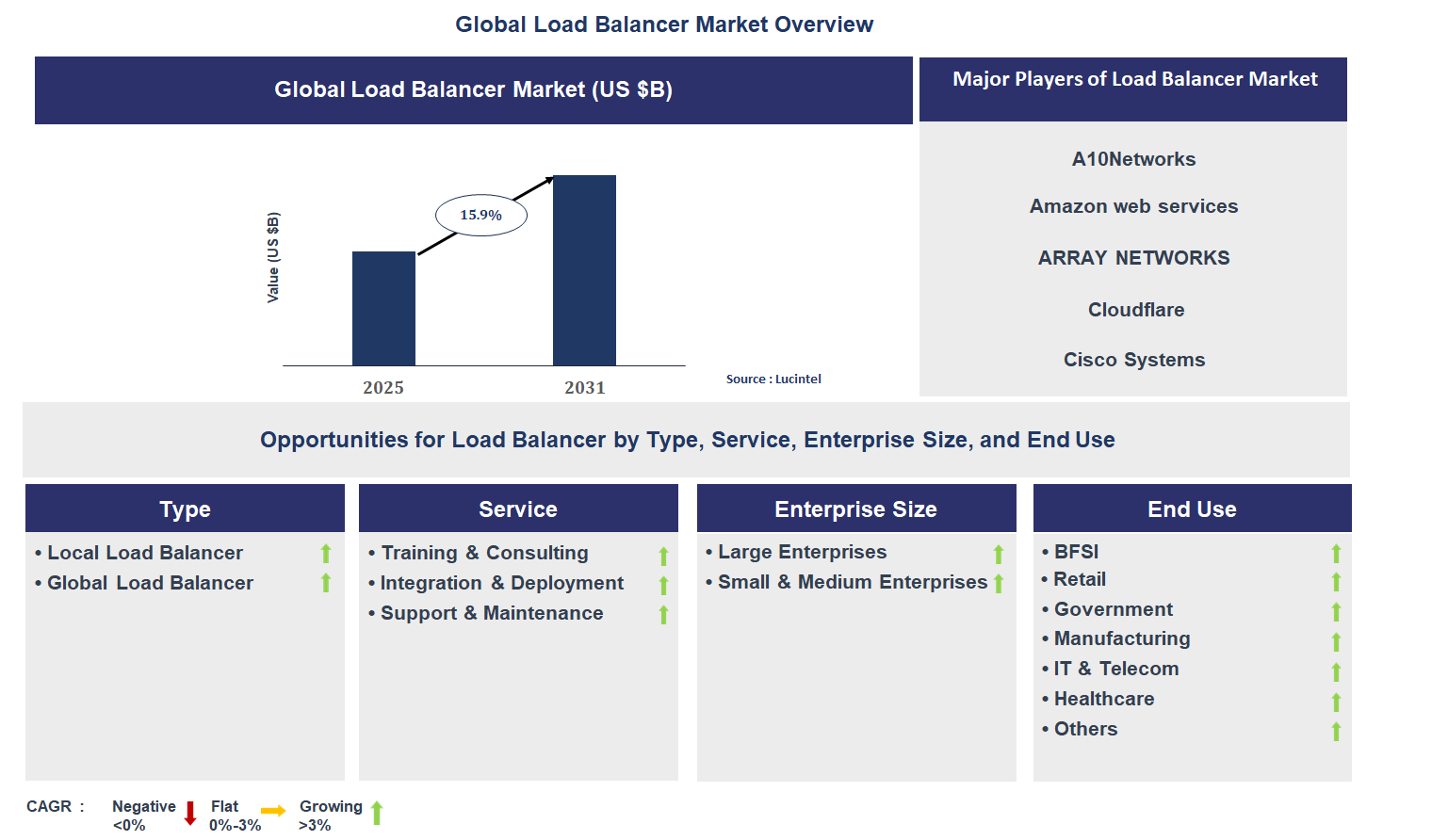
Key data points: The growth forecast = 15.9% annually for the next 7 years. Scroll below to get more insights. This market report covers trends, opportunities and forecasts in load balancer market to 2031 by type (local load balancer and global load balancer), service (training & consulting, integration & deployment, and support & maintenance), enterprise size (large enterprises and small & medium enterprises), end use (BFSI, retail, government, manufacturing, IT & telecom, healthcare, and others), and region (North America, Europe, Asia Pacific, and the Rest of the World)
We'll send your sample report shortly.
• Lucintel forecasts that, within the type category, local load balancer is expected to witness higher growth over the forecast period.
• Within the end use category, IT & telecom is expected to witness the highest growth.
• In terms of region, APAC is expected to witness the highest growth over the forecast period. Gain valuable insights for your business decisions with our comprehensive 150+ page report. Sample figures with some insights are shown below.
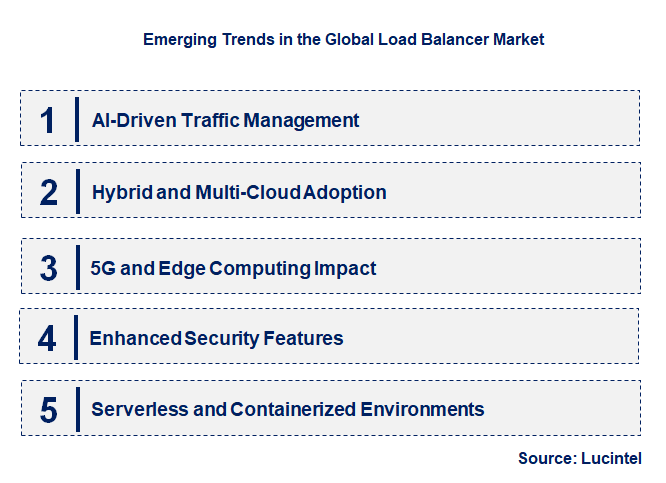
• AI-Driven Traffic Management: AI-driven load balancers are transforming traffic management by enabling predictive analytics and automated traffic distribution. This trend allows for real-time adjustments to network loads based on evolving patterns. AI integration enhances operational efficiency by reducing manual intervention and optimizing resource allocation for improved system performance and responsiveness.
• Hybrid and Multi-Cloud Adoption: Businesses are increasingly adopting hybrid and multi-cloud strategies, necessitating load balancing solutions that can efficiently distribute traffic across diverse environments. These solutions provide flexibility in managing workloads between on-premise and multiple cloud platforms, ensuring high availability, cost efficiency, and seamless scaling of applications and services.
• 5G and Edge Computing Impact: The rise of 5G networks and edge computing is driving the need for low-latency, high-throughput load balancing solutions. These technologies require efficient traffic management to ensure real-time data processing at the edge, enabling faster decision-making in applications such as IoT, autonomous vehicles, and smart cities. Load balancing is crucial for maintaining system performance and reliability.
• Enhanced Security Features: As cyber threats become more sophisticated, there is an increasing focus on incorporating advanced security features into load balancers. Solutions now integrate DDoS protection, encryption, and traffic monitoring to safeguard against malicious attacks. These security measures ensure that businesses can maintain uninterrupted service while protecting their infrastructure from external threats.
• Serverless and Containerized Environments: The adoption of serverless computing and containerized applications is driving the need for load balancing solutions that can dynamically scale and manage these architectures. Load balancers are evolving to integrate seamlessly with platforms like Kubernetes, providing flexibility, scalability, and automated management of containerized workloads across diverse environments. Emerging trends like AI integration, multi-cloud adoption, and edge computing are reshaping the load balancer market by addressing the need for greater scalability, performance, and security. These trends highlight the growing complexity of modern IT infrastructures and the need for more intelligent, flexible load balancing solutions. As these trends continue to evolve, they will define the future of network traffic management.
• Cloud-Native Load Balancers: The transition to cloud-native environments has accelerated the development of load balancers that can handle containerized applications and dynamic workloads. These solutions are designed to integrate seamlessly with cloud platforms such as AWS, Azure, and Google Cloud. Cloud-native load balancers are highly scalable, providing businesses with the flexibility to manage fluctuating traffic while ensuring optimal application performance.
• AI and Automation Integration: AI-driven load balancing is becoming increasingly common, enabling businesses to automate traffic distribution based on predictive analytics. Automation helps businesses optimize resource allocation, reduce downtime, and improve efficiency by dynamically adjusting to changes in network conditions without human intervention. This is particularly valuable in environments with unpredictable or fluctuating traffic.
• DDoS Protection and Security Enhancements: The integration of advanced DDoS protection and security features in load balancers is a major development in response to rising cyber threats. Modern load balancing solutions now include real-time monitoring, traffic filtering, and encryption capabilities, safeguarding businesses from malicious attacks and ensuring high availability even during periods of intense traffic congestion.
• Integration with Service Meshes: With the rise of microservices architectures, load balancers are now being integrated with service meshes to enable more granular control over network traffic between microservices. This integration provides enhanced security, scalability, and observability, particularly in complex distributed systems where managing inter-service communication is critical for overall performance.
• Serverless and Edge Load Balancing: The growth of serverless computing and edge deployments has led to the development of specialized load balancers that can handle real-time traffic at the edge of the network. These load balancers are optimized for low-latency applications, enabling efficient traffic distribution and ensuring that resources are available even in remote or decentralized environments. Recent developments in the load balancer market reflect the increasing complexity of modern IT environments. From cloud-native solutions to advanced security features, these innovations are enabling businesses to manage traffic more efficiently, scale their operations, and enhance security. As technology continues to evolve, these developments will play a crucial role in optimizing network performance and reliability.
• Cloud Computing: The rapid shift to cloud computing is driving demand for load balancers that can handle dynamic workloads across multi-cloud and hybrid environments. As businesses increasingly move to cloud-based infrastructures, the need for flexible, scalable, and high-performance load balancing solutions is growing, particularly for global organizations managing diverse cloud environments.
• E-Commerce Platforms: E-commerce businesses face significant traffic spikes during peak shopping periods, making efficient load balancing critical. Load balancers help ensure high availability, optimize response times, and provide a seamless user experience by distributing traffic efficiently across multiple servers. As e-commerce continues to expand, load balancing solutions will become even more integral to maintaining system stability and performance.
• Healthcare Sector: The healthcare industry is undergoing a digital transformation, creating opportunities for load balancing solutions to manage sensitive healthcare applications such as electronic health records (EHR) and telemedicine platforms. High availability, security, and data integrity are paramount, driving the need for load balancers that can ensure seamless performance and compliance with healthcare regulations.
• Media and Streaming Services: The demand for high-quality video streaming is creating a significant growth opportunity for load balancers in the media and entertainment industry. Load balancing solutions are essential to deliver uninterrupted, high-quality content to users worldwide. Optimizing traffic across global content delivery networks (CDNs) is crucial for maintaining user satisfaction and service reliability.
• IoT and Smart Devices: As the number of connected devices grows, the need for efficient load balancing solutions to manage IoT traffic is increasing. Load balancers play a critical role in handling the massive volumes of data generated by IoT devices, ensuring that real-time communication and data processing are managed effectively in applications like smart cities, autonomous vehicles, and industrial IoT. Strategic growth opportunities in the load balancer market span across multiple industries, including cloud computing, e-commerce, healthcare, media, and IoT. As businesses in these sectors continue to expand their digital infrastructures, the need for scalable, reliable, and high-performance load balancing solutions will grow. These applications are key drivers of future market growth, positioning load balancing as an essential technology in modern IT environments.
• A10Networks
• Amazon web services
• ARRAY NETWORKS
• Cloudflare
• Cisco Systems
• Citrix Systems
• F5 Networks
• Avi Networks
• Hewlett Packard Enterprise Development
• Local Load Balancer
• Global Load Balancer
• Training & Consulting
• Integration & Deployment
• Support & Maintenance
• Large Enterprises
• Small & Medium Enterprises
• BFSI
• Retail
• Government
• Manufacturing
• IT & Telecom
• Healthcare
• Others
• North America
• Europe
• Asia Pacific
• The Rest of the World
• United States: In the U.S., the demand for load balancing solutions is fueled by the rapid adoption of cloud-native applications and hybrid cloud architectures. Companies are increasingly relying on AI-driven traffic management to optimize performance. Major tech players continue to develop load balancers that integrate with multi-cloud environments, offering greater scalability and reliability for diverse enterprise applications.
• China: China’s load balancer market is growing with the country’s ambitious goals for digital infrastructure. The push towards 5G, IoT, and AI integration is driving the demand for efficient, low-latency load balancing solutions. Local providers are enhancing their offerings to meet regulatory requirements while ensuring high performance in the rapidly expanding cloud and data center sectors.
• Germany: Germany is seeing steady growth in the load balancer market due to the country’s emphasis on Industry 4.0 and digital transformation. The adoption of hybrid and multi-cloud solutions is accelerating, with businesses seeking load balancers that support high availability and security. Enhanced scalability and integration with containerized applications are central to the evolving needs of German enterprises.
• India: India’s load balancer market is expanding rapidly, driven by the rise of cloud computing, e-commerce, and government digital initiatives. The demand for scalable, high-performance load balancing solutions is increasing, especially in the technology and startup sectors. With the shift towards cloud-native architectures, businesses are prioritizing load balancing solutions that offer seamless scaling and minimal latency.
• Japan: In Japan, the load balancer market is influenced by the country’s emphasis on digital services and high-performance computing. Companies are adopting next-generation load balancing solutions to manage traffic for critical applications like IoT, 5G, and smart city infrastructure. The focus is on low-latency, high-availability solutions that can handle large-scale traffic while supporting Japan’s technological advancements.


• A10Networks
• Amazon web services
• ARRAY NETWORKS
• Cloudflare
• Cisco Systems
• Citrix Systems
• F5 Networks
• Avi Networks
• Hewlett Packard Enterprise Development Q5. Which load balancer market segment will be the largest in future? Answer: Lucintel forecasts that, within the type category, local load balancer is expected to witness higher growth over the forecast period. Q6. In load balancer market, which region is expected to be the largest in next 5 years? Answer: In terms of region, APAC is expected to witness the highest growth over the forecast period. Q7. Do we receive customization in this report? Answer: Yes, Lucintel provides 10% customization without any additional cost.


Choose a license that fits your team. Instant PDF delivery.
Prices exclude taxes. Instant delivery. Custom licensing available on request.
Market Report · July 29, 2026
Market Report · July 20, 2026
Market Report · July 20, 2026
Trusted partner for strategic intelligence and business growth


Receive a complimentary market analysis tailored to your industry. Our analysts will identify key growth opportunities and competitive dynamics specific to your business.

Market size, growth rate, and key trend analysis for your specific sector.

Top competitor positioning and market share analysis.

Strategic recommendations backed by data-driven insights.
Get curated market intelligence and competitive moves straight to your inbox.
By subscribing, you agree to receive our monthly insights. Unsubscribe anytime.
Receive a complimentary market analysis tailored to your industry. Our analysts will identify key growth opportunities and competitive dynamics specific to your business.
Market size, growth rate, and key trend analysis for your specific sector.
Top competitor positioning and market share analysis.
Strategic recommendations backed by data-driven insights.
Get curated market intelligence, emerging trends, and competitive moves straight to your inbox each month.
By subscribing, you agree to receive our monthly insights. Unsubscribe anytime.
We'll send your sample report shortly.