
Report Feature
Livestock Animal Vaccine Market Trends and Forecast
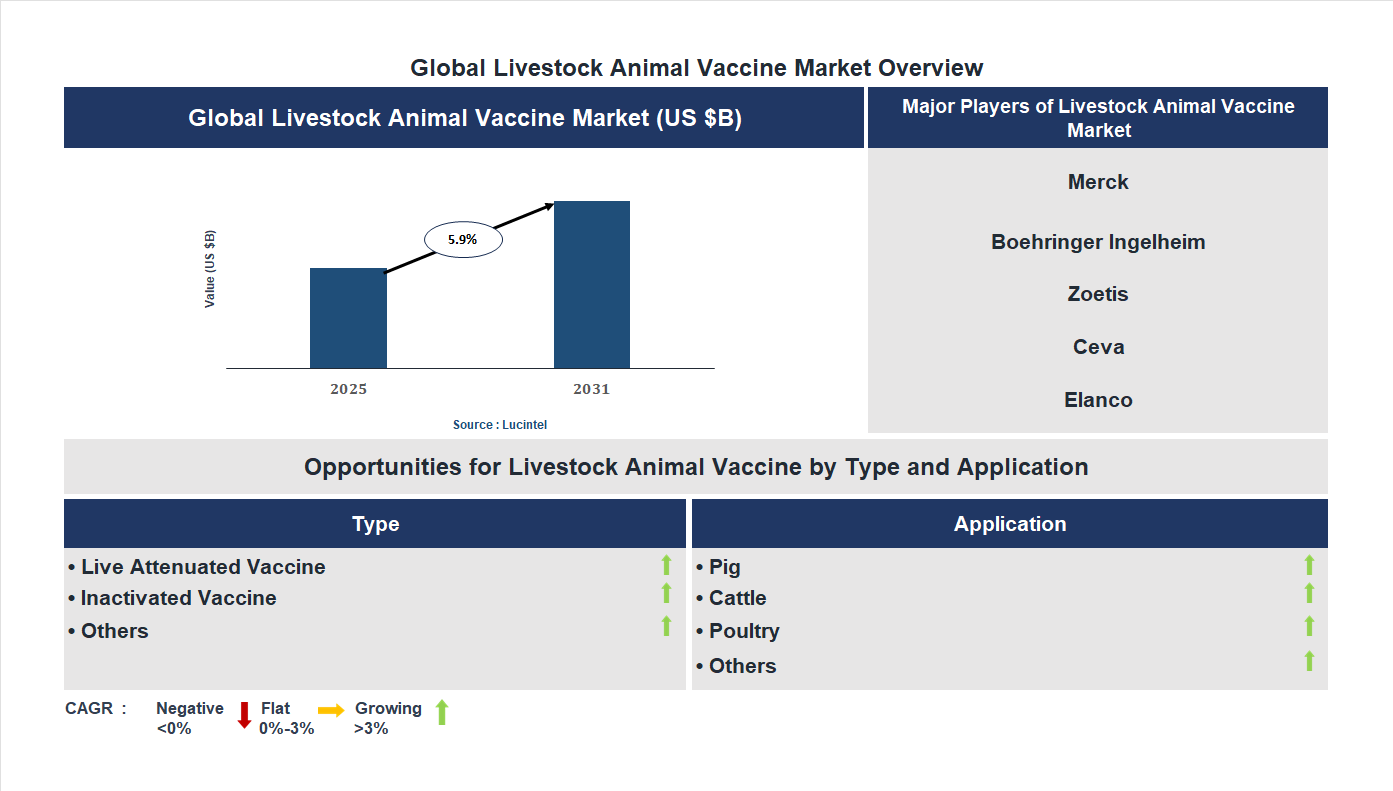
The future of the global livestock animal vaccine market looks promising with opportunities in the live attenuated vaccine and inactivated vaccine markets. The global livestock animal vaccine market is expected to grow with a CAGR of 5.9% from 2025 to 2031. The major drivers for this market are the increasing demand for disease free livestock, the rising focus on preventive animal healthcare, and the growing adoption of advanced veterinary vaccines.• Lucintel forecasts that, within the application category, pig is expected to witness the highest growth over the forecast period.
• Within the type category, inactivated vaccine is expected to witness higher growth.
• In terms of region, APAC is expected to witness the highest growth over the forecast period. Gain valuable insights for your business decisions with our comprehensive 150+ page report. Sample figures with some insights are shown below.
Emerging Trends in the Livestock Animal Vaccine Market
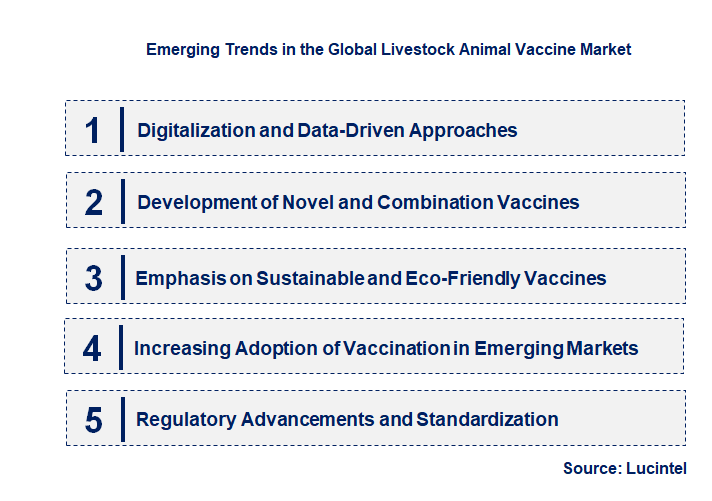
The livestock animal vaccine market is experiencing rapid evolution driven by technological advancements, changing regulatory landscapes, and increasing global demand for safe and effective animal health solutions. As the livestock industry faces challenges such as emerging diseases, antibiotic resistance, and the need for sustainable practices, innovative vaccine development and deployment are becoming crucial. These developments are reshaping how vaccines are produced, administered, and monitored, ultimately impacting livestock productivity, food security, and public health. Understanding the key emerging trends provides insight into the future trajectory of this vital market and its role in supporting global agricultural and health objectives.• Digitalization and Data-Driven Approaches: The integration of digital technologies such as IoT, AI, and big data analytics is transforming vaccine development and management. These tools enable real-time monitoring of animal health, predictive analytics for disease outbreaks, and personalized vaccination schedules. This trend improves vaccine efficacy, reduces costs, and enhances traceability, leading to more efficient and targeted interventions. Digital platforms also facilitate better supply chain management and regulatory compliance, ultimately increasing trust and transparency in the market.
• Development of Novel and Combination Vaccines: There is a growing focus on creating innovative vaccines that offer broader protection against multiple diseases simultaneously. Combination vaccines reduce the number of injections required, improving animal compliance and welfare. Advances in biotechnology, such as recombinant DNA and mRNA technologies, are accelerating the development of these vaccines. This trend enhances disease control, minimizes stress on animals, and optimizes resource utilization, making vaccination programs more effective and economical.
• Emphasis on Sustainable and Eco-Friendly Vaccines: Environmental concerns and sustainability goals are influencing vaccine development. Researchers are exploring biodegradable adjuvants, eco-friendly production processes, and vaccines that require fewer doses. These innovations aim to reduce the environmental footprint of vaccine manufacturing and administration. Sustainable vaccines support global efforts to combat climate change and promote responsible livestock management, aligning market growth with ecological preservation and social responsibility.
• Increasing Adoption of Vaccination in Emerging Markets: Rapid urbanization, rising income levels, and expanding livestock populations are driving vaccine adoption in developing regions. Governments and the private sector are investing in vaccination programs to improve animal health and productivity. Challenges such as a lack of infrastructure and awareness are being addressed through mobile clinics, subsidies, and education campaigns. This trend significantly expands market reach, diversifies customer bases, and fosters global growth in livestock health management.
• Regulatory Advancements and Standardization: Evolving regulatory frameworks are shaping vaccine approval, quality assurance, and safety standards. Harmonization of regulations across regions facilitates international trade and market entry. Enhanced focus on clinical trials, post-market surveillance, and quality control ensures higher vaccine efficacy and safety. These developments build consumer confidence, streamline market access, and encourage innovation, ultimately fostering a more robust and trustworthy livestock vaccine industry. In summary, these emerging trends are collectively transforming the livestock animal vaccine market by making it more innovative, sustainable, and accessible. Digital technologies, novel vaccine formulations, environmental considerations, expanding markets, and regulatory improvements are driving growth and efficiency. These changes are not only enhancing animal health and productivity but also supporting global food security and public health initiatives, positioning the market for sustained future expansion.
Recent Development in the Livestock Animal Vaccine Market
The livestock animal vaccine market has experienced significant growth driven by increasing demand for animal health products, advancements in vaccine technology, and rising awareness of zoonotic diseases. The market is influenced by factors such as government initiatives, technological innovations, and the need to improve livestock productivity. Recent developments reflect a shift towards more effective, safer, and cost-efficient vaccines, alongside expanding markets in emerging economies. These changes are shaping the future landscape of livestock health management, emphasizing sustainability and disease prevention. The following key developments highlight the current trajectory and future potential of this dynamic market.• Introduction of mRNA Vaccines: The development of mRNA vaccines for livestock has revolutionized disease prevention by enabling rapid, customizable, and highly effective immunizations. This innovation enhances the ability to respond swiftly to emerging diseases, reducing outbreaks and economic losses. The impact includes improved herd immunity, reduced vaccine development time, and increased adoption among farmers seeking advanced solutions.
• Expansion of Vaccination Programs in Emerging Markets: Governments and private entities are increasingly investing in livestock vaccination initiatives in regions like the Asia-Pacific and Africa. These programs aim to control endemic diseases, improve livestock productivity, and ensure food security. The expansion boosts market growth, creates new opportunities for vaccine manufacturers, and promotes sustainable livestock farming practices.
• Adoption of Digital Technologies for Vaccine Delivery: Integration of digital tools such as IoT, blockchain, and data analytics in vaccine management has improved traceability, storage, and distribution efficiency. These technologies ensure vaccine integrity, reduce wastage, and facilitate real-time monitoring. The impact is a more streamlined supply chain, enhanced vaccine efficacy, and increased confidence among stakeholders.
• Development of Combination Vaccines: The market has seen a rise in combination vaccines that protect against multiple diseases in a single shot. This reduces vaccination costs, minimizes stress on animals, and improves compliance among farmers. The development of such vaccines accelerates herd immunity and simplifies vaccination schedules, positively influencing market growth.
• Focus on Vaccines for Emerging Diseases: Researchers are prioritizing the development of vaccines for newly identified or re-emerging livestock diseases, such as African swine fever and avian influenza. These efforts aim to prevent large-scale outbreaks and economic losses. The focus on emerging diseases ensures market resilience, encourages innovation, and supports global food security. In summary, these recent developments are significantly transforming the livestock animal vaccine market by enhancing vaccine efficacy, expanding access in emerging regions, leveraging digital innovations, and addressing new disease threats. Collectively, they are driving market growth, improving livestock health, and supporting sustainable agricultural practices worldwide.
Strategic Growth Opportunities in the Livestock Animal Vaccine Market
The livestock animal vaccine market is experiencing rapid growth driven by increasing demand for disease prevention, rising awareness of animal health, and technological advancements in vaccine development. As the livestock industry expands globally, the need for effective vaccines to combat emerging and existing diseases becomes critical. Key applications such as cattle, poultry, swine, small ruminants, and aquaculture are witnessing significant investments and innovation. These developments are shaping the future landscape of the market, offering new opportunities for manufacturers and stakeholders to enhance productivity, ensure animal health, and meet regulatory standards. The following are five key growth opportunities across these applications.• Cattle Vaccines: Expanding disease prevention measures in cattle are crucial for improving herd health and productivity. Innovations in vaccines targeting bovine respiratory diseases and mastitis are reducing mortality rates and increasing milk and meat yields. This growth enhances profitability for farmers and supports global meat and dairy supply chains.
• Poultry Vaccines: The rising incidence of avian influenza and other poultry diseases is driving demand for advanced vaccines. Development of multivalent vaccines offers broader protection, reducing losses and improving poultry farm efficiency. This opportunity supports the growing global poultry industry and food security.
• Swine Vaccines: Increasing outbreaks of swine diseases like porcine reproductive and respiratory syndrome (PRRS) are prompting investments in effective vaccines. Enhanced vaccine formulations improve herd immunity, reduce economic losses, and support sustainable pork production, especially in emerging markets.
• Small Ruminant Vaccines: Growing demand for sheep and goat products is fueling the need for targeted vaccines against diseases such as clostridial infections and peste des petits ruminants. These vaccines help improve livestock health, productivity, and rural livelihoods in developing regions.
• Aquaculture Vaccines: The rising global fish and shrimp consumption is boosting the aquaculture sector. Vaccines against bacterial and viral infections are vital for reducing mortality rates and ensuring sustainable aquaculture practices, thus supporting food security and economic growth. In summary, these growth opportunities are significantly impacting the livestock animal vaccine market by driving innovation, expanding market reach, and improving animal health outcomes. They enable stakeholders to meet increasing global demand for animal products while addressing disease challenges effectively, fostering sustainable growth in the industry.
Livestock Animal Vaccine Market Driver and Challenges
The livestock animal vaccine market is influenced by a variety of technological, economic, and regulatory factors that shape its growth and development. Advances in vaccine technology, increasing demand for livestock products, and stringent government regulations are key drivers. Conversely, challenges such as high R&D costs, regulatory hurdles, and concerns over vaccine safety pose significant obstacles. Understanding these drivers and challenges is essential for stakeholders to navigate the market effectively and capitalize on emerging opportunities while addressing potential risks. The factors responsible for driving the livestock animal vaccine market include:-• Technological Advancements: The development of innovative vaccine formulations, including recombinant and DNA vaccines, has significantly improved efficacy and safety profiles. These advancements enable targeted immunization, reduce side effects, and extend shelf life, thereby increasing adoption among farmers and veterinarians. Continuous research and technological progress are expected to further enhance vaccine effectiveness, reduce costs, and facilitate rapid response to emerging diseases, ultimately expanding market reach and improving livestock health management.
• Rising Incidence of Livestock Diseases: Increasing outbreaks of infectious diseases such as foot-and-mouth disease, avian influenza, and bovine tuberculosis are driving the demand for effective vaccines. These diseases threaten livestock productivity and economic stability, prompting governments and farmers to invest in preventive measures. The growing awareness of disease control benefits and the need to minimize economic losses are fueling vaccine adoption, thereby expanding the market and encouraging innovation in vaccine development.
• Growing Livestock Population: The global increase in livestock populations, driven by rising meat consumption and expanding dairy industries, is a major market driver. As demand for animal-based products grows, so does the need for maintaining healthy livestock through vaccination. This demographic trend supports increased vaccine production and distribution, especially in developing regions where livestock farming is a primary livelihood, thus fueling market growth and encouraging infrastructure development.
• Regulatory Support and Government Initiatives: Governments worldwide are implementing policies to improve animal health and prevent disease outbreaks, including subsidies, vaccination campaigns, and strict regulatory standards. These initiatives promote vaccine usage and ensure quality control, fostering market confidence. Regulatory frameworks also facilitate international trade of livestock and animal products, further boosting vaccine demand. Supportive policies are crucial for market expansion, especially in emerging economies where livestock health is vital for economic development.
• Increasing Awareness and Adoption of Preventive Healthcare: Farmers and veterinarians are increasingly recognizing the importance of preventive measures to ensure livestock health and productivity. Educational campaigns, extension services, and improved access to vaccines are driving adoption rates. This shift from reactive to preventive healthcare reduces disease incidence, enhances productivity, and lowers treatment costs, thereby expanding the market. The trend also encourages innovation in vaccine delivery methods and formulations to meet diverse needs. The challenges facing this livestock animal vaccine market include:-
• High R&D Costs and Time-Intensive Development: Developing effective livestock vaccines involves extensive research, clinical trials, and regulatory approval processes, which are costly and time-consuming. These factors can delay product launches and increase overall expenses, limiting innovation and market entry for smaller players. High R&D costs also impact pricing strategies, potentially making vaccines less affordable for farmers, especially in developing regions, thereby restraining market growth.
• Regulatory and Approval Barriers: Stringent regulatory requirements vary across countries and can be complex and lengthy to navigate. These barriers delay vaccine approval, increase compliance costs, and create uncertainties for manufacturers. Variability in regulations hampers international trade and market expansion, especially for new or innovative vaccines. Ensuring compliance while maintaining rapid development cycles remains a significant challenge for market players.
• Concerns Over Vaccine Safety and Efficacy: Despite technological advances, skepticism about vaccine safety and concerns over adverse effects persist among farmers and veterinarians. Misinformation and lack of awareness can hinder adoption rates. Additionally, vaccine efficacy may vary depending on disease strains and environmental factors, leading to inconsistent results. Addressing these concerns through education, transparent testing, and post-market surveillance is essential to building trust and sustaining market growth. In summary, the livestock animal vaccine market is shaped by technological innovations, rising disease prevalence, demographic trends, supportive policies, and increasing awareness. However, high development costs, regulatory complexities, and safety concerns pose notable challenges. These drivers and obstacles collectively influence market dynamics, with technological progress and regulatory support fostering growth, while R&D costs and safety issues require strategic management. Overall, the markets future depends on balancing innovation with regulatory compliance and stakeholder confidence, ensuring sustainable growth and improved livestock health worldwide.
List of Livestock Animal Vaccine Companies
Companies in the market compete on the basis of product quality offered. Major players in this market focus on expanding their manufacturing facilities, R&D investments, infrastructural development, and leverage integration opportunities across the value chain. With these strategies livestock animal vaccine companies cater increasing demand, ensure competitive effectiveness, develop innovative products & technologies, reduce production costs, and expand their customer base. Some of the livestock animal vaccine companies profiled in this report include-• Merck
• Boehringer Ingelheim
• Zoetis
• Ceva
• Elanco
• CAHIC
• Jinyu Bio-Technology
• HVRI
• Ringpu Biology
• Yebio
Livestock Animal Vaccine Market by Segment
The study includes a forecast for the global livestock animal vaccine market by type, application, and region.Livestock Animal Vaccine Market by Type [Value from 2019 to 2031]:
• Live Attenuated Vaccine
• Inactivated Vaccine
• Others
Livestock Animal Vaccine Market by Application [Value from 2019 to 2031]:
• Pig
• Cattle
• Poultry
• Others
Livestock Animal Vaccine Market by Region [Value from 2019 to 2031]:
• North America
• Europe
• Asia Pacific
• The Rest of the World
Country Wise Outlook for the Livestock Animal Vaccine Market
The livestock animal vaccine market has experienced significant growth driven by increasing demand for animal health, rising concerns over zoonotic diseases, and advancements in vaccine technology. Governments and private sectors worldwide are investing heavily to improve vaccine efficacy and distribution channels. The markets evolution is also influenced by regulatory changes, technological innovations, and the need for sustainable livestock management practices. These developments vary across regions, reflecting differing priorities, technological capabilities, and disease prevalence. Understanding these regional trends is crucial for stakeholders aiming to capitalize on emerging opportunities and address challenges effectively.• United States: The US market has seen substantial innovation with the approval of new vaccines targeting emerging zoonotic diseases. There is a growing focus on vaccine development for livestock health management, supported by government initiatives and private investments. Advances in biotechnology, such as recombinant and mRNA vaccines, are enhancing efficacy. The adoption of digital tracking and data analytics is improving vaccine distribution and monitoring. Additionally, regulatory agencies are streamlining approval processes to facilitate faster market entry for new vaccines, boosting overall market growth.
• China: China’s livestock vaccine market is expanding rapidly due to increasing livestock production and rising disease outbreaks. The government has implemented strict vaccination policies and increased funding for vaccine research. Local companies are investing in developing affordable, effective vaccines tailored to regional disease strains. The country is also adopting advanced technologies like gene editing and nanotechnology to improve vaccine efficacy. Efforts to improve cold chain logistics are underway to ensure better vaccine distribution across rural areas, supporting the market’s robust growth.
• Germany: Germany’s market is characterized by a focus on high-quality, innovative vaccines, driven by stringent regulatory standards and a strong emphasis on animal welfare. The country is investing in research for vaccines against emerging diseases and antibiotic-resistant strains. Collaboration between academia and industry is fostering technological advancements, including the development of combination vaccines. Germany’s emphasis on sustainable livestock practices and biosecurity measures is also influencing vaccine demand. The market benefits from a well-established distribution network and a high level of regulatory oversight, ensuring safety and efficacy.
• India: India’s livestock vaccine market is witnessing rapid growth due to increasing livestock populations and rising awareness of animal health. The government’s initiatives to promote vaccination and disease control are boosting market expansion. Local manufacturers are focusing on affordable vaccines for diseases like foot-and-mouth disease and brucellosis. The adoption of new technologies such as thermostable vaccines is improving accessibility in rural areas. Additionally, collaborations with international organizations are enhancing research and development efforts, making vaccines more effective and affordable for the large rural population.
• Japan: Japan’s market is characterized by advanced technological integration and a focus on disease prevention in livestock. The country is investing in next-generation vaccines, including DNA and recombinant vaccines, to combat emerging threats. Strict regulatory standards ensure high safety and efficacy levels, fostering consumer confidence. Japan is also emphasizing sustainable practices and biosecurity measures, which influence vaccine development and deployment. The market benefits from a mature distribution network and strong government support for innovation in animal health, positioning Japan as a leader in high-quality livestock vaccines.

Features of the Global Livestock Animal Vaccine Market
Market Size Estimates: Livestock animal vaccine market size estimation in terms of value ($B). Trend and Forecast Analysis: Market trends (2019 to 2024) and forecast (2025 to 2031) by various segments and regions. Segmentation Analysis: Livestock animal vaccine market size by type, application, and region in terms of value ($B). Regional Analysis: Livestock animal vaccine market breakdown by North America, Europe, Asia Pacific, and Rest of the World. Growth Opportunities: Analysis of growth opportunities in different types, applications, and regions for the livestock animal vaccine market. Strategic Analysis: This includes M&A, new product development, and competitive landscape of the livestock animal vaccine market. Analysis of competitive intensity of the industry based on Porter’s Five Forces model.
FAQ
Q1. What is the growth forecast for livestock animal vaccine market? Answer: The global livestock animal vaccine market is expected to grow with a CAGR of 5.9% from 2025 to 2031. Q2. What are the major drivers influencing the growth of the livestock animal vaccine market? Answer: The major drivers for this market are the increasing demand for disease free livestock, the rising focus on preventive animal healthcare, and the growing adoption of advanced veterinary vaccines. Q3. What are the major segments for livestock animal vaccine market? Answer: The future of the livestock animal vaccine market looks promising with opportunities in the live attenuated vaccine and inactivated vaccine markets. Q4. Who are the key livestock animal vaccine market companies? Answer: Some of the key livestock animal vaccine companies are as follows:• Merck
• Boehringer Ingelheim
• Zoetis
• Ceva
• Elanco
• CAHIC
• Jinyu Bio-Technology
• HVRI
• Ringpu Biology
• Yebio Q5. Which livestock animal vaccine market segment will be the largest in future? Answer: Lucintel forecasts that, within the application category, pig is expected to witness the highest growth over the forecast period. Q6. In livestock animal vaccine market, which region is expected to be the largest in next 5 years? Answer: In terms of region, APAC is expected to witness the highest growth over the forecast period. Q7. Do we receive customization in this report? Answer: Yes, Lucintel provides 10% customization without any additional cost.
Table of Contents
List of Figures
List of Tables
Methodology
- In-depth interviews of the major players in this market
- Detailed secondary research from competitors’ financial statements and published data
- Extensive searches of published works, market, and database information pertaining to industry news, company press releases, and customer intentions
- A compilation of the experiences, judgments, and insights of Lucintel’s professionals, who have analyzed and tracked this market over the years.


Buy Now
Choose a license that fits your team. Instant PDF delivery.
Prices exclude taxes. Instant delivery. Custom licensing available on request.
Key Questions
- • What are some of the most promising, high-growth opportunities for the livestock animal vaccine market by type (live attenuated vaccine, inactivated vaccine, and others), application (pig, cattle, poultry, and others), and region (North America, Europe, Asia Pacific, and the Rest of the World)?
- • Which segments will grow at a faster pace and why?
- • Which region will grow at a faster pace and why?
- • What are the key factors affecting market dynamics? What are the key challenges and business risks in this market?
- • What are the business risks and competitive threats in this market?
- • What are the emerging trends in this market and the reasons behind them?
- • What are some of the changing demands of customers in the market?
- • What are the new developments in the market? Which companies are leading these developments?
- • Who are the major players in this market? What strategic initiatives are key players pursuing for business growth?
- • What are some of the competing products in this market and how big of a threat do they pose for loss of market share by material or product substitution?
- • What M&A activity has occurred in the last 5 years and what has its impact been on the industry? For any questions related to Livestock Animal Vaccine Market, Livestock Animal Vaccine Market Size, Livestock Animal Vaccine Market Growth, Livestock Animal Vaccine Market Analysis, Livestock Animal Vaccine Market Report, Livestock Animal Vaccine Market Share, Livestock Animal Vaccine Market Trends, Livestock Animal Vaccine Market Forecast, Livestock Animal Vaccine Companies, write Lucintel analyst at email: helpdesk@lucintel.com. We will be glad to get back to you soon.


