
Report Feature
Live Streaming Hardware Market Trends and Forecast
The future of the global live streaming hardware market looks promising with opportunities in the online sale and offline sale markets. The global live streaming hardware market is expected to grow with a CAGR of 9.2% from 2025 to 2031. The major drivers for this market are rising demand for high-quality live streaming content across industries, growth in social media platforms and online entertainment, and increasing use of live streaming in events, gaming, and education. Lucintel forecasts that, within the type category, mobile phones & camera is expected to witness the highest growth over the forecast period due to mobile phones and cameras are the primary devices used for capturing and broadcasting live streaming content. Within the application category, online sale is expected to witness the higher growth due to the growing trend of e-commerce, where consumers prefer the convenience of shopping online. In terms of region, North America is expected to witness the highest growth over the forecast period due to the region‘s strong digital infrastructure, high adoption of live streaming across entertainment. Gain valuable insights for your business decisions with our comprehensive 150+ page report. Sample figures with some insights are shown below.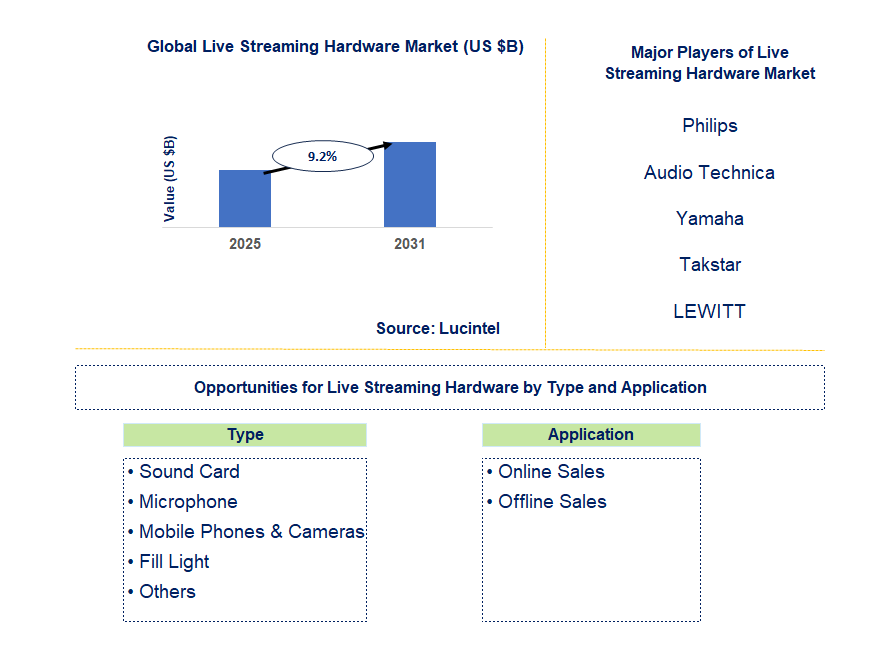
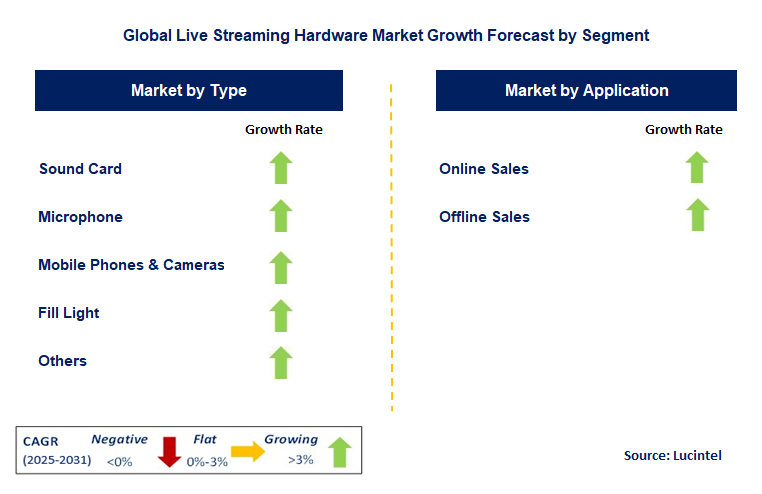
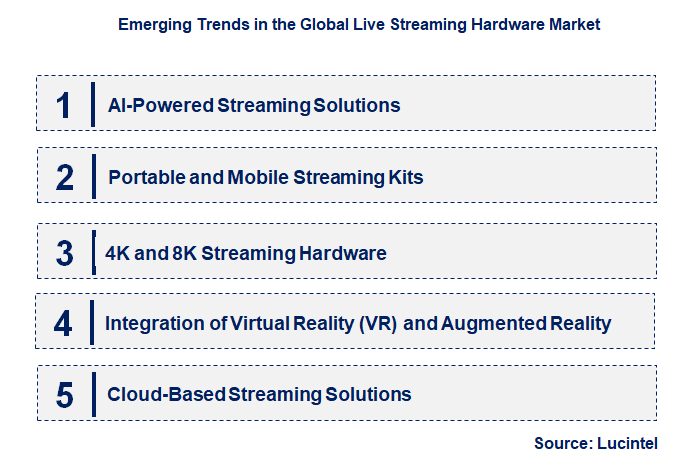
Emerging Trends in the Live Streaming Hardware Market
The live streaming hardware market is undergoing a radical transformation due to new technologies and evolving user needs. These trends are driven by increasing demand for higher-quality broadcasts, the rise of virtual events, and innovations in AI and connectivity. Here are the top five emerging trends shaping the live streaming hardware market.• AI-Powered Streaming Solutions: The more frequent integration of AI technologies into the hardware of live streaming is increasing video production and broadcasting quality. AI can perform tasks such as automated camera movement, real-time video enhancement, and audience engagement analytics. For example, an AI-driven camera can adjust the focus and framing depending on the type of content to be filmed and improves the quality of live streams with minimal human interference. This trend is further allowing more professional live broadcasts, not necessarily requiring large production teams; hence, they are cheaper, and live streaming will be more available to a variety of creators.
• Portable and Mobile Streaming Kits: The market for portable streaming solutions is increasing significantly, especially in the case of content creators and influencers who stream from different locations. Mobile streaming kits, including compact cameras, microphones, and stabilizers, allow users to broadcast high-quality content from anywhere. This is particularly beneficial for creators who go live on the go, like travel vloggers or event reporters. Companies are now coming up with all-in-one, easy-to-carry solutions that provide high production value with minimal setup to meet the growing need for flexible and mobile live streaming options.
• 4K and 8K Streaming Hardware: As internet speeds improve and more platforms support ultra-high-definition content, the demand for 4K and even 8K streaming hardware is increasing. Developing advanced cameras, encoders, and mixers with the ability to support high-resolution formats is ever the motivation for a better visual experience of the content being offered to its audience. This trend is highly common in gaming, sports, and entertainment industries where high-definition video quality increases the viewer‘s interest. 8K streaming is still at its infancy stage, but with the increased demand for quality content, there will be an increase in the need for 8K-capable hardware.
• Integration of Virtual Reality (VR) and Augmented Reality (AR): With the advent of immersive media, VR and AR technologies are being increasingly integrated into live streaming hardware. VR and AR are used to create more engaging live streams, especially in gaming and entertainment. VR headsets and AR cameras allow creators to broadcast immersive experiences to their audience in real time, enhancing the overall experience. This trend is pushing hardware manufacturers to develop specialized cameras, lenses, and software to enable seamless VR/AR streaming, expanding the possibilities for content creators and enhancing user engagement.
• Cloud-Based Streaming Solutions: Cloud technology is revolutionizing live streaming, offering benefits such as scalability, flexibility, and accessibility. Cloud-based solutions allow for easier collaboration, remote production, and storage of live content. For instance, live streaming solutions can offload video encoding and processing to the cloud, thereby not putting a strain on what is locally available, while simultaneously enhancing the quality of live streams. In addition, cloud technology allows for managing live content with greater efficiency; this way, businesses and individuals may instantly scale up their streaming operations without requiring expensive hardware upgrades. These newly emerging trends change the live streaming hardware market profoundly. From AI to portable streaming kits, 4K/8K technology, virtual reality/AR incorporation, and the cloud, live streaming hardware evolves to satisfy consumers‘ increasing expectations for quality and flexibility in watching live content. As these developments continue, more opportunities will open both for content developers and consumers with regard to efficiency, accessibility, and quality.
Recent Development in the Live Streaming Hardware Market
Live streaming hardware is an ever-changing market due to increasing demand for high-quality, real-time content among consumers. Technologies, such as AI-driven cameras, mobile streaming kits, and 4K/8K solutions, have revolutionized this market. This paper highlights five significant developments in shaping the landscape of live streaming hardware.• AI-Enhanced Cameras for Live Streaming: One of the most remarkable breakthroughs in live streaming hardware has been the emergence of AI-enhanced cameras. These cameras are able to apply AI for adjusting focus, lighting, and framing automatically depending on what is being streamed, thereby avoiding the intervention required by a human. It can also provide enhancements in video quality in real-time for content creators in order to help them deliver a professional-grade broadcast. This development is particularly helpful to smaller creators and businesses, which simplifies the production process while maintaining quality visuals.
• Mobile Streaming Solutions: The advancement of mobile streaming solutions has enabled content creators to stream high-quality content on the go. Portable live streaming kits, including compact cameras, microphones, and stabilizers, are now essentials for influencers, event reporters, and vloggers. These solutions enable users to capture and broadcast live content from anywhere, which increases the flexibility and mobility of these products. Demand for such products is expected to continue increasing, with more creators broadcasting live from different and dynamic environments.
• Support for 4K and 8K in the Type of Hardware Streamed: The rise in the creation of content in 4K and 8K resolution pushed manufacturers to produce high-performance cameras, encoders, and video mixers supporting ultra-high-definition formats. With more YouTube and Twitch accommodating 4K type video types, the need for 4K-capable live streaming hardware has picked up pace. Such an interest is notable in the field of gaming and sports, whose live streaming, or viewer experience, is high-definition video. Moving to 8K live streaming, despite still being very much in development, shows more demand for even higher quality and increased video immersion.
• Virtual Reality/Augmented Reality (VR/AR) Integration: Including VR and AR support into live stream hardware has dramatically expanded the possible creative applications. This comprises VR headsets, AR cameras, and immersive software, all meant to engage audiences in a way that was not previously possible. Gaming and entertainment are major areas where it has been clearly applied -- live events could be enhanced with virtual and augmented reality elements. As the demand for interactive and immersive content grows, so does the need for specialized hardware to support VR/AR live streaming.
• Cloud-Based Streaming Solutions: Cloud technology is changing the landscape of live streaming hardware. It makes remote production and collaboration possible. With cloud-based solutions, content creators can manage live streams, store video data, and offload encoding tasks to external servers. This way, they can scale streaming operations without significant investment in physical infrastructure. This development is streamlining the live streaming process for both small creators and large enterprises, offering more flexibility and reducing the reliance on expensive on-premises hardware. These advancements are highly driving the live streaming hardware market, thereby making high-quality streaming more accessible and efficient for content creators. From AI-powered cameras and mobile solutions to 4K/8K support, immersive VR/AR experiences, and cloud-based streaming, these innovations are shaping the future of live broadcasting and content creation.
Strategic Growth Opportunites in the Live Streaming Hardware Market
The live streaming hardware market is growing rapidly due to increased demand for high-quality, real-time content across various sectors. Applications that are growing are key, including gaming, e-commerce, and education. Below are five key growth opportunities in the live streaming hardware market.• Gaming and Esports: The gaming and esports sectors represent one of the biggest as well as the fastest growing markets in which live streaming hardware is found. As gamers and esports competitors deliver entertaining content to audiences on Twitch and YouTube, high-end streaming kits-made of gaming cameras, microphones, and encoders-are very much in demand. Simultaneously, the need for professional-grade equipment that can advertise ultra-high-definition content with minimal latency has amplified with the onset of live esports events. This looks promising for manufacturers to fill a rapidly growing, highly dynamic, and engaged market space.
• Online Education: The online education sector has grown dynamically in past years, and live streaming has become the most crucial tool for virtual classrooms and remote learning. So, the hardware of live streaming, cameras, microphones, lighting solutions are the equipment that is being prominently adopted by educators today to improve their online teaching experiences. This trend is very promising for hardware providers, because it will make it possible for educational institutions and individual instructors to develop affordable but highly efficient solutions. While the demand for online learning keeps growing, the demand for good-quality live streaming tools also grows in tandem.
• Corporate Events and Webinars: Another significant growth area for live streaming hardware is in the corporate events and webinar market. Since the use of virtual conferences and meetings is gaining prominence, business operations rely on strong hardware to stream their live broadcasts efficiently. Organizations invest in high-quality professional-grade cameras, switchers, and microphones for high-definition webinars and events. The popularity of hybrid and remote work settings has expanded the scope for corporate communications and webinars that utilize live streaming hardware, which is an increasing requirement for organizations.
• E-commerce and Live Shopping: Live shopping is the new trend. Especially in places like China, it has made Taobao Live, for example, change the game of how customers interact with brands. E-commerce firms are investing in live streaming equipment, including high-quality cameras, lighting kits, and mobile streaming devices, to broadcast live product demonstrations and interact with customers in real time. This trend is rapidly spreading across the globe, and here lies a massive opportunity for hardware manufacturers to design solutions for the online retailers and influencers.
• Entertainment and Virtual Events: The entertainment industry is increasingly looking at live streaming as a means of connecting with the audience through concerts, theater productions, and virtual events. From high-quality cameras and microphones to sophisticated production equipment, the demand for professional-grade live streaming hardware is growing. Companies are seeking to replicate the in-person experience for virtual audiences, requiring high-performance equipment capable of supporting large-scale productions. As virtual events become more popular, hardware providers have a significant opportunity to create innovative solutions for this burgeoning market. These strategic growth opportunities in gaming, education, corporate events, e-commerce, and entertainment are driving the live streaming hardware market forward. As the demand for high-quality and real-time content continues to increase across multiple sectors, manufacturers have an opportunity to innovate and develop value-added application-specific solutions, which will further help spur growth and expansion in the market.
Live Streaming Hardware Market Driver and Challenges
The live streaming hardware market can be influenced and driven by diverse technological, economic, and regulatory factors. Therefore, these influencing drivers and restraints are responsible for shaping the future of the growing and developing markets. It can help businesses catch opportunities while tackling challenges in a live streaming hardware area. The factors responsible for driving the live streaming hardware market include: 1. Improved Streaming Technology: Technological advancements, such as better cameras, encoders, and microphones, are driving the live streaming hardware market. The demand for 4K and 8K content is also pushing hardware manufacturers to develop solutions that support these high-resolution formats. As streaming platforms continue to evolve and improve, the need for more advanced, high-performance hardware grows, further fueling market expansion. 2. Growth of Live Streaming Platforms: With the rising numbers of the adoption of live streaming on Twitch, YouTube, and Facebook Live, many people have created a great deal of demand for live streaming hardware. The use of these platforms has become imperative for the content creator, the influencer, and the business looking to gain real-time engagement with audiences. As more and more people look to live streaming as entertainment, education, or commerce, the demand for low-cost, reliable streaming hardware continues to grow. 3. E-commerce and Live Shopping: Live shopping has revolutionized demand in the markets of countries like China. The e-commerce business is keen to undertake high-quality streaming equipment for live product demonstrations, which will increase the shopping experience of consumers. This trend will be observed to grow further in the coming future, thereby augmenting new opportunities for hardware producers in the e-commerce business. 4. Surging Demand for Virtual Events: The growing popularity of virtual events, including conferences, concerts, and webinars, has created substantial demand for live streaming hardware. Companies and organizations are adopting professional-grade equipment to deliver high-quality virtual experiences. As virtual events continue to be a viable option for reaching global audiences, the demand for advanced live streaming solutions is expected to rise. 5. Improved Internet Connectivity: Improved internet connectivity, with 5G network rollouts, will continue to spur the live streaming market. Fast and reliable internet speeds lead to better-quality streams, and demand for hardware quality is increased accordingly. As the global internet infrastructure continues to advance, live streaming hardware solutions will be made more accessible and efficient. Challenges in the live streaming hardware market are: 1. High Initial Costs: One of the key challenges of the live streaming hardware market is that professional-grade equipment is too expensive to buy outright. Even though there are inexpensive options available, cameras, encoders, and other production tools at high-quality levels are not inexpensive, so many smaller creators and businesses will be reluctant to spend on top-tier equipment. This will limit growth for some areas of the market. 2. Incompatibility: Integrating a live streaming with other hardware systems and software can at times be tricky. Technical hitches and delays in productions occur when different streaming systems and platforms do not go hand in hand and cause technical difficulties. Compatibility of hardware with all different platforms of streaming and software available is central to ensure smooth operations. 3. Cybersecurity Issues: With the increasing use of cloud-based streaming and virtual events, cybersecurity is a major concern. Data breaches, hacking, and other security threats can undermine the trust and safety of live streaming platforms. Therefore, hardware manufacturers must emphasize cybersecurity features that protect users and their content from malicious attacks. This means that the live stream hardware market is primarily influenced by key drivers such as technological advancements, expansion of the live streaming platforms, and increased demands for virtual events and live shopping. High costs, issues of compatibility, and cybersecurity raise challenges that continue to threaten growth. Businesses can better navigate the market by understanding these drivers and problems that currently face them and capitalize on emerging opportunities.List of Live Streaming Hardware Companies
Companies in the market compete on the basis of product quality offered. Major players in this market focus on expanding their manufacturing facilities, R&D investments, infrastructural development, and leverage integration opportunities across the value chain. With these strategies live streaming hardware companies cater increasing demand, ensure competitive effectiveness, develop innovative products & technologies, reduce production costs, and expand their customer base. Some of the live streaming hardware companies profiled in this report include-• Philips
• Audio Technica
• Yamaha
• Takstar
• LEWITT
• DJI
• MOMA
• HIKVISION
• Lenovo
• Panasonic
Live Streaming Hardware Market by Segment
The study includes a forecast for the global live streaming hardware market by type, application, and region.Live Streaming Hardware Market by Type [Value from 2019 to 2031]:
• Sound Card
• Microphone
• Mobile Phones & Cameras
• Fill Light
• Others
Live Streaming Hardware Market by Application [Value from 2019 to 2031]:
• Online Sales
• Offline Sales
Live Streaming Hardware Market by Region [Value from 2019 to 2031]:
• North America
• Europe
• Asia Pacific
• The Rest of the World
Country Wise Outlook for the Live Streaming Hardware Market
The live streaming hardware market has been evolving rapidly, fueled by the increasing demand for high-quality, real-time video broadcasting across various sectors such as entertainment, e-commerce, education, and gaming. Technological advancements in cameras, microphones, and encoders, alongside the growing popularity of live streaming platforms like Twitch, YouTube, and Facebook, have led to substantial changes in hardware development. The other countries like the United States, China, Germany, India, and Japan contribute innovations and adapt to the need for a product or service. A summary of the recent advancements of live streaming hardware in each country is mentioned below.• United States: This country remains first with innovations in the hardware for live streaming. These have been achieved by the well-establishment of the companies known as technology giants and their increased pace towards the development of the live streaming applications. Integrated 4K and 8K streaming solutions, advanced live production tools, and AI-based streaming enhancement are recent developments. Logitech, Legato, and others have steered the way for affordable yet professional-grade equipment that caters to both amateur and professional streamers. Hybrid events and virtual concerts have fueled demand for live streaming hardware that can cater to HD video and seamless audio quality.
• China: China‘s live streaming hardware market is ‘on fire‘, driven by e-commerce and entertainment industries that are growing in the country. Taobao Live and Doyin (TikTok) have contributed meaningfully to large demand for high-quality streaming solutions. Recent innovations involve rapid adoption of AI-powered cameras and encoders used in live shopping events and influencer-driven content. Chinese manufacturers, such as DJI, have been at the forefront of innovative gimbals and mobile streaming kits that make it easy for content creators to produce stable, high-quality streams on the go. Virtual events are creating an ever-increasing demand for robust, flexible live streaming hardware.
• Germany: In Germany, live streaming hardware is characterized by professional-grade equipment used for corporate events, concerts, and broadcasting. Blackmagic Design and AVT are prominent companies offering industry-leading switchers, cameras, and live productions to various business fields such as broadcasting, sports, and entertainment. These recent times saw an increase in the demand of hardware supporting 4K and HDR and more camera systems at the same time for live sporting events and others. The excellent engineering background developed a strong basis to design high reliability solutions for streaming; therefore, broadcasting was never to be interrupted at the best live quality.
• India: The Indian market for live streaming hardware is very nascent in nature. Yet, fast digitization, plus the entry of YouTube, Facebook Live, and some homegrown platforms are driving it further. Demand is increasing from this sector of the population with greater interest in education, religious services, and online social media video streaming, etc. Indian and international companies have concentrated on affordable solutions, such as compact cameras, microphones, and lighting, for professional streamers and small businesses. With improved internet connectivity, more people are entering the live streaming space, and the market is pushing further innovations.
• Japan: Japan‘s live streaming hardware market is very technology-innovative and has a very strong entertainment sector. Japanese companies such as Sony have been leaders in camera systems and broadcasting equipment with the finest quality for live streaming. The demand in hardware for ultra-high-definition (UHD) and virtual reality (VR) streaming is increasing, particularly in the gaming and e-sports platforms. Another area includes evolving robotics and AI to improve live streaming production, such as those associated with automated cameras and events. Japan has also started focusing highly on precision engineering, leading the contents and content creators to some compact, reliable, and user-friendly streaming devices.

Features of the Global Live Streaming Hardware Market
Market Size Estimates: Live streaming hardware market size estimation in terms of value ($B). Trend and Forecast Analysis: Market trends (2019 to 2024) and forecast (2025 to 2031) by various segments and regions. Segmentation Analysis: Live streaming hardware market size by type, application, and region in terms of value ($B). Regional Analysis: Live streaming hardware market breakdown by North America, Europe, Asia Pacific, and Rest of the World. Growth Opportunities: Analysis of growth opportunities in different type, application, and regions for the live streaming hardware market. Strategic Analysis: This includes M&A, new product development, and competitive landscape of the live streaming hardware market. Analysis of competitive intensity of the industry based on Porter’s Five Forces model.
FAQ
Q1. What is the growth forecast for live streaming hardware market? Answer: The global live streaming hardware market is expected to grow with a CAGR of 9.2% from 2025 to 2031. Q2. What are the major drivers influencing the growth of the live streaming hardware market? Answer: The major drivers for this market are rising demand for high-quality live streaming content across industries, growth in social media platforms and online entertainment, and increasing use of live streaming in events, gaming, and education. Q3. What are the major segments for live streaming hardware market? Answer: The future of the live streaming hardware market looks promising with opportunities in the online sale and offline sale markets. Q4. Who are the key live streaming hardware market companies? Answer: Some of the key live streaming hardware companies are as follows:• Philips
• Audio Technica
• Yamaha
• Takstar
• LEWITT
• DJI
• MOMA
• HIKVISION
• Lenovo
• Panasonic Q5. Which live streaming hardware market segment will be the largest in future? Answer: Lucintel forecasts that mobile phones & camera is expected to witness the highest growth over the forecast period due to mobile phones and cameras are the primary devices used for capturing and broadcasting live streaming content. Q6. In live streaming hardware market, which region is expected to be the largest in next 5 years? Answer: North America is expected to witness the highest growth over the forecast period due to the region‘s strong digital infrastructure, high adoption of live streaming across entertainment. Q7. Do we receive customization in this report? Answer: Yes, Lucintel provides 10% customization without any additional cost.
Table of Contents
Methodology
- In-depth interviews of the major players in this market
- Detailed secondary research from competitors’ financial statements and published data
- Extensive searches of published works, market, and database information pertaining to industry news, company press releases, and customer intentions
- A compilation of the experiences, judgments, and insights of Lucintel’s professionals, who have analyzed and tracked this market over the years.


Buy Now
Choose a license that fits your team. Instant PDF delivery.
Prices exclude taxes. Instant delivery. Custom licensing available on request.
Key Questions
- • What are some of the most promising, high-growth opportunities for the live streaming hardware market by type (sound card, microphone, mobile phones & cameras, fill light, and others), application (online sales and offline sales), and region (North America, Europe, Asia Pacific, and the Rest of the World)?
- • Which segments will grow at a faster pace and why?
- • Which region will grow at a faster pace and why?
- • What are the key factors affecting market dynamics? What are the key challenges and business risks in this market?
- • What are the business risks and competitive threats in this market?
- • What are the emerging trends in this market and the reasons behind them?
- • What are some of the changing demands of customers in the market?
- • What are the new developments in the market? Which companies are leading these developments?
- • Who are the major players in this market? What strategic initiatives are key players pursuing for business growth?
- • What are some of the competing products in this market and how big of a threat do they pose for loss of market share by material or product substitution?
- • What M&A activity has occurred in the last 5 years and what has its impact been on the industry? For any questions related to Live Streaming Hardware Market, Live Streaming Hardware Market Size, Live Streaming Hardware Market Growth, Live Streaming Hardware Market Analysis, Live Streaming Hardware Market Report, Live Streaming Hardware Market Share, Live Streaming Hardware Market Trends, Live Streaming Hardware Market Forecast, Live Streaming Hardware Companies, write Lucintel analyst at email: helpdesk@lucintel.com. We will be glad to get back to you soon.


