
Market Report · July 20, 2026

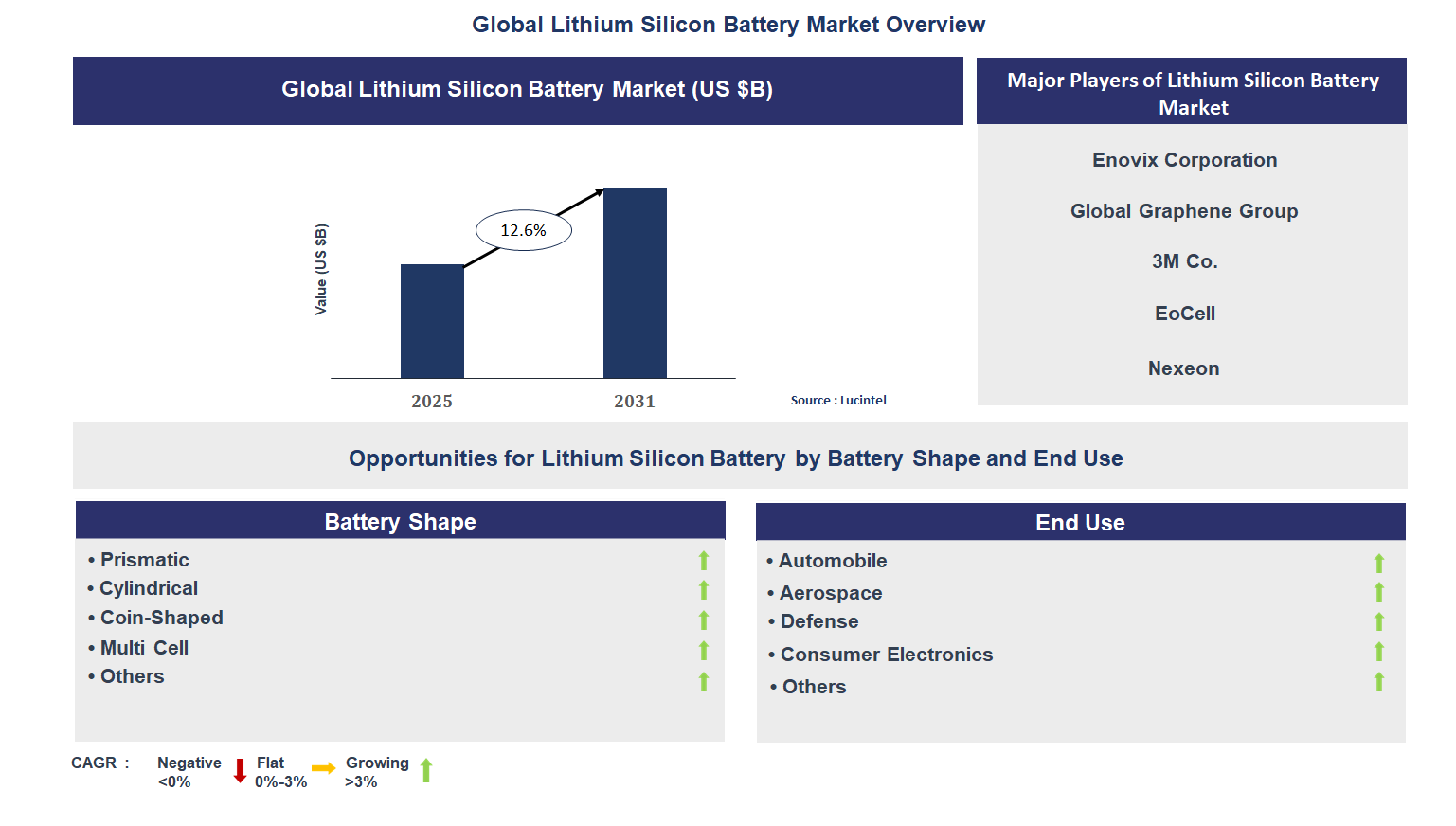
Key data points: The growth forecast = 12.6% annually for the next 7 years. Scroll below to get more insights. This market report covers trends, opportunities and forecasts in lithium silicon battery market to 2031 by battery shape (prismatic, cylindrical, coin-shaped, multi cell, and others), end use (automobile, aerospace, defense, consumer electronics, and others), and region (North America, Europe, Asia Pacific, and the Rest of the World)
We'll send your sample report shortly.
• Lucintel forecasts that, within the battery shape category, prismatic is expected to witness the highest growth over the forecast period.
• Within the end use category, automobile is expected to witness the highest growth.
• In terms of region, APAC is expected to witness the highest growth over the forecast period. Gain valuable insights for your business decisions with our comprehensive 150+ page report. Sample figures with some insights are shown below.
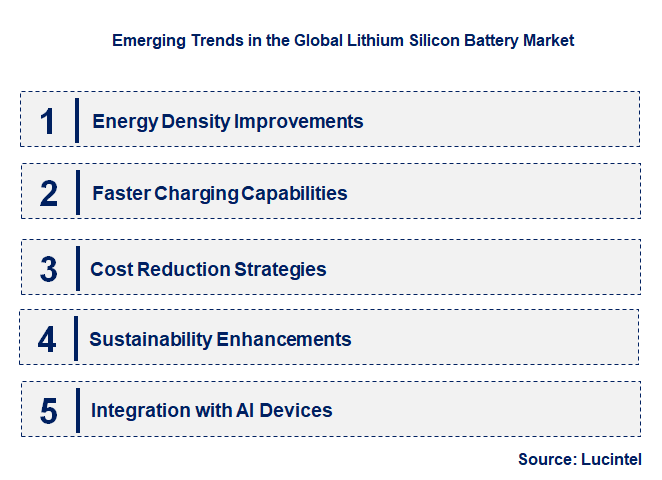
• Energy Density Improvements: Silicon anodes deliver up to 10x capacity over graphite, enabling compact, long-range batteries. Nano structuring mitigates swelling for sustained output. Impact boosts EV adoption, extends device runtimes, and attracts automakers, redefining portability in electronics and transport.
• Faster Charging Capabilities: Optimized electrolytes reduce charge times to minutes while preserving life cycles. Hybrid composites enhance ion flow. This trend revolutionizes user convenience, cuts downtime in fleets, and supports grid integration, accelerating market penetration across consumer and industrial apps.
• Cost Reduction Strategies: Abundant silicon sourcing and scalable production lower expenses versus rare materials. Recycling innovations reclaim components. The effect democratizes access, compresses prices for emerging markets, and intensifies competition, fostering volume growth in budget-sensitive sectors.
• Sustainability Enhancements: Eco-friendly manufacturing and recyclable designs align with green regulations. Reduced cobalt use minimizes mining impacts. Impact elevates corporate appeal, secures subsidies, and promotes circular economies, positioning silicon batteries as pillars of low-carbon transitions.
• Integration with AI Devices: High-density packs power data centers and wearables with minimal swaps. Thermal management ensures reliability. This drives AI ecosystem expansion, enhances edge computing, and inspires hybrid storage, blending energy with intelligent applications. These trends reshape the lithium silicon battery market by amplifying efficiency and eco-compatibility. They bridge tech gaps, broaden applications from EVs to AI. Overall, innovations spur resilient growth. This establishes silicon as a transformative force in energy storage.
• Silicon Anode Patent Surge: Q2 monitoring reveals 990 innovations in silicon tech, led by key players. Focus on SEI layers curbs degradation. This accelerates IP portfolios, attracts licensing deals, and sets efficiency benchmarks, fueling global R&D momentum.
• 100% Silicon Composite Debut: Polonium unveils anode with full silicon for ultra-high density and 5-minute charges. Targets EV ranges over 300km. The innovation disrupts hybrids, slashes weight, and inspires automotive shifts toward premium performance.
• Cycle Life Milestone Achievement: U.S. breakthrough hits 1,000 cycles at 80% capacity, using advanced composites. Suits harsh conditions. This builds trust in longevity, expands industrial uses, and draws investments for rugged applications.
• EV-Scale Plant Opening: Group14 launches silicon material facility for mass EV production, boosting 50% density. Integrates with global chains. Impact streamlines supply, cuts costs, and propels OEM adoptions in transport.
• Quasi-Solid-State Refinement: Japanese team develops non-flammable silicon variants for safer storage. Enhances thermal stability. This eases regulatory paths, widens consumer markets, and fortifies grid resilience against failures. These developments impact the lithium silicon battery market by enhancing practicality and adoption. They spark collaborations, overcome stability issues, and diversify uses. Collectively, they ignite innovation waves. This transforms storage into a high-performance, accessible essential.
• Electric Vehicle Propulsion: Silicon anodes extend ranges by 50%, suiting long-haul fleets. Fast charges minimize stops. Impact accelerates electrification, trims infrastructure costs, and captures auto market share through superior mileage.
• Consumer Electronics Powering: Compact cells energize smartphones with all-day life, reducing bulk. Durability fits daily abuse. This surges gadget sales, boosts brand loyalty, and embeds silicon in portable digital lifestyles.
• Grid Storage Buffering: High-capacity modules handle renewables variability for stable dispatch. Scalable designs suit utilities. Growth fortifies energy security, optimizes trading, and aligns with decarbonization incentives.
• AI Data Center Backup: Dense packs support uninterrupted computing with quick recharges. Thermal efficiency aids cooling. The opportunity powers AI booms, cuts operational expenses, and enables edge deployments.
• Medical Device Integration: Reliable, biocompatible batteries fuel implants for years without surgery. Miniaturization ensures comfort. This enhances patient care, opens healthcare revenues, and advances proactive monitoring tech. These opportunities impact the lithium silicon battery market by targeting high-value niches. They drive deployments, foster synergies, and match performance demands. Ultimately, this cultivates a dynamic domain. It advances sustainable, tech-enabled energy globally.
• Enovix Corporation
• Global Graphene Group
• 3M Co.
• EoCell
• Nexeon
• Prismatic
• Cylindrical
• Coin-Shaped
• Multi Cell
• Others
• Automobile
• Aerospace
• Defense
• Consumer Electronics
• Others
• North America
• Europe
• Asia Pacific
• The Rest of the World
• United States: U.S. firms like Group14 and Enovix scale silicon anode production for EVs and AI applications, achieving higher density and faster charging. Federal funding supports PNNLs low-cost silicon innovations, reducing reliance on graphite. This strengthens domestic supply chains, boosts EV ranges, and accelerates commercialization in consumer and industrial sectors.
• China: China dominates with expanded silicon anode manufacturing and export controls on lithium tech, fostering R&D in Li-Si alloys for high-capacity cells. State investments drive hybrid systems for urban grids and EVs. This enhances global supply leadership, lowers costs, and advances stable, scalable batteries for electronics and transport.
• Germany: German startups like E-magi and E-Lyte develop silicon-dominant anodes with 40% higher density, integrating into solid-state designs. Fraunhofer projects explore sulfur-silicon for safer storage. These collaborations align with EU green goals, improve cycle life, and promote material innovations for automotive and grid uses.
• India: India advances through Cellar Powertechs high-purity silicon anodes for affordable EVs, supported by incentives for local production. LIB demand surges, targeting rural electrification and hybrids. This reduces import dependence, spurs manufacturing jobs, and integrates silicon tech into sustainable mobility solutions.
• Japan: Japanese researchers at OIST pioneer nanostructures for silicon anodes, enhancing lithium-ion potential. Quasi-solid-state innovations offer non-flammable, high-density cells for EVs. This refines precision engineering, extends battery lifespans, and supports exports in aerospace and consumer devices.


• Enovix Corporation
• Global Graphene Group
• 3M Co.
• EoCell
• Nexeon Q5. Which lithium silicon battery market segment will be the largest in future? Answer: Lucintel forecasts that, within the battery shape category, prismatic is expected to witness the highest growth over the forecast period. Q6. In lithium silicon battery market, which region is expected to be the largest in next 5 years? Answer: In terms of region, APAC is expected to witness the highest growth over the forecast period. Q7. Do we receive customization in this report? Answer: Yes, Lucintel provides 10% customization without any additional cost.


Choose a license that fits your team. Instant PDF delivery.
Prices exclude taxes. Instant delivery. Custom licensing available on request.
Market Report · July 20, 2026
Market Report · July 20, 2026
Market Report · July 20, 2026
Trusted partner for strategic intelligence and business growth


Receive a complimentary market analysis tailored to your industry. Our analysts will identify key growth opportunities and competitive dynamics specific to your business.

Market size, growth rate, and key trend analysis for your specific sector.

Top competitor positioning and market share analysis.

Strategic recommendations backed by data-driven insights.
Get curated market intelligence and competitive moves straight to your inbox.
By subscribing, you agree to receive our monthly insights. Unsubscribe anytime.
Receive a complimentary market analysis tailored to your industry. Our analysts will identify key growth opportunities and competitive dynamics specific to your business.
Market size, growth rate, and key trend analysis for your specific sector.
Top competitor positioning and market share analysis.
Strategic recommendations backed by data-driven insights.
Get curated market intelligence, emerging trends, and competitive moves straight to your inbox each month.
By subscribing, you agree to receive our monthly insights. Unsubscribe anytime.
We'll send your sample report shortly.