
Market Report · July 22, 2026

Key data points: The market size in 2035 = $461 billion, growth forecast = 13.2% annually for the next 8 years. Scroll below to get more insights. This market report covers trends, opportunities and forecasts in lithium ion battery market to 2035 by technology type (lithium cobalt oxide (LCO), lithium nickel manganese cobalt (LI-NMC), lithium nickel cobalt aluminum oxide (NCA), lithium iron phosphate (IFP), lithium manganese oxide (LMO), and others), application (consumer electronics, transportation, industrial, and others), and region (North America, Europe, Asia Pacific, and the Rest of the World)
We'll send your sample report shortly.
• Lucintel forecasts that, within the technology type category, lithium iron phosphate (LFP) is expected to witness the highest growth over the forecast period.
• Within the application category, transportation is expected to witness the highest growth.
• In terms of region, APAC is expected to witness the highest growth over the forecast period.
Gain valuable insights for your business decisions with our comprehensive 150+ page report. Sample figures with some insights are shown below.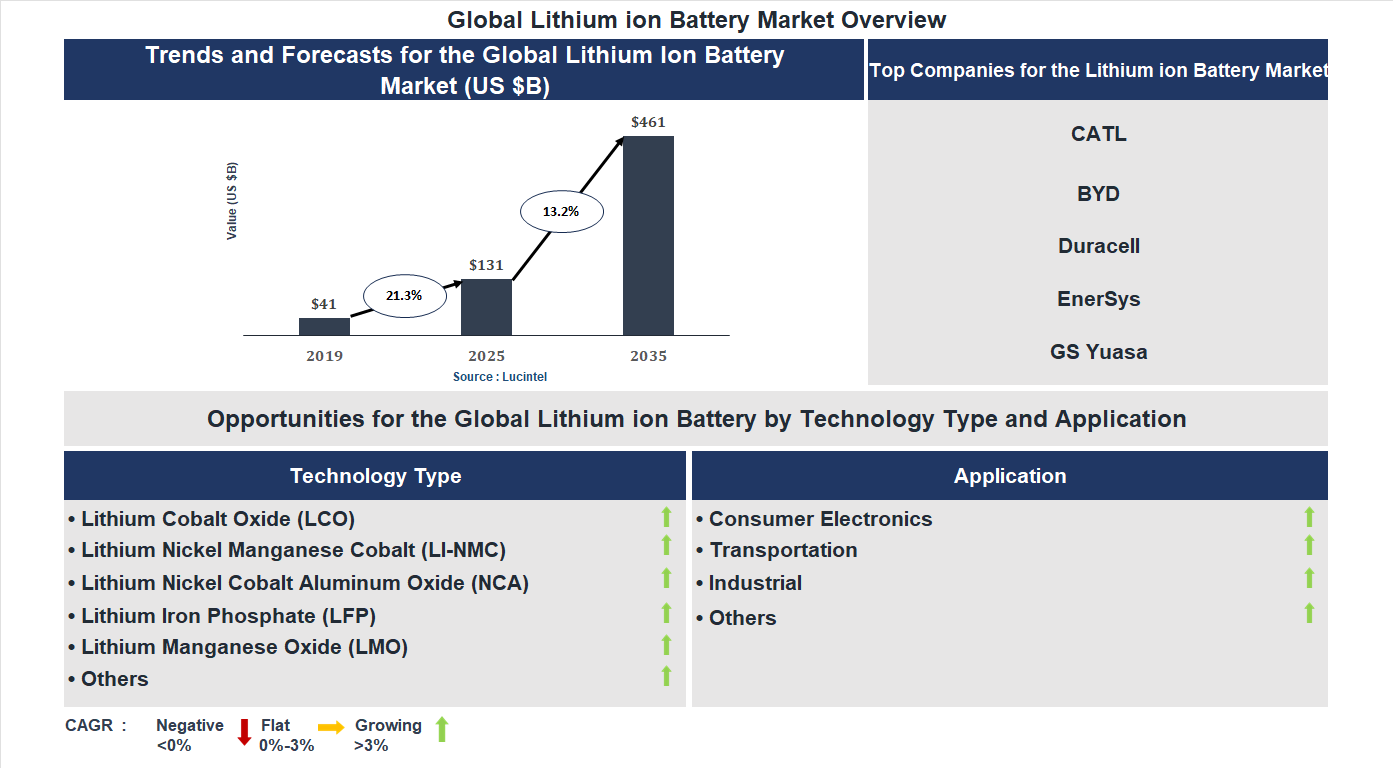
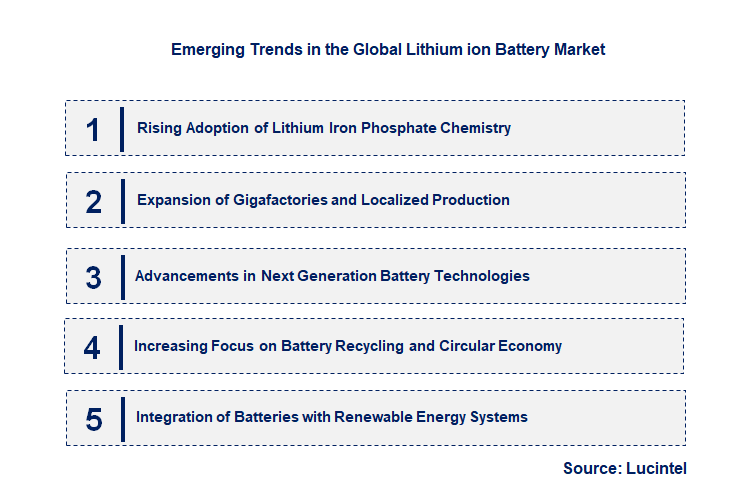
• Rising Adoption of Lithium Iron Phosphate Chemistry: Lithium iron phosphate batteries are gaining strong momentum due to their lower cost, improved safety, and longer lifecycle compared to other chemistries. Automakers and energy storage providers are increasingly shifting toward this chemistry, especially for mass market electric vehicles and stationary storage applications. This trend is reducing reliance on expensive and scarce materials such as cobalt and nickel, improving supply chain stability. Although energy density is slightly lower, continuous improvements are narrowing the performance gap. The growing preference for lithium iron phosphate is expected to significantly reshape battery manufacturing priorities and cost structures globally.
• Expansion of Gigafactories and Localized Production: The rapid expansion of battery manufacturing facilities, often referred to as gigafactories, is a major trend shaping the market. Countries are investing heavily in domestic production capabilities to reduce dependence on imports and strengthen energy security. This includes large scale investments by automotive companies and battery manufacturers in regions such as North America, Europe, and Asia. Localization of supply chains is also helping reduce transportation costs and improve resilience against disruptions. As a result, competition is intensifying, and new players are entering the market, leading to increased innovation and capacity growth.
• Advancements in Next Generation Battery Technologies: Research and development in next generation batteries, including solid state and sodium ion technologies, is accelerating. These technologies promise higher energy density, faster charging, improved safety, and reduced environmental impact. Solid state batteries, in particular, are gaining attention for their potential to revolutionize electric vehicles by extending driving range and reducing charging times. Meanwhile, sodium ion batteries are emerging as a cost effective alternative for large scale storage. Although commercialization is still in early stages, continuous investments and pilot projects are expected to drive significant breakthroughs in the coming years.
• Increasing Focus on Battery Recycling and Circular Economy: Sustainability is becoming a central focus in the lithium ion battery market, leading to increased emphasis on recycling and circular economy practices. Companies are investing in technologies to recover valuable materials such as lithium, cobalt, and nickel from used batteries. This not only reduces environmental impact but also helps address raw material shortages and price volatility. Governments are introducing regulations and incentives to promote responsible disposal and recycling. The development of efficient recycling infrastructure is expected to play a crucial role in ensuring long term sustainability and reducing dependency on mining activities.
• Integration of Batteries with Renewable Energy Systems: The growing adoption of renewable energy sources such as solar and wind is driving demand for efficient energy storage solutions. Lithium ion batteries are increasingly being integrated with renewable energy systems to store excess power and ensure stable supply. This trend is particularly important for grid stability and energy management in regions with high renewable penetration. Advancements in battery management systems and grid scale storage technologies are further enhancing performance and reliability. As renewable energy deployment continues to rise, the role of lithium ion batteries as a critical enabler of clean energy transition is becoming more prominent.
• Expansion of Large Scale Gigafactories and Domestic Manufacturing Capabilities: The rapid expansion of gigafactories across key regions is strengthening local battery production and reducing reliance on imports. Governments are supporting these initiatives through incentives and policy frameworks, encouraging automakers and energy companies to invest in domestic manufacturing. This development is improving supply chain resilience, reducing logistics costs, and enabling faster response to market demand. As capacity increases, economies of scale are helping lower battery prices, making electric vehicles and storage systems more affordable and accessible across diverse markets globally.
• Commercialization of Lithium Iron Phosphate Batteries in Electric Vehicles and Storage Systems: Lithium iron phosphate batteries are increasingly being adopted due to their cost efficiency, safety, and long lifecycle. Automakers are integrating this chemistry into electric vehicles, particularly for mass market models, while energy storage providers are deploying it for grid applications. This shift is reducing dependence on expensive raw materials such as cobalt and nickel, stabilizing supply chains. Continuous improvements in performance are enhancing competitiveness, making lithium iron phosphate a preferred choice for large scale deployment across transportation and stationary energy sectors worldwide.
• Accelerated Research and Pilot Deployment of Solid State Battery Technologies: Solid state battery development is gaining momentum as companies aim to achieve higher energy density, faster charging, and improved safety. Significant investments are being directed toward research, pilot production, and strategic partnerships. These batteries have the potential to revolutionize electric vehicles by extending driving range and reducing charging time. Although commercialization is still limited, early prototypes and pilot projects are demonstrating promising results. This development is expected to create long term disruption and redefine performance benchmarks in the lithium ion battery market.
• Strengthening of Battery Recycling Infrastructure and Circular Economy Practices: Increasing focus on sustainability is driving investments in battery recycling and material recovery technologies. Companies are developing efficient methods to extract valuable materials such as lithium, cobalt, and nickel from used batteries. Governments are introducing regulations to promote responsible disposal and reuse, supporting the development of a circular economy. This approach reduces environmental impact, mitigates raw material shortages, and lowers production costs. As recycling capacity expands, it is becoming a critical component of the battery value chain and long term market sustainability.
• Integration of Lithium ion Batteries with Renewable Energy and Grid Storage Solutions: The integration of lithium ion batteries with renewable energy systems is expanding rapidly to support grid stability and energy management. Solar and wind power generation require efficient storage solutions to manage intermittency, and batteries are playing a central role in this transition. Advancements in battery management systems and grid scale storage technologies are improving efficiency and reliability. This development is enabling higher renewable energy penetration, reducing dependence on fossil fuels, and creating new opportunities for energy storage deployment across residential, commercial, and utility sectors.
• Rapid Expansion of Electric Vehicle Adoption Creating Strong Battery Demand: The increasing adoption of electric vehicles is generating significant demand for lithium ion batteries across global markets. Governments are promoting clean mobility through incentives and regulations, encouraging automakers to accelerate electric vehicle production. This opportunity is driving innovation in battery performance, charging speed, and cost efficiency. As consumer acceptance grows, demand for high capacity and long range batteries is increasing. This trend is creating sustained growth opportunities for battery manufacturers, suppliers, and technology providers across the entire automotive value chain.
• Growing Deployment of Grid Scale Energy Storage Systems Supporting Renewable Integration: The rising share of renewable energy sources such as solar and wind is increasing the need for reliable energy storage systems. Lithium ion batteries are widely used for grid stabilization, peak load management, and backup power. This application is expanding rapidly as utilities invest in large scale storage projects. Improved battery efficiency and declining costs are making grid storage more viable. This opportunity is enabling better energy management, reducing power fluctuations, and supporting the transition toward cleaner and more sustainable energy systems worldwide.
• Increasing Demand from Consumer Electronics Driving Compact and Efficient Battery Solutions: The continuous growth of consumer electronics such as smartphones, laptops, and wearable devices is fueling demand for compact and high performance batteries. Manufacturers are focusing on improving energy density and battery life to enhance user experience. This application remains a stable and high volume segment, contributing to consistent market growth. Advancements in fast charging and miniaturization are further supporting demand. As technology evolves, the need for reliable and efficient power sources in portable devices continues to create strong growth opportunities.
• Rising use of Lithium ion Batteries in Industrial and Commercial Applications: Industrial and commercial sectors are increasingly adopting lithium ion batteries for applications such as material handling equipment, backup power systems, and automation. These batteries offer advantages such as longer lifespan, lower maintenance, and higher efficiency compared to traditional alternatives. This opportunity is supported by the growing trend of industrial automation and digitalization. Companies are investing in energy efficient solutions to reduce operational costs and improve productivity. As industries modernize, demand for advanced battery systems is expected to grow significantly.
• Expansion of Energy Storage Solutions in Residential and Distributed Energy Systems: The adoption of residential energy storage systems is increasing as consumers seek energy independence and cost savings. Lithium ion batteries are being integrated with rooftop solar systems to store excess energy and ensure uninterrupted power supply. This opportunity is gaining traction in regions with high electricity costs and unreliable grids. Technological improvements and declining battery prices are making residential storage more accessible. This trend is empowering consumers to manage energy consumption efficiently while supporting decentralized energy generation models.
• Rising Demand from Electric Vehicles Accelerating Battery Consumption: The rapid growth of electric vehicles is a primary driver of the lithium ion battery market. Governments worldwide are implementing strict emission regulations and offering incentives to promote clean mobility, encouraging automakers to expand electric vehicle production. This shift is significantly increasing demand for high capacity, efficient batteries. Continuous improvements in energy density and charging technologies are further supporting adoption. As consumers become more environmentally conscious, the transition toward electric mobility is gaining momentum, creating long term growth opportunities for battery manufacturers and strengthening the overall value chain.
• Increasing Integration of Renewable Energy Boosting Storage Requirements: The expansion of renewable energy sources such as solar and wind is driving the need for efficient energy storage systems. Lithium ion batteries are widely used to store excess energy and ensure grid stability, addressing intermittency challenges associated with renewables. Governments and utilities are investing in large scale storage projects to support energy transition goals. Declining battery costs and improved performance are enhancing the feasibility of these systems. This driver is not only increasing demand for batteries but also enabling the development of sustainable and resilient energy infrastructure globally.
• Technological Advancements Improving Battery Performance and Cost Efficiency: Continuous innovation in battery chemistry, design, and manufacturing processes is enhancing the performance and affordability of lithium ion batteries. Developments such as lithium iron phosphate chemistry and solid state technologies are improving safety, lifespan, and energy density. Automation and scaling of production are reducing manufacturing costs, making batteries more accessible for various applications. These advancements are expanding the use of lithium ion batteries beyond traditional sectors, driving adoption in new markets. As research and development efforts continue, technological progress remains a critical factor supporting market growth.
• Government Policies and Incentives Supporting Domestic Manufacturing and Adoption: Supportive government policies, including subsidies, tax benefits, and production linked incentives, are playing a crucial role in driving the lithium ion battery market. Many countries are focusing on building domestic manufacturing capabilities to reduce dependence on imports and enhance energy security. Regulations promoting electric vehicles and renewable energy adoption are further boosting demand. These policy frameworks are encouraging investments from both local and international players, fostering innovation and capacity expansion. As governments continue to prioritize clean energy and sustainability, policy support remains a key driver of market growth.
• Dependence on Critical Raw Materials Creating Supply Chain Vulnerabilities: The lithium ion battery market heavily relies on critical raw materials such as lithium, cobalt, and nickel, which are concentrated in a few geographic regions. This dependence exposes the market to supply disruptions, price volatility, and geopolitical risks. Fluctuating raw material costs can significantly impact battery pricing and profitability. Additionally, ethical and environmental concerns related to mining practices are increasing scrutiny. These challenges highlight the need for diversification of supply sources, development of alternative materials, and investment in recycling technologies to ensure long term supply stability.
• Environmental Concerns and Recycling Limitations Affecting Sustainability Goals: Despite supporting clean energy transition, lithium ion batteries pose environmental challenges related to production, usage, and disposal. Mining of raw materials can lead to ecological damage, while improper disposal of used batteries creates pollution risks. Although recycling technologies are improving, large scale infrastructure is still underdeveloped in many regions. High costs and technical complexities limit efficient material recovery. These issues are prompting stricter regulations and increasing pressure on manufacturers to adopt sustainable practices. Addressing environmental concerns is essential to ensure the long term viability of the market.
• High Initial Costs and Technological Barriers Limiting Widespread Adoption: Although battery prices are declining, the initial cost of lithium ion battery systems remains relatively high for certain applications, particularly in developing markets. Advanced technologies such as solid state batteries are still in early stages and require significant investment for commercialization. Infrastructure limitations, including charging networks and grid integration, further restrict adoption. These barriers can slow market growth and create uncertainties for investors. Overcoming cost and technology challenges through innovation, economies of scale, and supportive policies is critical to unlocking the full potential of the lithium ion battery market.
• CATL
• BYD
• Duracell
• EnerSys
• GS Yuasa
• Johnson Controls
• LG Chem
• Panasonic Corporation
• Samsung SDI
• Toshiba Corporation
• Lithium Cobalt Oxide (LCO)
• Lithium Nickel Manganese Cobalt (LI-NMC)
• Lithium Nickel Cobalt Aluminum Oxide (NCA)
• Lithium Iron Phosphate (LFP)
• Lithium Manganese Oxide (LMO)
• Others
• Consumer Electronics
• Transportation
• Industrial
• Others
• North America
• Europe
• Asia Pacific
• The Rest of the World
• United States: The United States lithium-ion battery market is witnessing strong expansion driven by government incentives, domestic manufacturing push, and growing energy storage demand. Battery storage installations increased significantly, supported by rising electricity demand from data centers and renewable integration. Automakers are converting existing facilities into battery production units, and large-scale gigafactory investments are accelerating capacity growth. However, the country still depends heavily on imports, particularly from China, for critical components such as battery cells. Policy frameworks, including tax credits and local sourcing requirements, are encouraging supply chain localization, although cost competitiveness and regulatory uncertainties remain key challenges.
• China: China continues to dominate the global lithium-ion battery market due to its strong manufacturing ecosystem, extensive supply chain control, and technological leadership. The country leads in lithium refining and battery production capacity, accounting for a major share of global output. Recent developments include the introduction of advanced fast-charging batteries and the commercialization of sodium-ion technology, which offers cost and safety advantages. Additionally, China is expanding electric vehicle exports and scaling production of lithium iron phosphate batteries, the fastest-growing chemistry segment. Despite its dominance, the market faces challenges such as price competition, overcapacity concerns, and raw material volatility.
• Germany: Germany is emerging as a key European hub for lithium-ion battery innovation and manufacturing, supported by strong automotive industry involvement and European Union policies. The country is investing heavily in gigafactories, supply chain localization, and sustainable battery production. European initiatives emphasize reducing dependence on Asian imports while strengthening regional energy security. Advances in battery chemistries, recycling technologies, and integration with renewable energy systems are notable trends. Germany automotive manufacturers are also forming strategic partnerships with battery producers to ensure long-term supply, positioning the country as a central player in the European battery ecosystem
• India: India lithium-ion battery market is rapidly growing, driven by increasing electric vehicle adoption, government initiatives such as production-linked incentives, and rising demand for energy storage. Battery demand is projected to increase significantly by 2030, highlighting strong future potential. Domestic companies are expanding manufacturing capacity and investing in recycling infrastructure to reduce reliance on imports. However, India still faces challenges including dependence on imported raw materials, limited local supply chains, and concerns over battery waste management. Efforts to build a self-reliant ecosystem and attract global investments are shaping recent developments.
• Japan: Japan lithium-ion battery market remains focused on technological innovation, high-quality manufacturing, and next-generation battery research. Japanese companies are investing in solid-state battery development, aiming to improve energy density, safety, and charging speed. The country continues to play a key role in supplying advanced battery materials and components globally. While Japan has lost some manufacturing share to China, it maintains a strong position in research and development, particularly in automotive applications. Strategic collaborations between automakers and battery manufacturers are further strengthening innovation capabilities and supporting long-term competitiveness.


• CATL
• BYD
• Duracell
• EnerSys
• GS Yuasa
• Johnson Controls
• LG Chem
• Panasonic Corporation
• Samsung SDI
• Toshiba Corporation
Q6. Which lithium ion battery market segment will be the largest in future?

Choose a license that fits your team. Instant PDF delivery.
Prices exclude taxes. Instant delivery. Custom licensing available on request.
Market Report · July 22, 2026
Market Report · July 22, 2026
Market Report · July 22, 2026
Trusted partner for strategic intelligence and business growth


Receive a complimentary market analysis tailored to your industry. Our analysts will identify key growth opportunities and competitive dynamics specific to your business.

Market size, growth rate, and key trend analysis for your specific sector.

Top competitor positioning and market share analysis.

Strategic recommendations backed by data-driven insights.
Get curated market intelligence and competitive moves straight to your inbox.
By subscribing, you agree to receive our monthly insights. Unsubscribe anytime.
Receive a complimentary market analysis tailored to your industry. Our analysts will identify key growth opportunities and competitive dynamics specific to your business.
Market size, growth rate, and key trend analysis for your specific sector.
Top competitor positioning and market share analysis.
Strategic recommendations backed by data-driven insights.
Get curated market intelligence, emerging trends, and competitive moves straight to your inbox each month.
By subscribing, you agree to receive our monthly insights. Unsubscribe anytime.
We'll send your sample report shortly.