
Market Report · July 29, 2026

Key data points: The growth forecast = 12% annually for the next 7 years. Scroll below to get more insights. This market report covers trends, opportunities and forecasts in level sensor & switch market to 2031 by type (polypropylene, polyamide, stainless steel, PVC, and others), application (oil & gas, chemical, water/wastewater processing, food & beverage, medical, boiler control, and others), and region (North America, Europe, Asia Pacific, and the Rest of the World)
We'll send your sample report shortly.
• Lucintel forecasts that, within the type category, polypropylene is expected to witness higher growth over the forecast period.
• Within the application category, water/wastewater processing is expected to witness the highest growth.
• In terms of region, APAC is expected to witness the highest growth over the forecast period.
Gain valuable insights for your business decisions with our comprehensive 150+ page report. Sample figures with some insights are shown below.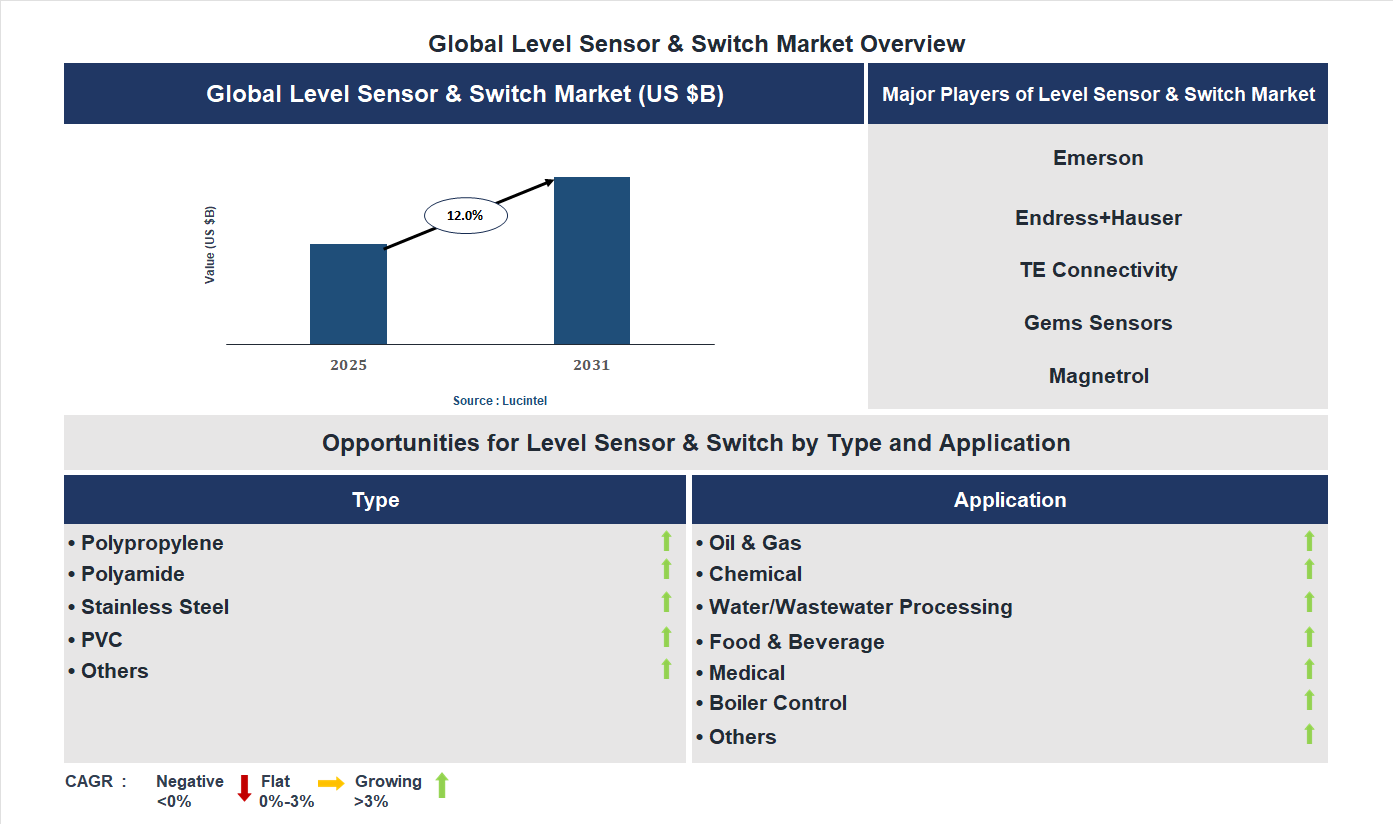
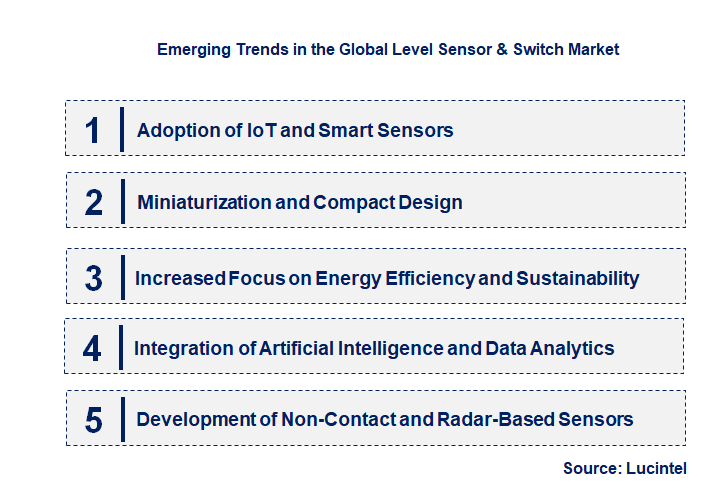
• Adoption of IoT and Smart Sensors: The integration of IoT technology into level sensors is enabling real-time data collection and remote monitoring. Smart sensors can communicate wirelessly with control systems, providing instant alerts and analytics. This trend enhances operational efficiency, reduces downtime, and improves predictive maintenance. Industries benefit from better process control and reduced manual intervention, leading to cost savings and increased safety. The proliferation of IoT-enabled sensors is also driving the development of more sophisticated, connected systems that support Industry 4.0 initiatives.
• Miniaturization and Compact Design: Advances in materials and manufacturing techniques are allowing sensors to become smaller and more compact. Miniaturized sensors are easier to install in tight spaces and complex systems, expanding their application scope. This trend is particularly significant in industries requiring discreet or embedded sensors, such as medical devices and portable equipment. Compact designs also contribute to lower costs and increased versatility, enabling manufacturers to deploy sensors in a wider range of environments and applications, thus broadening market reach.
• Increased Focus on Energy Efficiency and Sustainability: As environmental regulations tighten, there is a growing emphasis on energy-efficient sensor solutions that minimize power consumption. Manufacturers are developing low-power sensors that can operate for extended periods without frequent battery replacements, supporting sustainable practices. These sensors contribute to reducing the overall carbon footprint of industrial processes. Additionally, energy-efficient sensors help in lowering operational costs and aligning with corporate sustainability goals, making them attractive to environmentally conscious industries.
• Integration of Artificial Intelligence and Data Analytics: The incorporation of AI and advanced data analytics into level sensors is enabling predictive insights and smarter decision-making. These sensors can analyze historical and real-time data to predict failures, optimize processes, and improve accuracy. AI-driven sensors facilitate proactive maintenance, reduce downtime, and enhance safety. This trend is transforming traditional sensor systems into intelligent solutions that add significant value through automation and data-driven strategies, ultimately leading to more resilient and efficient operations across various sectors.
• Development of Non-Contact and Radar-Based Sensors: Non-contact sensors, including radar and ultrasonic technologies, are gaining popularity due to their ability to measure levels without physical contact with the material. These sensors are ideal for hazardous, corrosive, or high-temperature environments where contact sensors may fail or pose safety risks. Radar-based sensors offer high accuracy and reliability over long distances, making them suitable for large tanks and complex systems. The shift towards non-contact measurement solutions improves safety, reduces maintenance, and enhances measurement precision, thereby expanding their adoption in diverse industrial applications.
• Technological Advancements: Integration of IoT and wireless connectivity has revolutionized level sensors, enabling real-time data monitoring and remote management. This improves operational efficiency, reduces downtime, and enhances predictive maintenance capabilities, leading to cost savings and increased productivity.
• Miniaturization and Enhanced Accuracy: Development of compact sensors with higher precision allows for installation in space-constrained environments. These sensors provide more accurate readings, improving process control and safety in sensitive applications like pharmaceuticals and food processing.
• Industry-Specific Solutions: Customized level sensing solutions tailored to specific industry needs have emerged, offering better compatibility and performance. This specialization helps industries meet regulatory standards and optimize their processes, boosting overall efficiency.
• Adoption of Smart Sensors: The integration of smart sensors with advanced analytics and cloud platforms enables predictive insights and automated decision-making. This trend enhances process optimization, reduces waste, and supports Industry 4.0 initiatives.
• Rising Demand in Emerging Markets: Growing industrialization in regions such as Asia-Pacific and Latin America is driving demand for level sensors and switches. Increased infrastructure development and manufacturing activities are expanding market opportunities and fostering regional growth.
• Industrial Automation: Enhanced efficiency and safety : The adoption of level sensors in industrial automation is increasing, enabling real-time monitoring and control of liquids and solids. This improves operational efficiency, reduces downtime, and enhances safety protocols, making automation more reliable and cost-effective.
• Water and Wastewater Management: Improved water resource management : Level sensors are critical in water treatment plants for monitoring water levels, preventing overflows, and optimizing treatment processes. This application supports sustainable water management and regulatory compliance, driving market growth.
• Food and Beverage Industry: Ensuring product quality and safety : In food processing, level sensors help maintain consistent product quality by accurately monitoring ingredient levels and preventing contamination. This ensures compliance with safety standards and enhances consumer trust.
• Pharmaceuticals: Precision and regulatory compliance : The pharmaceutical industry relies on highly accurate level sensors for liquid handling and storage. These sensors support strict regulatory standards, ensuring product integrity and safety, thus expanding their application scope.
• Consumer Electronics and Smart Devices: Integration with IoT technologies : The integration of level sensors with IoT platforms enables smarter, connected devices for home automation and smart appliances. This creates new revenue streams and expands the market into consumer segments.
• Technological Innovation: The continuous development of more accurate, reliable, and cost-effective sensors enhances market appeal. Innovations such as wireless sensors and IoT integration enable real-time monitoring and data analytics, improving operational efficiency across industries like manufacturing, oil & gas, and water treatment. These advancements reduce maintenance costs and increase safety, encouraging widespread adoption. As technology evolves, the market benefits from increased versatility and application scope, fostering growth and competitive advantage for manufacturers.
• Industrial Automation and Digitalization: The global shift towards automation in manufacturing, process industries, and infrastructure projects significantly boosts demand for level sensors and switches. Automated systems require precise level measurement for process control, safety, and efficiency. The integration of sensors with control systems and SCADA platforms enhances operational visibility and reduces human error. As industries aim for smarter, more connected operations, the reliance on advanced level sensing solutions intensifies, driving market expansion and innovation.
• Regulatory and Safety Standards: Stringent safety regulations and environmental standards compel industries to adopt reliable level measurement solutions. For example, in oil & gas, chemical, and water treatment sectors, compliance with safety protocols necessitates accurate level detection to prevent spills, leaks, and accidents. These regulations incentivize investments in high-quality sensors that meet certification requirements, thereby expanding the market. Additionally, safety-driven applications foster trust and reliability, encouraging broader adoption across sectors.
• Economic Growth and Infrastructure Development: Rising investments in infrastructure, urbanization, and industrial expansion globally stimulate demand for level sensors and switches. Developing regions focus on building water management systems, power plants, and manufacturing facilities, all requiring precise level monitoring. Economic growth increases capital expenditure on automation and safety systems, further propelling market growth. As economies develop, the need for efficient resource management and process control becomes critical, making level sensors indispensable.
• Growing Adoption of IoT and Industry 4.0: The integration of IoT technologies with level sensors enables remote monitoring, predictive maintenance, and data-driven decision-making. Industry 4.0 initiatives promote smart factories where sensors communicate seamlessly with control systems. This connectivity enhances operational efficiency, reduces downtime, and lowers maintenance costs. As digital transformation accelerates, the demand for intelligent, connected level sensing solutions increases, opening new avenues for market expansion and technological innovation.
• High Initial Investment and Cost: Implementing advanced level sensors and switches often requires substantial capital expenditure, especially for large-scale or complex systems. The costs associated with procurement, installation, calibration, and maintenance can be prohibitive for small and medium-sized enterprises. This financial barrier limits market penetration in cost-sensitive regions and sectors, slowing overall growth. Additionally, the need for skilled personnel to operate and maintain these systems adds to the expense, impacting adoption rates.
• Technological Limitations and Reliability Concerns: Despite advancements, some level sensors face issues related to environmental conditions such as extreme temperatures, pressure, and corrosive substances. These factors can impair sensor accuracy and durability, leading to false readings or failures. Reliability concerns hinder trust in sensor performance, especially in critical applications like chemical processing or oil & gas. Overcoming these technical limitations requires ongoing R&D, which can be time-consuming and costly, potentially delaying market expansion.
• Regulatory and Standardization Challenges: Variability in regulatory requirements across regions complicates compliance for manufacturers and users. Lack of standardized testing and certification procedures can lead to inconsistent product quality and performance. Navigating diverse standards increases complexity and costs, potentially restricting market entry in certain jurisdictions. Moreover, evolving regulations demand continuous updates and certifications, posing ongoing compliance challenges that can slow innovation and deployment.
• Emerson
• Endress+Hauser
• TE Connectivity
• Gems Sensors
• Magnetrol
• ABB Group
• Sensata Technologies
• SST Sensing
• TT Electronics
• TTI, Inc.
• Polypropylene
• Polyamide
• Stainless Steel
• PVC
• Others
• Oil & Gas
• Chemical
• Water/Wastewater Processing
• Food & Beverage
• Medical
• Boiler Control
• Others
• North America
• Europe
• Asia Pacific
• The Rest of the World
• United States: The US market has seen rapid adoption of smart level sensors integrated with IoT for real-time monitoring and predictive maintenance. Major companies are focusing on developing wireless and contactless sensors to improve safety and reduce downtime. The government’s emphasis on industrial automation and safety standards has further propelled market growth. Innovations in sensor materials and miniaturization are also prominent, enabling deployment in compact and complex environments. Additionally, US firms are investing in AI-driven analytics to enhance sensor data interpretation, boosting operational efficiency across sectors like oil & gas, water treatment, and manufacturing.
• China: China is experiencing robust growth in the level sensor & switch market driven by rapid industrialization and infrastructure development. The country is focusing on cost-effective, high-performance sensors to support its manufacturing and automation sectors. Local manufacturers are expanding their R&D efforts to develop sensors with higher accuracy and durability suitable for harsh environments. The government’s initiatives toward smart cities and environmental monitoring are creating new demand for level sensors. Moreover, China is increasingly adopting IoT-enabled sensors to facilitate large-scale data collection and analysis, fostering a more connected and efficient industrial ecosystem.
• Germany: Germany’s market is characterized by a strong emphasis on precision engineering and high-quality sensor solutions. The country is leading in the development of industrial-grade level sensors used in automotive, chemical, and manufacturing industries. German companies are innovating in sensor technology to improve reliability, accuracy, and integration with Industry 4.0 systems. The focus on sustainability and energy efficiency has driven the adoption of sensors that optimize resource management. Additionally, Germany’s collaboration with research institutions is fostering advancements in sensor materials and wireless communication protocols, ensuring the market remains at the forefront of technological innovation.
• India: India’s level sensor & switch market is witnessing rapid expansion due to increasing industrial activity and infrastructure projects. The government’s push for Make in India and smart city initiatives is boosting demand for automation solutions, including advanced level sensors. Local manufacturers are focusing on affordable, durable sensors suitable for diverse environmental conditions. The adoption of IoT and wireless sensors is growing, especially in water management, agriculture, and manufacturing sectors. Additionally, startups and tech companies are innovating in sensor design and integration, contributing to the market’s dynamic growth and expanding the reach of automation across various industries.
• Japan: Japan’s market is driven by a focus on high-precision, reliable sensors used in robotics, automotive, and electronics manufacturing. The country is investing in developing sensors with enhanced durability and miniaturization to meet the demands of compact and complex systems. Japan’s emphasis on quality and innovation is reflected in the integration of sensors with AI and IoT for predictive maintenance and automation. The government’s initiatives to promote Industry 4.0 are encouraging the adoption of smart sensors. Furthermore, Japanese firms are exploring environmentally friendly sensor materials and energy-efficient solutions to align with sustainability goals.


• Emerson
• Endress+Hauser
• TE Connectivity
• Gems Sensors
• Magnetrol
• ABB Group
• Sensata Technologies
• SST Sensing
• TT Electronics
• TTI, Inc.
Q5. Which level sensor & switch market segment will be the largest in future?

Choose a license that fits your team. Instant PDF delivery.
Prices exclude taxes. Instant delivery. Custom licensing available on request.
Market Report · July 29, 2026
Market Report · July 20, 2026
Market Report · July 20, 2026
Trusted partner for strategic intelligence and business growth


Receive a complimentary market analysis tailored to your industry. Our analysts will identify key growth opportunities and competitive dynamics specific to your business.

Market size, growth rate, and key trend analysis for your specific sector.

Top competitor positioning and market share analysis.

Strategic recommendations backed by data-driven insights.
Get curated market intelligence and competitive moves straight to your inbox.
By subscribing, you agree to receive our monthly insights. Unsubscribe anytime.
Receive a complimentary market analysis tailored to your industry. Our analysts will identify key growth opportunities and competitive dynamics specific to your business.
Market size, growth rate, and key trend analysis for your specific sector.
Top competitor positioning and market share analysis.
Strategic recommendations backed by data-driven insights.
Get curated market intelligence, emerging trends, and competitive moves straight to your inbox each month.
By subscribing, you agree to receive our monthly insights. Unsubscribe anytime.
We'll send your sample report shortly.