
Market Report · July 20, 2026

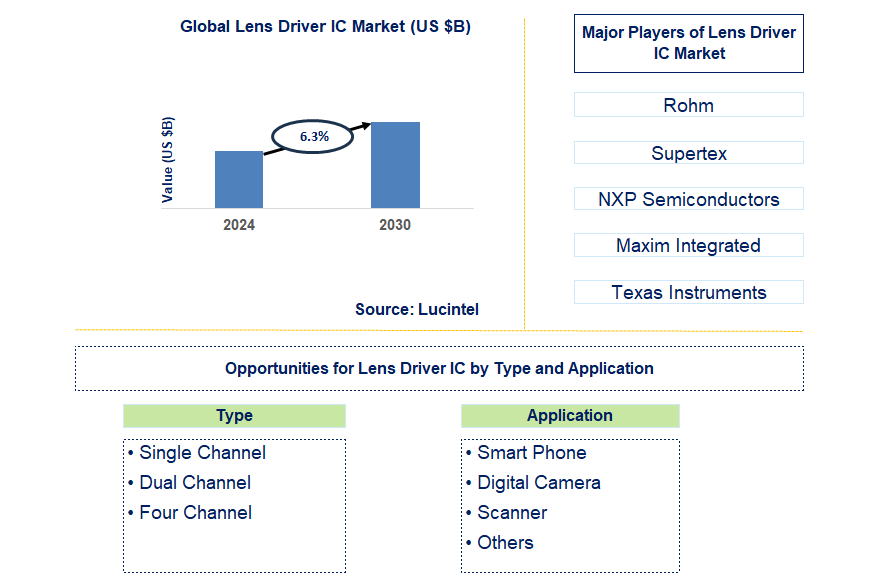
Key data points: The growth forecast = 6.3% annually for the next 6 years. Scroll below to get more insights. This market report covers trends, opportunities, and forecasts in the global lens driver ic market to 2030 by type (single channel, dual channel, and four channel), application (smart phone, digital camera, scanner, and others), and region (North America, Europe, Asia Pacific, and the Rest of the World)
We'll send your sample report shortly.
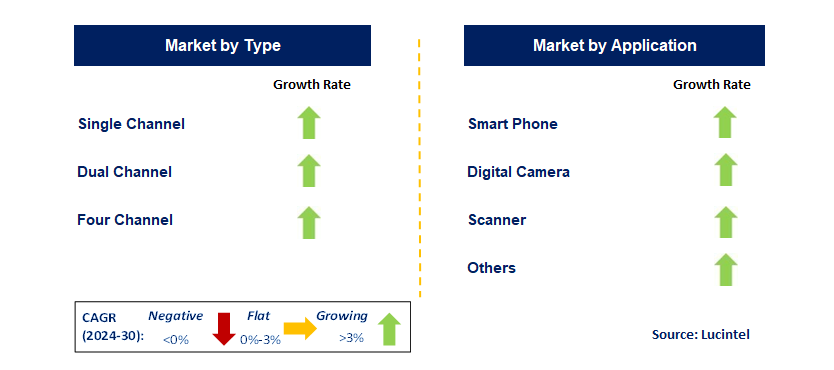
• Lucintel forecasts that, within the type category, the single channel is expected to witness higher growth over the forecast period.
• Within the application category, the smart phone is expected to witness the highest growth.
• In terms of region, APAC is expected to witness the highest growth over the forecast period. A more than 150-page report is developed to help in your business decisions.
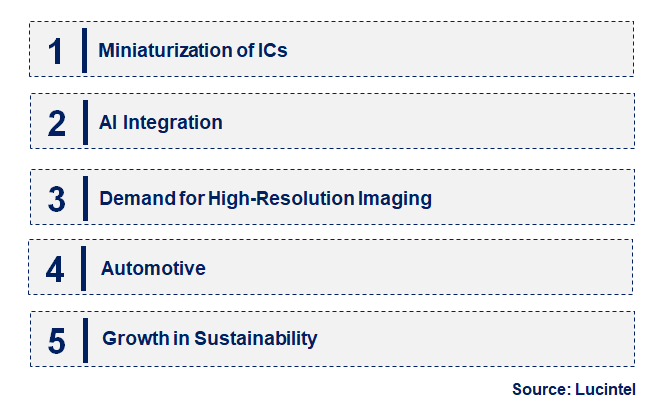
• Miniaturization of ICs: Manufacturers can go for a smaller, more efficient IC while maintaining the performance because of the trend of miniaturization. It will become important in devices like smartphones and drones, where the space is too small. More power is conserved in the smaller IC, and therefore, it brings about better battery life and performance overall. The miniaturized components become inevitable in the case of ever-increasingly compact consumer devices.
• AI Integration: Increasingly, imaging features in lens driver ICs are now becoming AI enabled, as seen in the features of autofocus and image stabilization. This provides superior capabilities for scene recognition and processing that can potentially deliver high-quality images under wide-ranging lighting conditions. The demand for such quality is most often felt in smartphone and automotive markets, where imaging quality stands out as a prime selling point and, at the same time, will break a consumer experience.
• Demand for High-Resolution Imaging: A recent development trend toward increasing consumer demand for high resolutions in cameras and smartphones is driving development in Lens Driver ICs. Manufacturers are focusing on higher pixel counts and faster processing speed. This is now becoming more critical in relation to maintaining competitiveness in the crowded consumer electronics space, which will ensure that products meet consumer expectations for better image quality.
• Automotive: Rise of autonomous vehicles and advanced driver-assistance systems will drive the demand for lens driver ICs in the automotive sector. They support high-resolution cameras and sensors, which increase the safety and functionality features of vehicles. Growing demand for smart vehicles is pushing application growth in this area significantly, as manufacturers try to integrate advanced imaging solutions that meet regulatory standards and consumer safety standards.
• Growth in Sustainability: Sustainability is the next big concern for the lens driver IC market, as firms seek to create more environmentally friendly products. It accounts for both the reuse of materials and the very energy-efficient production process that goes into the making of these products. In order to fulfill the slowly but surely increasing sensitivity toward the environment, producers are aligning their designs and operations in relation to consumer demands. Apart from inculcating loyalty for the brand, the principle also shows congruence with the global movement toward minimalism in wastes and negative impacts. Such innovation encompasses areas such as miniaturization and AI and sustainability in the lens driver IC market, thereby changing the very way these imaging technologies are conceptualized and realized. As this happens, manufacturers have to evolve if they want to remain competitive, with innovative solutions that might meet with increased demand for quality across applications for imaging. The market is changing at a furious pace as new avenues in growth and technological development present themselves.
• Advanced Autofocus Technologies: Recent advancements in autofocus technologies significantly affected the performance of lens driver ICs. Innovations include fast focusing speed and high accuracy to requirement ICs on which implementations take place in smartphones and cameras. The development attracted demand for sophisticated imaging solutions, such as upgrading experiences and offering high quality photoprinting at consumer expense.
• 5G Technology Integration: The insertion of 5G technology is changing the way lens driver ICs work with faster data transfer and connectivity in imaging products. Such development would be quite quintessential for real-time video streaming, Augmented Reality, etc. The current shift to 5G is a new takeoff point for development in the Lens Driver IC market since manufacturers readapt their products to utilize better potentials.
• Smart Cameras Development: The growing demand for utilizing smart cameras, especially in security and surveillance applications, increases the demand for sophisticated lens driver ICs. These ICs support advanced features such as motion detection and face recognition and upgrade the functionality of smart imaging systems. Market expansion necessitates the complexification and functionality of camera systems, which demand high-quality and reliable imaging solutions.
• Collaboration and Partnerships: Improving lens driver ICs through strategic collaborations between firms that manufacture technologic tools and semiconductor companies. The most prominent benefit of such collaborations is the realization of innovative products stemming from knowledge sharing via optimized resources. This creates competitiveness and facilitates rapid dynamism in this technology; therefore, it enables companies to release their edge solutions in the market more efficiently.
• Emergence of Edge Computing: Imagination has brought with it the adoption of edge computing in imaging applications and transformed how lens driver ICs are used. Since it reduces latency and performs faster in real-time applications by processing data closer to the source, it has led to more efficiency, and further responses through various imaging solutions-lens driver ICs have thus become crucial parts of modern technological ecosystems. The most important advancements-innovations in autofocus technology and the rise of edge computing-signify a watershed toward more advanced solutions in imaging. Not only do these innovations improve user experiences but also lend greater market differentiation to manufacturers; it will be important for interested growth companies to keep step with these developments.
• Imaging in Smartphones: The lens driver ICs for the smartphone segment have the opportunity to grow continuously as camera technology is advancing. In this regard, leading manufacturers look at high-resolution sensors and advanced features and, therefore, demand sophisticated lens driver ICs. This is a growth area since the smartphones are becoming the primary device with which people take photographs, thereby increasing consumer expectations and posing a need for rapid innovational offerings from the companies.
• Automotive Cameras: In the automotive sector, lens driver ICs appear to have enormous growth in the line of ADAS and autonomous driving applications. Since high-quality vehicle imaging solutions are the future demands, manufacturers need to innovate and design ICs with safety and functionality in vehicles, thereby shaping the automotive technology by installing these advance imaging systems as an integral part of modern vehicles.
• Security and Surveillance Systems: High demand for safer perimeter security is driving this growth in the market for security and surveillance. Lens driver ICs with advanced imaging capabilities such as night vision and facial recognition are in huge demand. This places focus on developing tailored solutions for this application, hence increasing innovation as well as competitive differentiation in this market.
• Industrial Automation: Industrial Automation: The market is extensively using lens driver ICs more to develop robotics and quality control systems for proper inspection and monitoring. The quality of imaging these ICs provide helps in the better processing of monitoring and inspection. With this advancement, it would be normal to expect more high-performance Lens Driver ICs usage as the industry at large continues to automate, bringing new growth horizons that are in line with the overall trend of making the manufacturing sector more digitized.
• Augmented and Virtual Reality: Augmented and Virtual Reality Markets The most exciting opportunities for lens driver ICs are the growing markets of augmented and virtual reality. To create very immersive experiences, such applications require high-performance imaging and processing. Manufacturers are working on developing ICs that meet the different requirements of AR and VR to let loose innovation and growth in the market and push their technological boundaries. The lens driver IC market offers a rich portfolio of strategic growth opportunities in a number of applications, including smartphones, automotive systems, and augmented reality. In doing so, companies have enhanced their market positioning, driving innovation through these opportunities. Through consumers' evolving demands and technology development, growth potential within this field is robust and encouraging.
• Rohm
• Supertex
• NXP Semiconductors
• Maxim Integrated
• Texas Instruments
• Dongwoon Anatech
• ONSEMI
• Single Channel
• Dual Channel
• Four Channel
• Smart Phone
• Digital Camera
• Scanner
• Others
• North America
• Europe
• Asia Pacific
• The Rest of the World
• United States: The U.S. market is focusing on the implementation of artificial intelligence into lens driver ICs and enhancing the image quality with features of focus ability. Large companies are investing heavily in R&D to create the next-generation ICs that are meant for high-resolution cameras. Consumer electronics and automotive sectors enjoy these advanced IC developments. Since innovation is the base of the U.S. market, the country leaves a mark as a pioneer in the lens driver IC market and would be prepared to develop more technological innovations.
• China: It has heavily invested in manufacturing technology development. With a high consumption of consumer electronics, it has become a fascinating market for advanced imaging solutions. Symbiotic technology collaborations between domestic companies and international tech companies promote innovation and, at the same time, improve the quality of domestically produced ICs, all of which further strengthens China's positioning on the global map of ICs.
• Germany: The German lens driver IC market has a strong presence of precision engineering and automotive applications. As autonomous cars gain momentum, Germany auto majors are focusing on high-performance ICs that guarantee reliable camera functionalities. Tie-ups between automotive and technology companies are helping drive advances in the driver-assistance systems of automobiles, thereby adding a shining touch to the Germany brand name for engineering excellence.
• India: Government initiatives for the production of electronics are driving India as a hub for the manufacturing of lens driver ICs. The country is on the growth curve with indigenous local startups specializing in semiconductor technologies. This means that the country is increasing its capacity to service its home market and also additional global markets. The surge in this direction places India in a competitive role amongst IC manufacturers, with the opportunity for huge market share gains.
• Japan: Innovation continues to thrive for Japan in the lens driver IC market. The lines for the robotics and industrial side of the business stay strong. Japanese companies will continue using innovative features such as miniaturization and energy efficiency in order to offer products that will gain them an even bigger share of the global market further solidifying their reputation for innovation.


• Rohm
• Supertex
• NXP Semiconductors
• Maxim Integrated
• Texas Instruments
• Dongwoon Anatech
• ONSEMI Q5. Which lens driver IC market segment will be the largest in the future? Answer: Lucintel forecasts that a single channel is expected to witness higher growth over the forecast period. Q6. In the lens driver IC market, which region is expected to be the largest in the next 5 years? Answer: APAC is expected to witness the highest growth over the forecast period. Q.7 Do we receive customization in this report? Answer: Yes, Lucintel provides 10% customization without any additional cost.


Choose a license that fits your team. Instant PDF delivery.
Prices exclude taxes. Instant delivery. Custom licensing available on request.
Market Report · July 20, 2026
Market Report · July 16, 2026
Market Report · July 15, 2026
Trusted partner for strategic intelligence and business growth


Receive a complimentary market analysis tailored to your industry. Our analysts will identify key growth opportunities and competitive dynamics specific to your business.

Market size, growth rate, and key trend analysis for your specific sector.

Top competitor positioning and market share analysis.

Strategic recommendations backed by data-driven insights.
Get curated market intelligence and competitive moves straight to your inbox.
By subscribing, you agree to receive our monthly insights. Unsubscribe anytime.
Receive a complimentary market analysis tailored to your industry. Our analysts will identify key growth opportunities and competitive dynamics specific to your business.
Market size, growth rate, and key trend analysis for your specific sector.
Top competitor positioning and market share analysis.
Strategic recommendations backed by data-driven insights.
Get curated market intelligence, emerging trends, and competitive moves straight to your inbox each month.
By subscribing, you agree to receive our monthly insights. Unsubscribe anytime.
We'll send your sample report shortly.