
Report Feature
Lens Blocking Machines Market Trends and Forecast
The technologies in the lens blocking machines market have undergone significant changes in recent years, with a shift from manual and semi-automatic lens blocking machines to fully automated systems. This shift has enabled faster, more precise, and cost-efficient lens processing, catering to the growing demand for high-volume production and high-quality standards in optics and laboratory applications.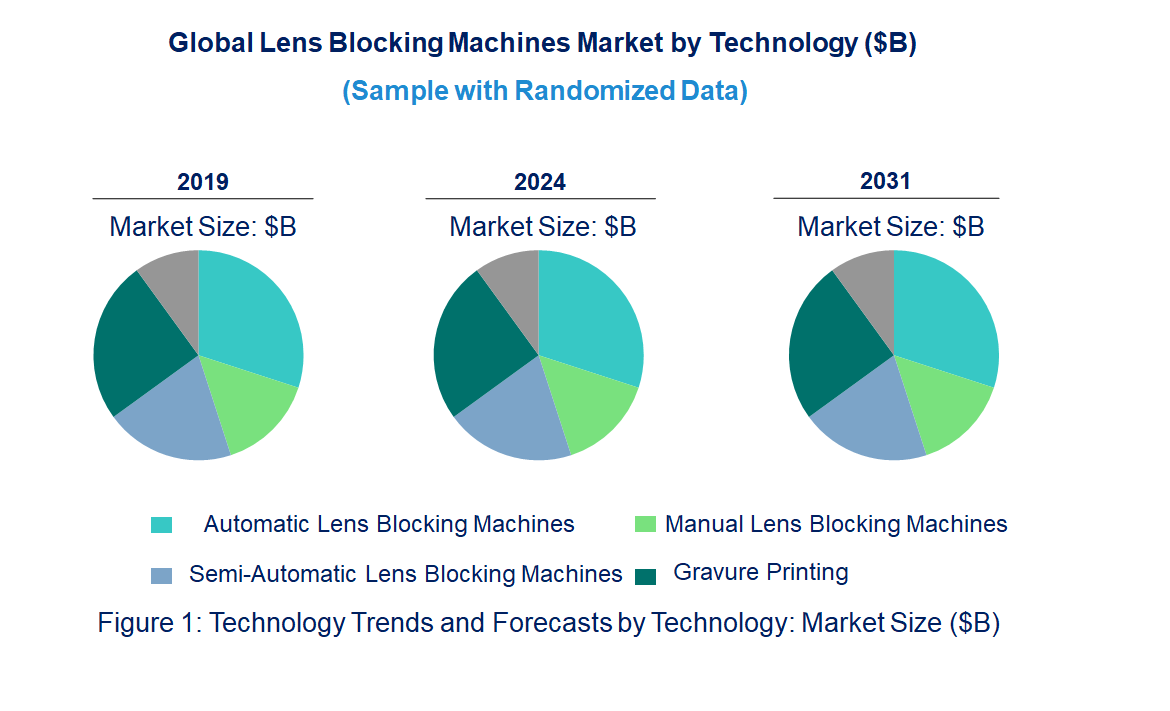
Emerging Trends in the Lens Blocking Machines Market
The lens blocking machines market is experiencing several emerging trends that are reshaping the industry. These trends are driven by technological advancements, automation, and the increasing demand for precision in optical manufacturing.• Automation Integration: The adoption of automatic lens blocking machines is increasing due to the need for higher throughput and reduced manual labor.
• Precision and Quality: Manufacturers are focusing on improving precision to meet the increasing demand for high-quality lenses in medical and optical applications.
• Compact and Efficient Designs: Newer machines are more compact and energy-efficient, meeting space and environmental considerations.
• Software and IoT Integration: Integration of advanced software systems for real-time monitoring and diagnostics is becoming more common in lens blocking machines.
• Customization Capabilities: Growing demand for personalized lenses is driving the development of customizable blocking machines that can handle a variety of lens types and materials. These trends are helping to improve the efficiency, precision, and flexibility of the lens blocking process, ensuring better alignment with modern optical manufacturing needs.
Lens Blocking Machines Market : Industry Potential, Technological Development, and Compliance Considerations
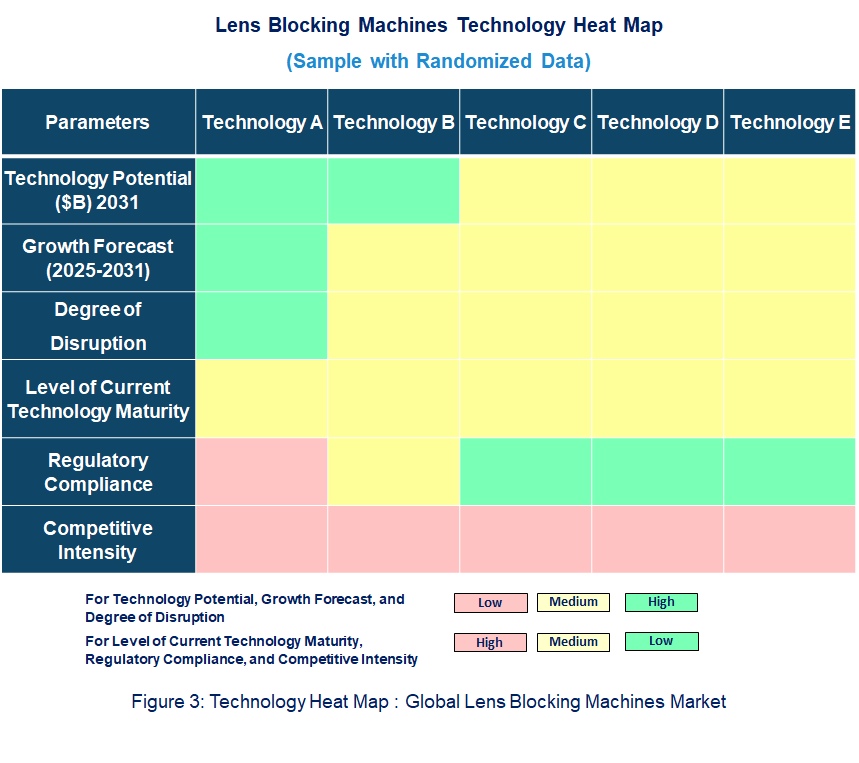
The lens blocking machines market has evolved significantly with advancements in technology, offering high potential for precision and automation in lens manufacturing. These machines, essential for blocking lenses during the eyewear production process, have become more sophisticated, with various models offering fully automated, semi-automated, and manual solutions. The technology potential is significant, as automated lens blocking machines can reduce human error, improve production speed, and maintain high-quality standards across large volumes of production.• Technology Potential: The integration of automation and advanced sensors in lens blocking machines allows for faster, more accurate lens production with fewer manual interventions. These advancements lead to reduced labor costs, improved efficiency, and the ability to produce complex, customized lenses.
• Degree of Disruption: The shift from manual to automated lens blocking technology has disrupted traditional manufacturing processes by enhancing precision, reducing labor dependency, and enabling greater customization.
• Current Technology Maturity: The technology has reached a high level of maturity, particularly with fully automated and semi-automated systems becoming mainstream in the market. However, some challenges remain in terms of cost, complexity, and operator training.
• Regulatory Compliance: Lens blocking machines must meet industry standards related to safety, quality, and environmental impact. As technologies evolve, companies must ensure compliance with these regulations, which can drive innovation while maintaining product integrity. In conclusion, the lens blocking machines market is poised for continued growth driven by technological advancements in automation and precision, although overcoming regulatory and cost challenges will be essential for future success.
Recent Technological development in Lens Blocking Machines Market by Key Players
The lens blocking machines market has experienced rapid advancements driven by the need for more efficient, precise, and automated systems for lens manufacturing. Key players such as OptiPro, Satisloh, SCHNEIDER, Luneau Technology, Essilor, Huvitz Corp, and NIDEK are leading these innovations, continuously developing new technologies that enhance performance, reduce manual labor, and improve quality across industries.• OptiPro: OptiPro has made significant strides with its advanced robotic and automated lens blocking systems, focusing on achieving high precision and efficiency. These developments are particularly beneficial for the optical industry, where accuracy and speed are crucial.
• Satisloh: Satisloh has introduced automated lens blocking machines equipped with advanced digital controls and real-time monitoring, enabling high-speed production with minimal error rates. Their systems are designed to increase throughput, benefiting large-scale manufacturing operations.
• SCHNEIDER: SCHNEIDER has integrated advanced software and AI into its lens blocking machines, allowing for enhanced control and diagnostics. Their innovations are focused on reducing the operational complexity of lens blocking while providing better precision for complex lens designs.
• Luneau Technology: Luneau Technology has focused on compact and efficient lens blocking machines with improved ergonomics and user-friendly interfaces, catering to small- and medium-sized optical labs looking for reliable, easy-to-use systems.
• Essilor: Essilor has advanced the automation of the lens blocking process, providing systems that optimize the quality of the final product while ensuring consistency. Their machines are designed to meet the increasing demand for high-volume production and precise lens blocking.
• Huvitz Corp: Huvitz has developed semi-automatic and fully automated lens blocking machines that streamline the lens manufacturing process. Their systems are designed to cater to various lens types and are known for their ease of use and precision.
• NIDEK: NIDEK has led the development of high-speed, fully automated lens blocking machines with a focus on reducing cycle time and increasing productivity in commercial optical labs. These technological advancements highlight the growing trend toward automation, precision, and efficiency in the lens blocking machines market, enhancing the capabilities of lens manufacturing across industries.
Lens Blocking Machines Market Driver and Challenges
The lens blocking machines market has seen steady growth driven by advancements in optical manufacturing technology and the increasing demand for precision in lens production. As eyewear manufacturing becomes more automated and efficient, several key drivers are pushing the industry forward, while challenges remain that need to be addressed for further development. The factors responsible for driving the global lens blocking machines market are:• Advancement in automation technology: The increasing integration of automated systems in lens blocking machines improves efficiency, reduces human error, and increases throughput, driving the demand for more advanced, automated solutions.
• Demand for high-quality lenses: The rise in demand for precise, high-quality lenses in both eyewear and specialized applications, such as prescription lenses and optical devices, has made advanced lens blocking machines critical for maintaining quality and consistency.
• Customization in lens production: Consumer demand for customized and specialized lenses has spurred innovation in lens blocking machines that can handle various types of lenses with high precision, thus improving production flexibility and expanding market applications.
• Cost efficiency and reduced labor costs: Lens blocking machines that offer automated processes reduce labor costs and human error, enabling manufacturers to scale production while keeping costs under control. This drives the adoption of new technologies in manufacturing. Challenges facing the global lens blocking machine market are:
• High initial investment costs: The adoption of advanced lens blocking machines, particularly fully automated systems, requires a high upfront investment, which may deter smaller optical labs from upgrading to the latest technology.
• Technological complexity: As machines become more advanced, the complexity of operating and maintaining these systems increases, which can require skilled labor and additional training, posing challenges for companies with limited expertise.
• Regulatory compliance and standardization: The lens blocking machines market faces regulatory pressures related to safety, quality standards, and environmental considerations. Ensuring compliance with these regulations requires constant innovation and updates to machinery. The drivers and challenges in the lens blocking machines market are shaping its trajectory. As automation and customization continue to evolve, there is a clear push toward more efficient, high-quality solutions. However, overcoming the challenges of high costs, technical complexity, and regulatory compliance is essential for fully realizing the potential of this market.
List of Lens Blocking Machines Companies
Companies in the market compete on the basis of product quality offered. Major players in this market focus on expanding their manufacturing facilities, R&D investments, infrastructural development, and leverage integration opportunities across the value chain. With these strategies lens blocking machines companies cater increasing demand, ensure competitive effectiveness, develop innovative products & technologies, reduce production costs, and expand their customer base. Some of the lens blocking machines companies profiled in this report includes.• Optipro
• Satisloh
• Schneider
• Luneau Technology
• Essilor
• Huvitz Corp
Lens Blocking Machines Market by Technology
• Technology Readiness by Technology Type: Automatic lens blocking machines are highly mature and widely adopted due to their efficiency and precision. Semi-automatic machines are moderately advanced, offering flexibility for smaller operations. Manual machines are less competitive as they fall behind in terms of automation. Emerging hybrid systems show potential but are still developing, requiring further innovation.
• Competitive Intensity and Regulatory Compliance: Automatic systems dominate the market with intense competition, offering high efficiency and compliance with strict regulatory standards. Manual machines face decreasing demand as automation rises. Semi-automatic machines strike a balance between automation and compliance, appealing to mid-market segments. Regulatory compliance remains crucial, especially for medical and optical applications.
• Disruption Potential of Different Technologies: Automatic lens blocking machines offer the highest disruption potential, significantly improving efficiency and precision. Semi-automatic systems provide a balance of automation and manual control, catering to diverse needs. Manual machines have lower disruption potential as automation becomes the industry standard. Innovations in hybrid systems continue to evolve, but are less mature.
Lens Blocking Machines Market Trend and Forecast by Technology [Value from 2019 to 2031]:
• Automatic Lens Blocking Machines
• Manual Lens Blocking Machines
• Semi-Automatic Lens Blocking Machines
• Others
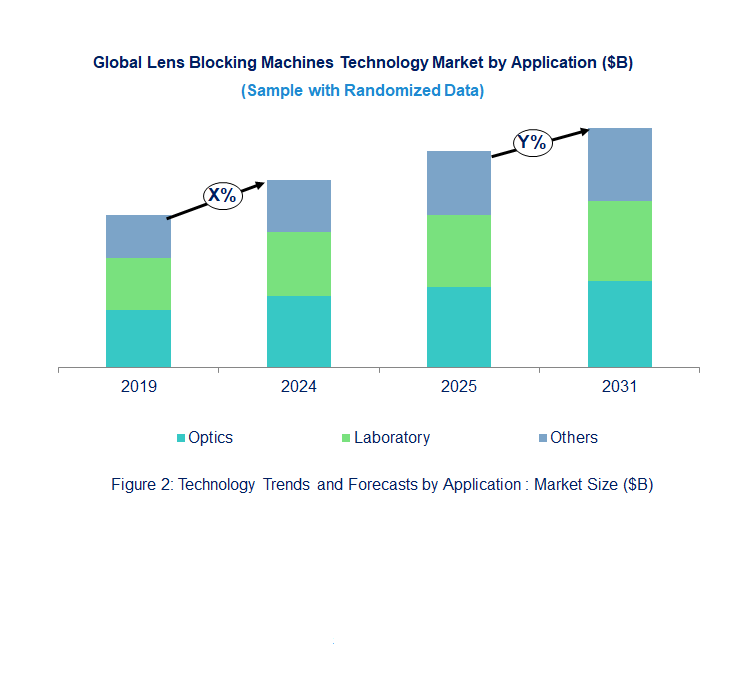
Lens Blocking Machines Market Trend and Forecast by Application [Value from 2019 to 2031]:
• Optics
• Laboratory
• Others
Lens Blocking Machines Market by Region [Value from 2019 to 2031]:
• North America
• Europe
• Asia Pacific
• The Rest of the World
• Latest Developments and Innovations in the Lens Blocking Machines Technologies
• Companies / Ecosystems
• Strategic Opportunities by Technology Type
Features of the Global Lens Blocking Machines Market
Market Size Estimates: Lens blocking machines market size estimation in terms of ($B). Trend and Forecast Analysis: Market trends (2019 to 2024) and forecast (2025 to 2031) by various segments and regions. Segmentation Analysis: Technology trends in the global lens blocking machines market size by various segments, such as application and technology in terms of value and volume shipments. Regional Analysis: Technology trends in the global lens blocking machines market breakdown by North America, Europe, Asia Pacific, and the Rest of the World. Growth Opportunities: Analysis of growth opportunities in different end use industries, technologies, and regions for technology trends in the global lens blocking machines market. Strategic Analysis: This includes M&A, new product development, and competitive landscape for technology trends in the global lens blocking machines market. Analysis of competitive intensity of the industry based on Porter’s Five Forces model.Table of Contents
Methodology
- In-depth interviews of the major players in this market
- Detailed secondary research from competitors’ financial statements and published data
- Extensive searches of published works, market, and database information pertaining to industry news, company press releases, and customer intentions
- A compilation of the experiences, judgments, and insights of Lucintel’s professionals, who have analyzed and tracked this market over the years.


Buy Now
Choose a license that fits your team. Instant PDF delivery.
Prices exclude taxes. Instant delivery. Custom licensing available on request.
Key Questions
- • What are some of the most promising potential, high-growth opportunities for the technology trends in the global lens blocking machines market by technology (automatic lens blocking machines, manual lens blocking machines, semi-automatic lens blocking machines, and others), application (optics, laboratory, and others), and region (North America, Europe, Asia Pacific, and the Rest of the World)?
- • Which technology segments will grow at a faster pace and why?
- • Which regions will grow at a faster pace and why?
- • What are the key factors affecting dynamics of different technology? What are the drivers and challenges of these technologies in the global lens blocking machines market?
- • What are the business risks and threats to the technology trends in the global lens blocking machines market?
- • What are the emerging trends in these material technologies in the global lens blocking machines market and the reasons behind them?
- • Which technologies have potential of disruption in this market?
- • What are the new developments in the technology trends in the global lens blocking machines market? Which companies are leading these developments?
- • Who are the major players in technology trends in the global lens blocking machines market? What strategic initiatives are being implemented by key players for business growth?
- • What are strategic growth opportunities in this lens blocking machines technology space?
- • What M & A activities did take place in the last five years in technology trends in the global lens blocking machines market?


