
Report Feature
LED Flicker Suppression CMOS Image Sensor Market Trends and Forecast
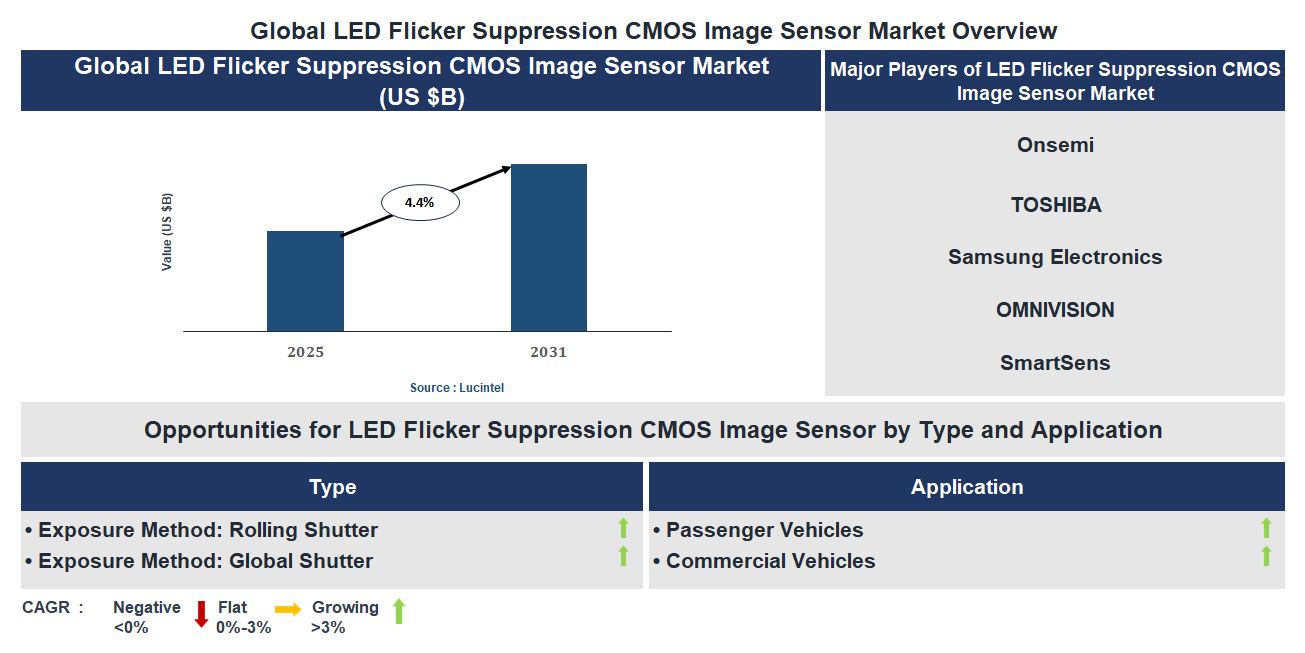
The future of the global LED flicker suppression CMOS image sensor market looks promising with opportunities in the passenger vehicle and commercial vehicle markets. The global LED flicker suppression CMOS image sensor market is expected to grow with a CAGR of 4.4% from 2025 to 2031. The major drivers for this market are the increasing prevalence of LED lighting in devices, the rising demand for clear imaging solutions, and the growing adoption in automotive camera systems.• Lucintel forecasts that, within the type category, exposure method: global shutter is expected to witness higher growth over the forecast period.
• Within the application category, passenger vehicle is expected to witness higher growth.
• In terms of region, APAC is expected to witness the highest growth over the forecast period. Gain valuable insights for your business decisions with our comprehensive 150+ page report. Sample figures with some insights are shown below.
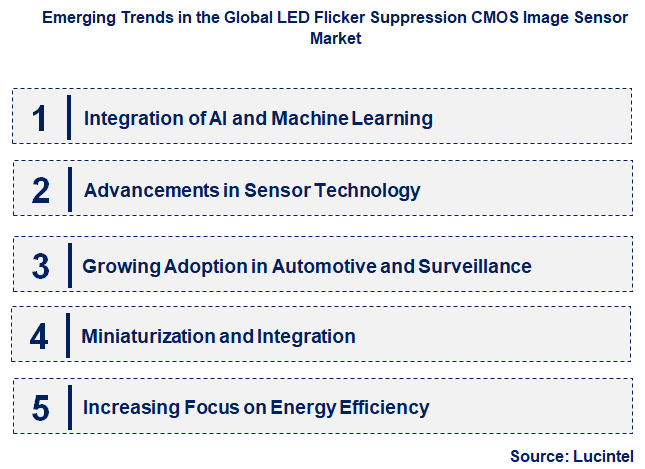
Emerging Trends in the LED Flicker Suppression CMOS Image Sensor Market
The LED flicker suppression CMOS image sensor market is experiencing rapid growth driven by advancements in imaging technology, increasing demand for high-quality video and photography, and the need for flicker-free imaging in various applications such as surveillance, automotive, and consumer electronics. As industries seek more reliable and efficient sensors, emerging trends are shaping the future landscape of this market. These developments are not only enhancing sensor performance but also expanding their application scope, leading to more innovative and integrated solutions. Understanding these key trends is essential for stakeholders aiming to capitalize on the evolving opportunities within this dynamic market.• Integration of AI and Machine Learning: The incorporation of AI algorithms into CMOS sensors enables real-time flicker detection and suppression, improving image quality in challenging lighting conditions. This trend enhances the sensors ability to adapt dynamically, reducing artifacts caused by flickering lights in video recordings and live streaming. AI-driven solutions also facilitate smarter image processing, enabling better noise reduction and exposure control. As a result, devices become more reliable and produce clearer images, especially in environments with inconsistent lighting, thereby expanding the application scope in security, automotive, and consumer electronics sectors.
• Advancements in Sensor Technology: Innovations in CMOS sensor design, such as back-illuminated (BSI) architecture and higher pixel densities, are improving sensitivity and reducing flicker artifacts. These technological improvements allow sensors to operate effectively under various lighting conditions, including flickering LED lights common in modern environments. Enhanced sensor performance leads to sharper images, better low-light functionality, and reduced motion blur. This progress is crucial for applications requiring high-resolution imaging, such as professional photography, medical imaging, and industrial inspection, thereby broadening market opportunities and elevating product standards.
• Growing Adoption in Automotive and Surveillance: The increasing deployment of CMOS sensors with flicker suppression capabilities in automotive cameras and surveillance systems is a significant trend. In automotive applications, flicker-free imaging is vital for driver assistance systems and autonomous vehicles operating under artificial lighting or variable sunlight conditions. Similarly, surveillance cameras benefit from flicker suppression to ensure clear, stable footage in environments with artificial lighting, such as streetlights or LED billboards. This trend is driven by the rising demand for safety, security, and autonomous vehicle technologies, fueling market growth and innovation in sensor design.
• Miniaturization and Integration: The trend toward smaller, more integrated CMOS sensors is enabling their use in compact devices like smartphones, wearable tech, and IoT gadgets. Miniaturization allows for the inclusion of flicker suppression features without increasing device size, making high-quality imaging accessible in portable formats. Integration of multiple functionalities, such as autofocus, image stabilization, and flicker suppression, into single chips reduces manufacturing costs and enhances device performance. This development is transforming consumer electronics, making advanced imaging features more widespread and affordable, thus expanding market reach and consumer adoption.
• Increasing Focus on Energy Efficiency: As the demand for battery-powered devices grows, energy-efficient CMOS sensors with flicker suppression are becoming a priority. Innovations aim to reduce power consumption while maintaining high image quality, enabling longer device operation without frequent charging. Energy-efficient sensors are particularly important for mobile devices, drones, and remote surveillance systems. This trend supports sustainable development goals and appeals to environmentally conscious consumers and manufacturers. The focus on energy efficiency is driving research into low-power sensor architectures and algorithms, further enhancing the markets growth potential. In summary, these emerging trends are collectively transforming the LED flicker suppression CMOS image sensor market by improving performance, expanding application areas, and enabling integration into smaller, more energy-efficient devices. These developments are fostering innovation, increasing market competitiveness, and opening new opportunities across various industries, ultimately reshaping how imaging technology is utilized in a flicker-prone environment.
Recent Development in the LED Flicker Suppression CMOS Image Sensor Market
The LED flicker suppression CMOS image sensor market is experiencing rapid advancements driven by increasing demand for high-quality imaging in various applications. Innovations in sensor technology and integration are enhancing performance, reducing costs, and expanding market reach. These developments are transforming industries such as consumer electronics, automotive, and security, creating new opportunities for manufacturers and consumers alike. As the market evolves, stakeholders are focusing on improving image clarity, reducing power consumption, and enabling smarter, more efficient imaging solutions.• Enhanced Flicker Suppression Algorithms: Improved algorithms significantly reduce flicker artifacts in images and videos, leading to clearer visuals in fluctuating lighting conditions. This advancement enhances user experience in smartphones, security cameras, and automotive systems, ensuring consistent image quality. The impact is a broader adoption of CMOS sensors in environments with variable lighting, boosting market growth and customer satisfaction.
• Integration of AI for Real-Time Processing: Incorporating artificial intelligence into CMOS sensors enables real-time flicker detection and suppression, optimizing image quality instantly. This development allows for smarter cameras capable of adapting to changing lighting conditions without user intervention. The impact includes increased demand for intelligent imaging devices across sectors, fostering innovation and expanding market opportunities for sensor manufacturers.
• Development of Low-Power CMOS Sensors: New low-power designs are reducing energy consumption while maintaining high performance, ideal for battery-operated devices. These sensors are crucial for portable electronics, IoT devices, and wearable technology, where power efficiency is vital. The impact is an extension of device battery life, cost savings, and increased adoption of flicker-suppressed CMOS sensors in energy-sensitive applications.
• Advancements in Sensor Miniaturization: Smaller CMOS sensors with enhanced flicker suppression capabilities are enabling compact device designs without compromising image quality. This miniaturization supports the development of slim smartphones, compact security cameras, and wearable devices. The impact is a surge in innovative product designs, increased market penetration, and new application opportunities in space-constrained environments.
• Expansion of Automotive Imaging Solutions: CMOS sensors with flicker suppression are increasingly integrated into automotive cameras for ADAS and autonomous driving, ensuring clear images in challenging lighting conditions. This development improves vehicle safety and reliability, fostering trust in autonomous systems. The impact is a growing market for automotive-grade sensors, driving technological innovation and expanding the scope of intelligent transportation solutions. These developments are significantly transforming the LED flicker suppression CMOS image sensor market by enhancing image quality, reducing power consumption, and enabling miniaturization. The integration of AI and advanced algorithms is fostering smarter, more adaptable imaging solutions across various sectors. As a result, market growth is accelerating, with increased adoption in consumer electronics, automotive, and security industries. These innovations are setting new standards for performance, efficiency, and application diversity, shaping the future of imaging technology.
Strategic Growth Opportunities in the LED Flicker Suppression CMOS Image Sensor Market
The LED flicker suppression CMOS image sensor market is experiencing rapid growth driven by increasing demand for high-quality imaging in various applications. Advancements in sensor technology and the need for flicker-free video capture are fueling innovation. Market players are focusing on developing more efficient sensors to meet the rising requirements of industries such as consumer electronics, automotive, and security. Strategic investments and collaborations are expected to further accelerate market expansion, creating numerous opportunities for growth and technological breakthroughs.• Integration of Flicker Suppression Technology in Consumer Electronics: The adoption of flicker suppression in smartphones, tablets, and cameras enhances image quality by reducing flicker artifacts caused by artificial lighting. As consumers demand clearer, more professional-looking images and videos, manufacturers are incorporating advanced CMOS sensors with built-in flicker mitigation. This integration improves user experience and supports the trend toward high-resolution, flicker-free content creation, driving market growth in the consumer electronics segment.
• Expansion of Automotive Imaging Systems for Safer Driving: Automotive applications require reliable, high-performance sensors for ADAS and autonomous vehicles. CMOS image sensors with flicker suppression capabilities help mitigate flickering issues caused by LED headlights and street lighting, ensuring clear visibility and accurate object detection. The increasing adoption of LED lighting in vehicles and the push for safer driving systems are fueling demand for specialized sensors, opening new growth avenues in automotive safety and autonomous driving markets.
• Growth of Security and Surveillance Systems with Enhanced Image Clarity: Security cameras increasingly rely on CMOS sensors with flicker suppression to deliver clear footage in environments with artificial lighting. This technology reduces flickering caused by fluorescent and LED lights, improving image quality for surveillance and monitoring. As security concerns grow globally, the demand for high-quality, flicker-free imaging solutions in public and private sectors is expanding, creating significant opportunities for sensor manufacturers to innovate and capture market share.
• Advancements in Medical Imaging for Accurate Diagnostics: Medical imaging devices such as endoscopes and diagnostic cameras benefit from CMOS sensors with flicker suppression to produce stable, high-quality images. This technology minimizes flickering artifacts during procedures, enabling more accurate diagnoses and better patient outcomes. The increasing adoption of digital imaging in healthcare and the need for precise, flicker-free visualization are driving growth in this segment, encouraging R&D investments and new product development.
• Development of High-Resolution Sensors for Industrial and Scientific Applications: Industrial inspection, scientific research, and machine vision systems require high-resolution CMOS sensors with flicker suppression to ensure precise imaging under artificial lighting conditions. These sensors improve defect detection, measurement accuracy, and data reliability. The rising demand for automation and quality control in manufacturing, along with scientific research requiring detailed imaging, presents substantial growth opportunities for sensor manufacturers to innovate and expand their product portfolios. The overall market is poised for significant expansion as these opportunities foster technological innovation and address critical needs across diverse applications. Companies investing in these growth areas will likely strengthen their market positions, driving further advancements and adoption of LED flicker suppression CMOS image sensors worldwide.
LED Flicker Suppression CMOS Image Sensor Market Driver and Challenges
The LED flicker suppression CMOS image sensor market is influenced by a variety of technological, economic, and regulatory factors. Rapid advancements in imaging technology, increasing demand for high-quality video recording, and the proliferation of smart devices are key drivers. Additionally, regulatory standards for image quality and energy efficiency shape market growth. Economic factors such as rising consumer spending on electronics and the expansion of surveillance infrastructure further propel the market. However, challenges like technological complexity, high manufacturing costs, and regulatory compliance issues pose significant hurdles. Understanding these drivers and challenges is essential for stakeholders aiming to capitalize on market opportunities and navigate potential risks effectively. The factors responsible for driving the LED flicker suppression CMOS image sensor market include:• Technological Advancements: The continuous development of CMOS image sensor technology enhances image quality, reduces power consumption, and enables better flicker suppression. Innovations such as back-illuminated sensors and on-chip processing improve performance in challenging lighting conditions. These advancements meet the increasing demand for high-resolution, low-light, and flicker-free imaging in applications like smartphones, security cameras, and automotive systems. As technology evolves, manufacturers can offer more sophisticated sensors, driving market growth and expanding application scope.
• Rising Adoption in Consumer Electronics: The surge in smartphone and wearable device usage fuels demand for high-quality imaging components. Consumers increasingly seek devices capable of capturing clear, flicker-free videos and images, especially in environments with artificial lighting. This trend encourages manufacturers to integrate advanced CMOS sensors with flicker suppression capabilities, boosting sales and market penetration. The proliferation of smart home devices and IoT-enabled security cameras further amplifies this demand, creating a robust growth trajectory for the market.
• Growth in Surveillance and Security Markets: The expanding deployment of surveillance systems in public and private sectors necessitates reliable, high-performance imaging sensors. Flicker suppression is critical for clear video footage in environments with artificial lighting, such as streetlights and indoor settings. Governments and organizations are investing heavily in security infrastructure, which drives demand for CMOS sensors capable of delivering consistent, flicker-free images. This growth not only enhances safety but also opens new avenues for sensor manufacturers to innovate and expand their product portfolios.
• Regulatory and Industry Standards: Increasing regulatory requirements for image quality, energy efficiency, and safety standards influence market dynamics. Governments and industry bodies are establishing guidelines that mandate flicker-free imaging for certain applications, especially in automotive and industrial sectors. Compliance with these standards compels manufacturers to develop advanced sensors with integrated flicker suppression features, fostering innovation and ensuring market competitiveness. Adherence to regulations also helps in gaining consumer trust and expanding market reach.
• Expansion of Automotive Imaging: The automotive industry’s shift towards advanced driver-assistance systems (ADAS) and autonomous vehicles significantly impacts the market. CMOS sensors with flicker suppression are vital for reliable image capture in variable lighting conditions, such as tunnels or bright sunlight. The integration of these sensors enhances vehicle safety, navigation, and driver monitoring systems. As automotive manufacturers prioritize safety and automation, the demand for high-performance, flicker-free CMOS sensors is expected to grow substantially, opening new growth opportunities within the market. The challenges facing this LED flicker suppression CMOS image sensor market include:
• Technological Complexity and Integration Costs: Developing CMOS sensors with effective flicker suppression involves complex design and manufacturing processes. Integrating advanced features increases production costs and requires specialized expertise, which can limit scalability and affordability. Smaller manufacturers may struggle to keep pace with technological advancements, leading to market fragmentation. Additionally, ensuring compatibility with various devices and lighting conditions adds to the complexity, potentially delaying product launches and increasing R&D expenses.
• High Manufacturing and Development Costs: The production of high-quality CMOS sensors with flicker suppression capabilities demands significant investment in research, development, and manufacturing infrastructure. These costs can be prohibitive, especially for emerging players, limiting market entry and innovation. The need for precision fabrication and quality control further escalates expenses. Consequently, high costs may translate into higher product prices, restricting adoption in price-sensitive markets and slowing overall market growth.
• Regulatory and Standardization Challenges: Navigating diverse regulatory landscapes and establishing industry standards pose considerable hurdles. Variations in regulations across regions regarding image quality, safety, and energy efficiency require manufacturers to adapt products accordingly, increasing complexity and costs. Lack of unified standards for flicker suppression can lead to compatibility issues and hinder global market expansion. Ensuring compliance while maintaining technological innovation remains a delicate balance, impacting overall market development and competitiveness. In summary, the LED flicker suppression CMOS image sensor market is driven by rapid technological innovations, increasing adoption in consumer electronics, expanding surveillance applications, regulatory standards, and automotive industry growth. However, challenges such as technological complexity, high costs, and regulatory hurdles could impede progress. Overall, these factors collectively shape a dynamic market landscape, offering significant opportunities for growth while necessitating strategic navigation of potential obstacles. Stakeholders must focus on innovation, cost management, and regulatory compliance to capitalize on emerging trends and sustain competitive advantage.
List of LED Flicker Suppression CMOS Image Sensor Companies
Companies in the market compete on the basis of product quality offered. Major players in this market focus on expanding their manufacturing facilities, R&D investments, infrastructural development, and leverage integration opportunities across the value chain. With these strategies LED flicker suppression CMOS image sensor companies cater increasing demand, ensure competitive effectiveness, develop innovative products & technologies, reduce production costs, and expand their customer base. Some of the LED flicker suppression CMOS image sensor companies profiled in this report include-• Onsemi
• TOSHIBA
• Samsung Electronics
• OMNIVISION
• SmartSens
LED Flicker Suppression CMOS Image Sensor Market by Segment
The study includes a forecast for the global LED flicker suppression CMOS image sensor market by type, application, and region.LED Flicker Suppression CMOS Image Sensor Market by Type [Value from 2019 to 2031]:
• Exposure Method: Rolling Shutter
• Exposure Method: Global Shutter
LED Flicker Suppression CMOS Image Sensor Market by Application [Value from 2019 to 2031]:
• Passenger Vehicles
• Commercial Vehicles
LED Flicker Suppression CMOS Image Sensor Market by Region [Value from 2019 to 2031]:
• North America
• Europe
• Asia Pacific
• The Rest of the World
Country Wise Outlook for the LED Flicker Suppression CMOS Image Sensor Market
The LED flicker suppression CMOS image sensor market is experiencing rapid growth driven by increasing demand for high-quality imaging in various applications such as consumer electronics, automotive, and security systems. Technological advancements are focused on improving image stability, reducing flicker artifacts, and enhancing overall sensor performance. As industries prioritize better visual experiences and reliable performance, countries are investing heavily in research and development to lead in this innovative sector. The market dynamics are also influenced by regulatory standards, consumer preferences, and the integration of AI and machine learning for smarter image processing.• United States: The US market is at the forefront of LED flicker suppression CMOS sensor development, with major tech companies investing heavily in R&D. Innovations include advanced algorithms for flicker reduction and integration with AI for real-time image correction. The automotive sector is adopting these sensors for autonomous vehicles, enhancing safety and image clarity. Consumer electronics manufacturers are also incorporating these sensors into smartphones and cameras, boosting market growth. Regulatory standards and consumer demand for high-quality imaging are driving continuous technological improvements. The US government supports innovation through grants and partnerships with tech firms, maintaining its leadership position.
• China: China is rapidly expanding its market share in LED flicker suppression CMOS sensors, driven by a booming electronics manufacturing industry. Local companies are focusing on cost-effective solutions without compromising quality, making these sensors more accessible across various price segments. The automotive and security sectors are significant adopters, with smart city initiatives fueling demand. Chinese firms are also investing in AI integration to enhance flicker suppression capabilities. Government policies favor domestic innovation, and collaborations with international firms are common to accelerate development. The market is characterized by aggressive growth, with a focus on scaling production and expanding application areas.
• Germany: Germanys market emphasizes high precision and reliability in LED flicker suppression CMOS sensors, primarily serving automotive and industrial applications. The country’s strong automotive industry is integrating these sensors into advanced driver-assistance systems (ADAS) and autonomous vehicles. German firms prioritize quality standards and long-term durability, leading to innovations in sensor design and performance. Research institutions collaborate with industry players to develop next-generation solutions with enhanced flicker suppression and low power consumption. The focus on sustainability and energy efficiency also influences product development. Overall, Germany maintains a competitive edge through technological excellence and stringent quality controls.
• India: The Indian market is witnessing increasing adoption of LED flicker suppression CMOS sensors across consumer electronics, security, and automotive sectors. Cost-effective manufacturing and local R&D are driving growth, making these sensors more affordable for domestic use. The government’s push for smart city projects and digital infrastructure is boosting demand. Indian companies are exploring AI-driven flicker suppression techniques to improve image quality in diverse lighting conditions. The market is still developing, with a focus on scaling production and establishing local supply chains. Collaborations with international firms are helping Indian manufacturers enhance technological capabilities and expand their market presence.
• Japan: Japan’s market is characterized by advanced technological integration and high-quality standards in LED flicker suppression CMOS sensors. The automotive industry, especially in autonomous vehicle development, is a key adopter, with sensors integrated into safety and navigation systems. Japanese firms focus on miniaturization, energy efficiency, and enhanced image stability. R&D efforts are directed toward combining flicker suppression with other imaging enhancements like HDR and low-light performance. The country’s strong emphasis on innovation and precision manufacturing sustains its competitive advantage. Collaborations with global tech companies and government support further promote the development of cutting-edge sensor solutions.

Features of the Global LED Flicker Suppression CMOS Image Sensor Market
Market Size Estimates: LED flicker suppression CMOS image sensor market size estimation in terms of value ($B). Trend and Forecast Analysis: Market trends (2019 to 2024) and forecast (2025 to 2031) by various segments and regions. Segmentation Analysis: LED flicker suppression CMOS image sensor market size by type, application, and region in terms of value ($B). Regional Analysis: LED flicker suppression CMOS image sensor market breakdown by North America, Europe, Asia Pacific, and Rest of the World. Growth Opportunities: Analysis of growth opportunities in different types, applications, and regions for the LED flicker suppression CMOS image sensor market. Strategic Analysis: This includes M&A, new product development, and competitive landscape of the LED flicker suppression CMOS image sensor market. Analysis of competitive intensity of the industry based on Porter’s Five Forces model.
FAQ
Q1. What is the growth forecast for LED flicker suppression CMOS image sensor market? Answer: The global LED flicker suppression CMOS image sensor market is expected to grow with a CAGR of 4.4% from 2025 to 2031. Q2. What are the major drivers influencing the growth of the LED flicker suppression CMOS image sensor market? Answer: The major drivers for this market are the increasing prevalence of led lighting in devices, the rising demand for clear imaging solutions, and the growing adoption in automotive camera systems. Q3. What are the major segments for LED flicker suppression CMOS image sensor market? Answer: The future of the LED flicker suppression CMOS image sensor market looks promising with opportunities in the passenger vehicle and commercial vehicle markets. Q4. Who are the key LED flicker suppression CMOS image sensor market companies? Answer: Some of the key LED flicker suppression CMOS image sensor companies are as follows:• Onsemi
• TOSHIBA
• Samsung Electronics
• OMNIVISION
• SmartSens Q5. Which LED flicker suppression CMOS image sensor market segment will be the largest in future? Answer: Lucintel forecasts that, within the type category, exposure method: global shutter is expected to witness higher growth over the forecast period. Q6. In LED flicker suppression CMOS image sensor market, which region is expected to be the largest in next 5 years? Answer: In terms of region, APAC is expected to witness the highest growth over the forecast period. Q7. Do we receive customization in this report? Answer: Yes, Lucintel provides 10% customization without any additional cost.
Table of Contents
List of Figures
List of Tables
Methodology
- In-depth interviews of the major players in this market
- Detailed secondary research from competitors’ financial statements and published data
- Extensive searches of published works, market, and database information pertaining to industry news, company press releases, and customer intentions
- A compilation of the experiences, judgments, and insights of Lucintel’s professionals, who have analyzed and tracked this market over the years.


Buy Now
Choose a license that fits your team. Instant PDF delivery.
Prices exclude taxes. Instant delivery. Custom licensing available on request.
Key Questions
- • What are some of the most promising, high-growth opportunities for the LED flicker suppression CMOS image sensor market by type (exposure method: rolling shutter and exposure method: global shutter), application (passenger vehicles and commercial vehicles), and region (North America, Europe, Asia Pacific, and the Rest of the World)?
- • Which segments will grow at a faster pace and why?
- • Which region will grow at a faster pace and why?
- • What are the key factors affecting market dynamics? What are the key challenges and business risks in this market?
- • What are the business risks and competitive threats in this market?
- • What are the emerging trends in this market and the reasons behind them?
- • What are some of the changing demands of customers in the market?
- • What are the new developments in the market? Which companies are leading these developments?
- • Who are the major players in this market? What strategic initiatives are key players pursuing for business growth?
- • What are some of the competing products in this market and how big of a threat do they pose for loss of market share by material or product substitution?
- • What M&A activity has occurred in the last 6 years and what has its impact been on the industry? For any questions related to LED Flicker Suppression CMOS Image Sensor Market, LED Flicker Suppression CMOS Image Sensor Market Size, LED Flicker Suppression CMOS Image Sensor Market Growth, LED Flicker Suppression CMOS Image Sensor Market Analysis, LED Flicker Suppression CMOS Image Sensor Market Report, LED Flicker Suppression CMOS Image Sensor Market Share, LED Flicker Suppression CMOS Image Sensor Market Trends, LED Flicker Suppression CMOS Image Sensor Market Forecast, LED Flicker Suppression CMOS Image Sensor Companies, write Lucintel analyst at email: helpdesk@lucintel.com. We will be glad to get back to you soon.


