
Report Feature
Lead-Free Multilayer Piezoelectric Ceramic Market Trends and Forecast
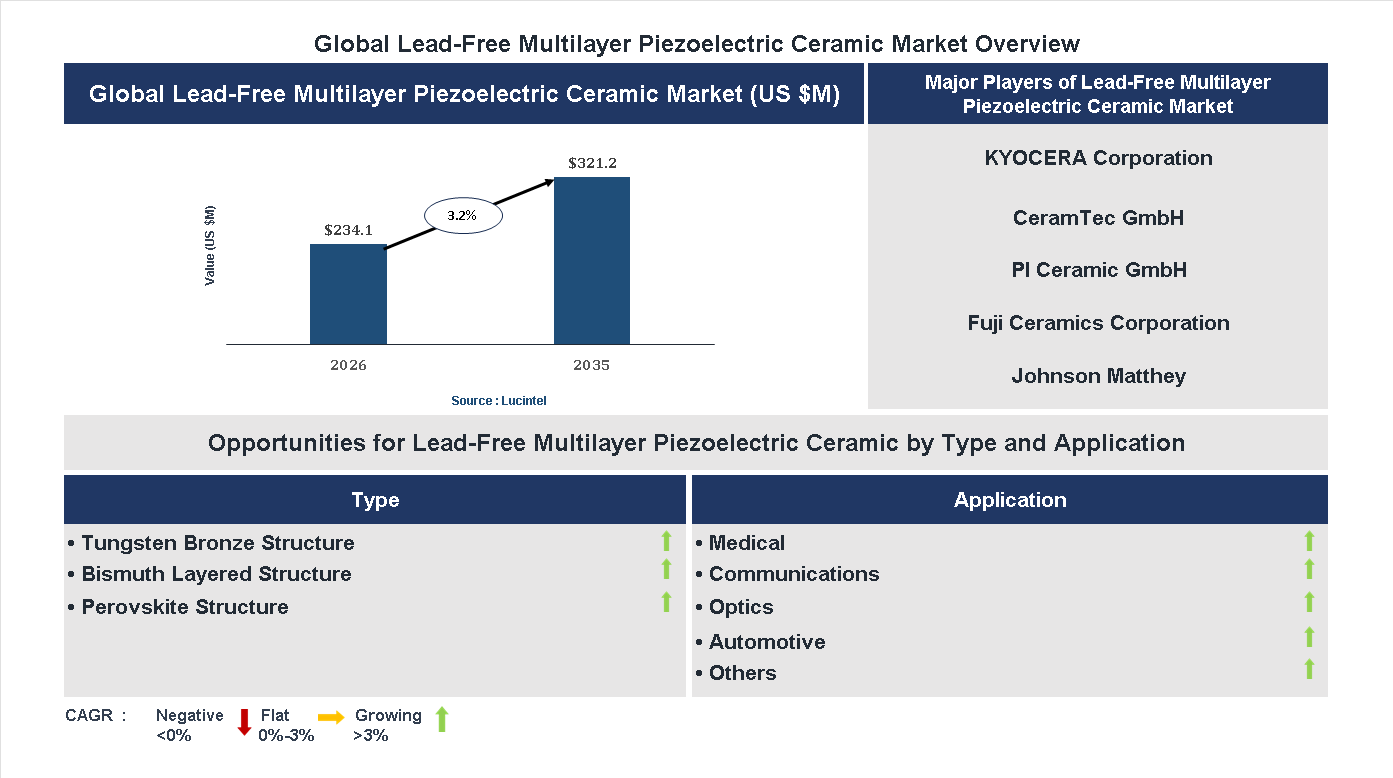
The future of the global lead-free multilayer piezoelectric ceramic market looks promising with opportunities in the medical, communication, optic, and automotive markets. The global lead-free multilayer piezoelectric ceramic market is expected to reach an estimated $321.2 million by 2035 with a CAGR of 3.2% from 2026 to 2035. The major drivers for this market are the increasing demand for eco-friendly electronic components, the rising adoption in automotive sensor applications, and the growing need for precise medical devices.• Lucintel forecasts that, within the type category, perovskite structure is expected to witness the highest growth over the forecast period.
• Within the application category, medical is expected to witness the highest growth.
• In terms of region, APAC is expected to witness the highest growth over the forecast period. Gain valuable insights for your business decisions with our comprehensive 150+ page report. Sample figures with some insights are shown below.
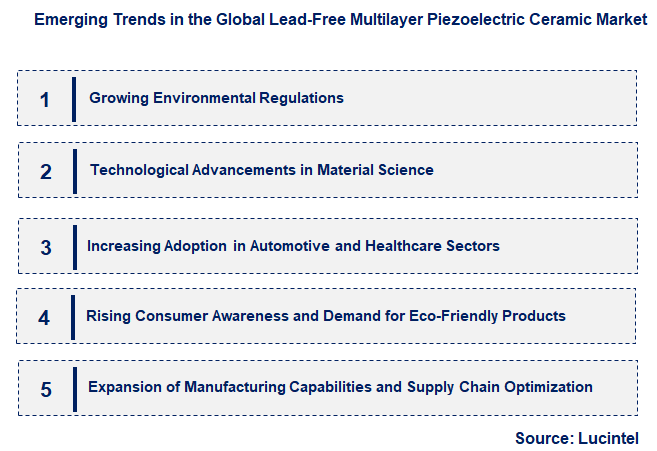
Emerging Trends in the Lead-Free Multilayer Piezoelectric Ceramic Market
The lead-free multilayer piezoelectric ceramic market is experiencing rapid growth driven by increasing environmental concerns, technological advancements, and regulatory changes. As industries shift towards sustainable and eco-friendly solutions, the demand for lead-free alternatives is rising. Innovations in material science and manufacturing processes are further propelling this market forward. These developments are not only addressing environmental issues but also enhancing product performance and safety standards. The markets evolution reflects a broader trend towards greener, safer, and more efficient electronic components, impacting various sectors including consumer electronics, automotive, and healthcare. Understanding these key trends is essential for stakeholders aiming to capitalize on emerging opportunities.• Growing Environmental Regulations: Increasing global regulations against lead usage are driving the shift to lead-free piezoelectric ceramics. Governments and environmental agencies are imposing strict standards to reduce hazardous substances in electronic components, prompting manufacturers to develop compliant materials. This regulatory push accelerates innovation and adoption of eco-friendly ceramics, ensuring market players remain compliant and competitive. The trend enhances market growth by expanding the customer base seeking sustainable solutions and reducing environmental impact.
• Technological Advancements in Material Science: Innovations in ceramic formulations and manufacturing techniques are improving the performance of lead-free piezoelectric ceramics. Researchers are developing new compositions with enhanced piezoelectric properties, durability, and temperature stability. These advancements enable the replacement of traditional lead-based ceramics in high-performance applications, broadening their use across various industries. The continuous improvement in material quality is crucial for meeting industry standards and expanding market applications.
• Increasing Adoption in Automotive and Healthcare Sectors: The automotive industry is integrating lead-free piezoelectric ceramics into sensors, actuators, and other electronic components to meet safety and environmental standards. Similarly, the healthcare sector utilizes these ceramics in medical devices due to their biocompatibility and safety. The rising adoption in these sectors is driven by stringent regulations and the need for reliable, eco-friendly components. This trend significantly boosts demand and opens new avenues for market growth.
• Rising Consumer Awareness and Demand for Eco-Friendly Products: Consumers are increasingly aware of environmental issues and prefer products that are sustainable and safe. This shift influences manufacturers to adopt lead-free ceramics to meet consumer expectations and enhance brand reputation. The demand for eco-friendly electronic devices and sensors is fueling market expansion, encouraging companies to innovate and offer greener solutions. Consumer preference for sustainability is a key driver shaping the market landscape.
• Expansion of Manufacturing Capabilities and Supply Chain Optimization: Companies are investing in advanced manufacturing facilities and optimizing supply chains to meet the rising demand for lead-free piezoelectric ceramics. This includes adopting automation, improving quality control, and sourcing sustainable raw materials. Enhanced manufacturing efficiency reduces costs and ensures consistent product quality, enabling faster market penetration. Strengthening supply chains also helps in scaling production to meet global demand, making the market more resilient and competitive. In summary, these trends are collectively transforming the lead-free multilayer piezoelectric ceramic market by fostering innovation, ensuring regulatory compliance, and aligning with consumer preferences. They are driving sustainable growth, expanding application areas, and positioning the market as a key player in the eco-friendly electronics industry.
Recent Development in the Lead-Free Multilayer Piezoelectric Ceramic Market
The lead-free multilayer piezoelectric ceramic market is experiencing rapid growth driven by increasing environmental regulations and demand for sustainable electronic components. Innovations in material science and manufacturing processes are expanding application areas across industries such as healthcare, automotive, and consumer electronics. Market players are investing heavily in research to develop eco-friendly alternatives that meet performance standards. These developments are shaping a more sustainable and technologically advanced industry landscape, offering new opportunities for manufacturers and consumers alike.• Growth in Green Regulations: The tightening of environmental policies worldwide is pushing manufacturers to adopt lead-free materials, fostering innovation and expanding market opportunities.
• Advancements in Material Technology: New formulations of lead-free ceramics are improving piezoelectric performance, enabling broader application in precision devices and sensors.
• Expansion in Automotive Applications: Increasing use of lead-free piezoelectric ceramics in automotive sensors and actuators is driving demand, especially with the rise of electric vehicles.
• Rising Adoption in Healthcare Devices: The biocompatibility and eco-friendliness of lead-free ceramics are making them ideal for medical imaging and diagnostic equipment.
• Innovations in Manufacturing Processes: Enhanced fabrication techniques are reducing costs and improving quality, making lead-free multilayer ceramics more accessible and reliable. These developments are significantly impacting the market by promoting sustainable practices, enhancing product performance, and expanding application sectors. The shift towards eco-friendly materials is fostering innovation, attracting new investments, and creating competitive advantages. Overall, the market is poised for substantial growth, driven by regulatory pressures and technological advancements that align with global sustainability goals.
Strategic Growth Opportunities in the Lead-Free Multilayer Piezoelectric Ceramic Market
The lead-free multilayer piezoelectric ceramic market is experiencing rapid growth driven by increasing environmental regulations, technological advancements, and demand for sustainable electronic components. As industries shift towards eco-friendly solutions, the adoption of lead-free materials is gaining momentum. Innovations in ceramic formulations and manufacturing processes are expanding application scopes across various sectors, including healthcare, automotive, and consumer electronics. This evolving landscape presents significant opportunities for market players to capitalize on emerging trends and meet the rising global demand for environmentally responsible piezoelectric solutions.• Regulatory Push for Eco-Friendly Materials: The global shift towards environmental sustainability is prompting stricter regulations against lead-based materials, encouraging the adoption of lead-free piezoelectric ceramics. Governments and industry standards are mandating safer, non-toxic alternatives, which accelerates market growth. Manufacturers are investing in R&D to develop high-performance, lead-free ceramics that meet or exceed the properties of traditional lead-based options, opening new avenues for application expansion and market penetration.
• Technological Innovations in Ceramic Formulations: Advances in material science are enabling the development of high-quality, lead-free multilayer piezoelectric ceramics with improved piezoelectric properties, durability, and temperature stability. These innovations are overcoming previous limitations related to performance and manufacturing complexity. Enhanced formulations are facilitating broader application in precision sensors, actuators, and transducers, thereby expanding the market scope and attracting new industry segments seeking environmentally friendly solutions.
• Growing Demand in Healthcare and Medical Devices: The healthcare sector is increasingly adopting lead-free piezoelectric ceramics for medical imaging, ultrasound devices, and diagnostic equipment due to safety and biocompatibility concerns. The demand for miniaturized, high-performance, and environmentally safe components is fueling market growth. Manufacturers are focusing on customizing ceramic compositions to meet stringent medical standards, which further drives innovation and adoption in this highly regulated industry.
• Expansion of Automotive and Industrial Applications: The automotive industry’s shift towards electric vehicles and smart sensors is boosting demand for lead-free piezoelectric ceramics in applications like vibration sensors, fuel injectors, and adaptive suspension systems. Industrial automation and robotics also benefit from these materials for precise motion control and sensing. The need for durable, eco-friendly components in these sectors is creating significant growth opportunities, prompting manufacturers to develop specialized ceramic solutions tailored to these demanding environments.
• Increasing Investment in R&D and Manufacturing Capabilities: Market players are investing heavily in research and development to enhance the performance and cost-effectiveness of lead-free multilayer piezoelectric ceramics. Expansion of manufacturing facilities and adoption of advanced production techniques are reducing costs and improving scalability. These efforts are enabling wider adoption across diverse applications and geographies, fostering innovation, and strengthening competitive positioning in the global market. The overall impact of these growth opportunities is set to significantly accelerate the adoption of lead-free multilayer piezoelectric ceramics, fostering sustainable development and innovation across multiple industries. As environmental concerns and technological advancements continue to evolve, the market is poised for substantial expansion, offering lucrative prospects for stakeholders committed to eco-friendly and high-performance solutions.
Lead-Free Multilayer Piezoelectric Ceramic Market Driver and Challenges
The lead-free multilayer piezoelectric ceramic market is influenced by a variety of technological, economic, and regulatory factors. As environmental concerns grow, regulations are increasingly favoring lead-free alternatives, prompting innovation in ceramic materials. Technological advancements are enabling the development of more efficient and durable piezoelectric devices, expanding their applications across industries such as healthcare, automotive, and consumer electronics. Economic factors, including rising manufacturing costs and demand for sustainable products, are shaping market dynamics. Additionally, regulatory pressures to eliminate hazardous substances are compelling manufacturers to adopt eco-friendly materials, which further drives market growth. However, these factors also present challenges related to material performance and cost competitiveness. The factors responsible for driving the lead-free multilayer piezoelectric ceramic market include:• Increasing Environmental Regulations: Stringent government policies worldwide are banning or restricting the use of lead in electronic components. This regulatory push encourages manufacturers to develop and adopt lead-free piezoelectric ceramics, fostering innovation and expanding market opportunities. The shift not only aligns with global sustainability goals but also reduces health hazards associated with lead exposure, making products safer for consumers and the environment. As regulations become more rigorous, the demand for compliant materials is expected to surge, driving market growth significantly.
• Technological Advancements in Material Science: Continuous research and development efforts are leading to the creation of high-performance lead-free piezoelectric ceramics with improved properties such as higher piezoelectric coefficients, better stability, and enhanced durability. These innovations enable broader application scopes, including in precision sensors, actuators, and medical devices. Advanced manufacturing techniques, such as multilayer fabrication, are also improving efficiency and reducing costs. As technology progresses, the market benefits from more reliable and cost-effective solutions, fueling adoption across various sectors.
• Growing Demand in Healthcare and Consumer Electronics: The healthcare industry increasingly relies on piezoelectric ceramics for ultrasound imaging, sensors, and other diagnostic tools, where lead-free options are preferred for safety reasons. Similarly, consumer electronics, including smartphones and wearable devices, utilize piezoelectric components for haptic feedback and sensors. The rising adoption of these devices, coupled with consumer preference for environmentally friendly products, is propelling market growth. The expanding application base in these sectors underscores the importance of lead-free solutions that meet performance and safety standards.
• Rising Focus on Sustainability and Eco-Friendly Products: Consumers and manufacturers are prioritizing sustainability, prompting a shift toward eco-friendly materials like lead-free ceramics. This trend is driven by increasing awareness of environmental impacts and corporate social responsibility initiatives. The demand for sustainable electronics and green manufacturing practices is encouraging companies to innovate and adopt lead-free piezoelectric materials. This focus not only enhances brand reputation but also aligns with global sustainability goals, creating a favorable environment for market expansion.
• Expansion of Automotive and Industrial Applications: The automotive industry is integrating lead-free piezoelectric ceramics into sensors, actuators, and other electronic components to improve vehicle safety, comfort, and efficiency. Industrial applications, such as precision positioning and vibration control, are also benefiting from these materials. The push for cleaner, more efficient, and environmentally compliant solutions in these sectors is driving demand. As automotive and industrial sectors seek sustainable and high-performance materials, the market for lead-free multilayer piezoelectric ceramics is poised for significant growth. The challenges facing the lead-free multilayer piezoelectric ceramic market include:
• Performance Limitations of Lead-Free Materials: Despite technological progress, lead-free piezoelectric ceramics often exhibit lower piezoelectric coefficients and stability compared to traditional lead-based counterparts. These performance limitations can restrict their use in high-precision or high-stress applications, posing a challenge for manufacturers aiming to replace lead-based materials entirely. Overcoming these limitations requires extensive research and development, which can be time-consuming and costly, potentially delaying market adoption and increasing product development costs.
• Higher Manufacturing Costs: Producing lead-free multilayer piezoelectric ceramics often involves complex manufacturing processes and expensive raw materials, leading to higher costs compared to traditional lead-based ceramics. These increased costs can hinder widespread adoption, especially in price-sensitive markets. Manufacturers face the challenge of balancing performance improvements with cost efficiency to remain competitive. Additionally, scaling up production while maintaining quality standards adds to the financial and technical hurdles.
• Material Durability and Long-Term Stability Concerns: Lead-free ceramics may face issues related to long-term stability and durability under operational stresses such as temperature fluctuations, mechanical vibrations, and environmental exposure. These concerns can impact the reliability and lifespan of devices utilizing these materials, limiting their application in critical sectors like healthcare and automotive. Addressing these durability issues requires extensive testing and material optimization, which can delay product deployment and increase development costs. In summary, the lead-free multilayer piezoelectric ceramic market is driven by regulatory pressures, technological innovations, and expanding application areas, particularly in healthcare, consumer electronics, and automotive sectors. However, challenges such as performance limitations, higher manufacturing costs, and durability concerns pose significant hurdles. The overall market outlook remains positive, with ongoing research and technological improvements expected to mitigate these challenges. The shift toward eco-friendly, high-performance materials will continue to shape the industry, fostering sustainable growth and innovation in the coming years.
List of Lead-Free Multilayer Piezoelectric Ceramic Companies
Companies in the market compete on the basis of product quality offered. Major players in this market focus on expanding their manufacturing facilities, R&D investments, infrastructural development, and leverage integration opportunities across the value chain. With these strategies lead-free multilayer piezoelectric ceramic companies cater increasing demand, ensure competitive effectiveness, develop innovative products & technologies, reduce production costs, and expand their customer base. Some of the lead-free multilayer piezoelectric ceramic companies profiled in this report include-• KYOCERA Corporation
• CeramTec GmbH
• PI Ceramic GmbH
• Fuji Ceramics Corporation
• Johnson Matthey
• CTS Corporation
• Piezo Technologies
• TRS Technologies
• Meggitt PLC
• Piezo Kinetics Inc
Lead-Free Multilayer Piezoelectric Ceramic Market by Segment
The study includes a forecast for the global lead-free multilayer piezoelectric ceramic market by type, application, and region.Lead-Free Multilayer Piezoelectric Ceramic Market by Type [Value from 2019 to 2035]:
• Tungsten Bronze Structure
• Bismuth Layered Structure
• Perovskite Structure
Lead-Free Multilayer Piezoelectric Ceramic Market by Application [Value from 2019 to 2035]:
• Medical
• Communications
• Optics
• Automotive
• Others
Lead-Free Multilayer Piezoelectric Ceramic Market by Region [Value from 2019 to 2035]:
• North America
• Europe
• Asia Pacific
• The Rest of the World
Country Wise Outlook for the Lead-Free Multilayer Piezoelectric Ceramic Market
The lead-free multilayer piezoelectric ceramic market is experiencing rapid growth driven by increasing environmental regulations, technological advancements, and rising demand for eco-friendly electronic components worldwide. Countries are adopting stricter policies to phase out lead-based materials, fostering innovation in lead-free alternatives. The market is also benefiting from the expanding applications in consumer electronics, automotive, and healthcare sectors. As sustainability becomes a priority, manufacturers are investing heavily in research and development to improve the performance and cost-effectiveness of lead-free piezoelectric ceramics. This evolving landscape reflects a global shift towards greener, safer materials in electronic manufacturing.• United States: The US market has seen significant advancements with increased adoption of lead-free piezoelectric ceramics in consumer electronics and medical devices. Regulatory pressures from agencies like the EPA have accelerated R&D efforts to develop high-performance, eco-friendly materials. Major companies are investing in innovative manufacturing techniques to enhance product efficiency and durability. The US also witnesses growing collaborations between academia and industry to push technological boundaries, fostering a competitive environment that promotes sustainable solutions.
• China: China remains a dominant player in the market, driven by its large electronics manufacturing sector. The country has made substantial investments in research to develop lead-free alternatives that meet international standards. Government policies favor environmentally friendly materials, encouraging local companies to innovate. China’s focus on expanding its electric vehicle and smart device industries has increased demand for lead-free piezoelectric ceramics, positioning it as a key growth hub in this market.
• Germany: Germany’s market development is characterized by a strong emphasis on quality and sustainability. The country’s automotive and industrial sectors are adopting lead-free piezoelectric ceramics to comply with stringent EU regulations. German companies are pioneering advanced manufacturing processes to improve the performance of these ceramics. Additionally, Germany’s focus on renewable energy and smart technology integration is driving demand for environmentally safe piezoelectric solutions, reinforcing its position as a leader in sustainable electronic components.
• India: India is witnessing rapid growth in the adoption of lead-free piezoelectric ceramics, primarily driven by government initiatives promoting green technology and environmental safety. The expanding electronics and automotive sectors are key consumers. Indian manufacturers are increasingly investing in R&D to develop cost-effective, high-performance lead-free materials suitable for local applications. The country’s focus on sustainable development and increasing export activities is further propelling market expansion.
• Japan: Japan continues to innovate in the lead-free piezoelectric ceramic market with a focus on high-performance applications in robotics, healthcare, and consumer electronics. The country’s strict environmental regulations have accelerated the shift away from lead-based materials. Japanese firms are leading in developing advanced manufacturing techniques that enhance the durability and efficiency of lead-free ceramics. The integration of these materials into next-generation electronic devices underscores Japan’s commitment to sustainable and cutting-edge technological solutions.

Features of the Global Lead-Free Multilayer Piezoelectric Ceramic Market
Market Size Estimates: Lead-free multilayer piezoelectric ceramic market size estimation in terms of value ($M). Trend and Forecast Analysis: Market trends (2019 to 2025) and forecast (2026 to 2035) by various segments and regions. Segmentation Analysis: Lead-free multilayer piezoelectric ceramic market size by type, application, and region in terms of value ($M). Regional Analysis: Lead-free multilayer piezoelectric ceramic market breakdown by North America, Europe, Asia Pacific, and Rest of the World. Growth Opportunities: Analysis of growth opportunities in different types, applications, and regions for the lead-free multilayer piezoelectric ceramic market. Strategic Analysis: This includes M&A, new product development, and competitive landscape of the lead-free multilayer piezoelectric ceramic market. Analysis of competitive intensity of the industry based on Porter’s Five Forces model.
FAQ
Q1. What is the lead-free multilayer piezoelectric ceramic market size? Answer: The global lead-free multilayer piezoelectric ceramic market is expected to reach an estimated $321.2 million by 2035. Q2. What is the growth forecast for lead-free multilayer piezoelectric ceramic market? Answer: The global lead-free multilayer piezoelectric ceramic market is expected to grow with a CAGR of 3.2% from 2026 to 2035. Q3. What are the major drivers influencing the growth of the lead-free multilayer piezoelectric ceramic market? Answer: The major drivers for this market are the increasing demand for eco-friendly electronic components, the rising adoption in automotive sensor applications, and the growing need for precise medical devices. Q4. What are the major segments for lead-free multilayer piezoelectric ceramic market? Answer: The future of the lead-free multilayer piezoelectric ceramic market looks promising with opportunities in the medical, communication, optic, and automotive markets. Q5. Who are the key lead-free multilayer piezoelectric ceramic market companies? Answer: Some of the key lead-free multilayer piezoelectric ceramic companies are as follows:• KYOCERA Corporation
• CeramTec GmbH
• PI Ceramic GmbH
• Fuji Ceramics Corporation
• Johnson Matthey
• CTS Corporation
• Piezo Technologies
• TRS Technologies
• Meggitt PLC
• Piezo Kinetics Inc Q6. Which lead-free multilayer piezoelectric ceramic market segment will be the largest in future? Answer: Lucintel forecasts that, within the type category, perovskite structure is expected to witness the highest growth over the forecast period. Q7. In lead-free multilayer piezoelectric ceramic market, which region is expected to be the largest in next 5 years? Answer: In terms of region, APAC is expected to witness the highest growth over the forecast period. Q8. Do we receive customization in this report? Answer: Yes, Lucintel provides 10% customization without any additional cost.
Table of Contents
List of Figures
List of Tables
Methodology
- In-depth interviews of the major players in this market
- Detailed secondary research from competitors’ financial statements and published data
- Extensive searches of published works, market, and database information pertaining to industry news, company press releases, and customer intentions
- A compilation of the experiences, judgments, and insights of Lucintel’s professionals, who have analyzed and tracked this market over the years.


Buy Now
Choose a license that fits your team. Instant PDF delivery.
Prices exclude taxes. Instant delivery. Custom licensing available on request.
Key Questions
- • What are some of the most promising, high-growth opportunities for the lead-free multilayer piezoelectric ceramic market by type (tungsten bronze structure, bismuth layered structure, and perovskite structure), application (medical, communications, optics, automotive, and others), and region (North America, Europe, Asia Pacific, and the Rest of the World)?
- • Which segments will grow at a faster pace and why?
- • Which region will grow at a faster pace and why?
- • What are the key factors affecting market dynamics? What are the key challenges and business risks in this market?
- • What are the business risks and competitive threats in this market?
- • What are the emerging trends in this market and the reasons behind them?
- • What are some of the changing demands of customers in the market?
- • What are the new developments in the market? Which companies are leading these developments?
- • Who are the major players in this market? What strategic initiatives are key players pursuing for business growth?
- • What are some of the competing products in this market and how big of a threat do they pose for loss of market share by material or product substitution?
- • What M&A activity has occurred in the last 7 years and what has its impact been on the industry? For any questions related to Lead-Free Multilayer Piezoelectric Ceramic Market, Lead-Free Multilayer Piezoelectric Ceramic Market Size, Lead-Free Multilayer Piezoelectric Ceramic Market Growth, Lead-Free Multilayer Piezoelectric Ceramic Market Analysis, Lead-Free Multilayer Piezoelectric Ceramic Market Report, Lead-Free Multilayer Piezoelectric Ceramic Market Share, Lead-Free Multilayer Piezoelectric Ceramic Market Trends, Lead-Free Multilayer Piezoelectric Ceramic Market Forecast, Lead-Free Multilayer Piezoelectric Ceramic Companies, write Lucintel analyst at email: helpdesk@lucintel.com. We will be glad to get back to you soon.


