
Market Report · July 31, 2026

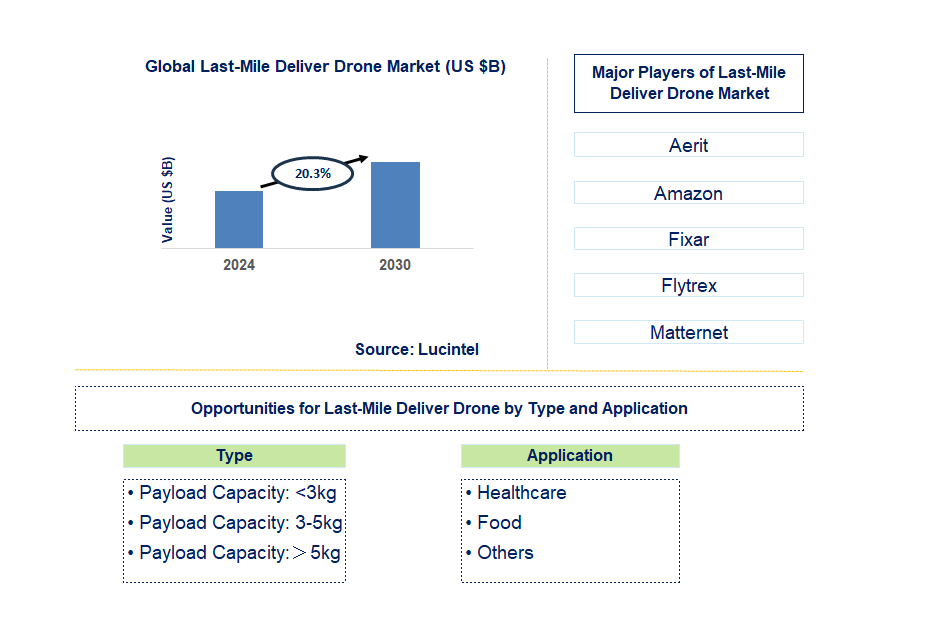
Key data points: The growth forecast = 20.3% annually for the next 6 years. Scroll below to get more insights. This market report covers trends, opportunities, and forecasts in the global last-mile deliver drone market to 2030 by type (payload capacity: <3kg, payload capacity: 3-5kg, and payload capacity:>5kg), application (healthcare, food, and others), and region (North America, Europe, Asia Pacific, and the Rest of the World)
We'll send your sample report shortly.
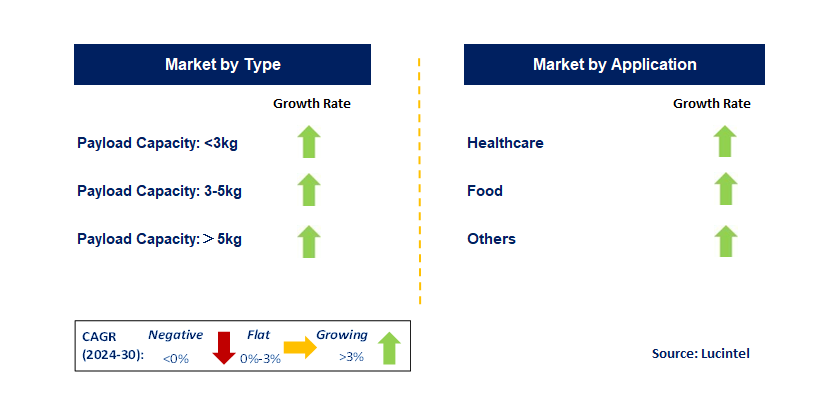
• Lucintel forecasts that, within the type category, payload capacity: <3kg is expected to witness the highest growth over the forecast period.
• Within the application category, healthcare is expected to witness a higher growth.
• In terms of regions, APAC is expected to witness the highest growth over the forecast period. A more than 150-page report is developed to help in your business decisions.
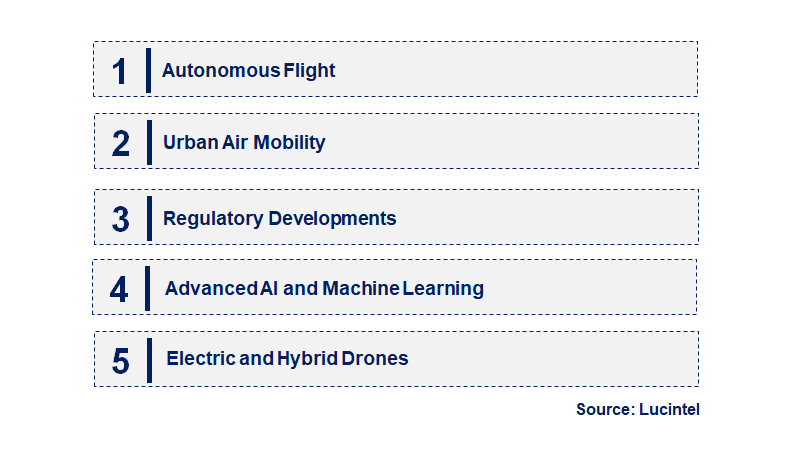
• Autonomous Flight: The increasing use of autonomous drone technology for precise and efficient last-mile deliveries, reducing reliance on human operators.
• Urban Air Mobility: The development of urban air mobility solutions, integrating drones into city transport networks to alleviate congestion and improve delivery times.
• Regulatory Developments: The evolution of regulatory frameworks to support safe and scalable drone operations, including BVLOS (Beyond Visual Line of Sight) permissions.
• Advanced AI and Machine Learning: The integration of AI and machine learning for optimizing flight paths, managing deliveries, and enhancing operational efficiency.
• Electric and Hybrid Drones: The growing adoption of electric and hybrid drone technologies to address environmental concerns and extend flight range. Emerging trends in the last-mile delivery drone market include autonomous flight, urban air mobility, regulatory developments, advanced AI and machine learning, electric and hybrid drones, and public-private partnerships, driving innovation and growth in the sector.
• Successful Pilot Programs: Numerous successful pilot programs by major companies, demonstrating the feasibility and efficiency of drone-based last-mile deliveries.
• Enhanced Technology: Advances in drone technology, including improved battery life, payload capacity, and navigation systems for better performance in delivery operations.
• Regulatory Approvals: Progress in obtaining regulatory approvals and certifications for commercial drone operations, including new guidelines for BVLOS operations.
• Infrastructure Investments: Investments in drone infrastructure, such as dedicated landing zones and charging stations, to support the widespread deployment of delivery drones.
• Expanded Service Areas: The expansion of drone delivery services to new geographic areas, including rural and underserved locations, increasing market reach.
• Partnerships and Collaborations: The formation of strategic partnerships between technology providers, logistics companies, and regulatory bodies to advance drone technology and operational standards. Recent developments in the last-mile delivery drone market include successful pilot programs, enhanced technology, regulatory approvals, infrastructure investments, expanded service areas, and strategic partnerships, reflecting significant progress and growing adoption of drone technologies in delivery applications.
• Technology Integration: Leveraging advancements in AI, IoT, and autonomous systems to enhance drone capabilities and integrate them with existing logistics networks.
• Urban Integration: Developing solutions for integrating drones into urban infrastructure, including air traffic management systems and designated flight paths.
• Market Expansion: Exploring new market segments and geographic regions, particularly in underserved areas and emerging economies, to expand drone delivery services.
• Regulatory Engagement: Collaborating with regulatory bodies to shape and adapt regulations that facilitate the safe and scalable deployment of delivery drones.
• Partnership Opportunities: Forming partnerships with e-commerce platforms, logistics providers, and technology developers to create innovative drone delivery solutions.
• Consumer Adoption: Educating consumers about the benefits and convenience of drone deliveries to drive adoption and increase market demand. Strategic growth opportunities for the last-mile delivery drone market include technology integration, urban integration, market expansion, regulatory engagement, partnership opportunities, and consumer adoption, driving innovation and market expansion.
• Efficiency Improvement: Drones enhance delivery efficiency by reducing delivery times and optimizing routes, addressing urban congestion issues.
• Cost Reduction: Potential cost savings through reduced labor costs and operational efficiencies in delivery processes.
• Technological Advancements: Innovations in drone technology, including improved battery life and autonomous systems, driving market growth and capability.
• Regulatory Support: Supportive regulatory frameworks and pilot programs facilitating the deployment and scaling of drone delivery services.
• E-commerce Growth: Increasing demand for fast and reliable delivery services driven by the growth of e-commerce and online shopping. Challenges in the last-mile deliver drone market are:
• Regulatory Hurdles: Navigating complex and evolving regulations for drone operations, including airspace management and privacy concerns.
• High Costs: High initial costs of drone technology and infrastructure, which can be a barrier for widespread adoption.
• Technical Limitations: Technical challenges related to drone performance, including battery life, payload capacity, and weather conditions.
• Infrastructure Needs: Developing and maintaining infrastructure for drone operations, such as landing zones and charging stations.
• Public Perception: Addressing public concerns about safety, privacy, and noise associated with drone operations.
• Operational Complexity: Managing the logistics and integration of drones into existing delivery networks and workflows. The last-mile delivery drone market is driven by efficiency improvement, cost reduction, technological advancements, regulatory support, e-commerce growth, and sustainability goals, while facing challenges such as regulatory hurdles, high costs, technical limitations, infrastructure needs, public perception, and operational complexity.
• Aerit
• Amazon
• Fixar
• Flytrex
• Matternet
• UPS Flight Forward
• Wing
• Payload Capacity: <3kg
• Payload Capacity: 3-5kg
• Payload Capacity:>5kg
• Healthcare
• Food
• Others
• North America
• Europe
• Asia Pacific
• The Rest of the World
• USA: In the USA, the last-mile delivery drone market has seen significant developments, with several major companies and logistics providers exploring and implementing drone technology. Amazon has been at the forefront, with its Prime Air service conducting successful drone delivery trials in select cities. UPS has also made strides with its Flight Forward division, deploying drones for delivering medical supplies and packages to remote areas. Regulatory progress by the Federal Aviation Administration (FAA) is facilitating these advancements, enabling more comprehensive testing and deployment of drones for urban and suburban last-mile deliveries.
• Germany: Germany has been proactive in integrating drones into last-mile delivery solutions, with several innovative projects and partnerships emerging. Deutsche Post DHL has launched its “Parcelcopter” initiative, which aims to use drones for delivering packages to remote locations and islands. The German government is supportive of drone technology, with regulations evolving to accommodate commercial drone operations. Additionally, research institutions and technology startups in Germany are working on enhancing drone capabilities, including improving flight endurance and payload capacity for efficient last-mile deliveries.
• China: In China, the last-mile delivery drone market is rapidly growing, driven by major e-commerce giants like Alibaba and JD.com. These companies have been actively testing and deploying drones to optimize their delivery networks, particularly in rural and underserved areas. JD.com’s drone delivery service, JD Drone, has significantly expanded its reach, with numerous successful deliveries and ongoing advancements in drone technology. The Chinese government’s supportive policies and investment in drone infrastructure are accelerating the adoption of drones for last-mile delivery applications across the country.
• India: India is making strides in the last-mile delivery drone market, with several pilot projects and trials underway. Companies like Zomato and Dunzo are exploring drone technology for food and parcel deliveries, aiming to address the challenges of traffic congestion and delivery efficiency in urban areas. The Indian government is also working on developing regulations to facilitate the use of drones in commercial applications. Despite these advancements, the market faces challenges related to infrastructure, regulatory approval, and the high cost of drone technology.
• Japan: Japan is embracing drone technology for last-mile delivery solutions, with a focus on integrating drones into existing logistics networks. Major companies such as Rakuten are testing drone deliveries for packages and groceries. The Japanese government is actively working on regulatory frameworks to support drone operations, including air traffic management systems for safe and efficient use. Additionally, Japan’s strong technology sector is contributing to advancements in drone design and functionality, aiming to enhance delivery efficiency and expand market adoption.


• Aerit
• Amazon
• Fixar
• Flytrex
• Matternet
• UPS Flight Forward
• Wing Q5. Which last-mile deliver drone market segment will be the largest in future? Answer: Lucintel forecasts that payload capacity: <3kg is expected to witness the highest growth over the forecast period. Q6. In last-mile deliver drone market, which region is expected to be the largest in next 5 years? Answer: APAC is expected to witness the highest growth over the forecast period. Q.7 Do we receive customization in this report? Answer: Yes, Lucintel provides 10% customization without any additional cost.


Choose a license that fits your team. Instant PDF delivery.
Prices exclude taxes. Instant delivery. Custom licensing available on request.
Market Report · July 31, 2026
Market Report · July 22, 2026
Market Report · July 20, 2026
Trusted partner for strategic intelligence and business growth


Receive a complimentary market analysis tailored to your industry. Our analysts will identify key growth opportunities and competitive dynamics specific to your business.

Market size, growth rate, and key trend analysis for your specific sector.

Top competitor positioning and market share analysis.

Strategic recommendations backed by data-driven insights.
Get curated market intelligence and competitive moves straight to your inbox.
By subscribing, you agree to receive our monthly insights. Unsubscribe anytime.
Receive a complimentary market analysis tailored to your industry. Our analysts will identify key growth opportunities and competitive dynamics specific to your business.
Market size, growth rate, and key trend analysis for your specific sector.
Top competitor positioning and market share analysis.
Strategic recommendations backed by data-driven insights.
Get curated market intelligence, emerging trends, and competitive moves straight to your inbox each month.
By subscribing, you agree to receive our monthly insights. Unsubscribe anytime.
We'll send your sample report shortly.