
Market Report · July 29, 2026

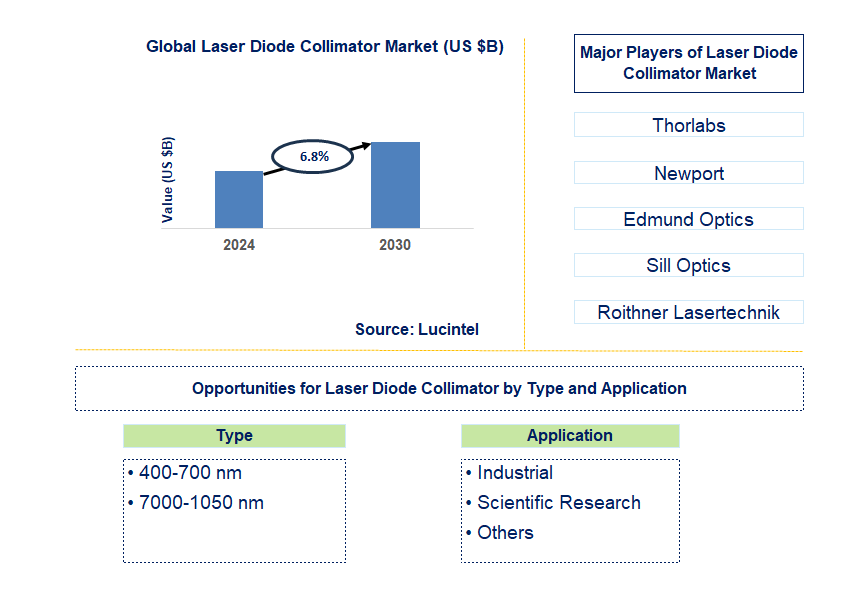
Key data points: The growth forecast = 6.8% annually for the next 6 years. Scroll below to get more insights. This market report covers trends, opportunities, and forecasts in the global laser diode collimator market to 2030 by type (400-700 nm and 7000-1050 nm), application (industrial, scientific research, and others), and region (North America, Europe, Asia Pacific, and the Rest of the World)
We'll send your sample report shortly.
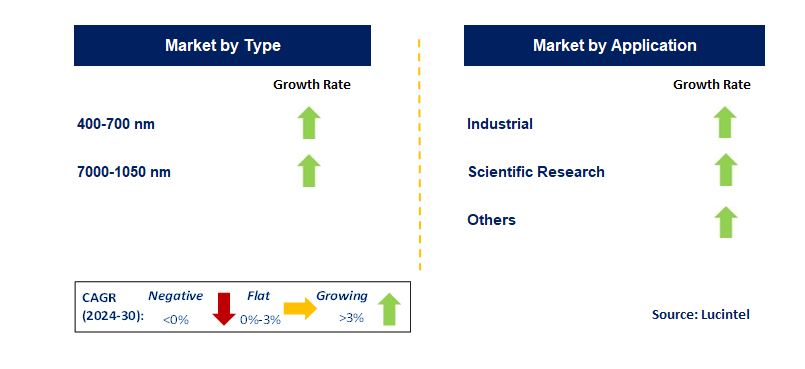
• Lucintel forecasts that, within the type category, 7000-1050 nm is expected to witness a higher growth over the forecast period due to increasing demand for infrared lasers in a variety of applications such as medical devices and military and defense applications.
• In terms of region, APAC is expected to witnessv the highest growth over the forecast period. Gain valuable insights for your business decisions with our comprehensive 150+ page report.
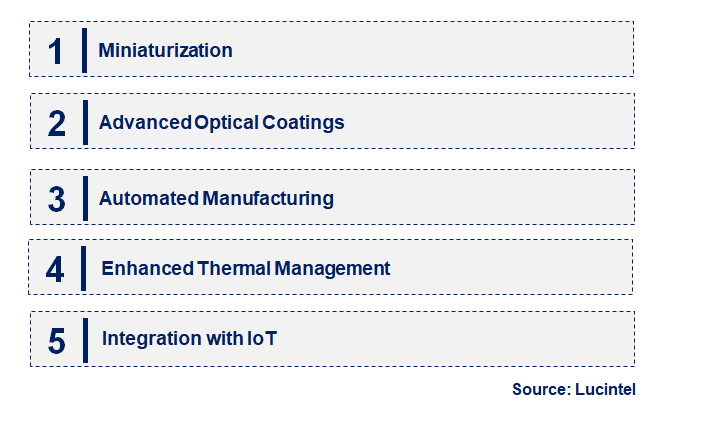
• Miniaturization: The trend of miniaturization continues to push for the construction of smaller collimators. This enables use in handheld devices as well as in all appliances, as the world requires lighter and smaller working devices.
• Advanced Optical Coatings: New coatings are increasing the efficiency and effectiveness of laser diode collimators. Beam quality improves with these new coatings, reducing losses and enhancing system performance in precision applications.
• Automated Manufacturing: As automated manufacturing processes gain acceptance in industries, costs are decreasing, and productivity is increasing. The consistency and quality of collimators have improved, allowing for the production of various customized applications more efficiently than before.
• Enhanced Thermal Management: Innovative thermal management technologies have been developed to address heat removal issues in high-power collimators. Improved thermal performance ensures the reliability and durability of these products in harsh conditions.
• Integration with IoT: Advances in collimator systems involve communication technologies, particularly integration with the Internet of Things (IoT). The presence of IoT connectivity in these collimators enables users to track and regulate operations as well as detect faults instantly. These trends include strategies that are redefining the landscape of the laser diode collimator market by improving performance, lowering costs, and increasing the scope of applications. The conquest of miniaturization, along with advancements in coatings, manufacturing, and connectivity, will unify the various market verticals.
• High-Precision Optical Designs: Recent high-precision optical designs are addressing issues of alignment and stability within the beam. These developments are important for beams with precise specifications required in telecommunications and aerospace applications.
• Use of Cheaper Raw Materials: Emerging raw material options are reducing the cost of laser diode collimators. This trend is increasing their applicability in more sectors, such as consumer electronics and industrial automation.
• Enhanced Heat Dissipation: Improved solutions for heat management are addressing heat removal problems concerning high-power collimators. These enhancements maintain performance and dependability under extreme working conditions.
• Use of Production Automation Methods: The use of production automation methods is optimizing the manufacturing process. Increased production units enhance uniformity in product quality, reduce costs, and improve overall quality.
• New Integration Features for Collimators: New integration features are allowing collimators to be incorporated into more complex systems. This trend supports the creation of multipurpose equipment and extends the areas of use. These developments drive changes in the Laser Diode Collimator market in terms of enhanced performance, lower costs, and wider applications. Improved design, better materials, and optimized manufacturing contribute to a more robust market.
• Telecommunications: With the growing need for quicker data transfer, there are more opportunities for development in the telecommunications sector. The design and functionality of collimators are improving optical communication systems.
• Medical Devices: The medical device market also provides an opportunity for the growth of collimators in imaging diagnostic devices. The growing adoption of precision and miniaturization is influencing the need for high-quality collimation systems.
• Industrial Automation: The growth of industrial automation is opening the market for effective and dependable collimators for use in machine vision systems and laser processing. Better performance, along with improved safety and durability, drives these factors.
• Consumer Electronics: The consumer electronics market is seeing increased use of miniaturized collimators in devices such as smartphones and cameras. Innovations in compact designs are meeting the demand for high-performance optics in portable devices.
• Defense and Aerospace: Advanced collimation systems are required by the defense and aerospace industries for operating targeting and surveillance systems, which demand high accuracy and efficiency. There are growth prospects related to the increasing need for high-performance and robust collimators. These growth opportunities are actively fueling the development and diversification of the Laser Diode Collimator market. Companies should exploit this emerging market potential by designing products that meet specific application needs.
• Technological Advancements: Developments in optical design and materials have enhanced collimator efficiency. Sophisticated technology offers improved beam quality and efficiency, creating market opportunities in many sectors.
• Growing Demand for Miniaturization: The miniaturization of devices has increased the demand for mini collimators. This is driven by the rise of portable and consumer electronic devices.
• Increased Industrial Automation: There are new prospects for laser diode collimators due to developments in industrial automation and machine vision applications. These applications require better performance and heat endurance.
• Expansion of Telecommunication Networks: The development of new high-speed telecommunication networks increases the need for advanced collimators. These collimators improve optical efficiency and enhance data transmission speed and reliability.
• Advancements in Manufacturing Technology: Recent technological advancements in manufacturing processes, particularly automation, have improved operational efficiency and reduced costs. This leads to more competitive prices and increased market coverage. Challenges in the laser diode collimator market are:
• Regulatory Compliance: For optical and electronic components, regulatory procedures can be difficult to implement. This is particularly problematic for manufacturers trying to comply with various standards set across different regions.
• Cost of Advanced Materials: The high costs associated with advanced materials and technological systems can pose a barrier to entry. Participants in the market face the challenge of balancing cost with performance and innovation.
• Competition and Market Saturation: Rising levels of competition and market saturation are driving price wars and constraining profitability. Companies must enhance the uniqueness of their products and the value offered to the market. All the drivers mentioned above are facilitating the enhancement and diversification of the Laser Diode Collimator market, while the challenges highlight the intensity of regulatory, cost, and competitive management that must be addressed. These factors will enhance market growth if managed effectively.
• Thorlabs
• Newport
• Edmund Optics
• Sill Optics
• Roithner Lasertechnik
• Schafter+Kirchhoff
• II-VI Incorporated
• 400-700 nm
• 7000-1050 nm
• Industrial
• Scientific Research
• Others
• North America
• Europe
• Asia Pacific
• The Rest of the World
• United States: In the U.S. market, high-quality collimators for telecommunication and aerospace applications, which require high precision, are being developed. These developments include new types of optical coatings and compact systems that provide beam stability and efficiency, enhancing the demand for efficient optical devices in the market.
• China: China aims to enhance its manufacturing capabilities through modern technology. This is largely due to advancements such as the introduction of assembly lines and new, cost-effective materials that reduce the cost of products for various industrial applications.
• Germany: In Germany, the enhancement of collimators with better thermal conductivity and lifespan has been achieved. Such advances are critical in eliminating quality loss in areas where technology faces challenges, such as in medical and scientific fields, which require high standards of consistency.
• India: Consumers have observed that there is a leader in the market investing in research and development of custom collimators relevant for emerging sectors like automotive and defense. These products are expected to meet local demand and support growth in high-tech markets.
• Japan: There is progress in Japan in delivering miniaturized collimators that will be utilized in electronic products and portable devices. The latest modifications are focused on designing collimators as part of mini-systems without compromising optical efficiency, in response to the need for smaller devices and efficient working systems.


• Thorlabs
• Newport
• Edmund Optics
• Sill Optics
• Roithner Lasertechnik
• Schafter+Kirchhoff
• II-VI Incorporated Q5. Which laser diode collimator market segment will be the largest in future? Answer: Lucintel forecasts that 7000-1050 nm is expected to witness higher growth over the forecast period due to increasing demand for infrared lasers in a variety of applications such as medical devices and military and defense applications. Q6. In laser diode collimator market, which region is expected to be the largest in next 5 years? Answer: APAC is expected to witness highest growth over the forecast period. Q.7 Do we receive customization in this report? Answer: Yes, Lucintel provides 10% customization without any additional cost.


Choose a license that fits your team. Instant PDF delivery.
Prices exclude taxes. Instant delivery. Custom licensing available on request.
Market Report · July 29, 2026
Market Report · July 20, 2026
Market Report · July 20, 2026
Trusted partner for strategic intelligence and business growth


Receive a complimentary market analysis tailored to your industry. Our analysts will identify key growth opportunities and competitive dynamics specific to your business.

Market size, growth rate, and key trend analysis for your specific sector.

Top competitor positioning and market share analysis.

Strategic recommendations backed by data-driven insights.
Get curated market intelligence and competitive moves straight to your inbox.
By subscribing, you agree to receive our monthly insights. Unsubscribe anytime.
Receive a complimentary market analysis tailored to your industry. Our analysts will identify key growth opportunities and competitive dynamics specific to your business.
Market size, growth rate, and key trend analysis for your specific sector.
Top competitor positioning and market share analysis.
Strategic recommendations backed by data-driven insights.
Get curated market intelligence, emerging trends, and competitive moves straight to your inbox each month.
By subscribing, you agree to receive our monthly insights. Unsubscribe anytime.
We'll send your sample report shortly.