
Close Lucintel Chat
Didn't Find What You're Looking for?
Call us at +1972 636 5056 or write at helpdesk@Lucintel.com
Ask an Expert Provide Custom Requirements Download Sample Report Search Available Reports
  • helpdesk@Lucintel.com
  • |
  • Call Lucintel +1 972 636 5056
  • |
  • Login
  • |
  • Register
  • |
  • Search
  • |
'
...

The Impact of COVID-19 is included in Laboratory Furniture Market Report. Buy it today to get an advantage.

Request the impact of COVID-19 on your product or industry


Laboratory Furniture Market Trends and Forecast

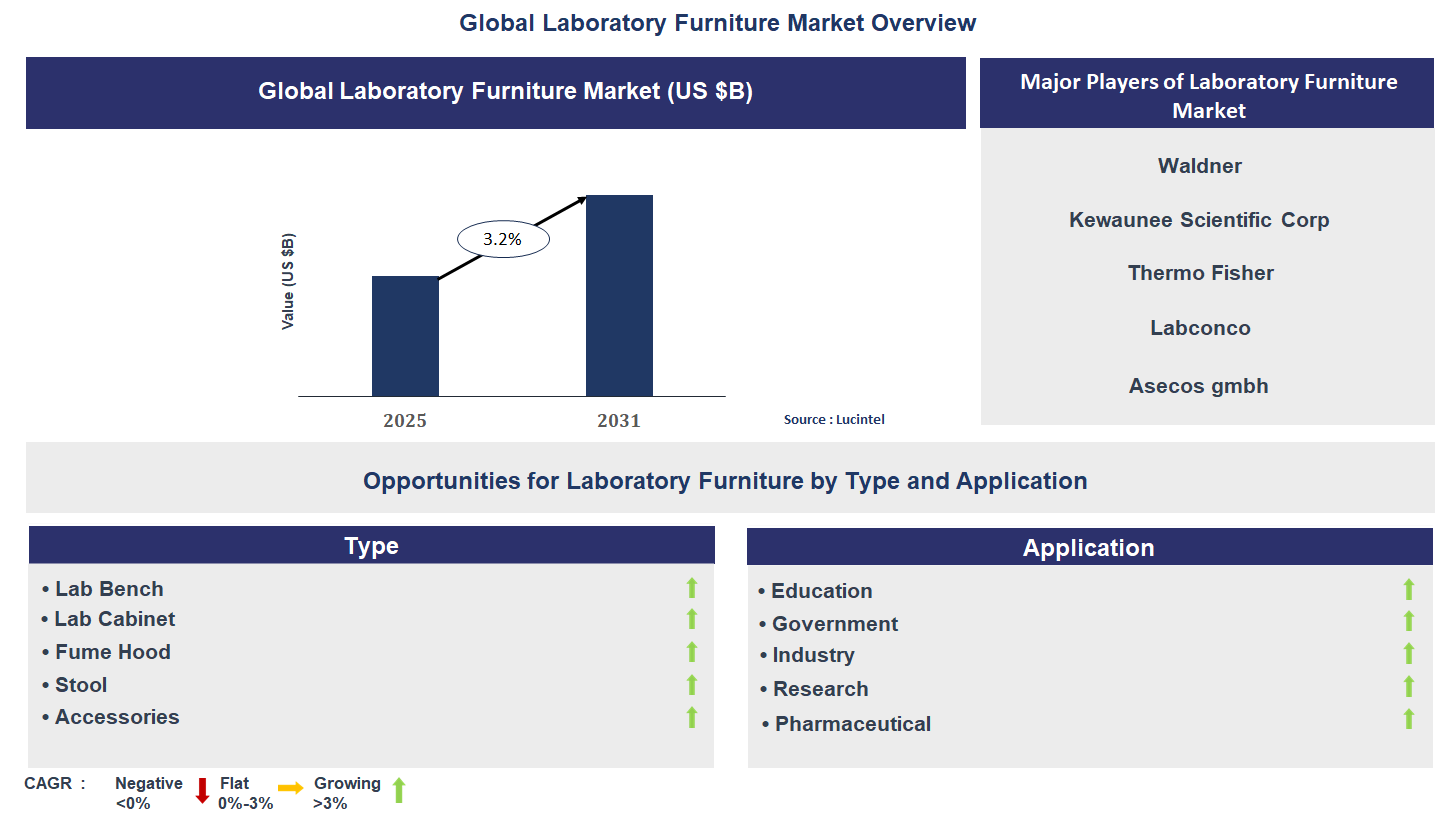
The future of the global laboratory furniture market looks promising with opportunities in the education, government, industry, research, and pharmaceutical markets. The global laboratory furniture market is expected to grow with a CAGR of 3.2% from 2025 to 2031. The major drivers for this market are the increasing need for advanced lab equipment, the rising focus on laboratory safety standards, and the growing demand for customizable workstations.

• Lucintel forecasts that, within the type category, fume hood is expected to witness the highest growth over the forecast period.
• Within the application category, pharmaceutical is expected to witness the highest growth.
• In terms of region, APAC is expected to witness the highest growth over the forecast period.
Gain valuable insights for your business decisions with our comprehensive 150+ page report. Sample figures with some insights are shown below.
Laboratory Furniture Market Trends and Forecast

Emerging Trends in the Laboratory Furniture Market

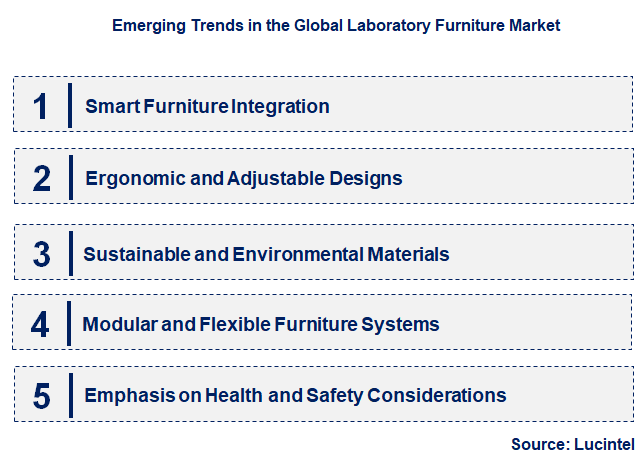
The laboratory furniture market is being influenced by various new trends that are a consequence of changing requirements for contemporary laboratories. These trends are influenced by technology, sustainability efforts, and the changing needs of those industries that use laboratory environments. The following are five major trends redefining the laboratory furniture landscape:
• Smart Furniture Integration: Smart lab furniture is one of the most rapidly expanding trends, with workstations and storage components having built-in technology. This encompasses in-built sensors to measure temperature, humidity, and chemical levels and touch-screen interfaces for improved control over laboratory operations. Demand is especially high in pharmaceutical and biotechnology sectors, where there is a need for precise control over the laboratory environment for reliable results and safety.
• Ergonomic and Adjustable Designs: Ergonomic laboratory furniture with better posture, comfort, and productivity is increasingly in demand. Sit-stand desks, adjustable workstations, and adjustable layouts enable personalized set-ups for individual users specific needs. Such a trend is crucial in the workplace where lab workers spend extended periods and need flexibility to support varying tasks and work streams.
• Sustainable and Environmental Materials: Sustainability remains high on the agenda within the laboratory furniture industry. Companies are adopting more and more eco-friendly components, including recycled steel, bamboo, and low-emission laminates, to minimize the environmental footprint of their products. Green certification systems, like LEED (Leadership in Energy and Environmental Design), are gaining wider use, guaranteeing laboratory furniture is both practical and environmentally friendly.
• Modular and Flexible Furniture Systems: Modular lab furniture systems are highly versatile and flexible, allowing labs to redesign their layouts as necessary. This is especially important in education and research settings, where lab layouts need to be altered constantly to keep up with new projects or increasing teams. Modular configurations can maximize space efficiency, enhance workflow, and facilitate easier expansion or modification of laboratory environments.
• Emphasis on Health and Safety Considerations: Health and safety continue to be uppermost in laboratory design, and manufacturers are meeting that by creating furniture that maximizes both. Examples include furniture that is inherently chemical-resistant, antimicrobial-coated, and designed to improve air quality and minimize contamination. Safety is extended even to easy-to-use, non-toxic materials and cleanable surfaces that eliminate the chance of accidents and guarantee a healthier work environment.
These trends show that the market for laboratory furniture is changing towards smarter, adjustable, green, and user-centric solutions. Growing technology integration, customization, and safety orientations are shaping the design and operations of laboratories. These trends will further influence the future of laboratory furniture to suit the demands of contemporary scientific research, education, and healthcare industries.
Emerging Trends in the Laboratory Furniture Market

Recent Development in the Laboratory Furniture Market

Recent trends in the laboratory furniture industry have been driven by technological innovation, heightened demand for customization, and a push towards sustainability. With industries like pharmaceuticals, biotechnology, and healthcare fast-growing, the demand for sophisticated laboratory furniture that can satisfy changing standards is higher than ever. Manufacturers are responding by adding new materials, improving ergonomics, and embedding technology into pieces of furniture. This change is remodeling laboratory spaces, enhancing them to be more efficient, safe, and sustainable.
• Technological Incorporation into Furniture Designs: Incorporation of intelligent technology into lab furniture is now a major trend. Sensor-integrated furniture that can monitor environmental conditions such as temperature, humidity, and chemical exposure has become increasingly popular. The trend supports more productive and precise experiments, especially in highly controlled settings such as pharmaceutical laboratories. Further, the technology helps labs optimize workflow and enhance safety by offering real-time information to researchers.
• Green Manufacturing and Materials: More and more manufacturers are placing a priority on sustainability in manufacturing. The application of environmentally friendly materials like recycled plastics, metals, and sustainably sourced wood products is on the increase. The companies are also concentrating on creating energy-efficient furniture as well as providing green-certified products. The concern for sustainability plays a key role in limiting the environmental impact of laboratory furniture and capitalizes on the need for environmentally friendly solutions in many industries.
• Customized Solutions for Specific Industries: One of the most important trends in laboratory furniture is increasing custom demand. Laboratories specializing in industries like pharmaceuticals, chemistry, and biotechnology need furniture customized to particular requirements. From chemical-resistant countertops to adjustable workstations for optimal ergonomic comfort, manufacturers are providing more customized designs. Customization enables laboratories to maximize space and functionality, enhancing productivity and safety and conforming to industry-specific standards.
• Emphasis on Ergonomics and Worker Comfort: As laboratory working conditions continue to intensify, ergonomics has emerged as a key consideration in laboratory furniture design. Desks that are adjustable, sit-stand workstations, and ergonomic chairs that minimize body strain are now common features. These ergonomic enhancements are intended to promote comfort and productivity, particularly in labs where employees work long hours on repetitive activities. This evolution is becoming ever more important to worker health.
• Modular Designs for Flexible Laboratory Setups: Modular laboratory furniture systems have been increasingly popular as labs look for more flexible solutions. Modular systems enable simple reconfiguration and expansion of laboratory facilities to meet evolving research demands or expanding teams. Modular designs also enable space optimization, particularly in compact or congested lab settings. Such flexibility is important for research laboratories, schools, and even hospitals that need dynamic configurations.
These recent trends point towards increased sustainability, flexibility, and high-technology applications in laboratory furniture. Companies are giving back to the industry with changing needs by providing adjustable, ergonomic, and environmentally friendly products that improve productivity, safety, and comfort. This transition is making laboratory furniture a very important part of optimizing laboratory operations in all sectors.

Strategic Growth Opportunities in the Laboratory Furniture Market

The laboratory furniture market is being transformed by increasing demand for increasingly innovative, efficient, and environmentally friendly solutions. A number of key uses are benefiting from growth due to advances in technology, stricter safety regulations, and greater emphasis on laboratory optimization. These uses include healthcare, research institutes, educational labs, and others. As the requirements of these industries change, manufacturers are responding by offering customized, modular, ergonomic, and sustainable laboratory furniture. The following are five strategic growth opportunities in major laboratory applications.
• Healthcare and Medical Laboratories: Healthcare and medical labs are quickly growing with increased demand for diagnostics, research, and medical treatments. As such facilities improve, there is a greater demand for laboratory furniture that complies with strict health and safety requirements. Adjustable, ergonomic designs, chemical-resistant finishes, and modular systems that can be easily reconfigured are becoming ever more necessary. These needs for bespoke furniture represent huge growth prospects for manufacturers to supply high-performance, eco-friendly solutions specific to healthcare laboratories specific needs.
• Educational and Research Institutions: Educational and research organizations offer a profitable growth opportunity in the laboratory furniture market. With the increasing number of science and technology research projects and educational programs, these organizations require laboratory furniture that is flexible, budget-friendly, and allows for teaching and research initiatives to be done effectively. Modular systems which may easily be reconfigured for alternate experiments, and student-friendly furniture with ergonomic support structures, are highly sought after. This offers manufacturers a chance to introduce flexible, long-lasting, and adaptable furniture options designed with academic settings in mind.
• Biotechnology and Pharmaceutical Research: The pharmaceutical and biotechnology sectors are witnessing rapid research and development efforts fueled by innovation in medicine and biotechnology. Laboratories in these industries need highly specialized and custom furniture, which is capable of complying with strict regulations and providing safety and efficiency. The increasing demand for modular laboratory systems that may be customized to suit various experiments and the need for chemical-resistant, solvent-resistant, and biohazardous material-resistant surfaces pose great opportunities for manufacturers to offer long-lasting, high-quality laboratory furniture solutions for this use.
• Industrial and Chemical Laboratories: As chemical, petrochemical, and manufacturing industries expand, the demand for industrial labs that have strong, chemically resistant furniture also increases. The laboratory furniture market for these industries has vast growth opportunities. Heavy-duty storage units, chemically resistant countertops, and strong, safe worktables that meet industrial regulations are in high demand. Manufacturers can capitalize on opportunities by providing specialized materials and designs capable of withstanding the extreme conditions of industrial labs so that they can be safer and more efficient in these challenging environments.
• Environmental and Testing Laboratories: Environmental and testing laboratories handling air quality, water purity, soil analysis, and other research fields need laboratory furniture capable of resisting a variety of environmental conditions. The need for chemical-resistant, ergonomically designed, and space-saving furniture in this use is increasing. Companies that can provide modular, customizable, and environmentally friendly furniture solutions that pass the tough tests of testing environments are in a great position to gain a substantial market share. The growing consciousness of environmental concerns will further lead to the demand for specialized furniture solutions that ensure sustainability.
The laboratory furniture industry is witnessing encouraging opportunities in various applications. With growth in industries such as healthcare, education, pharmaceuticals, and environmental science, the demand for tailored, flexible, and sustainable furniture is increasing. These opportunities enable manufacturers to innovate and meet the unique requirements of various laboratory settings, propelling the market toward higher level, efficient, and sustainable solutions.

Laboratory Furniture Market Driver and Challenges

The laboratory furniture industry is impacted by various drivers and challenges, including technological developments, economic factors, regulatory forces, and shifting user requirements. The companies are emphasizing the provision of furniture solutions that address the dynamic requirements of laboratories in different industries. Nevertheless, the drivers pose some issues that companies need to overcome in order to remain competitive. Understanding both the factors propelling market growth and the obstacles that must be overcome is critical for future success in this industry.
The factors responsible for driving the laboratory furniture market include:
1. Technological Advancements in Laboratory Operations: The incorporation of smart technology into lab furniture is one of the key market drivers. Furniture systems with sensors, automation storage, and data monitoring features are growing in significance. They enable labs to maximize efficiency, safety, and overall operations. As labs increasingly introduce more sophisticated technologies for research and data collection, the need for smart, flexible furniture will grow.
2. Greater Emphasis on Ergonomics and Employee Welfare: Greater concern for employee comfort and productivity is fueling the need for ergonomic lab furniture. Adjustable workstations with plenty of storage and support for good posture can enhance productivity and eliminate workplace injury potential. With greater concern being placed on employee welfare, the need for lab furniture that accommodates both physical and mental wellness is an important market driver.
3. Increased Demand for Customization and Flexibility: Laboratories are now seeking flexible furniture solutions that can be tailored to particular requirements. Whether it involves incorporating chemical-resistant materials, modular systems for easy reconfiguration, or furniture that can accommodate various kinds of research, flexibility is on the rise. Those manufacturers that are able to offer bespoke solutions are in a good position to gain market share as this is a trend being followed across laboratory sectors.
4. Regulatory Pressures and Safety Standards: With more stringent health and safety regulations being imposed in different industries, laboratory furniture is adapting to these compliance standards. Safety-enhancing furniture solutions like chemical-resistant surfaces, fire-resistant materials, and ergonomic designs minimizing the risk of accidents are fast becoming necessary. With industries being subjected to more stringent regulation, manufacturers will be required to provide products that align with changing safety and environmental requirements.
5. Enhanced Investment in Research and Development: The ongoing investment in R&D, particularly in industries like biotechnology, pharma, and healthcare, is one of the major drivers of demand for laboratory furniture. As research institutions and companies invest more in R&D, the demand for laboratory furniture facilitating such activities—e.g., adjustable workstations and research-oriented designs—will be on the rise. This will result in increased growth of the laboratory furniture market with more advanced laboratories being set up.
Challenges in the laboratory furniture market are:
1. Excessive Manufacturing Costs: The requirement for high-standard, custom, and eco-friendly laboratory furniture tends to be associated with increased production costs. Companies might find it difficult to balance the demand for superior materials and designs with affordability. Excessive manufacturing costs may impede growth in price-sensitive economies, restricting access for small and mid-scale laboratories that may not have the financial capacity to purchase high-end products. This is a challenge manufacturers must overcome by being creative and how they can lower the cost of production without sacrificing quality.
2. Supply Chain Disruptions: The lab furniture market, and indeed most markets, is subjected to supply chain interruptions stemming from the likes of raw material shortages, delays in transportation, and worldwide economic uncertainty. These will lead to longer lead times, higher manufacturing costs, and less capacity to keep up with demand on time. It is up to manufacturers to evolve to these risks by having more diversified supply chains, accessing alternative suppliers, and incorporating more resilience into the running of their businesses.
3. Competition from Low-Cost Manufacturers: Even as the need for high-quality, specialty laboratory furniture increases, competition from low-cost manufacturers, particularly in developing markets, is a major challenge. Such manufacturers tend to offer cheaper options, which may appeal to price-conscious buyers. This could potentially lead to price wars in the market, particularly in the case of commodity or simpler furniture solutions, where it becomes challenging for premium product manufacturers to maintain competitive advantage.
The laboratory furniture industry is influenced by a combination of robust drivers, including technology advancements, growing customization needs, and regulatory pressures, and challenges such as high production expenses and supply chain disruptions. Managing these challenges while capitalizing on the opportunities arising from technological and design innovations will be critical for manufacturers wishing to succeed in the challenging and developing market.

List of Laboratory Furniture Companies

Companies in the market compete on the basis of product quality offered. Major players in this market focus on expanding their manufacturing facilities, R&D investments, infrastructural development, and leverage integration opportunities across the value chain. With these strategies laboratory furniture companies cater increasing demand, ensure competitive effectiveness, develop innovative products & technologies, reduce production costs, and expand their customer base. Some of the laboratory furniture companies profiled in this report include-
• Waldner
• Kewaunee Scientific Corp
• Thermo Fisher
• Labconco
• Asecos gmbh
• Esco
• Diversified Woodcrafts
• NuAire
• Institutional Casework
• Mott Manufacturing

Laboratory Furniture Market by Segment

The study includes a forecast for the global laboratory furniture market by type, application, and region.

Laboratory Furniture Market by Type [Value from 2019 to 2031]:


• Lab Bench
• Lab Cabinet
• Fume Hood
• Stool
• Accessories

Laboratory Furniture Market by Application [Value from 2019 to 2031]:


• Education
• Government
• Industry
• Research
• Pharmaceutical

Laboratory Furniture Market by Region [Value from 2019 to 2031]:


• North America
• Europe
• Asia Pacific
• The Rest of the World

Country Wise Outlook for the Laboratory Furniture Market

The laboratory furniture industry has experienced tremendous growth and change in the recent past, fueled by technological innovation, regulatory requirements, and a growing need for environmentally friendly solutions. Major markets like the United States, China, Germany, India, and Japan have evolved towards personalized, ergonomic, and modular designs to address the unique requirements of laboratories. These nations have also witnessed an increase in investments in research and development, enhanced safety measures, and more emphasis on sustainability.
• United States: Laboratory furniture development in the U.S. has been driven by increasing needs for high-performance, modular workstations in research, healthcare, and educational environments. The emphasis has turned to ergonomic solutions that enhance comfort and productivity, in line with safety and environmental regulations. Material innovations, including antimicrobial surfaces and sustainable, recycled materials, have been becoming more popular. Tailored solutions are also becoming more common, as laboratory spaces look for furniture that addresses their particular research requirements, from chemically resistant countertops to adjustable workstations.
• China: Chinas laboratory furniture market is growing very fast thanks to the increasing focus of the country on scientific research, healthcare, and technological advancements. The Chinese governments rising investment in R&D, as well as opening more research institutes and laboratories, has resulted in a huge demand for laboratory furniture. Consequently, domestic producers are targeting production of affordable and flexible furniture solutions, using environmentally friendly materials to cater to sustainability trends.
• Germany: Germany is still at the forefront of the laboratory furniture market, typified by high-class, precision-engineered products. Germanys firm emphasis on sustainability and innovation has spurred the creation of energy-saving, recyclable lab furniture. German makers are famed for producing systems modular in design that provide additional flexibility and expandability, serving the pharmaceuticals, chemical, and biotech industries. The new trend of digitization in laboratories, whereby intelligent systems and automated systems are incorporated into the work environment, is impacting the design of contemporary laboratory furniture in the nation.
• India: Indias laboratory furniture sector is growing steadily, fueled by demand for research and development purposes in the pharmaceutical, biotechnology, and educational sectors. With the nations fast-growing scientific community, the need is for long-lasting, affordable, and customizable laboratory furniture. Increasingly, local producers manufacture laboratory furniture to international standards at reasonable prices. Increasing demand for laboratory furniture that is space-saving, versatile, and capable of resisting multiple chemicals arises, especially in new industries such as agriculture and healthcare.
• Japan: The Japanese laboratory furniture market is changing with a great focus on innovative, space-efficient designs and sustainability. The Japanese market is renowned for very functional and tasteful laboratory furniture with a high interest in customizable and ergonomic workstations. The manufacturers are incorporating advanced technology, including intelligent furniture with sensors and automated storage, to optimize laboratory operations. In addition, Japans dedication to lowering environmental footprints has prompted laboratory furniture manufacturers to use green materials and energy-efficient production processes.

Lucintel Analytics Dashboard

Features of the Global Laboratory Furniture Market

Market Size Estimates: Laboratory furniture market size estimation in terms of value ($B).
Trend and Forecast Analysis: Market trends (2019 to 2024) and forecast (2025 to 2031) by various segments and regions.
Segmentation Analysis: Laboratory furniture market size by type, application, and region in terms of value ($B).
Regional Analysis: Laboratory furniture market breakdown by North America, Europe, Asia Pacific, and Rest of the World.
Growth Opportunities: Analysis of growth opportunities in different type, application, and regions for the laboratory furniture market.
Strategic Analysis: This includes M&A, new product development, and competitive landscape of the laboratory furniture market.
Analysis of competitive intensity of the industry based on Porter’s Five Forces model.

Lucintel Consulting Services

FAQ

Q1. What is the growth forecast for laboratory furniture market?
Answer: The global laboratory furniture market is expected to grow with a CAGR of 3.2% from 2025 to 2031.
Q2. What are the major drivers influencing the growth of the laboratory furniture market?
Answer: The major drivers for this market are the increasing need for advanced lab equipment, the rising focus on laboratory safety standards, and the growing demand for customizable workstations.
Q3. What are the major segments for laboratory furniture market?
Answer: The future of the laboratory furniture market looks promising with opportunities in the education, government, industry, research, and pharmaceutical markets.
Q4. Who are the key laboratory furniture market companies?
Answer: Some of the key laboratory furniture companies are as follows:
• Waldner
• Kewaunee Scientific Corp
• Thermo Fisher
• Labconco
• Asecos gmbh
• Esco
• Diversified Woodcrafts
• NuAire
• Institutional Casework
• Mott Manufacturing
Q5. Which laboratory furniture market segment will be the largest in future?
Answer: Lucintel forecasts that, within the type category, fume hood is expected to witness the highest growth over the forecast period.
Q6. In laboratory furniture market, which region is expected to be the largest in next 5 years?
Answer: In terms of region, APAC is expected to witness the highest growth over the forecast period.
Q7. Do we receive customization in this report?
Answer: Yes, Lucintel provides 10% customization without any additional cost.

This report answers following 11 key questions:

Q.1. What are some of the most promising, high-growth opportunities for the laboratory furniture market by type (lab bench, lab cabinet, fume hood, stool, and accessories), application (education, government, industry, research, and pharmaceutical), and region (North America, Europe, Asia Pacific, and the Rest of the World)?
Q.2. Which segments will grow at a faster pace and why?
Q.3. Which region will grow at a faster pace and why?
Q.4. What are the key factors affecting market dynamics? What are the key challenges and business risks in this market?
Q.5. What are the business risks and competitive threats in this market?
Q.6. What are the emerging trends in this market and the reasons behind them?
Q.7. What are some of the changing demands of customers in the market?
Q.8. What are the new developments in the market? Which companies are leading these developments?
Q.9. Who are the major players in this market? What strategic initiatives are key players pursuing for business growth?
Q.10. What are some of the competing products in this market and how big of a threat do they pose for loss of market share by material or product substitution?
Q.11. What M&A activity has occurred in the last 5 years and what has its impact been on the industry?

For any questions related to Laboratory Furniture Market, Laboratory Furniture Market Size, Laboratory Furniture Market Growth, Laboratory Furniture Market Analysis, Laboratory Furniture Market Report, Laboratory Furniture Market Share, Laboratory Furniture Market Trends, Laboratory Furniture Market Forecast, Laboratory Furniture Companies, write Lucintel analyst at email: helpdesk@lucintel.com. We will be glad to get back to you soon.
                                           Table of Contents

            1. Executive Summary

            2. Market Overview

                        2.1 Background and Classifications
                        2.2 Supply Chain

            3. Market Trends & Forecast Analysis

                        3.1 Macroeconomic Trends and Forecasts
                        3.2 Industry Drivers and Challenges
                        3.3 PESTLE Analysis
                        3.4 Patent Analysis
                        3.5 Regulatory Environment
                        3.6 Global Laboratory Furniture Market Trends and Forecast Market Trends and Forecast

            4. Global Laboratory Furniture Market by Type

                        4.1 Overview
                        4.2 Attractiveness Analysis by Type
                        4.3 Lab Bench : Trends and Forecast 2025 to 2031
                        4.4 Lab Cabinet : Trends and Forecast 2025 to 2031
                        4.5 Fume Hood : Trends and Forecast 2025 to 2031
                        4.6 Stool : Trends and Forecast 2025 to 2031
                        4.7 Accessories : Trends and Forecast 2025 to 2031

            5. Global Laboratory Furniture Market by Application

                        5.1 Overview
                        5.2 Attractiveness Analysis by Application
                        5.3 Education : Trends and Forecast 2025 to 2031
                        5.4 Government : Trends and Forecast 2025 to 2031
                        5.5 Industry : Trends and Forecast 2025 to 2031
                        5.6 Research : Trends and Forecast 2025 to 2031
                        5.7 Pharmaceutical : Trends and Forecast 2025 to 2031

            6. Regional Analysis

                        6.1 Overview
                        6.2 Global Laboratory Furniture Market by Region

            7. North American Laboratory Furniture Market

                        7.1 Overview
                        7.2 North American Laboratory Furniture Market by Type
                        7.3 North American Laboratory Furniture Market by Application
                        7.4 The United States Laboratory Furniture Market
                        7.5 Canadian Laboratory Furniture Market
                        7.6 Mexican Laboratory Furniture Market

            8. European Laboratory Furniture Market

                        8.1 Overview
                        8.2 European Laboratory Furniture Market by Type
                        8.3 European Laboratory Furniture Market by Application
                        8.4 German Laboratory Furniture Market
                        8.5 French Laboratory Furniture Market
                        8.6 Italian Laboratory Furniture Market
                        8.7 Spanish Laboratory Furniture Market
                        8.8 The United Kingdom Laboratory Furniture Market

            9. APAC Laboratory Furniture Market

                        9.1 Overview
                        9.2 APAC Laboratory Furniture Market by Type
                        9.3 APAC Laboratory Furniture Market by Application
                        9.4 Chinese Laboratory Furniture Market
                        9.5 Indian Laboratory Furniture Market
                        9.6 Japanese Laboratory Furniture Market
                        9.7 South Korean Laboratory Furniture Market
                        9.8 Indonesian Laboratory Furniture Market

            10. ROW Laboratory Furniture Market

                        10.1 Overview
                        10.2 ROW Laboratory Furniture Market by Type
                        10.3 ROW Laboratory Furniture Market by Application
                        10.4 Middle Eastern Laboratory Furniture Market
                        10.5 South American Laboratory Furniture Market
                        10.6 African Laboratory Furniture Market

            11. Competitor Analysis

                        11.1 Product Portfolio Analysis
                        11.2 Operational Integration
                        11.3 Porter’s Five Forces Analysis
                                    • Competitive Rivalry
                                    • Bargaining Power of Buyers
                                    • Bargaining Power of Suppliers
                                    • Threat of Substitutes
                                    • Threat of New Entrants
                        11.4 Market Share Analysis

            12. Opportunities & Strategic Analysis

                        12.1 Value Chain Analysis
                        12.2 Growth Opportunity Analysis
                                    12.2.1 Growth Opportunity by Type
                                    12.2.2 Growth Opportunity by Application
                        12.3 Emerging Trends in the Global Laboratory Furniture Market
                        12.4 Strategic Analysis
                                    12.4.1 New Product Development
                                    12.4.2 Certification and Licensing
                                    12.4.3 Mergers, Acquisitions, Agreements, Collaborations, and Joint Ventures

            13. Company Profiles of the Leading Players Across the Value Chain

                        13.1 Competitive Analysis Overview
                        13.2 Waldner
                                    • Company Overview
                                    • Laboratory Furniture Market Business Overview
                                    • New Product Development
                                    • Merger, Acquisition, and Collaboration
                                    • Certification and Licensing
                        13.3 Kewaunee Scientific Corp
                                    • Company Overview
                                    • Laboratory Furniture Market Business Overview
                                    • New Product Development
                                    • Merger, Acquisition, and Collaboration
                                    • Certification and Licensing
                        13.4 Thermo Fisher
                                    • Company Overview
                                    • Laboratory Furniture Market Business Overview
                                    • New Product Development
                                    • Merger, Acquisition, and Collaboration
                                    • Certification and Licensing
                        13.5 Labconco
                                    • Company Overview
                                    • Laboratory Furniture Market Business Overview
                                    • New Product Development
                                    • Merger, Acquisition, and Collaboration
                                    • Certification and Licensing
                        13.6 Asecos gmbh
                                    • Company Overview
                                    • Laboratory Furniture Market Business Overview
                                    • New Product Development
                                    • Merger, Acquisition, and Collaboration
                                    • Certification and Licensing
                        13.7 Esco
                                    • Company Overview
                                    • Laboratory Furniture Market Business Overview
                                    • New Product Development
                                    • Merger, Acquisition, and Collaboration
                                    • Certification and Licensing
                        13.8 Diversified Woodcrafts
                                    • Company Overview
                                    • Laboratory Furniture Market Business Overview
                                    • New Product Development
                                    • Merger, Acquisition, and Collaboration
                                    • Certification and Licensing
                        13.9 NuAire
                                    • Company Overview
                                    • Laboratory Furniture Market Business Overview
                                    • New Product Development
                                    • Merger, Acquisition, and Collaboration
                                    • Certification and Licensing
                        13.10 Institutional Casework
                                    • Company Overview
                                    • Laboratory Furniture Market Business Overview
                                    • New Product Development
                                    • Merger, Acquisition, and Collaboration
                                    • Certification and Licensing
                        13.11 Mott Manufacturing
                                    • Company Overview
                                    • Laboratory Furniture Market Business Overview
                                    • New Product Development
                                    • Merger, Acquisition, and Collaboration
                                    • Certification and Licensing

            14. Appendix

                        14.1 List of Figures
                        14.2 List of Tables
                        14.3 Research Methodology
                        14.4 Disclaimer
                        14.5 Copyright
                        14.6 Abbreviations and Technical Units
                        14.7 About Us
                        14.8 Contact Us

                                               List of Figures


            Chapter 1

                        Figure 1.1: Trends and Forecast for the Global Laboratory Furniture Market

            Chapter 2

                        Figure 2.1: Usage of Laboratory Furniture Market
                        Figure 2.2: Classification of the Global Laboratory Furniture Market
                        Figure 2.3: Supply Chain of the Global Laboratory Furniture Market

            Chapter 3

                        Figure 3.1: Trends of the Global GDP Growth Rate
                        Figure 3.2: Trends of the Global Population Growth Rate
                        Figure 3.3: Trends of the Global Inflation Rate
                        Figure 3.4: Trends of the Global Unemployment Rate
                        Figure 3.5: Trends of the Regional GDP Growth Rate
                        Figure 3.6: Trends of the Regional Population Growth Rate
                        Figure 3.7: Trends of the Regional Inflation Rate
                        Figure 3.8: Trends of the Regional Unemployment Rate
                        Figure 3.9: Trends of Regional Per Capita Income
                        Figure 3.10: Forecast for the Global GDP Growth Rate
                        Figure 3.11: Forecast for the Global Population Growth Rate
                        Figure 3.12: Forecast for the Global Inflation Rate
                        Figure 3.13: Forecast for the Global Unemployment Rate
                        Figure 3.14: Forecast for the Regional GDP Growth Rate
                        Figure 3.15: Forecast for the Regional Population Growth Rate
                        Figure 3.16: Forecast for the Regional Inflation Rate
                        Figure 3.17: Forecast for the Regional Unemployment Rate
                        Figure 3.18: Forecast for Regional Per Capita Income
                        Figure 3.19: Driver and Challenges of the Laboratory Furniture Market

            Chapter 4

                        Figure 4.1: Global Laboratory Furniture Market by Type in 2019, 2024, and 2031
                        Figure 4.2: Trends of the Global Laboratory Furniture Market ($B) by Type
                        Figure 4.3: Forecast for the Global Laboratory Furniture Market ($B) by Type
                        Figure 4.4: Trends and Forecast for Lab Bench in the Global Laboratory Furniture Market (2019-2031)
                        Figure 4.5: Trends and Forecast for Lab Cabinet in the Global Laboratory Furniture Market (2019-2031)
                        Figure 4.6: Trends and Forecast for Fume Hood in the Global Laboratory Furniture Market (2019-2031)
                        Figure 4.7: Trends and Forecast for Stool in the Global Laboratory Furniture Market (2019-2031)
                        Figure 4.8: Trends and Forecast for Accessories in the Global Laboratory Furniture Market (2019-2031)

            Chapter 5

                        Figure 5.1: Global Laboratory Furniture Market by Application in 2019, 2024, and 2031
                        Figure 5.2: Trends of the Global Laboratory Furniture Market ($B) by Application
                        Figure 5.3: Forecast for the Global Laboratory Furniture Market ($B) by Application
                        Figure 5.4: Trends and Forecast for Education in the Global Laboratory Furniture Market (2019-2031)
                        Figure 5.5: Trends and Forecast for Government in the Global Laboratory Furniture Market (2019-2031)
                        Figure 5.6: Trends and Forecast for Industry in the Global Laboratory Furniture Market (2019-2031)
                        Figure 5.7: Trends and Forecast for Research in the Global Laboratory Furniture Market (2019-2031)
                        Figure 5.8: Trends and Forecast for Pharmaceutical in the Global Laboratory Furniture Market (2019-2031)

            Chapter 6

                        Figure 6.1: Trends of the Global Laboratory Furniture Market ($B) by Region (2019-2024)
                        Figure 6.2: Forecast for the Global Laboratory Furniture Market ($B) by Region (2025-2031)

            Chapter 7

                        Figure 7.1: Trends and Forecast for the North American Laboratory Furniture Market (2019-2031)
                        Figure 7.2: North American Laboratory Furniture Market by Type in 2019, 2024, and 2031
                        Figure 7.3: Trends of the North American Laboratory Furniture Market ($B) by Type (2019-2024)
                        Figure 7.4: Forecast for the North American Laboratory Furniture Market ($B) by Type (2025-2031)
                        Figure 7.5: North American Laboratory Furniture Market by Application in 2019, 2024, and 2031
                        Figure 7.6: Trends of the North American Laboratory Furniture Market ($B) by Application (2019-2024)
                        Figure 7.7: Forecast for the North American Laboratory Furniture Market ($B) by Application (2025-2031)
                        Figure 7.8: Trends and Forecast for the United States Laboratory Furniture Market ($B) (2019-2031)
                        Figure 7.9: Trends and Forecast for the Mexican Laboratory Furniture Market ($B) (2019-2031)
                        Figure 7.10: Trends and Forecast for the Canadian Laboratory Furniture Market ($B) (2019-2031)

            Chapter 8

                        Figure 8.1: Trends and Forecast for the European Laboratory Furniture Market (2019-2031)
                        Figure 8.2: European Laboratory Furniture Market by Type in 2019, 2024, and 2031
                        Figure 8.3: Trends of the European Laboratory Furniture Market ($B) by Type (2019-2024)
                        Figure 8.4: Forecast for the European Laboratory Furniture Market ($B) by Type (2025-2031)
                        Figure 8.5: European Laboratory Furniture Market by Application in 2019, 2024, and 2031
                        Figure 8.6: Trends of the European Laboratory Furniture Market ($B) by Application (2019-2024)
                        Figure 8.7: Forecast for the European Laboratory Furniture Market ($B) by Application (2025-2031)
                        Figure 8.8: Trends and Forecast for the German Laboratory Furniture Market ($B) (2019-2031)
                        Figure 8.9: Trends and Forecast for the French Laboratory Furniture Market ($B) (2019-2031)
                        Figure 8.10: Trends and Forecast for the Spanish Laboratory Furniture Market ($B) (2019-2031)
                        Figure 8.11: Trends and Forecast for the Italian Laboratory Furniture Market ($B) (2019-2031)
                        Figure 8.12: Trends and Forecast for the United Kingdom Laboratory Furniture Market ($B) (2019-2031)

            Chapter 9

                        Figure 9.1: Trends and Forecast for the APAC Laboratory Furniture Market (2019-2031)
                        Figure 9.2: APAC Laboratory Furniture Market by Type in 2019, 2024, and 2031
                        Figure 9.3: Trends of the APAC Laboratory Furniture Market ($B) by Type (2019-2024)
                        Figure 9.4: Forecast for the APAC Laboratory Furniture Market ($B) by Type (2025-2031)
                        Figure 9.5: APAC Laboratory Furniture Market by Application in 2019, 2024, and 2031
                        Figure 9.6: Trends of the APAC Laboratory Furniture Market ($B) by Application (2019-2024)
                        Figure 9.7: Forecast for the APAC Laboratory Furniture Market ($B) by Application (2025-2031)
                        Figure 9.8: Trends and Forecast for the Japanese Laboratory Furniture Market ($B) (2019-2031)
                        Figure 9.9: Trends and Forecast for the Indian Laboratory Furniture Market ($B) (2019-2031)
                        Figure 9.10: Trends and Forecast for the Chinese Laboratory Furniture Market ($B) (2019-2031)
                        Figure 9.11: Trends and Forecast for the South Korean Laboratory Furniture Market ($B) (2019-2031)
                        Figure 9.12: Trends and Forecast for the Indonesian Laboratory Furniture Market ($B) (2019-2031)

            Chapter 10

                        Figure 10.1: Trends and Forecast for the ROW Laboratory Furniture Market (2019-2031)
                        Figure 10.2: ROW Laboratory Furniture Market by Type in 2019, 2024, and 2031
                        Figure 10.3: Trends of the ROW Laboratory Furniture Market ($B) by Type (2019-2024)
                        Figure 10.4: Forecast for the ROW Laboratory Furniture Market ($B) by Type (2025-2031)
                        Figure 10.5: ROW Laboratory Furniture Market by Application in 2019, 2024, and 2031
                        Figure 10.6: Trends of the ROW Laboratory Furniture Market ($B) by Application (2019-2024)
                        Figure 10.7: Forecast for the ROW Laboratory Furniture Market ($B) by Application (2025-2031)
                        Figure 10.8: Trends and Forecast for the Middle Eastern Laboratory Furniture Market ($B) (2019-2031)
                        Figure 10.9: Trends and Forecast for the South American Laboratory Furniture Market ($B) (2019-2031)
                        Figure 10.10: Trends and Forecast for the African Laboratory Furniture Market ($B) (2019-2031)

            Chapter 11

                        Figure 11.1: Porter’s Five Forces Analysis of the Global Laboratory Furniture Market
                        Figure 11.2: Market Share (%) of Top Players in the Global Laboratory Furniture Market (2024)

            Chapter 12

                        Figure 12.1: Growth Opportunities for the Global Laboratory Furniture Market by Type
                        Figure 12.2: Growth Opportunities for the Global Laboratory Furniture Market by Application
                        Figure 12.3: Growth Opportunities for the Global Laboratory Furniture Market by Region
                        Figure 12.4: Emerging Trends in the Global Laboratory Furniture Market

                                               List of Tables


            Chapter 1

                        Table 1.1: Growth Rate (%, 2023-2024) and CAGR (%, 2025-2031) of the Laboratory Furniture Market by Type and Application
                        Table 1.2: Attractiveness Analysis for the Laboratory Furniture Market by Region
                        Table 1.3: Global Laboratory Furniture Market Parameters and Attributes

            Chapter 3

                        Table 3.1: Trends of the Global Laboratory Furniture Market (2019-2024)
                        Table 3.2: Forecast for the Global Laboratory Furniture Market (2025-2031)

            Chapter 4

                        Table 4.1: Attractiveness Analysis for the Global Laboratory Furniture Market by Type
                        Table 4.2: Market Size and CAGR of Various Type in the Global Laboratory Furniture Market (2019-2024)
                        Table 4.3: Market Size and CAGR of Various Type in the Global Laboratory Furniture Market (2025-2031)
                        Table 4.4: Trends of Lab Bench in the Global Laboratory Furniture Market (2019-2024)
                        Table 4.5: Forecast for Lab Bench in the Global Laboratory Furniture Market (2025-2031)
                        Table 4.6: Trends of Lab Cabinet in the Global Laboratory Furniture Market (2019-2024)
                        Table 4.7: Forecast for Lab Cabinet in the Global Laboratory Furniture Market (2025-2031)
                        Table 4.8: Trends of Fume Hood in the Global Laboratory Furniture Market (2019-2024)
                        Table 4.9: Forecast for Fume Hood in the Global Laboratory Furniture Market (2025-2031)
                        Table 4.10: Trends of Stool in the Global Laboratory Furniture Market (2019-2024)
                        Table 4.11: Forecast for Stool in the Global Laboratory Furniture Market (2025-2031)
                        Table 4.12: Trends of Accessories in the Global Laboratory Furniture Market (2019-2024)
                        Table 4.13: Forecast for Accessories in the Global Laboratory Furniture Market (2025-2031)

            Chapter 5

                        Table 5.1: Attractiveness Analysis for the Global Laboratory Furniture Market by Application
                        Table 5.2: Market Size and CAGR of Various Application in the Global Laboratory Furniture Market (2019-2024)
                        Table 5.3: Market Size and CAGR of Various Application in the Global Laboratory Furniture Market (2025-2031)
                        Table 5.4: Trends of Education in the Global Laboratory Furniture Market (2019-2024)
                        Table 5.5: Forecast for Education in the Global Laboratory Furniture Market (2025-2031)
                        Table 5.6: Trends of Government in the Global Laboratory Furniture Market (2019-2024)
                        Table 5.7: Forecast for Government in the Global Laboratory Furniture Market (2025-2031)
                        Table 5.8: Trends of Industry in the Global Laboratory Furniture Market (2019-2024)
                        Table 5.9: Forecast for Industry in the Global Laboratory Furniture Market (2025-2031)
                        Table 5.10: Trends of Research in the Global Laboratory Furniture Market (2019-2024)
                        Table 5.11: Forecast for Research in the Global Laboratory Furniture Market (2025-2031)
                        Table 5.12: Trends of Pharmaceutical in the Global Laboratory Furniture Market (2019-2024)
                        Table 5.13: Forecast for Pharmaceutical in the Global Laboratory Furniture Market (2025-2031)

            Chapter 6

                        Table 6.1: Market Size and CAGR of Various Regions in the Global Laboratory Furniture Market (2019-2024)
                        Table 6.2: Market Size and CAGR of Various Regions in the Global Laboratory Furniture Market (2025-2031)

            Chapter 7

                        Table 7.1: Trends of the North American Laboratory Furniture Market (2019-2024)
                        Table 7.2: Forecast for the North American Laboratory Furniture Market (2025-2031)
                        Table 7.3: Market Size and CAGR of Various Type in the North American Laboratory Furniture Market (2019-2024)
                        Table 7.4: Market Size and CAGR of Various Type in the North American Laboratory Furniture Market (2025-2031)
                        Table 7.5: Market Size and CAGR of Various Application in the North American Laboratory Furniture Market (2019-2024)
                        Table 7.6: Market Size and CAGR of Various Application in the North American Laboratory Furniture Market (2025-2031)
                        Table 7.7: Trends and Forecast for the United States Laboratory Furniture Market (2019-2031)
                        Table 7.8: Trends and Forecast for the Mexican Laboratory Furniture Market (2019-2031)
                        Table 7.9: Trends and Forecast for the Canadian Laboratory Furniture Market (2019-2031)

            Chapter 8

                        Table 8.1: Trends of the European Laboratory Furniture Market (2019-2024)
                        Table 8.2: Forecast for the European Laboratory Furniture Market (2025-2031)
                        Table 8.3: Market Size and CAGR of Various Type in the European Laboratory Furniture Market (2019-2024)
                        Table 8.4: Market Size and CAGR of Various Type in the European Laboratory Furniture Market (2025-2031)
                        Table 8.5: Market Size and CAGR of Various Application in the European Laboratory Furniture Market (2019-2024)
                        Table 8.6: Market Size and CAGR of Various Application in the European Laboratory Furniture Market (2025-2031)
                        Table 8.7: Trends and Forecast for the German Laboratory Furniture Market (2019-2031)
                        Table 8.8: Trends and Forecast for the French Laboratory Furniture Market (2019-2031)
                        Table 8.9: Trends and Forecast for the Spanish Laboratory Furniture Market (2019-2031)
                        Table 8.10: Trends and Forecast for the Italian Laboratory Furniture Market (2019-2031)
                        Table 8.11: Trends and Forecast for the United Kingdom Laboratory Furniture Market (2019-2031)

            Chapter 9

                        Table 9.1: Trends of the APAC Laboratory Furniture Market (2019-2024)
                        Table 9.2: Forecast for the APAC Laboratory Furniture Market (2025-2031)
                        Table 9.3: Market Size and CAGR of Various Type in the APAC Laboratory Furniture Market (2019-2024)
                        Table 9.4: Market Size and CAGR of Various Type in the APAC Laboratory Furniture Market (2025-2031)
                        Table 9.5: Market Size and CAGR of Various Application in the APAC Laboratory Furniture Market (2019-2024)
                        Table 9.6: Market Size and CAGR of Various Application in the APAC Laboratory Furniture Market (2025-2031)
                        Table 9.7: Trends and Forecast for the Japanese Laboratory Furniture Market (2019-2031)
                        Table 9.8: Trends and Forecast for the Indian Laboratory Furniture Market (2019-2031)
                        Table 9.9: Trends and Forecast for the Chinese Laboratory Furniture Market (2019-2031)
                        Table 9.10: Trends and Forecast for the South Korean Laboratory Furniture Market (2019-2031)
                        Table 9.11: Trends and Forecast for the Indonesian Laboratory Furniture Market (2019-2031)

            Chapter 10

                        Table 10.1: Trends of the ROW Laboratory Furniture Market (2019-2024)
                        Table 10.2: Forecast for the ROW Laboratory Furniture Market (2025-2031)
                        Table 10.3: Market Size and CAGR of Various Type in the ROW Laboratory Furniture Market (2019-2024)
                        Table 10.4: Market Size and CAGR of Various Type in the ROW Laboratory Furniture Market (2025-2031)
                        Table 10.5: Market Size and CAGR of Various Application in the ROW Laboratory Furniture Market (2019-2024)
                        Table 10.6: Market Size and CAGR of Various Application in the ROW Laboratory Furniture Market (2025-2031)
                        Table 10.7: Trends and Forecast for the Middle Eastern Laboratory Furniture Market (2019-2031)
                        Table 10.8: Trends and Forecast for the South American Laboratory Furniture Market (2019-2031)
                        Table 10.9: Trends and Forecast for the African Laboratory Furniture Market (2019-2031)

            Chapter 11

                        Table 11.1: Product Mapping of Laboratory Furniture Suppliers Based on Segments
                        Table 11.2: Operational Integration of Laboratory Furniture Manufacturers
                        Table 11.3: Rankings of Suppliers Based on Laboratory Furniture Revenue

            Chapter 12

                        Table 12.1: New Product Launches by Major Laboratory Furniture Producers (2019-2024)
                        Table 12.2: Certification Acquired by Major Competitor in the Global Laboratory Furniture Market

.

Buy full report or by chapter as follows

Limited Time Offer

Price by License Type:
[-] Hide Chapter Details
[Chapter Number] [Chapter Name] [Chapter Number Of Pages] [Chapter Price]
Title/Chapter Name Pages Price
Full Report: Laboratory Furniture Market Report: Trends, Forecast and Competitive Analysis to 2031 Full Report $ 2,990
A 150 Page Report
Lucintel has been in the business of market research and management consulting since 2000 and has published over 1000 market intelligence reports in various markets / applications and served over 1,000 clients worldwide. This study is a culmination of four months of full-time effort performed by Lucintel's analyst team. The analysts used the following sources for the creation and completion of this valuable report:
  • In-depth interviews of the major players in this market
  • Detailed secondary research from competitors’ financial statements and published data 
  • Extensive searches of published works, market, and database information pertaining to industry news, company press releases, and customer intentions
  • A compilation of the experiences, judgments, and insights of Lucintel’s professionals, who have analyzed and tracked this market over the years.
Extensive research and interviews are conducted across the supply chain of this market to estimate market share, market size, trends, drivers, challenges, and forecasts. Below is a brief summary of the primary interviews that were conducted by job function for this report.
 
Thus, Lucintel compiles vast amounts of data from numerous sources, validates the integrity of that data, and performs a comprehensive analysis. Lucintel then organizes the data, its findings, and insights into a concise report designed to support the strategic decision-making process. The figure below is a graphical representation of Lucintel’s research process. 
 

Please sign in below to get report brochure - Laboratory Furniture Market Report.

At Lucintel, we respect your privacy and maintain the confidentiality of information / data provided by you
(Please enter your corporate email. * These fields are mandatory )

Follow us on