
Market Report · July 17, 2026

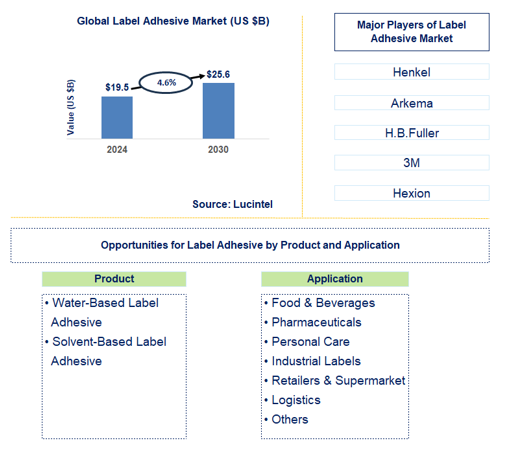
Key data points: The market size in 2030 = $25.6 billion, growth forecast = 4.6% annually for the next 6 years. Scroll below to get more insights. This market report covers trends, opportunities, and forecasts in the global label adhesive market to 2030 by product (water-based label adhesive and solvent-based label adhesive), application (food & beverages, pharmaceuticals, personal care, industrial labels, retailers & supermarket, logistics, and others), and region (North America, Europe, Asia Pacific, and the Rest of the World)
We'll send your sample report shortly.
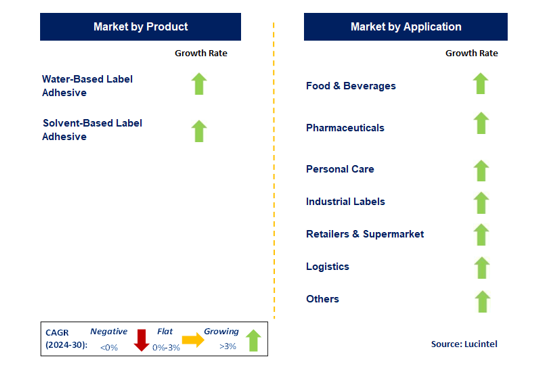
• Lucintel forecasts that, within the product category, water-based label adhesives is expected to witness a higher growth over the forecast period due to the strong resistance to a broad variety of temperatures.
• APAC is expected to witness the highest growth over the forecast period due to the rapid growth of the consumer and packaging sectors, as well as the growth of disposable income and consumption of packaged goods. Gain valuable insights for your business decisions with our comprehensive 150+ page report.
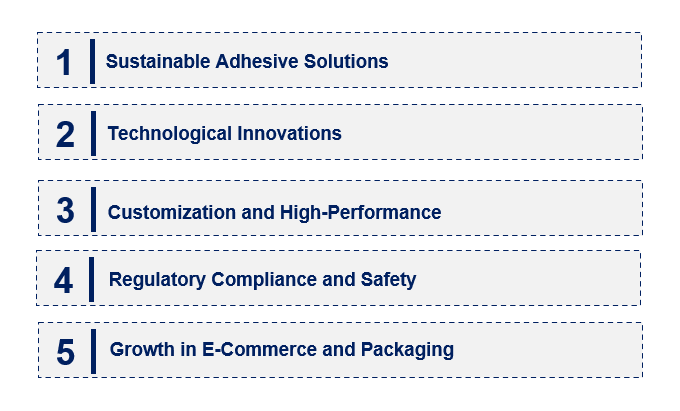
• Sustainable Adhesive Solutions: The increase in green label adhesives, which can be easily recycled or manufactured from renewable resources, is a clear indication of the growing demand for eco-friendly products. This trend is driven by increased environmental awareness and regulatory pressures. Companies are creating adhesives that reduce waste and enhance recyclability to align with global sustainability goals.
• Technological Innovations: Improvements in adhesive technologies have led to better performance and functionality. Some of these innovations include pressure-sensitive adhesives with stronger bonding capabilities and special adhesives designed for use under extreme conditions. These advances make it possible to use labels more flexibly, thereby increasing efficiency throughout labeling procedures across industries.
• Customization and High-Performance Requirements: There is a need for tailor-made label adhesives that meet specific requirements, such as resistance to extreme temperatures or exposure to chemicals. This trend is driven by the varying needs within sectors like pharmaceuticals and food packaging, among others. Companies are investing in custom-made solutions to address these high-performance criteria.
• Regulatory Compliance and Safety: The label adhesive market is affected by increasingly complex regulations regarding product safety, environmental pollution, and other concerns. In addition, all companies must ensure that their adhesives meet strict regulatory standards concerning safety and environmental protection. Consequently, this leads to developments in adhesive formulations and production processes aimed at ensuring compliance with changing regulations.
• Growth in E-Commerce and Packaging: With the rapid expansion of e-commerce, there is an increased demand for durable label adhesives that can adhere to various packaging materials. This means special labels must be made to stick well on surfaces even during long-distance transport via different transport systems, such as airways or waterways. This demand has pushed manufacturers to produce high-quality adhesives. These trends are redefining the market by focusing on sustainability, innovation, and customization, which will help drive growth and shape the future of the industry.
• Progress in Eco-Friendly Adhesives: As companies increase their production of adhesives made from renewable materials and recyclable components, there is growing awareness of the ecological consequences of consumerism. These improvements have ensured that global sustainability goals are met.
• Enhanced Technological Development: Innovations in adhesive technology, such as improved pressure-sensitive adhesives and novel curing techniques, have led to increased effectiveness and interchangeability. New developments now allow for various applications, such as those used in high temperatures and on challenging substrates.
• Explosion of Industrial Uses: The industrial sector is driving growth in the market for label adhesives used in cars, electronics, and logistics. More durable, highly functional adhesives are required as the adhesive market expands. Manufacturers are focusing on compliant adhesive formulations for specific industries.
• Improved Regulation Adherence: Regulations concerning safety and the environmental impact of adhesives are becoming more stringent, thereby affecting adhesive manufacturing and composition. With evolving standards, companies are investing in technologies and processes to remain compliant. This leads to innovation, higher costs, and increased product credibility.
• Emerging Market Opportunities: The demand for labeling adhesives in emerging markets, especially in the Asia Pacific region, has grown rapidly due to the expansion of both industrial and consumer sectors. In response to this growing market segment, firms have increased their production capacities while focusing on cost-effective solutions, thus boosting overall industry growth. These developments impact technological advancements and sustainability in emerging regions, resulting in new dynamics and opportunities within the label adhesive market.
• Pharmaceutical Packaging: The demand for secure, high-quality tamper-evident labels in pharmaceutical packaging is increasing. There are significant growth opportunities for label adhesives that satisfy stringent safety and regulatory requirements. By creating advanced adhesives that improve product integrity and compliance, companies can exploit this demand.
• Food and Beverage Labeling: Adhesives used in the food and beverage industries must have the ability to withstand varying temperatures and moisture levels. Some potential areas of growth include the development of adhesive formulations that ensure long shelf life for labels while adhering to global food safety regulations. Innovations within this sphere may be tailor-made to suit specific packaging needs in this industry segment.
• E-Commerce Packaging: The advent of e-commerce has led to the need for durable, versatile label adhesives capable of sticking to various packaging materials during transportation and handling. Opportunities exist in creating e-commerce application-specific, highly adhesive products with durability.
• Cosmetics and Personal Care: Superior aesthetic appeal, beauty, and functionality characterize the high-quality cosmetic labels demanded by the cosmetics industry today. Thus, producers should focus on developing adhesives for products that exhibit the best printing and design capabilities and adhere properly to numerous types of cosmetic containers.
• Industrial and Automotive Applications: There is an increased demand for high-performance adhesives in the industrial and automotive sectors. This will involve developing extreme-condition-tolerant, strong-bonding adhesives for various applications. Innovations in this area can meet the unique requirements specific to these demanding sectors. These growth opportunities are influencing the label adhesive market by driving innovation and expanding applications across diverse industries, creating new avenues for market development.
• Technological Advancements: Market growth is driven by innovations in adhesive technology that enhance performance, versatility, and efficiency. New developments, such as advanced formulations and production techniques, are enabling adhesives to meet diverse application needs and improve market offerings.
• Sustainability Trends: The market is being shaped by a demand for eco-friendly and sustainable adhesive solutions. This trend has led to companies investing in environmentally friendly materials and production processes aimed at reducing environmental impact, as requested by consumers and regulators. This trend induces innovation, which helps grow the market.
• Regulatory Compliance: Regulations pertaining to product safety, environmental impact, and label requirements have become stricter, thus impacting the market. Companies must ensure their adhesives conform to these rules, which increases operating costs as they invest in new technologies, forcing them into higher operational costs.
• Evolving Consumer Preferences: Changing consumer preferences for high-quality, aesthetic, and functional labels are influencing the market. By responding to these preferences, companies can develop innovative adhesive solutions that improve product appeal while expanding markets through competition. Challenges in the label adhesive market include:
• Raw Material Costs: Variations in raw material costs used in adhesive manufacturing can affect profitability. An effective supply chain management framework is required to implement cost-control measures that maintain financial stability and competitiveness in pricing due to fluctuating raw material costs.
• Environmental Impact: Addressing the environmental impact of adhesive production, such as waste generation and emissions, is a major challenge. Companies are therefore adopting cleaner production methods and practices that will help them meet environmental standards outlined in regulations, which may be costly but are inevitable. In summary, these drivers and challenges shape the label adhesive market by influencing its growth opportunities, technological advances, and regulatory compliance factors, among others. Therefore, companies must address these factors to succeed in a highly competitive and evolving market environment.
• Henkel
• Arkema
• H.B.Fuller
• 3M
• Hexion
• Dow Corning
• Eastman Chemical
• Water-Based Label Adhesive
• Solvent-Based Label Adhesive
• Food & Beverages
• Pharmaceuticals
• Personal Care
• Industrial Labels
• Retailers & Supermarket
• Logistics
• Others
• North America
• Europe
• Asia Pacific
• The Rest of the World
• United States: In the US, a remarkable shift is observed towards sustainable and eco-friendly label adhesives. Significant strides are being made in biodegradable and recyclable adhesive technologies. Moreover, innovations in high-performance adhesives for various applications, such as food and beverage packaging, have expanded the market offering. These changes are driven by a focus on regulatory compliance and a consumer preference for green products.
• China: China has been increasing its investments in both production capabilities and technology for the label adhesive industry. The country is focusing on developing high-quality adhesives to meet the growing domestic demand across industries such as retail and pharmaceuticals. Additionally, there is a heightened emphasis on research and development efforts aimed at improving adhesion performance and sustainability.
• Germany: The German label adhesive market places great emphasis on ecological sustainability and efficiency. Companies have invested heavily in advanced adhesive technologies that reduce waste and improve recyclability. The demand for top-quality adhesives from the automotive and consumer goods sectors also contributes to this goal, considering Germany's broader environmental aspirations.
• India: Industrial activity, coupled with consumer demand, is driving the rapid growth of India’s label adhesive market. Advanced adhesives are being adopted due to the expansion of the retail sector and the packaging industry. Furthermore, there is increasing interest in developing cost-effective yet high-performance adhesives to address various applications within India's growing industrial base.
• Japan: Technological innovation, combined with high standards, remains a hallmark of Japan’s label adhesive market performance. Corporations are using their resources to create superior adhesion through advanced adhesive formulations. Additionally, these companies are striving to produce highly durable adhesives while ensuring compliance with stringent environmental requirements set by the Japanese government, especially regarding electronics and automotive use. Japan’s regulations require products to comply with environmental laws, thus meeting demands from sectors such as electronics and the automotive industry, where precision matters most.


• Henkel
• Arkema
• H.B.Fuller
• 3M
• Hexion
• Dow Corning
• Eastman Chemical Q6. Which label adhesive market segment will be the largest in future? Answer: Lucintel forecasts that water-based label adhesives is expected to witness the higher growth over the forecast period due to the strong resistance to a broad variety of temperatures. Q7. In label adhesive market, which region is expected to be the largest in next 5 years? Answer: APAC is expected to witness highest growth over the forecast period due to the rapid growth of the consumer and packaging sectors, as well as the growth of disposable income and consumption of packaged goods. Q.8 Do we receive customization in this report? Answer: Yes, Lucintel provides 10% customization without any additional cost.


Choose a license that fits your team. Instant PDF delivery.
Prices exclude taxes. Instant delivery. Custom licensing available on request.
Market Report · July 17, 2026
Market Report · July 17, 2026
Market Report · May 18, 2026
Trusted partner for strategic intelligence and business growth


Receive a complimentary market analysis tailored to your industry. Our analysts will identify key growth opportunities and competitive dynamics specific to your business.

Market size, growth rate, and key trend analysis for your specific sector.

Top competitor positioning and market share analysis.

Strategic recommendations backed by data-driven insights.
Get curated market intelligence and competitive moves straight to your inbox.
By subscribing, you agree to receive our monthly insights. Unsubscribe anytime.
Receive a complimentary market analysis tailored to your industry. Our analysts will identify key growth opportunities and competitive dynamics specific to your business.
Market size, growth rate, and key trend analysis for your specific sector.
Top competitor positioning and market share analysis.
Strategic recommendations backed by data-driven insights.
Get curated market intelligence, emerging trends, and competitive moves straight to your inbox each month.
By subscribing, you agree to receive our monthly insights. Unsubscribe anytime.
We'll send your sample report shortly.