
Report Feature
The technologies in image sensor market have undergone significant change in recent years, with chemical and analog imaging to electronic and digital imaging. The rising wave of new technologies, such as CMOS technology are creating significant potential in applications, such as security & surveillance and automotive, and driving the demand for image sensor.
In image sensor market, various technologies, such as CMOS and CCD sensors are used. Increasing demand for dual and triple camera in smartphones, advancement in medical imaging, and increasing penetration of image sensor in automotive ADAS application are creating new opportunities for various image sensor technologies.
Some of the latest technological developments by various countries in the image sensor market are as follows:
This report analyzes technology maturity, degree of disruption, competitive intensity, market potential, and other parameters of various technologies in the image sensor market. Some insights are depicted below by a sample figure. For more details on figures, the companies researched, and other objectives/benefits on this research report, please download the report brochure.
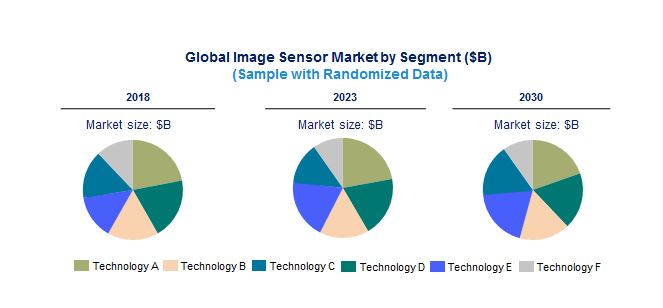
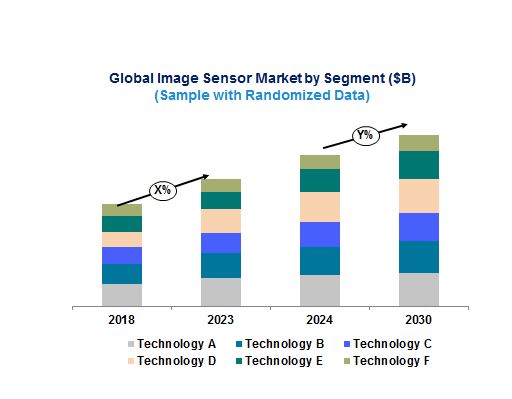
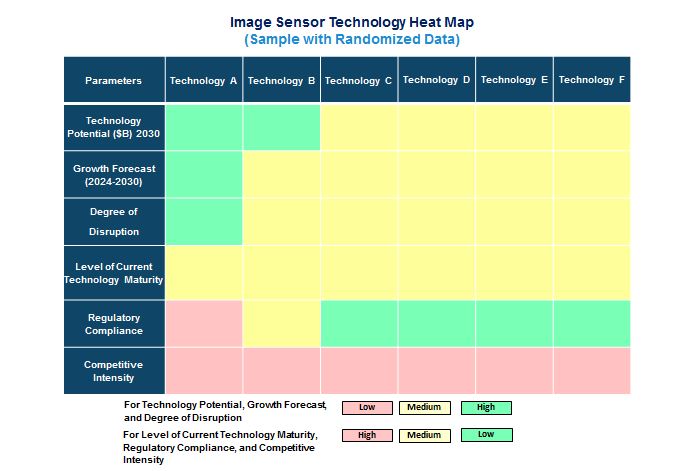
The study includes technology readiness, competitive intensity, regulatory compliance, disruption potential, trends, forecasts and strategic implications for the global image sensor technology by application, technology, and region as follows:
Technology Readiness by Technology Type
Competitive Intensity and Regulatory Compliance
Disruption Potential by Technology Type
Trends and Forecasts by Technology Type [$M shipment analysis from 2018 to 2030]:
Technology Trends and Forecasts by Application [$M shipment analysis from 2018 to 2030]:
Technology Trends and Forecasts by Region [$M shipment analysis for 2018 to 2030]:
Latest Developments and Innovations in the Image sensor Technologies
Companies / Ecosystems
Strategic Opportunities by Technology Type
Some of the image sensor companies profiled in this report include ADT, Moni, Honeywell, Securitas, UTC, Schneider, Johnson Controls, Vivint, Vector Security, and Bosch.
Below are the latest technological developments from top companies in the image sensor market:
This report answers following 9 key questions:
Q.1 What are some of the most promising and high-growth technology opportunities for the image sensor market?
Q.2 Which technology will grow at a faster pace and why?
Q.3 What are the key factors affecting dynamics of different technologies? What are the drivers and challenges of these technologies in image sensor market?
Q.4 What are the levels of technology readiness, competitive intensity and regulatory compliance in this technology space?
Q.5 What are the business risks and threats to these technologies in image sensor market?
Q.6 What are the latest developments in image sensor technologies? Which companies are leading these developments?
Q.7 Which technologies have potential of disruption in this market?
Q.8 Who are the major players in this image sensor market? What strategic initiatives are being implemented by key players for business growth?
Q.9 What are strategic growth opportunities in this image sensor technology space?
In image sensor market, various technologies, such as CMOS and CCD sensors are used. Increasing demand for dual and triple camera in smartphones, advancement in medical imaging, and increasing penetration of image sensor in automotive ADAS application are creating new opportunities for various image sensor technologies.
Some of the latest technological developments by various countries in the image sensor market are as follows:
- United States: Sony and OmniVision are leading advancements in CMOS image sensor technology, focusing on higher resolutions and improved low-light performance. The U.S. government has allocated funding for research in image sensor technology through initiatives like the National Science Foundation's Sensor, Imaging, and Signal Processing program.
- Japan: Sony Corporation continues to innovate in CMOS sensor technology, aiming for higher pixel counts and faster readout speeds. Additionally, Panasonic is investing in organic CMOS image sensors for enhanced sensitivity. The Japanese government's Ministry of Economy, Trade and Industry (METI) supports the development of image sensors through various grants and subsidies.
- South Korea: Samsung Electronics is investing in CMOS image sensor technology with a focus on reducing power consumption and enhancing image quality. The Korean government's Ministry of Science and ICT (MSIT) has launched initiatives to foster innovation in image sensor technology like the Image Sensor Global Development Support Center.
- China: SK Hynix are expanding their presence in the Chinese image sensor market, offering advanced CMOS sensor solutions for the smartphones and automotive applications. The Chinese government's Ministry of Industry and Information Technology (MIIT) has outlined targets for domestic image sensor production to reduce reliance on imports.
This report analyzes technology maturity, degree of disruption, competitive intensity, market potential, and other parameters of various technologies in the image sensor market. Some insights are depicted below by a sample figure. For more details on figures, the companies researched, and other objectives/benefits on this research report, please download the report brochure.
The study includes technology readiness, competitive intensity, regulatory compliance, disruption potential, trends, forecasts and strategic implications for the global image sensor technology by application, technology, and region as follows:
Technology Readiness by Technology Type
Competitive Intensity and Regulatory Compliance
Disruption Potential by Technology Type
Trends and Forecasts by Technology Type [$M shipment analysis from 2018 to 2030]:
- CMOS
- CCD
- Others
Technology Trends and Forecasts by Application [$M shipment analysis from 2018 to 2030]:
-
Consumer Electronics
- CMOS
- CCD
- Others
-
Healthcare
- CMOS
- CCD
- Others
-
Industrial
- CMOS
- CCD
- Others
-
Security and Surveillance
- CMOS
- CCD
- Others
-
Automotive and Transportation
- CMOS
- CCD
- Others
-
Aerospace and Defense
- CMOS
- CCD
- Others
-
Others
- CMOS
- CCD
- Others
Technology Trends and Forecasts by Region [$M shipment analysis for 2018 to 2030]:
-
North America
- United States
- Canada
- Mexico
-
Europe
- United Kingdom
- Germany
- France
-
Asia Pacific
- Japan
- China
- South Korea
- India
- The Rest of the World
Latest Developments and Innovations in the Image sensor Technologies
Companies / Ecosystems
Strategic Opportunities by Technology Type
Some of the image sensor companies profiled in this report include ADT, Moni, Honeywell, Securitas, UTC, Schneider, Johnson Controls, Vivint, Vector Security, and Bosch.
Below are the latest technological developments from top companies in the image sensor market:
- Sony has recently announced the development of a groundbreaking stacked CMOS image sensor with integrated AI processing capabilities. This sensor aims to significantly improve image processing speed and accuracy in various applications, including automotive, surveillance, and consumer electronics. Sony's innovation is expected to set new standards in the industry for smart image sensors.
- Samsung has unveiled its latest ISOCELL GN2 Plus CMOS image sensor, featuring advanced pixel-binning technology for improved low-light performance and enhanced autofocus capabilities. The sensor targets high-end smartphones and aims to deliver superior image quality and faster focusing speeds in challenging lighting conditions. Samsung's innovation reinforces its position as a key player in the mobile imaging market.
- Hamamatsu Photonics has introduced a new line of scientific-grade CCD image sensors optimized for the spectroscopy applications. These sensors offer high sensitivity and low noise performance, making them ideal for analytical instruments used in research laboratories and industrial settings. Hamamatsu's CCD sensors contribute to advancements in scientific imaging and analytical technologies.
- ON Semiconductor has launched a series of Time-of-Flight (ToF) image sensors designed for the depth sensing and 3D imaging applications. The new sensors offer high-resolution depth mapping and enhanced ambient light rejection, catering to the growing demand for gesture recognition, augmented reality, and robotics. ON Semiconductor's ToF sensors empower next-generation imaging solutions across various industries.
This report answers following 9 key questions:
Q.1 What are some of the most promising and high-growth technology opportunities for the image sensor market?
Q.2 Which technology will grow at a faster pace and why?
Q.3 What are the key factors affecting dynamics of different technologies? What are the drivers and challenges of these technologies in image sensor market?
Q.4 What are the levels of technology readiness, competitive intensity and regulatory compliance in this technology space?
Q.5 What are the business risks and threats to these technologies in image sensor market?
Q.6 What are the latest developments in image sensor technologies? Which companies are leading these developments?
Q.7 Which technologies have potential of disruption in this market?
Q.8 Who are the major players in this image sensor market? What strategic initiatives are being implemented by key players for business growth?
Q.9 What are strategic growth opportunities in this image sensor technology space?
Table of Contents
3. Technology Readiness 3.1: Technology Commercialization and Readiness 3.2: Drivers and Challenges in Image Sensor Technologies 3.3: Competitive Intensity 3.4: Regulatory Compliance
6. Latest Developments and Innovations in the Image Sensor Technologies 7. Companies / Ecosystem 7.1: Product Portfolio Analysis 7.2: Market Share Analysis 7.3: Geographical Reach
9. Company Profiles of Leading Players 9.1: ADT 9.2: Moni 9.3: Honeywell 9.4: Securitas 9.5: UTC 9.6: Schneider 9.7: Johnson Controls 9.8: Vivint 9.9: Vector Security 9.10: Bosch
Methodology
Lucintel has been in the business of market research and management consulting since 2000 and has published over 1000 market intelligence reports in various markets / applications and served over 1,000 clients worldwide. This study is a culmination of four months of full-time effort performed by Lucintel's analyst team. The analysts used the following sources for the creation and completion of this valuable report:
- In-depth interviews of the major players in this market
- Detailed secondary research from competitors’ financial statements and published data
- Extensive searches of published works, market, and database information pertaining to industry news, company press releases, and customer intentions
- A compilation of the experiences, judgments, and insights of Lucintel’s professionals, who have analyzed and tracked this market over the years.
Extensive research and interviews are conducted across the supply chain of this market to estimate market share, market size, trends, drivers, challenges, and forecasts. Below is a brief summary of the primary interviews that were conducted by job function for this report.

Thus, Lucintel compiles vast amounts of data from numerous sources, validates the integrity of that data, and performs a comprehensive analysis. Lucintel then organizes the data, its findings, and insights into a concise report designed to support the strategic decision-making process. The figure below is a graphical representation of Lucintel’s research process.

Buy Now
Choose a license that fits your team. Instant PDF delivery.
Prices exclude taxes. Instant delivery. Custom licensing available on request.


