
Report Feature
The technologies in automotive tooling have undergone significant change in recent years, with metal based stamping dies to plastic based tooling. The rising wave of new technologies, such as stamping dies, casting, and plastic technologies are creating significant potential for advanced tooling market in various vehicle platforms to design and produce complex parts using various machines.
In automotive tooling market, various material technologies, such as stamping dies, casting, and plastic are used in tooling for the passenger car, and commercial vehicle applications. Rapid development in advance manufacturing technologies and lower cost of raw materials are creating new opportunities for various automotive tooling technologies.
Some of the latest technological developments by various countries in the automotive tooling market are as follows:


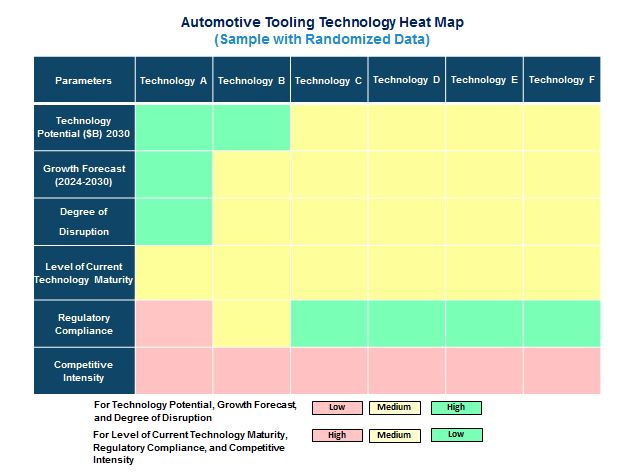
The study includes technology readiness, competitive intensity, regulatory compliance, disruption potential, trends, forecasts and strategic implications for the global automotive tooling technology by application, technology, and region as follows:
Technology Readiness by Technology Type
Competitive Intensity and Regulatory Compliance
Disruption Potential by Technology Type
Trends and Forecasts by Technology [$M shipment analysis from 2018 to 2030]:
Latest Developments and Innovations in the Automotive Tooling Technologies
Companies / Ecosystems
Strategic Opportunities by Technology Type
Some of the automotive tooling companies profiled in this report include Toyota, Simoldes, Himile Yifeng, Fuji, Tqm, Schafer Group, Botou Xingda, Shandong Wantong, Y-Tec, Ogihara, Foboha, Greatoo Intelligent, Rayhoo, Ssdt, and Hlgy.
Below are the latest technological developments from top companies in the automotive tooling market:
Q.1 What are some of the most promising and high-growth technology opportunities for the automotive tooling market?
Q.2 Which technology will grow at a faster pace and why?
Q.3 What are the key factors affecting dynamics of different technologies? What are the drivers and challenges of these technologies in automotive tooling market?
Q.4 What are the levels of technology readiness, competitive intensity and regulatory compliance in this technology space?
Q.5 What are the business risks and threats to these technologies in automotive tooling market?
Q.6 What are the latest developments in automotive tooling technologies? Which companies are leading these developments?
Q.7 Which technologies have potential of disruption in this market?
Q.8 Who are the major players in this automotive tooling market? What strategic initiatives are being implemented by key players for business growth?
Q.9 What are strategic growth opportunities in this automotive tooling technology space?
In automotive tooling market, various material technologies, such as stamping dies, casting, and plastic are used in tooling for the passenger car, and commercial vehicle applications. Rapid development in advance manufacturing technologies and lower cost of raw materials are creating new opportunities for various automotive tooling technologies.
Some of the latest technological developments by various countries in the automotive tooling market are as follows:
- Germany: Bosch announced collaboration with Siemens to develop AI-powered toolpath optimization for stamping dies. This aims to reduce development time and material waste. The German government aims to invest €2 billion in research for lightweight materials and innovative forming techniques for car bodies.
- Japan: Mitsui Chemicals announced a new high-strength, lightweight resin for plastic car parts, targeting a 20% weight reduction compared to traditional materials. Toyota is investing in additive manufacturing (3D printing) technologies for casting molds, aiming for faster prototyping and complex designs.
- South Korea: Hyundai set a target to increase the use of recycled aluminum in casting by 30% by 2030, promoting sustainable tooling practices. South Korean tooling companies are focusing on developing tools for electric vehicle battery production, driven by the growing EV market.
The study includes technology readiness, competitive intensity, regulatory compliance, disruption potential, trends, forecasts and strategic implications for the global automotive tooling technology by application, technology, and region as follows:
Technology Readiness by Technology Type
Competitive Intensity and Regulatory Compliance
Disruption Potential by Technology Type
Trends and Forecasts by Technology [$M shipment analysis from 2018 to 2030]:
- Stamping Dies Based Tooling
- Casting Based Tooling
- Plastic Based Tooling
-
Passenger Vehicles
- Stamping Dies Based Tooling
- Casting Based Tooling
- Plastic Based Tooling
-
Commercial Vehicles
- Stamping Dies Based Tooling
- Casting Based Tooling
- Plastic Based Tooling
-
North America
- United States
- Canada
- Mexico
-
Europe
- United Kingdom
- Germany
- France
-
Asia Pacific
- Japan
- China
- South Korea
- India
- The Rest of the World
Latest Developments and Innovations in the Automotive Tooling Technologies
Companies / Ecosystems
Strategic Opportunities by Technology Type
Some of the automotive tooling companies profiled in this report include Toyota, Simoldes, Himile Yifeng, Fuji, Tqm, Schafer Group, Botou Xingda, Shandong Wantong, Y-Tec, Ogihara, Foboha, Greatoo Intelligent, Rayhoo, Ssdt, and Hlgy.
Below are the latest technological developments from top companies in the automotive tooling market:
- Schuler announced a partnership with Siemens to develop a new generation of digital stamping presses. This collaboration aims to integrate Industry 4.0 technologies for improved efficiency and automation in stamping processes.
- Die Technologies announced a significant capex investment to expand its production capacity for large format stamping dies used in electric vehicle chassis manufacturing.
- Vauquelin Group acquired a foundry specializing in aluminum die casting for automotive parts. This acquisition allows Vauquelin to offer a wider range of casting-based tooling solutions to its customers.
- Sinto announced the launch of a new environmentally friendly sand casting process that reduces waste generation and energy consumption in automotive engine block production.
- Ryobi partnered with a leading automotive manufacturer to develop next-generation lightweight casting solutions for electric vehicle battery casings.
Q.1 What are some of the most promising and high-growth technology opportunities for the automotive tooling market?
Q.2 Which technology will grow at a faster pace and why?
Q.3 What are the key factors affecting dynamics of different technologies? What are the drivers and challenges of these technologies in automotive tooling market?
Q.4 What are the levels of technology readiness, competitive intensity and regulatory compliance in this technology space?
Q.5 What are the business risks and threats to these technologies in automotive tooling market?
Q.6 What are the latest developments in automotive tooling technologies? Which companies are leading these developments?
Q.7 Which technologies have potential of disruption in this market?
Q.8 Who are the major players in this automotive tooling market? What strategic initiatives are being implemented by key players for business growth?
Q.9 What are strategic growth opportunities in this automotive tooling technology space?
Table of Contents
1. Executive Summary 2. Technology Landscape 2.1. Technology Background and Evolution 2.2. Technology and Application Mapping 2.3. Supply Chain
3. Technology Readiness 3.1. Technology Commercialization and Readiness 3.2. Drivers and Challenges in Automotive Tooling Technologies 3.3. Competitive Intensity 3.4. Regulatory Compliance
4. Technology Trends and Forecasts Analysis from 2018-2030 4.1. Automotive Tooling Opportunity 4.2. Technology Trends (2018-2023) and Forecasts (2024-2030)
5. Technology Opportunities (2018-2030) by Region 5.1. Automotive Tooling Market by Region 5.2. North American Automotive Tooling Technology Market
6. Latest Developments and Innovations in the Automotive Tooling Technologies 7. Companies / Ecosystem 7.1. Product Portfolio Analysis 7.2. Market Share Analysis 7.3. Geographical Reach
8. Strategic Implications 8.1. Implications 8.2. Growth Opportunity Analysis
9. Company Profiles of Leading Players 9.1. Toyota 9.2. Simoldes 9.3. Himile Yifeng 9.4. Fuji 9.5. Tqm 9.6. Schafer Group 9.7. Botou Xingda 9.8. Shandong Wantong 9.9. Y-Tec 9.10. Ogihara
Methodology
Lucintel has been in the business of market research and management consulting since 2000 and has published over 1000 market intelligence reports in various markets / applications and served over 1,000 clients worldwide. This study is a culmination of four months of full-time effort performed by Lucintel's analyst team. The analysts used the following sources for the creation and completion of this valuable report:
- In-depth interviews of the major players in this market
- Detailed secondary research from competitors’ financial statements and published data
- Extensive searches of published works, market, and database information pertaining to industry news, company press releases, and customer intentions
- A compilation of the experiences, judgments, and insights of Lucintel’s professionals, who have analyzed and tracked this market over the years.
Extensive research and interviews are conducted across the supply chain of this market to estimate market share, market size, trends, drivers, challenges, and forecasts. Below is a brief summary of the primary interviews that were conducted by job function for this report.

Thus, Lucintel compiles vast amounts of data from numerous sources, validates the integrity of that data, and performs a comprehensive analysis. Lucintel then organizes the data, its findings, and insights into a concise report designed to support the strategic decision-making process. The figure below is a graphical representation of Lucintel’s research process.

Buy Now
Choose a license that fits your team. Instant PDF delivery.
Prices exclude taxes. Instant delivery. Custom licensing available on request.


