
Report Feature
Submarine Propulsion System Market Trends and Forecast
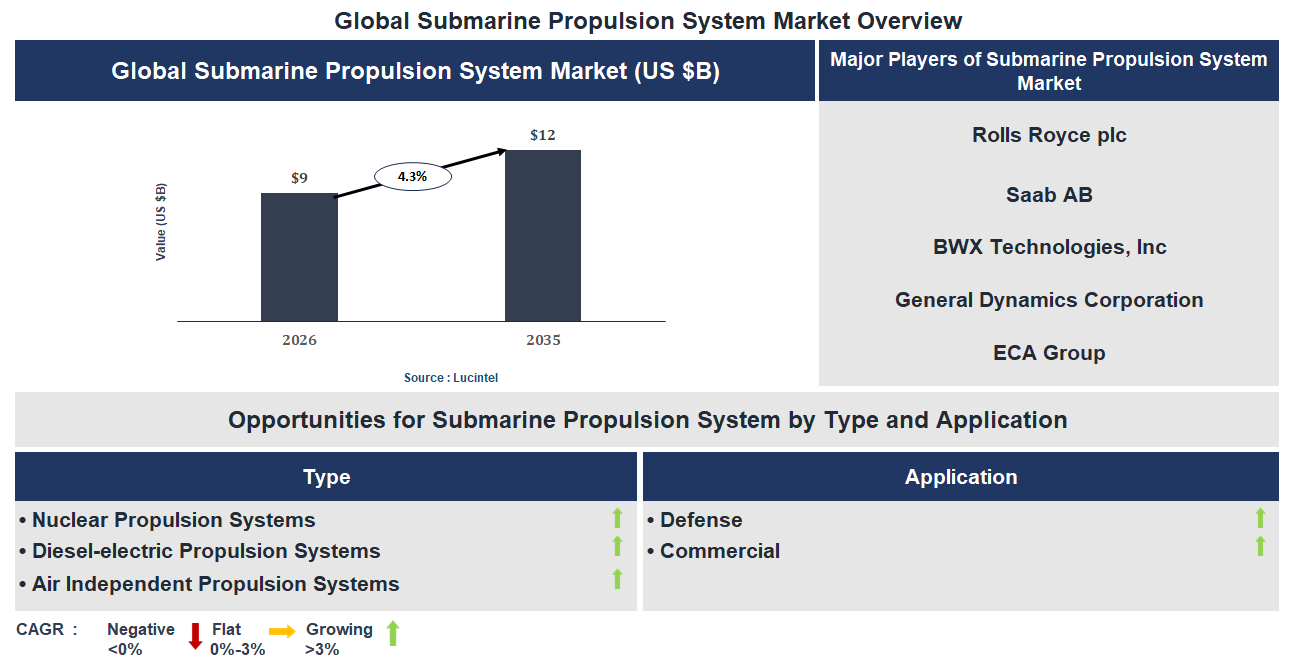
The future of the global submarine propulsion system market looks promising with opportunities in the defense and commercial markets. The global submarine propulsion system market is expected to reach an estimated $12 billion by 2035 with a CAGR of 4.3% from 2026 to 2035. The major drivers for this market are the increasing military investments in defense, the rising demand for energy-efficient systems, and the growing focus on underwater exploration technologies.• Lucintel forecasts that, within the type category, nuclear propulsion system is expected to witness the highest growth over the forecast period.
• Within the application category, defense is expected to witness higher growth.
• In terms of region, North America is expected to witness the highest growth over the forecast period. Gain valuable insights for your business decisions with our comprehensive 150+ page report. Sample figures with some insights are shown below.
Emerging Trends in the Submarine Propulsion System Market
The submarine propulsion system market is experiencing rapid evolution driven by technological advancements, environmental considerations, and shifting defense strategies. As nations seek more efficient, stealthy, and sustainable underwater capabilities, the industry is witnessing significant changes. These developments are not only enhancing operational performance but also influencing global defense budgets and strategic alliances. The markets future will be shaped by innovations that improve efficiency, reduce environmental impact, and meet the increasing demand for advanced underwater systems. Understanding these emerging trends is crucial for stakeholders aiming to stay competitive and aligned with global defense and maritime objectives.• Increasing Adoption of Air-Independent Propulsion: AIP systems are gaining popularity due to their ability to extend underwater endurance without surfacing. They enable submarines to operate stealthily for longer periods, reducing the risk of detection. This trend is driven by the need for enhanced operational capabilities and strategic advantages in underwater warfare. Countries are investing heavily in AIP technology to modernize their fleets, making submarines more autonomous and less dependent on traditional diesel-electric systems. The adoption of AIP is expected to significantly influence market growth and technological development.
• Focus on Environmental Sustainability: The market is witnessing a shift towards eco-friendly propulsion solutions to minimize environmental impact. This includes the development of systems that reduce emissions and noise pollution, which are critical for stealth and environmental compliance. Governments and defense agencies are prioritizing sustainable practices, encouraging innovation in propulsion technologies that are less harmful to marine ecosystems. This trend is fostering research into alternative fuels and energy-efficient systems, ultimately leading to cleaner, quieter submarines that align with global environmental standards.
• Integration of Hybrid Propulsion Systems: Hybrid systems combining traditional and alternative power sources are emerging as a key trend. These systems offer flexibility, improved fuel efficiency, and reduced emissions. They enable submarines to switch between power modes based on operational requirements, enhancing performance and sustainability. The integration of hybrid propulsion is driven by the need for versatile, cost-effective solutions that can adapt to various mission profiles. This trend is expected to accelerate as technological advancements make hybrid systems more reliable and affordable.
• Increasing Demand for Stealth and Low Noise Technologies: Stealth remains a critical factor in submarine design, prompting innovations in propulsion systems that minimize acoustic signatures. Low noise technologies are being integrated into propulsion systems to evade detection by adversaries. This trend is vital for maintaining strategic superiority and operational effectiveness. Manufacturers are investing in advanced materials, vibration damping, and noise reduction techniques to develop quieter propulsion solutions. The focus on stealth technology is reshaping the market by prioritizing innovations that enhance underwater survivability and mission success.
• Growing Emphasis on Modular and Scalable Designs: The market is moving towards modular propulsion systems that can be easily upgraded or customized for different submarine classes. Scalability allows manufacturers to meet diverse operational needs without extensive redesigns, reducing costs and development time. Modular designs facilitate easier maintenance and future upgrades, ensuring longer service life and adaptability to emerging technologies. This trend is driven by the need for flexible, cost-efficient solutions that can be tailored to specific defense requirements, thereby expanding market opportunities and fostering innovation in system integration. These emerging trends are fundamentally transforming the submarine propulsion system market by enhancing operational capabilities, promoting sustainability, and fostering technological innovation. They are enabling submarines to become more stealthy, efficient, and adaptable, which is reshaping global naval strategies and defense procurement priorities. As these trends continue to evolve, the market is poised for significant growth and technological breakthroughs that will define the future of underwater warfare and maritime security.

Recent Developments in the Submarine Propulsion System Market
The submarine propulsion system market is experiencing rapid advancements driven by technological innovation, increasing defense budgets, and the need for stealth and efficiency. Governments and private sectors are investing heavily to develop quieter, more powerful, and environmentally friendly systems. These developments are shaping the future of underwater navigation, military capabilities, and commercial applications, creating new opportunities and challenges. The following key developments highlight the current trajectory and potential growth areas within this dynamic industry.• Technological Innovations in Nuclear Propulsion: The integration of advanced nuclear reactors is revolutionizing submarine propulsion by offering higher efficiency, longer endurance, and reduced emissions. These systems enable submarines to operate submerged for extended periods without surfacing, significantly enhancing stealth and operational capabilities. Countries investing in nuclear propulsion are gaining strategic advantages, fostering innovation, and setting new standards for underwater propulsion technology. This shift is expected to influence global military balance and commercial exploration efforts.
• Development of Hybrid Propulsion Systems: Hybrid propulsion combines traditional diesel-electric and emerging battery technologies to improve performance and reduce environmental impact. These systems offer quieter operation, lower fuel consumption, and increased maneuverability, making them ideal for both military and research submarines. The adoption of hybrid systems is driven by stricter environmental regulations and the need for operational flexibility. This development is fostering a more sustainable and adaptable submarine fleet, opening new markets and enhancing existing capabilities.
• Advances in Underwater Acoustic Technologies: Innovations in sonar and noise reduction are critical for stealth and detection capabilities. New materials and design techniques are reducing noise signatures, making submarines harder to detect. Enhanced acoustic sensors improve navigation, communication, and threat detection. These advancements are vital for military dominance and underwater exploration, providing strategic advantages. The market is witnessing increased R&D investments, leading to more sophisticated, quieter, and efficient propulsion systems that redefine underwater warfare and research.
• Increasing Focus on Eco-Friendly Propulsion Solutions: Environmental concerns are prompting the development of greener propulsion options, such as fuel cells and alternative energy sources. These systems aim to reduce carbon footprints and comply with international environmental standards. The shift towards eco-friendly propulsion is attracting investments from governments and private firms, fostering innovation in sustainable technologies. This trend is expected to reshape the industry by promoting cleaner, more efficient submarine operations, and expanding market opportunities in environmentally conscious regions.
• Growing Demand for Autonomous Underwater Vehicles (AUVs): The rise of autonomous systems is transforming submarine operations with increased endurance, reduced crew requirements, and enhanced data collection. AUVs utilize advanced propulsion technologies for extended missions in complex environments. They are crucial for scientific research, military reconnaissance, and resource exploration. The market is witnessing significant R&D activity, leading to more reliable, efficient, and versatile autonomous propulsion systems. This development is expanding the scope and scale of underwater missions globally. These developments are significantly impacting the submarine propulsion system market by enhancing operational efficiency, stealth, and environmental sustainability. Innovations in nuclear, hybrid, and autonomous systems are opening new avenues for military and commercial applications. The focus on eco-friendly solutions aligns with global sustainability goals, while advancements in acoustic technologies improve underwater capabilities. Collectively, these trends are driving market growth, fostering innovation, and shaping the future landscape of submarine propulsion technology.
Strategic Growth Opportunities in the Submarine Propulsion System Market
The submarine propulsion system market is experiencing significant growth driven by technological advancements, increasing defense budgets, and the need for stealthier, more efficient underwater vehicles. Emerging markets and modernization initiatives are further fueling demand. Companies are investing in innovative propulsion technologies to enhance performance, reduce environmental impact, and meet evolving military and commercial requirements. This dynamic landscape presents numerous opportunities for strategic expansion and technological development, shaping the future of underwater propulsion solutions globally.• Increasing Adoption of Nuclear Propulsion Systems for Submarines: The shift towards nuclear propulsion offers submarines longer endurance, higher speeds, and reduced refueling needs, making them more effective for defense and strategic missions. Governments are investing heavily in nuclear technology to modernize their fleets, creating a substantial market for nuclear propulsion systems. This trend is driven by the need for enhanced operational capabilities and strategic superiority, encouraging manufacturers to develop advanced, reliable nuclear propulsion solutions tailored for next-generation submarines.
• Growing Demand for Eco-Friendly and Energy-Efficient Propulsion Technologies: Environmental concerns and regulatory pressures are pushing the industry toward greener propulsion options. Innovations such as hybrid systems, air-independent propulsion (AIP), and fuel cell technologies are gaining traction. These systems reduce emissions, improve fuel efficiency, and extend operational range. Military and commercial operators are increasingly prioritizing sustainability, which opens avenues for R&D investments and the deployment of environmentally friendly propulsion solutions that meet strict environmental standards.
• Technological Advancements in Electric and Hybrid Propulsion Systems: Electric and hybrid propulsion systems are transforming submarine performance by offering quieter operation, lower maintenance, and reduced emissions. Advances in battery technology, power management, and motor efficiency are enabling these systems to match or surpass traditional propulsion methods. The integration of these technologies enhances stealth capabilities and operational flexibility, making them attractive options for navies and commercial entities seeking sustainable, high-performance underwater propulsion solutions.
• Expansion of Defense Budgets and Modernization Programs Globally: Rising defense expenditures, especially in Asia-Pacific and the Middle East, are fueling submarine procurement and modernization initiatives. Countries are investing in advanced propulsion systems to upgrade existing fleets and develop new submarines with enhanced capabilities. This financial commitment creates a robust market for propulsion system manufacturers, encouraging innovation and strategic partnerships to meet the increasing demand for cutting-edge, reliable submarine propulsion solutions.
• Increasing Focus on Autonomous and Unmanned Underwater Vehicles: The rise of autonomous underwater vehicles (AUVs) and unmanned submarines is creating new opportunities for propulsion system providers. These vehicles require compact, efficient, and highly reliable propulsion solutions to operate effectively in diverse environments. The demand for miniaturized, energy-efficient systems that support extended missions is driving innovation. This trend aligns with military and commercial interests in surveillance, exploration, and environmental monitoring, expanding the scope of propulsion technology applications in the underwater domain. The overall market is poised for substantial growth as these opportunities drive innovation, enhance operational capabilities, and meet evolving environmental and strategic demands, shaping the future landscape of submarine propulsion systems.
Submarine Propulsion System Market Driver and Challenges
The submarine propulsion system market is influenced by a complex interplay of technological advancements, economic considerations, and regulatory frameworks. Rapid innovations in propulsion technologies aim to enhance efficiency, stealth, and operational range, while economic factors such as defense budgets and geopolitical tensions drive demand. Additionally, stringent environmental regulations and safety standards shape the development and deployment of these systems. The markets growth is also impacted by geopolitical stability and the need for modernization of existing naval fleets. Navigating these diverse drivers and challenges is crucial for stakeholders aiming to capitalize on emerging opportunities while addressing potential risks in this highly specialized sector. The factors responsible for driving the submarine propulsion system market include:• Technological Innovation: The continuous development of advanced propulsion technologies, such as nuclear and hybrid systems, enhances submarine performance by increasing speed, endurance, and stealth capabilities. Innovations like air-independent propulsion (AIP) systems allow non-nuclear submarines to operate submerged for longer durations, reducing the need for surfacing and improving operational security. These technological advancements are driven by military requirements for more capable and sustainable submarines, fostering increased R&D investments. As countries seek to modernize their naval fleets, the demand for cutting-edge propulsion systems accelerates, making technological innovation a primary growth driver in this market.
• Defense Budget Allocations: Growing defense budgets, especially among major naval powers, significantly influence the market. Countries like the United States, China, and Russia are investing heavily in modernizing their submarine fleets to maintain strategic superiority. Increased government spending on defense procurement enables the acquisition of advanced propulsion systems, supporting national security objectives. Budget allocations also facilitate research collaborations and technological development, further propelling market growth. As geopolitical tensions persist, nations prioritize submarine capabilities, making defense spending a critical driver for market expansion.
• Geopolitical Tensions and Naval Modernization: Rising geopolitical tensions and regional conflicts compel nations to enhance their naval capabilities, including submarine fleets. Countries seek to secure maritime borders and project power, which necessitates the deployment of advanced submarines equipped with sophisticated propulsion systems. Modernization programs driven by strategic considerations lead to increased procurement of new submarines and retrofitting of existing ones with state-of-the-art propulsion technologies. This demand surge directly impacts market growth, as nations aim to maintain a credible deterrent and ensure maritime security in volatile regions.
• Environmental Regulations and Sustainability: Increasing environmental concerns and regulations influence the development of eco-friendly propulsion systems. Governments and international bodies are encouraging the adoption of cleaner, quieter, and more efficient propulsion technologies to reduce underwater noise pollution and environmental impact. This drives innovation in air-independent and hybrid propulsion systems that offer lower emissions and reduced acoustic signatures. The push for sustainable naval operations encourages manufacturers to develop environmentally compliant systems, shaping the future landscape of the submarine propulsion market.
• Strategic Collaborations and Defense Contracts: Partnerships between defense contractors and government agencies foster technological exchange and accelerate product development. Strategic collaborations enable access to advanced research facilities, funding, and expertise, leading to innovative propulsion solutions. Large defense contracts and tenders stimulate market activity, encouraging manufacturers to invest in R&D and expand their product portfolios. These collaborations also facilitate technology transfer and standardization, ensuring compatibility and operational efficiency across different naval platforms, thus serving as a significant growth driver. The challenges facing the submarine propulsion system market are:
• High Development and Maintenance Costs: Developing advanced submarine propulsion systems involves substantial investment in research, testing, and manufacturing. The high costs associated with nuclear propulsion, in particular, pose financial challenges for many countries, limiting market accessibility. Additionally, maintenance and lifecycle costs are significant, requiring specialized facilities and skilled personnel. These financial barriers can delay procurement and modernization programs, constraining market growth. The economic burden also impacts smaller nations with limited defense budgets, potentially restricting their ability to adopt the latest propulsion technologies.
• Regulatory and Safety Standards: Stringent safety and environmental regulations impose complex compliance requirements on submarine propulsion systems. Nuclear propulsion, in particular, faces rigorous international safety standards, licensing procedures, and environmental restrictions, which can delay deployment and increase costs. Compliance with these standards necessitates extensive testing and certification, often prolonging project timelines. Variations in regulatory frameworks across countries further complicate international collaborations and procurement processes, posing significant hurdles for manufacturers and operators in the market.
• Technological Complexity and Integration Challenges: Integrating advanced propulsion systems into submarines involves overcoming significant technical challenges. Ensuring compatibility with existing submarine platforms, maintaining stealth characteristics, and achieving operational reliability require sophisticated engineering solutions. The complexity of hybrid and air-independent propulsion systems demands specialized expertise, which can limit rapid deployment. Additionally, ongoing technological advancements may render existing systems obsolete, necessitating continuous upgrades. These factors contribute to project delays, increased costs, and operational risks, hindering market expansion. The submarine propulsion system market is driven by technological innovation, defense spending, geopolitical factors, environmental considerations, and strategic collaborations. However, high costs, regulatory hurdles, and technological complexities present notable challenges. The interplay of these drivers and challenges shapes the markets trajectory, requiring stakeholders to balance innovation with compliance and cost-efficiency. Overall, the markets growth prospects remain promising, provided that technological and regulatory hurdles are effectively managed, enabling nations to enhance their naval capabilities in an increasingly complex geopolitical landscape.
List of Submarine Propulsion System Companies
Companies in the market compete on the basis of product quality offered. Major players in this market focus on expanding their manufacturing facilities, R&D investments, infrastructural development, and leverage integration opportunities across the value chain. With these strategies submarine propulsion system companies cater increasing demand, ensure competitive effectiveness, develop innovative products & technologies, reduce production costs, and expand their customer base. Some of the submarine propulsion system companies profiled in this report include-• Rolls Royce plc
• Saab AB
• BWX Technologies, Inc
• General Dynamics Corporation
• ECA Group
• Thyssenkrupp AG
• Siemens AG
Submarine Propulsion System Market by Segment
The study includes a forecast for the global submarine propulsion system market by type, application, and region.Submarine Propulsion System Market by Type [Value from 2019 to 2035]:
• Nuclear Propulsion Systems
• Diesel-electric Propulsion Systems
• Air Independent Propulsion Systems
Submarine Propulsion System Market by Application [Value from 2019 to 2035]:
• Defense
• Commercial
Submarine Propulsion System Market by Region [Value from 2019 to 2035]:
• North America
• Europe
• Asia Pacific
• The Rest of the World
Country Wise Outlook for the Submarine Propulsion System Market
The submarine propulsion system market has experienced significant technological advancements and strategic shifts across major global players. As nations seek to enhance their underwater capabilities for defense and strategic dominance, innovations in propulsion technology, increased investment in submarine fleets, and evolving geopolitical considerations are shaping the market landscape. The United States, China, Germany, India, and Japan are at the forefront, each making notable progress to strengthen their submarine capabilities and adapt to emerging threats and technological opportunities.• United States: The US has focused on developing advanced nuclear propulsion systems, with ongoing upgrades to its submarine fleet, including the Virginia-class and Ohio-class submarines. Investments in stealth technology and hybrid propulsion systems aim to improve operational efficiency and strategic deterrence. The US Navy is also exploring next-generation propulsion technologies to maintain technological superiority.
• China: China has rapidly expanded its submarine fleet, emphasizing the development of both nuclear and diesel-electric submarines. Recent advancements include the introduction of the Type 039A and Type 096 submarines, equipped with improved propulsion systems for enhanced stealth and endurance. China is also investing in quiet propulsion technologies to bolster its underwater strategic capabilities.
• Germany: Germany continues to innovate in submarine propulsion, primarily focusing on diesel-electric systems with a focus on energy efficiency and reduced acoustic signatures. The Type 212 and Type 214 submarines incorporate air-independent propulsion (AIP) technology, allowing longer submerged operations and increased stealth, strengthening Germany’s naval defense capabilities.
• India: India has made significant strides in submarine propulsion, with the development of indigenous AIP technology and the acquisition of Scorpaena-class submarines. The Kalari-class submarines feature advanced diesel-electric propulsion systems, and ongoing projects aim to develop nuclear-powered submarines to enhance strategic deterrence and underwater endurance.
• Japan: Japan emphasizes technological innovation in submarine propulsion, integrating AIP systems into its Soryu-class submarines to extend underwater endurance and reduce acoustic signatures. Japan is also investing in next-generation propulsion technologies to improve stealth and operational range, aligning with its focus on maritime security and regional defense strategies.

Features of the Global Submarine Propulsion System Market
Market Size Estimates: Submarine propulsion system market size estimation in terms of value ($B). Trend and Forecast Analysis: Market trends (2019 to 2025) and forecast (2026 to 2035) by various segments and regions. Segmentation Analysis: Submarine propulsion system market size by type, application, and region in terms of value ($B). Regional Analysis: Submarine propulsion system market breakdown by North America, Europe, Asia Pacific, and Rest of the World. Growth Opportunities: Analysis of growth opportunities in different types, applications, and regions for the submarine propulsion system market. Strategic Analysis: This includes M&A, new product development, and competitive landscape of the submarine propulsion system market. Analysis of competitive intensity of the industry based on Porter’s Five Forces model.
FAQ
Q1. What is the submarine propulsion system market size? Answer: The global submarine propulsion system market is expected to reach an estimated $12 billion by 2035. Q2. What is the growth forecast for submarine propulsion system market? Answer: The global submarine propulsion system market is expected to grow with a CAGR of 4.3% from 2026 to 2035. Q3. What are the major drivers influencing the growth of the submarine propulsion system market? Answer: The major drivers for this market are the increasing military investments in defense, the rising demand for energy-efficient systems, and the growing focus on underwater exploration technologies. Q4. What are the major segments for submarine propulsion system market? Answer: The future of the submarine propulsion system market looks promising with opportunities in the defense and commercial markets. Q5. Who are the key submarine propulsion system market companies? Answer: Some of the key submarine propulsion system companies are as follows:• Rolls Royce plc
• Saab AB
• BWX Technologies, Inc
• General Dynamics Corporation
• ECA Group
• Thyssenkrupp AG
• Siemens AG Q6. Which submarine propulsion system market segment will be the largest in future? Answer: Lucintel forecasts that, within the type category, nuclear propulsion system is expected to witness the highest growth over the forecast period. Q7. In submarine propulsion system market, which region is expected to be the largest in next 8 years? Answer: In terms of region, North America is expected to witness the highest growth over the forecast period. Q8. Do we receive customization in this report? Answer: Yes, Lucintel provides 10% customization without any additional cost.
Table of Contents
List of Figures
List of Tables
Methodology
- In-depth interviews of the major players in this market
- Detailed secondary research from competitors’ financial statements and published data
- Extensive searches of published works, market, and database information pertaining to industry news, company press releases, and customer intentions
- A compilation of the experiences, judgments, and insights of Lucintel’s professionals, who have analyzed and tracked this market over the years.


Buy Now
Choose a license that fits your team. Instant PDF delivery.
Prices exclude taxes. Instant delivery. Custom licensing available on request.
Key Questions
- • What are some of the most promising, high-growth opportunities for the submarine propulsion system market by type (nuclear propulsion systems, diesel-electric propulsion systems, and air independent propulsion systems), application (defense and commercial), and region (North America, Europe, Asia Pacific, and the Rest of the World)?
- • Which segments will grow at a faster pace and why?
- • Which region will grow at a faster pace and why?
- • What are the key factors affecting market dynamics? What are the key challenges and business risks in this market?
- • What are the business risks and competitive threats in this market?
- • What are the emerging trends in this market and the reasons behind them?
- • What are some of the changing demands of customers in the market?
- • What are the new developments in the market? Which companies are leading these developments?
- • Who are the major players in this market? What strategic initiatives are key players pursuing for business growth?
- • What are some of the competing products in this market and how big of a threat do they pose for loss of market share by material or product substitution?
- • What M&A activity has occurred in the last 5 years and what has its impact been on the industry? For any questions related to Submarine Propulsion System Market, Submarine Propulsion System Market Size, Submarine Propulsion System Market Growth, Submarine Propulsion System Market Analysis, Submarine Propulsion System Market Report, Submarine Propulsion System Market Share, Submarine Propulsion System Market Trends, Submarine Propulsion System Market Forecast, Submarine Propulsion System Companies, write Lucintel analyst at email: helpdesk@lucintel.com. We will be glad to get back to you soon.


