
Report Feature
Solar Powered Microbe Market Trends and Forecast
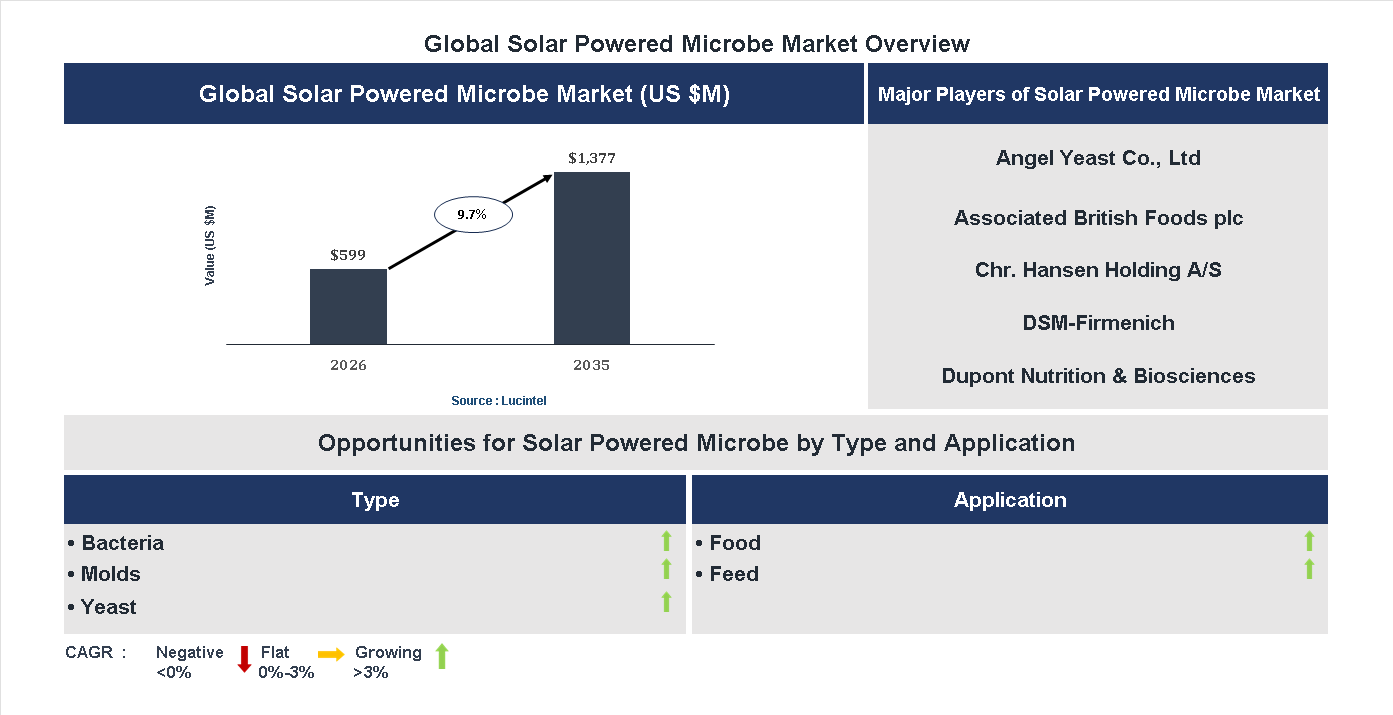
The future of the global solar powered microbe market looks promising with opportunities in the food and feed markets. The global solar powered microbe market is expected to reach an estimated $1,377 million by 2035 with a CAGR of 9.7% from 2026 to 2035. The major drivers for this market are the increasing demand for renewable sustainable energy solutions, the rising adoption of green energy alternatives, and the growing government support for clean energy innovation.• Lucintel forecasts that, within the type category, bacteria is expected to witness the highest growth over the forecast period.
• Within the application category, food is expected to witness higher growth.
• In terms of region, APAC is expected to witness the highest growth over the forecast period. Gain valuable insights for your business decisions with our comprehensive 150+ page report. Sample figures with some insights are shown below.
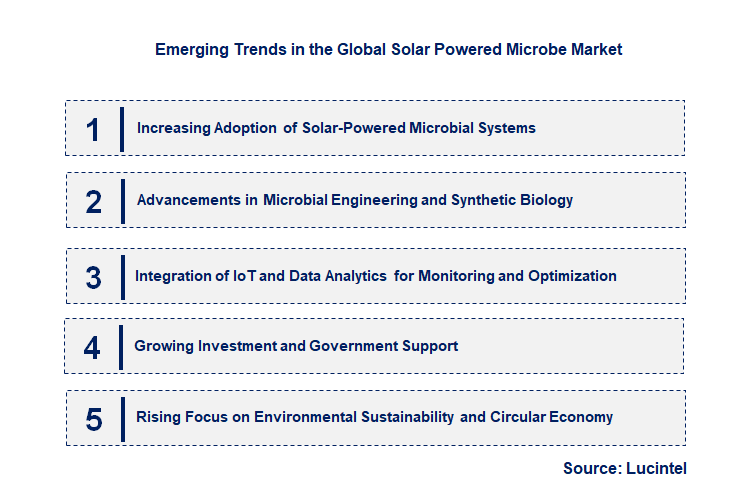
Emerging Trends in the Solar Powered Microbe Market
The solar powered microbe market is experiencing rapid growth driven by advancements in renewable energy and biotechnology. As the world shifts towards sustainable solutions, this niche market is gaining prominence for its potential in environmental remediation, bioenergy, and industrial applications. Innovations in solar technology and microbial engineering are enabling more efficient and cost-effective solutions, attracting investments and research interest. These developments are not only expanding the market size but also transforming traditional approaches to waste management, energy production, and environmental conservation. The following key trends highlight the dynamic evolution of this emerging sector.• Increasing Adoption of Solar-Powered Microbial Systems: Growing environmental concerns and the need for sustainable solutions are driving the adoption of solar-powered microbial systems. These systems utilize solar energy to power microbes that can degrade pollutants, produce biofuels, or treat wastewater. The integration of solar technology reduces reliance on conventional energy sources, making processes more eco-friendly and cost-effective. This trend is particularly prominent in wastewater treatment plants and bioremediation projects, where solar-powered microbes offer a renewable and efficient alternative to traditional methods.
• Advancements in Microbial Engineering and Synthetic Biology: Innovations in microbial engineering and synthetic biology are enhancing the capabilities of microbes used in solar-powered systems. Researchers are developing genetically modified microbes with improved efficiency in pollutant degradation, biofuel production, and nutrient cycling. These advancements enable microbes to operate effectively under solar-powered conditions, increasing their productivity and stability. The impact is a broader application scope, including more complex environmental challenges and industrial processes, ultimately making solar-powered microbes more viable and scalable.
• Integration of IoT and Data Analytics for Monitoring and Optimization: The incorporation of Internet of Things (IoT) devices and data analytics is revolutionizing the management of solar-powered microbial systems. Sensors monitor parameters such as microbial activity, solar intensity, and pollutant levels in real-time, allowing for precise control and optimization. This integration improves system efficiency, reduces operational costs, and enhances predictive maintenance. As a result, stakeholders can ensure consistent performance, adapt to changing environmental conditions, and make data-driven decisions, thereby increasing the reliability and attractiveness of solar-powered microbial solutions.
• Growing Investment and Government Support: Increased investments from private sectors and supportive government policies are fueling market growth. Funding is directed toward research, pilot projects, and commercial-scale deployments, fostering innovation and reducing costs. Governments are offering incentives, grants, and regulatory support to promote renewable energy and sustainable biotechnologies. This financial backing accelerates the development and adoption of solar-powered microbes across various industries, including agriculture, waste management, and energy production, creating a conducive environment for market expansion and technological breakthroughs.
• Rising Focus on Environmental Sustainability and Circular Economy: The market is increasingly aligned with global sustainability goals and the circular economy model. Solar-powered microbes are used to convert waste into valuable products like biofuels, fertilizers, and bioplastics, reducing landfill waste and greenhouse gas emissions. This focus encourages industries to adopt eco-friendly practices, minimize their carbon footprint, and promote resource recycling. The trend underscores the market’s role in fostering sustainable development, environmental conservation, and economic resilience, positioning solar-powered microbes as a key component in future green economies. These trends are collectively reshaping the solar powered microbe market by enhancing technological capabilities, increasing adoption, and aligning with global sustainability objectives. They are driving innovation, reducing costs, and expanding applications, which will likely lead to broader market penetration and significant environmental benefits. As these developments continue, the market is poised for substantial growth, contributing to a more sustainable and resilient future.
Recent Development in the Solar Powered Microbe Market
The solar powered microbe market is experiencing rapid growth driven by increasing demand for sustainable energy solutions and innovative biotechnologies. Advances in solar technology and microbial applications are opening new avenues for environmental management, renewable energy, and industrial processes. These developments are transforming how microbes are utilized in various sectors, promoting eco-friendly practices and reducing reliance on fossil fuels. As the market evolves, stakeholders are exploring diverse applications that promise significant environmental and economic benefits.• Growing Demand for Sustainable Energy Solutions: The shift towards renewable energy sources is boosting the solar powered microbe market. Microbes harness solar energy to produce biofuels, bioplastics, and other biochemicals, reducing carbon emissions. This trend aligns with global efforts to combat climate change and promotes eco-friendly industrial processes. Increased investments and technological innovations are expanding the market, making solar-powered microbes a viable alternative to traditional energy sources. The markets growth is expected to accelerate as environmental regulations tighten worldwide.
• Advances in Microbial Engineering Enhance Efficiency: Innovations in genetic engineering and synthetic biology are improving microbial efficiency in solar energy conversion. Engineered microbes can now produce higher yields of biofuels and biochemicals under solar-powered conditions. These advancements reduce production costs and increase scalability, making microbial solutions more commercially viable. Enhanced microbial strains also exhibit greater resilience to environmental stresses, ensuring consistent performance. This progress is attracting investments and fostering new research collaborations, further propelling market growth and application diversity.
• Integration of IoT and Automation in Microbial Processes: The incorporation of Internet of Things (IoT) devices and automation technologies is optimizing microbial cultivation and energy harvesting processes. Real-time monitoring and data analytics improve process control, efficiency, and yield. Automated systems reduce labor costs and minimize human error, leading to more sustainable and cost-effective operations. This technological integration is enabling large-scale deployment of solar-powered microbes across industries, including waste management and biofuel production. The trend is expected to enhance operational scalability and market competitiveness.
• Expansion into Environmental Remediation Applications: Solar-powered microbes are increasingly used for environmental cleanup, such as wastewater treatment and bioremediation of contaminated sites. These microbes efficiently degrade pollutants using solar energy, offering eco-friendly and cost-effective solutions. The market expansion is driven by rising environmental concerns and stricter regulations. Solar-powered microbial remediation reduces reliance on chemical treatments, minimizes secondary pollution, and promotes sustainable practices. Growing awareness and government support are further accelerating adoption, broadening the market scope beyond energy to environmental management.
• Rising Government Initiatives and Funding Support: Governments worldwide are launching policies and funding programs to promote renewable energy and microbial technologies. Incentives, grants, and subsidies are encouraging research, development, and commercialization of solar-powered microbes. These initiatives aim to reduce greenhouse gas emissions and foster sustainable industrial growth. Public-private partnerships are also emerging to accelerate market adoption. Increased regulatory support and financial backing are creating a conducive environment for innovation, attracting new entrants, and expanding market reach across various sectors. These recent developments are significantly transforming the solar powered microbe market by enhancing efficiency, expanding applications, and fostering sustainable practices. Technological innovations, supportive policies, and growing environmental awareness are driving market expansion and diversification. As these opportunities mature, they are poised to revolutionize renewable energy, environmental management, and industrial processes, making solar-powered microbes a vital component of a sustainable future. The markets evolution promises substantial environmental and economic benefits worldwide.
Strategic Growth Opportunities in the Solar Powered Microbe Market
The solar powered microbe market is experiencing rapid growth driven by increasing demand for sustainable energy solutions and innovative biotechnologies. Advancements in solar energy integration and microbial applications are opening new avenues for environmental, industrial, and healthcare sectors. As global focus shifts toward eco-friendly practices, this market presents significant opportunities for development, investment, and technological breakthroughs. Companies are exploring diverse applications to capitalize on the potential of solar-powered microbes, fostering a competitive landscape with promising growth prospects.• Expansion of Renewable Energy Applications Through Solar-Powered Microbes: Solar-powered microbes offer a sustainable approach to energy production by harnessing solar energy to activate microbial processes. This technology can be used for biofuel generation, waste treatment, and bioremediation, reducing reliance on fossil fuels. The integration of solar energy with microbial systems enhances efficiency and lowers operational costs, making it attractive for industrial-scale applications. Growing environmental concerns and government incentives further accelerate adoption, creating substantial growth opportunities in renewable energy markets.
• Development of Bio-Based Products Using Solar-Powered Microbes: Solar-powered microbes are increasingly utilized to produce bio-based chemicals, pharmaceuticals, and materials. These microbes can convert solar energy into valuable compounds, offering eco-friendly alternatives to traditional manufacturing processes. The ability to produce biodegradable plastics, biofuels, and specialty chemicals aligns with sustainability goals. Investment in research and development is expanding, enabling scalable production methods. This opportunity supports the transition toward greener industries and opens new revenue streams for biotech firms.
• Application of Solar-Powered Microbes in wastewater Treatment and Environmental Cleanup: Microbes powered by solar energy are effective in degrading pollutants and treating wastewater sustainably. They can operate in remote or off-grid locations, reducing the need for extensive infrastructure. Solar-powered microbial systems are particularly useful for bioremediation of contaminated sites and industrial effluents. As environmental regulations tighten, demand for eco-friendly treatment solutions rises. This creates a significant market opportunity for deploying solar microbial technologies in environmental management and pollution control.
• Integration of Solar-Powered Microbes in Agriculture and Soil Health Enhancement: Solar-powered microbes are being explored to improve soil fertility, promote plant growth, and enable sustainable agriculture. These microbes can fix nitrogen, decompose organic matter, and enhance nutrient availability using solar energy. Their application reduces dependence on chemical fertilizers and pesticides, supporting organic farming practices. The growing global emphasis on food security and sustainable farming practices drives investment in microbial solutions, presenting opportunities for agricultural biotech companies to develop innovative, eco-friendly products.
• Advancements in Microbial Engineering for Enhanced Solar Energy Utilization: Innovations in genetic and metabolic engineering are enabling microbes to more efficiently capture and convert solar energy. These advancements improve microbial resilience, productivity, and energy conversion rates, expanding their practical applications. Enhanced microbial strains can be tailored for specific industrial processes, biofuel production, or environmental remediation. Continuous research fosters the development of high-performance microbes, unlocking new commercial opportunities and positioning the market for long-term growth driven by technological breakthroughs. The overall impact of these growth opportunities is poised to significantly expand the solar powered microbe market, fostering sustainable solutions across energy, environmental, and industrial sectors. Increased innovation, investment, and application diversity will drive market expansion, supporting global efforts toward eco-friendly and efficient technologies. As these opportunities mature, they will contribute to a more sustainable and resilient future, positioning the market as a key player in the green economy.
Solar Powered Microbe Market Driver and Challenges
The solar powered microbe market is influenced by a variety of technological, economic, and regulatory factors that shape its growth trajectory. Advances in renewable energy technologies and microbial engineering are expanding application possibilities. Economic incentives such as government subsidies and increasing investments in sustainable solutions further propel market expansion. However, regulatory frameworks and environmental concerns pose challenges that could hinder progress. Understanding these drivers and challenges is essential for stakeholders to navigate the evolving landscape effectively and capitalize on emerging opportunities within this innovative sector. The factors responsible for driving the solar powered microbe market include:-• Technological Innovation: The continuous development of solar energy harvesting and microbial engineering technologies enhances efficiency and scalability. Breakthroughs in bioengineering enable microbes to produce biofuels, bioplastics, and other valuable compounds using solar energy, reducing reliance on fossil fuels. These innovations lower costs and improve sustainability, attracting investments and expanding market applications. As technology advances, the market benefits from increased product yields and broader deployment potential, making solar-powered microbes a viable solution for renewable resource generation.
• Government Policies and Incentives: Governments worldwide are implementing policies to promote renewable energy and sustainable practices. Subsidies, tax incentives, and grants for clean energy projects encourage research, development, and commercialization of solar-powered microbes. Regulatory support helps reduce barriers to entry and accelerates market adoption. These policies also foster collaborations between public and private sectors, driving innovation and scaling production. As governments prioritize climate goals, the market experiences increased funding and favorable regulatory environments, boosting growth prospects.
• Rising Demand for Sustainable Bio-products: The global shift towards environmentally friendly products fuels demand for bio-based alternatives in industries such as agriculture, packaging, and energy. Solar-powered microbes offer a sustainable method to produce biofuels, bioplastics, and other bio-products with lower carbon footprints. This rising consumer and industrial demand incentivizes companies to adopt microbial solutions powered by solar energy, creating new revenue streams and market opportunities. The focus on sustainability and circular economy principles further amplifies the market’s growth potential.
• Investment and Funding: Increased investments from venture capitalists, government agencies, and private firms are fueling research and commercialization efforts. Funding supports the development of scalable microbial strains, solar energy integration, and pilot projects. This financial backing accelerates technological advancements and reduces time-to-market for innovative products. As investment flows into the sector, it stimulates competition and collaboration, leading to more efficient and cost-effective solutions, ultimately expanding the market’s reach and impact.
• Environmental and Climate Change Concerns: Growing awareness of climate change and environmental degradation drives the search for sustainable energy and production methods. Solar-powered microbes offer a promising solution to reduce greenhouse gas emissions and dependence on fossil fuels. Their ability to convert solar energy into valuable bio-products aligns with global climate mitigation goals. This environmental focus encourages policy support, consumer acceptance, and corporate responsibility initiatives, all of which contribute to market growth. The emphasis on eco-friendly solutions positions solar-powered microbes as a key component of sustainable development strategies. The challenges facing the solar powered microbe market include:-
• Technological Complexity and Scalability: Developing efficient, cost-effective microbial strains that can operate at an industrial scale remains a significant challenge. Microbial processes often require precise conditions and can be sensitive to environmental fluctuations, complicating large-scale deployment. Scaling laboratory successes to commercial levels involves overcoming technical hurdles, optimizing bioreactor designs, and ensuring consistent product quality. These complexities increase development costs and timelines, potentially delaying market entry and limiting widespread adoption.
• Regulatory and Safety Concerns: The deployment of genetically modified microbes and bio-products raises regulatory and safety issues. Strict approval processes and environmental impact assessments are required, which can be time-consuming and costly. Public perception and acceptance of genetically engineered organisms also influence market growth. Ensuring biosafety and compliance with international standards is essential but challenging, potentially creating barriers to commercialization and limiting market expansion.
• Market Adoption and Awareness: Limited awareness among end-users and industry stakeholders about the benefits and applications of solar-powered microbes can hinder adoption. Resistance to change, lack of technical expertise, and uncertainty about return on investment slow down market penetration. Educating consumers and businesses about the advantages of microbial bio-products and solar integration is crucial for accelerating adoption. Overcoming these barriers requires targeted marketing, demonstration projects, and strategic partnerships to build confidence and trust in the technology. The solar powered microbe market is shaped by a combination of technological advancements, supportive policies, increasing demand for sustainable products, and significant investment inflows. These drivers create a favorable environment for innovation and growth, positioning the market as a vital component of renewable energy and bio-based industries. However, challenges such as technological complexity, regulatory hurdles, and market awareness need to be addressed to realize its full potential. Overcoming these obstacles will require collaborative efforts among researchers, policymakers, and industry players. Overall, the market holds promising prospects for sustainable development, driven by the imperative to combat climate change and transition to greener solutions.
List of Solar Powered Microbe Companies
Companies in the market compete on the basis of product quality offered. Major players in this market focus on expanding their manufacturing facilities, R&D investments, infrastructural development, and leverage integration opportunities across the value chain. With these strategies solar powered microbe companies cater increasing demand, ensure competitive effectiveness, develop innovative products & technologies, reduce production costs, and expand their customer base. Some of the solar powered microbe companies profiled in this report include-• Angel Yeast Co., Ltd
• Associated British Foods plc
• Chr. Hansen Holding A/S
• DSM-Firmenich
• Dupont Nutrition & Biosciences
• E&O Laboratories Ltd
• HiMedia Laboratories
• Kemin Industries Inc
• Kerry Foods
• Lallemand Inc
Solar Powered Microbe Market by Segment
The study includes a forecast for the global solar powered microbe market by type, application, and region.Solar Powered Microbe Market by Type [Value from 2019 to 2035]:
• Bacteria
• Molds
• Yeast
Solar Powered Microbe Market by Application [Value from 2019 to 2035]:
• Food
• Feed
Solar Powered Microbe Market by Region [Value from 2019 to 2035]:
• North America
• Europe
• Asia Pacific
• The Rest of the World
Country Wise Outlook for the Solar Powered Microbe Market
The solar powered microbe market is experiencing rapid growth driven by increasing demand for sustainable energy solutions and environmental remediation technologies. Innovations in biotechnology and renewable energy are fueling new applications across various sectors, including agriculture, waste management, and industrial processes. Governments worldwide are supporting research and development through incentives and policies, further accelerating market expansion. As the focus on reducing carbon footprints intensifies, the integration of solar-powered microbes offers promising solutions for eco-friendly practices. This evolving landscape reflects a global shift towards greener technologies, with key developments emerging in major economies such as the United States, China, Germany, India, and Japan.• United States: The US market has seen significant advancements with increased investments in biotech startups focusing on solar-powered microbes for waste treatment and biofuel production. Research institutions are developing genetically engineered microbes that optimize solar energy absorption, enhancing efficiency. Several pilot projects are underway in California and Texas, demonstrating commercial viability. Government agencies like the DOE are providing grants to support innovation, and collaborations between academia and industry are accelerating commercialization efforts.
• China: China is rapidly expanding its solar microbe market through government-backed initiatives aimed at environmental cleanup and renewable energy. Major companies are investing in large-scale bioremediation projects utilizing solar-powered microbes to treat wastewater and soil contamination. The country is also focusing on bioenergy production, integrating solar microbes into existing biomass facilities. Policy support and funding from the Chinese government are driving research, with a focus on scaling up production and reducing costs to meet national sustainability goals.
• Germany: Germanys market is characterized by strong research and development activities, particularly in sustainable agriculture and waste management. Several universities and research institutes are pioneering the use of solar-powered microbes to enhance soil fertility and reduce reliance on chemical fertilizers. The country’s emphasis on circular economy principles has led to innovative applications in biogas plants, where solar microbes improve methane yields. Public-private partnerships are fostering commercialization, supported by EU funding and national policies promoting green technologies.
• India: India is leveraging its vast agricultural sector to adopt solar-powered microbes for soil health and crop productivity. Initiatives are underway to develop low-cost microbial solutions that utilize solar energy to break down organic waste and improve soil nutrients. The government’s focus on renewable energy and sustainable farming practices is encouraging startups and research organizations to innovate in this space. Pilot projects in states like Punjab and Maharashtra are demonstrating the potential for large-scale adoption, aiming to reduce dependence on chemical inputs and enhance food security.
• Japan: Japan is advancing its solar microbe market through cutting-edge research in environmental remediation and bioenergy. The country is developing microbes capable of degrading pollutants in water and soil, powered by solar energy, to address industrial pollution. Innovations in microbial engineering are enabling more efficient biofuel production, aligning with Japan’s goal of carbon neutrality. Several collaborations between industry and academia are fostering commercialization, supported by government initiatives promoting green technology and disaster recovery efforts involving microbial solutions.

Features of the Global Solar Powered Microbe Market
Market Size Estimates: Solar powered microbe market size estimation in terms of value ($M). Trend and Forecast Analysis: Market trends (2019 to 2025) and forecast (2026 to 2035) by various segments and regions. Segmentation Analysis: Solar powered microbe market size by type, application, and region in terms of value ($M). Regional Analysis: Solar powered microbe market breakdown by North America, Europe, Asia Pacific, and Rest of the World. Growth Opportunities: Analysis of growth opportunities in different types, applications, and regions for the solar powered microbe market. Strategic Analysis: This includes M&A, new product development, and competitive landscape of the solar powered microbe market. Analysis of competitive intensity of the industry based on Porter’s Five Forces model.
FAQ
Q1. What is the solar powered microbe market size? Answer: The global solar powered microbe market is expected to reach an estimated $1,377 million by 2035. Q2. What is the growth forecast for solar powered microbe market? Answer: The global solar powered microbe market is expected to grow with a CAGR of 9.7% from 2026 to 2035. Q3. What are the major drivers influencing the growth of the solar powered microbe market? Answer: The major drivers for this market are the increasing demand for renewable sustainable energy solutions, the rising adoption of green energy alternatives, and the growing government support for clean energy innovation. Q4. What are the major segments for solar powered microbe market? Answer: The future of the solar powered microbe market looks promising with opportunities in the food and feed markets. Q5. Who are the key solar powered microbe market companies? Answer: Some of the key solar powered microbe companies are as follows:• Angel Yeast Co., Ltd
• Associated British Foods plc
• Chr. Hansen Holding A/S
• DSM-Firmenich
• Dupont Nutrition & Biosciences
• E&O Laboratories Ltd
• HiMedia Laboratories
• Kemin Industries Inc
• Kerry Foods
• Lallemand Inc Q6. Which solar powered microbe market segment will be the largest in future? Answer: Lucintel forecasts that, within the type category, bacteria is expected to witness the highest growth over the forecast period. Q7. In solar powered microbe market, which region is expected to be the largest in next 5 years? Answer: In terms of region, APAC is expected to witness the highest growth over the forecast period. Q8. Do we receive customization in this report? Answer: Yes, Lucintel provides 10% customization without any additional cost.
Table of Contents
List of Figures
List of Tables
Methodology
- In-depth interviews of the major players in this market
- Detailed secondary research from competitors’ financial statements and published data
- Extensive searches of published works, market, and database information pertaining to industry news, company press releases, and customer intentions
- A compilation of the experiences, judgments, and insights of Lucintel’s professionals, who have analyzed and tracked this market over the years.


Buy Now
Choose a license that fits your team. Instant PDF delivery.
Prices exclude taxes. Instant delivery. Custom licensing available on request.
Key Questions
- • What are some of the most promising, high-growth opportunities for the solar powered microbe market by type (bacteria, molds, and yeast), application (food and feed), and region (North America, Europe, Asia Pacific, and the Rest of the World)?
- • Which segments will grow at a faster pace and why?
- • Which region will grow at a faster pace and why?
- • What are the key factors affecting market dynamics? What are the key challenges and business risks in this market?
- • What are the business risks and competitive threats in this market?
- • What are the emerging trends in this market and the reasons behind them?
- • What are some of the changing demands of customers in the market?
- • What are the new developments in the market? Which companies are leading these developments?
- • Who are the major players in this market? What strategic initiatives are key players pursuing for business growth?
- • What are some of the competing products in this market and how big of a threat do they pose for loss of market share by material or product substitution?
- • What M&A activity has occurred in the last 7 years and what has its impact been on the industry? For any questions related to Solar Powered Microbe Market, Solar Powered Microbe Market Size, Solar Powered Microbe Market Growth, Solar Powered Microbe Market Analysis, Solar Powered Microbe Market Report, Solar Powered Microbe Market Share, Solar Powered Microbe Market Trends, Solar Powered Microbe Market Forecast, Solar Powered Microbe Companies, write Lucintel analyst at email: helpdesk@lucintel.com. We will be glad to get back to you soon.


