
Report Feature
Server Cabinets Market Trends and Forecast
The technologies in the server cabinets market have changed dramatically in recent years, from "Traditional, Standard Server Cabinets" to "Modular and Scalable Server Cabinets," which provides greater flexibility, better space usage, and scalability to support the increasing demand for high-density computing. This shift is the reflection of changing data center needs for efficient, high-performance, and adaptive infrastructure.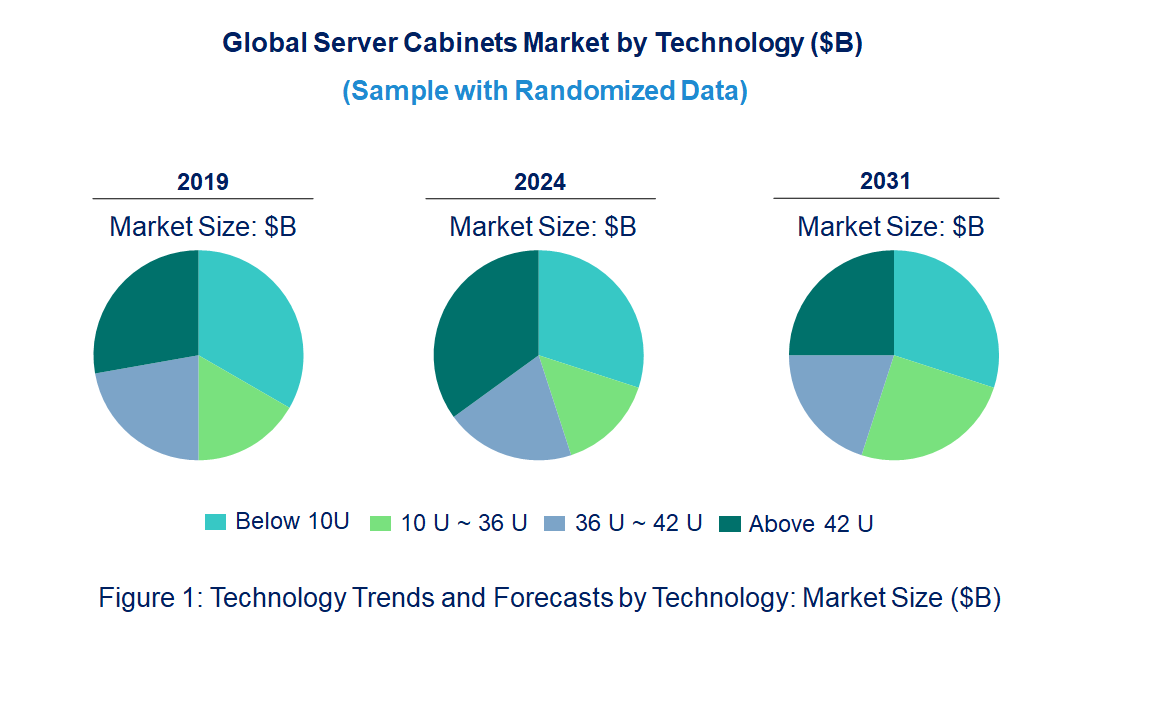
Emerging Trends in the Server Cabinets Market
Emerging trends are driven by new technology and shifting demands from a growing data center industry. The need for better energy efficiency, higher density configurations, and integration with cloud computing services is reshaping the market. Below are five key trends influencing the development of server cabinets:• Modular Server Cabinets: To implement flexible and scalable solutions in data centers, modular server cabinets are being increasingly used. Modular server cabinets can easily be reconfigured with multiple servers and other networking equipment for companies looking to scale up their operations without undergoing significant infrastructure changes.
• High-Density Server Cabinets for Efficiency: With the rising demand for high-performance computing and the explosion of data generation, there is a need for high-density server cabinets. The business can now fit more servers in less space with these cabinets, thus improving energy efficiency and space utilization while reducing the overall physical footprint of data centers.
• Integrated advanced cooling solutions are important because the increased heat load that occurs in higher-density servers requires it. Liquid cooling and air cooling systems have been embedded into server cabinets to help in thermal management, and therefore, ensure energy efficiency and longevity in hardware.
• IoT-enabled Smart Server Cabinets: The server cabinet market is increasingly witnessing the launch of IoT-based smart cabinets. These smart cabinets allow one to monitor temperature, humidity, power consumption, and rack utilization in real-time. This data helps data center managers optimize server performance, thus ensuring better security, knowing when maintenance is needed ahead of time, and enhancing operation efficiency.
• Sustainability and Energy Efficiency Energy-efficient server cabinets are in high demand as data centers look to reduce their environmental footprint. Innovations such as low-energy lighting, passive cooling techniques, and optimized airflow designs are helping to minimize energy consumption, thus making the server cabinet more sustainable and cost-effective in the long run. These trends suggest that the server cabinets market is experiencing a shift toward more efficient, flexible, and environmentally conscious solutions. Modular design, high-density configurations, integrated cooling, and IoT-based smart cabinets will continue to reshape data center infrastructure to meet higher demands in performance and sustainability.
Server Cabinets Market : Industry Potential, Technological Development, and Compliance Considerations
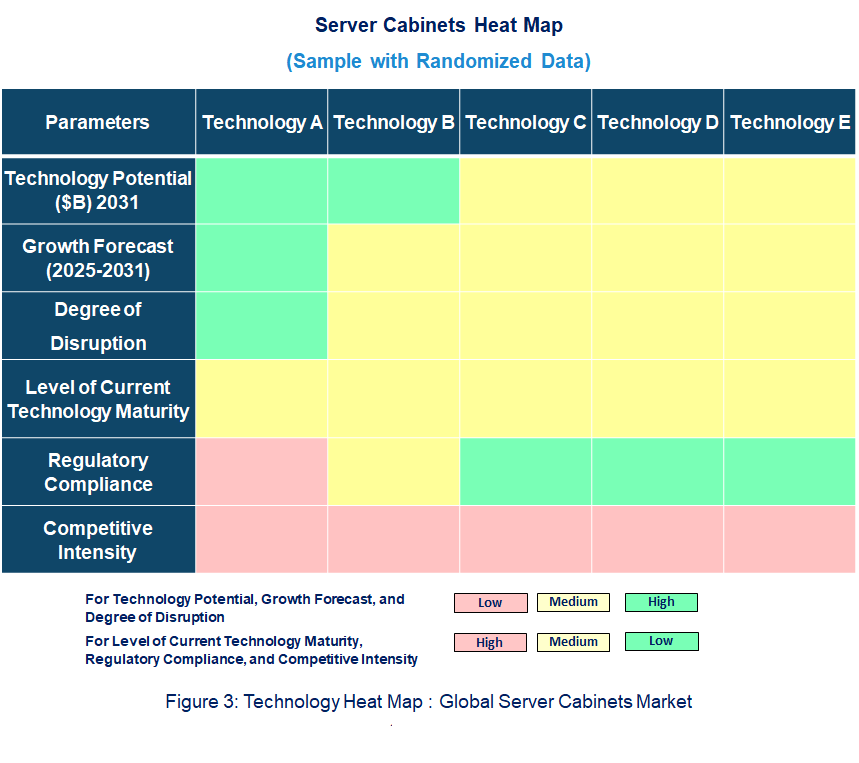
Server cabinets are essential for organizing, housing, and protecting server equipment in data centers and IT infrastructure. With the increasing demand for cloud computing, edge computing, and data processing, the server cabinets market is changing to meet the growing needs of modern technology.• Technology Potential: The server cabinet's potential is in the support for high-density servers, advanced cooling systems, and improved security features. With the increase in data centers and edge computing, server cabinets are evolving to support optimized airflow, energy efficiency, and high-performance computing. The growth of the market will be further driven by innovations such as modular designs, enhanced cable management, and IoT-based monitoring systems.
• Degree of Disruption: The server cabinet market is relatively stable, but innovations such as micro-modular data centers or advancements in serverless computing could disrupt the technology, reducing the need for traditional server housing solutions. Still, these disruptions are unlikely to displace server cabinets in the near term because physical infrastructure is still required in data centers.
• Current Technology Maturity: Server cabinets are a mature technology as well, where continuous improvement in designing, durability, and cooling capabilities in server cabinets are done. Current emphasis is in smart cabinets with integrated monitoring systems and sustainable cooling.
• Compliance with Regulation: Server cabinets need to comply with regulations in terms of fire safety, electrical efficiency, and cooling efficiency. Such products need to meet the international standard certifications of UL, RoHS, and energy efficiency standards for safety and environmental responsibility.
Recent Technological development in Server Cabinets Market by Key Players
The following are key players in the server cabinets market who have led innovation and development in server cabinets: Vertu Ltd, Vertiv, EATON, Schneider Electric, HPE, IBM, Nitto-Kogyo, Dell, Oracle, and ZHEJIANG SHIP ELECTRONICS TECHNOLOGY CO., LTD. The companies concentrate on efficiency, modularity, cooling systems, and integration with smart technology to meet growing demands in the data centre. Here are some recent key developments:• Vertiv: Vertiv launched the Vertiv Smart Row, a modular data center solution designed to optimize space and efficiency. The Smart Row integrates power, cooling, and monitoring systems into a single solution, making it easier for companies to deploy IT infrastructure with minimal effort and space.
• Vertiv: Vertiv also introduced its Liebert® DSE DX cooling solution; it has efficient cooling with a server cabinet design in high density. This technology solves the heat issues of modern data centers while decreasing the amount of energy consumption. Therefore, high-performance computing environments are offered a sustainable solution.
• EATON: EATON has unveiled Eaton 9SX UPS, which is integrated with server cabinets to offer unity of power protection. The unit comes with energy-efficient, high-performance technologies that enable data centers to have continuous uptime and improved reliability in operations while lowering total energy consumption.
• Schneider Electric: Schneider Electric's Schneider Uniflair series offers integrated cooling solutions with server cabinets. Their advanced cooling, monitoring, and management capabilities improve operational efficiency and energy use in high-density server environments. Schneider is also advancing its modular designs, which allow for faster deployment and scalability.
• HPE: HPE has been developing its HPE ProLiant DL series, which integrates its server cabinets with high-density configurations and advanced thermal management. These systems focus on energy efficiency and seamless management of complex workloads, providing businesses with more scalable and efficient server infrastructure.
• IBM: IBM continues to innovate with its IBM System x3650 M5 rack-mounted server cabinets that provide high performance, integrated management features, and advanced cooling. The systems are suited for cloud-based applications, high performance computing, and enterprise-level workloads.
• Dell: Dell introduces PowerEdge R740 server systems, offering optimized cooling as well as modular server cabinets. Its scalable and available in all varieties of power requirements for processing, making it suitable for any business that may require the flexibility of operations and a high density in their working environment.
• Oracle: Oracle has launched its Oracle Server X8-2 series with integrated cabinets that support high-density configurations and energy-efficient cooling. The advanced Oracle Cloud systems are integrated into the cabinets, which would ensure a seamless operation for businesses that are scaling their cloud infrastructure.
• ZHEJIANG SHIP ELECTRONICS TECHNOLOGY CO., LTD.: ZHEJIANG SHIP is focusing on the development of high-density, cost-effective server cabinets aimed at small to medium-sized businesses. Their products are designed to support various IT infrastructure needs with easy integration and optimized space and energy usage. These trends clearly show the direction of modular, energy-efficient, and high-density server cabinets. Innovative key players will elaborate on the growing scale of scalability, cooling, and sustainable solutions for data centers, allowing server infrastructure to be more flexible and efficient than ever.
Server Cabinets Market Driver and Challenges
The server cabinets market is growing at a really good pace due to some main drivers and faced with obstacles that can deter its growth. Here are the main drivers and obstacles of the market: The factors responsible for driving the server cabinets market include:• Increased Demand for Data Centers: The growth of cloud services, big data analytics, and the Internet of Things is driving an increase in demand for data centers. Such businesses and organizations move their operations to the cloud, making demand for efficient and scalable server cabinets grow.
• Growth in High-Performance Computing: With growing computational complexity, the demand for high-performance computing solutions increases. This creates a necessity to accommodate powerful servers, GPUs, and networking equipment with a maximum amount of space optimization while saving energy.
• Energy Efficiency Regulations and Sustainability Goals: A global push for energy efficiency and sustainability in IT infrastructure drives innovation in server cabinets. Companies are concentrating on making cabinets with enhanced cooling, airflow management, and energy efficiency in order to fulfill the demands of regulatory compliance and the reduction of environmental footprint.
• Modular and Scalable IT Infrastructure: Businesses are increasingly adopting modular and scalable IT infrastructure to meet their dynamic operational needs. Server cabinets that support modular configurations offer flexibility and easier upgrades, providing cost-effective solutions for data centers of all sizes. Challenges in the server cabinets market are:
• High Initial Cost of Advanced Server Cabinets: Although server cabinets result in long-term cost saving through energy efficiency and optimal space, the initial cost for high-performance and high-density cabinets is very high. It may be a problem for small businesses or organizations.
• Lack of Space in Current Data Centers. Most data centers face a lack of space, limiting the implementation of new server cabinet technologies. It may be costly or very inconvenient and time-consuming to retrofit an existing data center with server cabinets, especially in facilities not designed for high-density configurations.
• High-density cooling challenges: Increasing server densities raise significant heat generation problems from the servers. Though most high-density servers come with efficient cooling systems that maintain these at optimal operating temperatures, cooling solutions integrated with the cabinets have their complexities and costs, mainly in environments requiring precise thermal management. The driving forces behind the server cabinets market stem from the rising demand for high-performance computing, energy efficiency, and modular solutions. However, the challenges include high initial costs, space constraints, and cooling complexities that must be overcome to fully capitalize on these opportunities and satisfy the evolving needs of data centers.
List of Server Cabinets Companies
Companies in the market compete based on product quality offered. Major players in this market focus on expanding their manufacturing facilities, R&D investments, infrastructural development, and leverage integration opportunities across the value chain. With these strategies server cabinets companies cater to increasing demand, ensure competitive effectiveness, develop innovative products & technologies, reduce production costs, and expand their customer base. Some of the server cabinets companies profiled in this report include.• Vertu Ltd
• Vertiv
• EATON
• Schneider Electric
• HPE
• IBM
Server Cabinets Market by Technology
• Disruption Potential of Server Cabinet Technologies: Server cabinets in different U-sizes—Below 10U, 10U ~ 36U, 36U ~ 42U, and Above 42U—have varying disruption potentials. Below 10U cabinets are gaining traction in edge computing and small-scale IT due to space efficiency. Cabinets in the 10U ~ 36U range dominate mid-sized data centers. The 36U ~ 42U range is best suited for cloud services-type high-density applications. Above 42U cabinets are for big enterprises, and innovations in cooling and modularity are driving disruptions. Advances in energy efficiency and customizations will continue to shape the market.
• Competitive Intensity and Regulatory Compliance: Competitive intensity varies by U-size. Below 10U Cabinets are competitive with compact or modular systems for edge computing. The 10U ~ 36U segment is highly competitive in medium-sized data centers with bespoke solutions. Competition in high-density fields is very fierce in the 36U ~ 42U segment. Above 42U cabinets focus on super-large data centers. Regulation compliance is imperative for all, especially safety, thermal, and environmental compliance. More size means higher power consumption and cooling demand, and consequently, more rigid regulation requirements.
• Technology Readiness by Type: Less than 10U edge computing cabinets are mature and extensively deployed. The 10U ~ 36U size range is mature in data center applications, providing flexible and highly customizable solutions. The 36U ~ 42U size range is mature, but more suitable for large, dense setups; there is good readiness in big business. More than 42U cabinets are for huge centers, with high readiness but few applications. The most intensive competitive is in the range of 10U ~ 36U. In regard to safety and energy efficiency regulations, it is vital that all sizes comply. Safety and energy efficiency will have stringent standards on larger cabinets. Its applications range from low IT racks (Below 10U) to data centers (10U ~ 36U), high-density storage (36U ~ 42U), and large-scale data centers (Above 42U).
Server Cabinets Market Trend and Forecast by Technology [Value from 2019 to 2031]:
• Below 10U
• 10 U ~ 36 U
• 36 U ~ 42 U
• Above 42 U
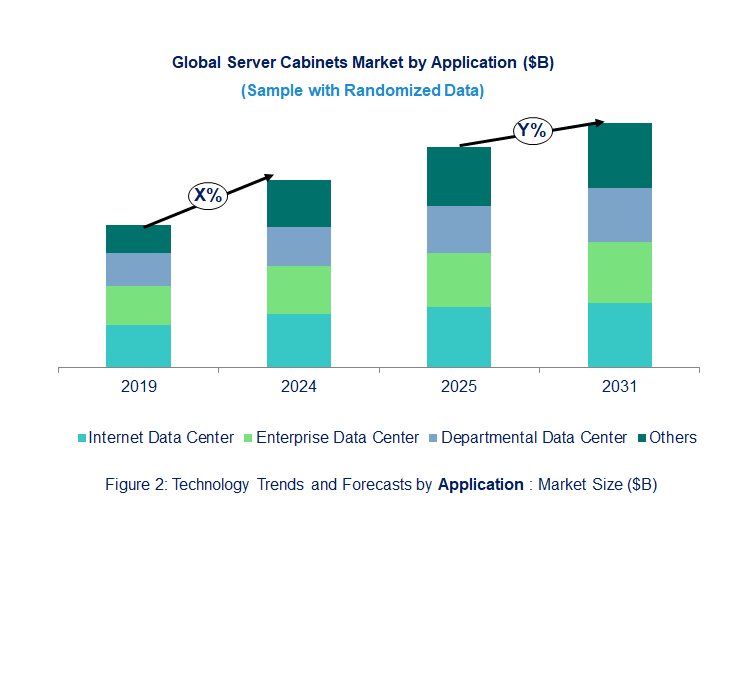
Server Cabinets Market Trend and Forecast by Application [Value from 2019 to 2031]:
• Internet Data Center
• Enterprise Data Center
• Departmental Data Center
• Others
Server Cabinets Market by Region [Value from 2019 to 2031]:
• North America
• Europe
• Asia Pacific
• The Rest of the World
• Latest Developments and Innovations in the Server Cabinets Technologies
• Companies / Ecosystems
• Strategic Opportunities by Technology Type
Features of the Global Server Cabinets Market
Market Size Estimates: Server cabinets market size estimation in terms of ($B). Trend and Forecast Analysis: Market trends (2019 to 2024) and forecast (2025 to 2031) by various segments and regions. Segmentation Analysis: Technology trends in the global server cabinets market size by various segments, such as application and technology in terms of value and volume shipments. Regional Analysis: Technology trends in the global server cabinets market breakdown by North America, Europe, Asia Pacific, and the Rest of the World. Growth Opportunities: Analysis of growth opportunities in different applications, technologies, and regions for technology trends in the global server cabinets market. Strategic Analysis: This includes M&A, new product development, and competitive landscape for technology trends in the global server cabinets market. Analysis of competitive intensity of the industry based on Porter’s Five Forces model.Table of Contents
Methodology
- In-depth interviews of the major players in this market
- Detailed secondary research from competitors’ financial statements and published data
- Extensive searches of published works, market, and database information pertaining to industry news, company press releases, and customer intentions
- A compilation of the experiences, judgments, and insights of Lucintel’s professionals, who have analyzed and tracked this market over the years.


Buy Now
Choose a license that fits your team. Instant PDF delivery.
Prices exclude taxes. Instant delivery. Custom licensing available on request.
Key Questions
- • What are some of the most promising potential, high-growth opportunities for the technology trends in the global server cabinets market by technology (below 10u, 10 u ~ 36 u, 36 u ~ 42 u, and above 42 u), application (internet data center, enterprise data center, departmental data center, and others), and region (North America, Europe, Asia Pacific, and the Rest of the World)?
- • Which technology segments will grow at a faster pace and why?
- • Which regions will grow at a faster pace and why?
- • What are the key factors affecting dynamics of different technology? What are the drivers and challenges of these technologies in the global server cabinets market?
- • What are the business risks and threats to the technology trends in the global server cabinets market?
- • What are the emerging trends in these technologies in the global server cabinets market and the reasons behind them?
- • Which technologies have potential of disruption in this market?
- • What are the new developments in the technology trends in the global server cabinets market? Which companies are leading these developments?
- • Who are the major players in technology trends in the global server cabinets market? What strategic initiatives are being implemented by key players for business growth?
- • What are strategic growth opportunities in this server cabinets technology space?
- • What M & A activities did take place in the last five years in technology trends in the global server cabinets market?


