
Quantum Computing Market
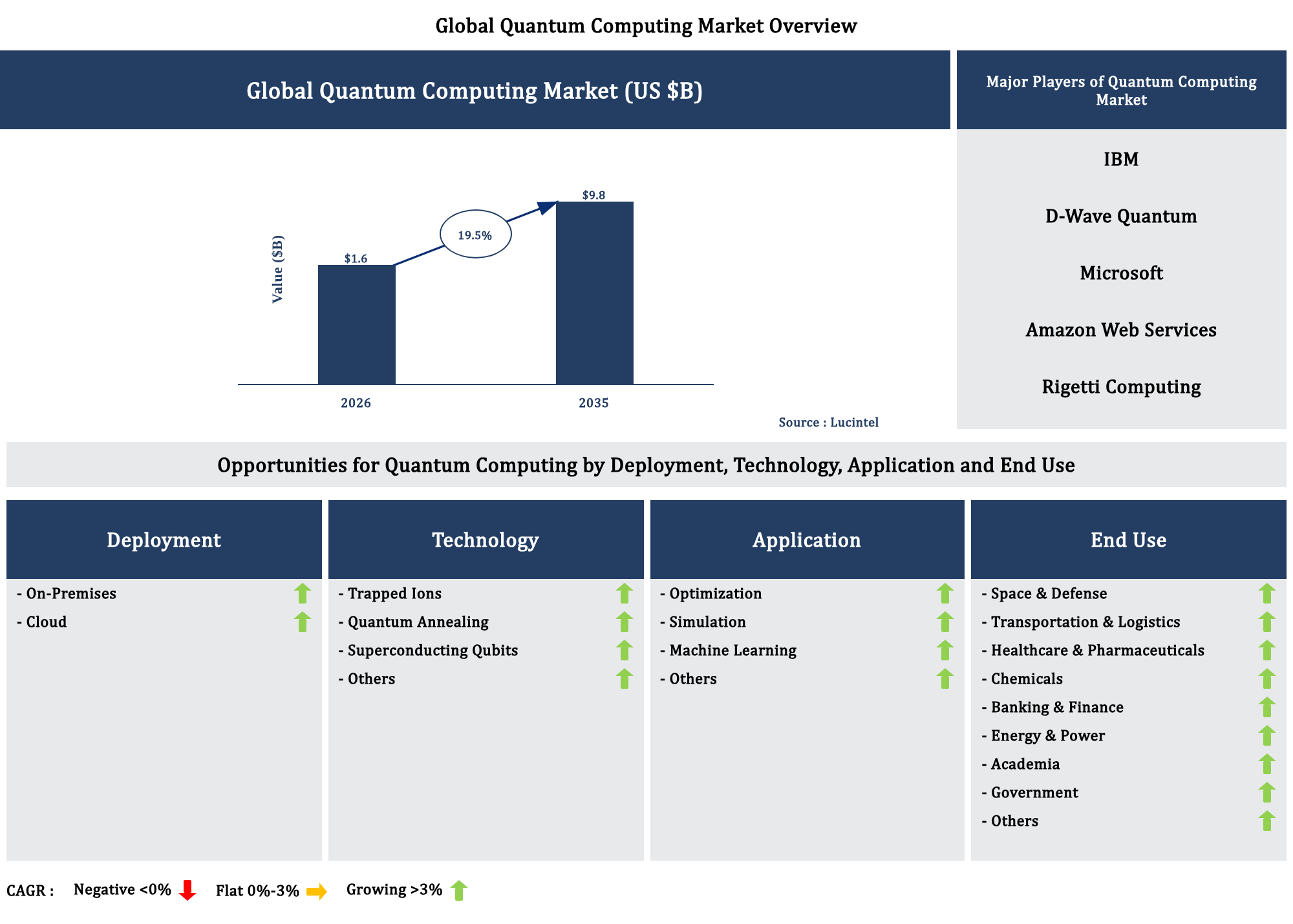
The future of the global quantum computing market looks promising with opportunities in the space & defense, transportation & logistic, healthcare & pharmaceutical, chemical, banking & finance, energy & power, academia, and government markets. The global quantum computing market is expected to reach an estimated $9.8 billion by 2035 with a CAGR of 19.5% from 2026 to 2035. The major drivers for this market are the rising demand for advanced computing in research fields, the growing adoption in financial modeling & risk analysis, and the increasing demand for high speed data processing.
Gain valuable insights for your business decisions with our comprehensive 150+ page report. Sample figures with some insights are shown below.
Emerging Trends in the Quantum Computing Market
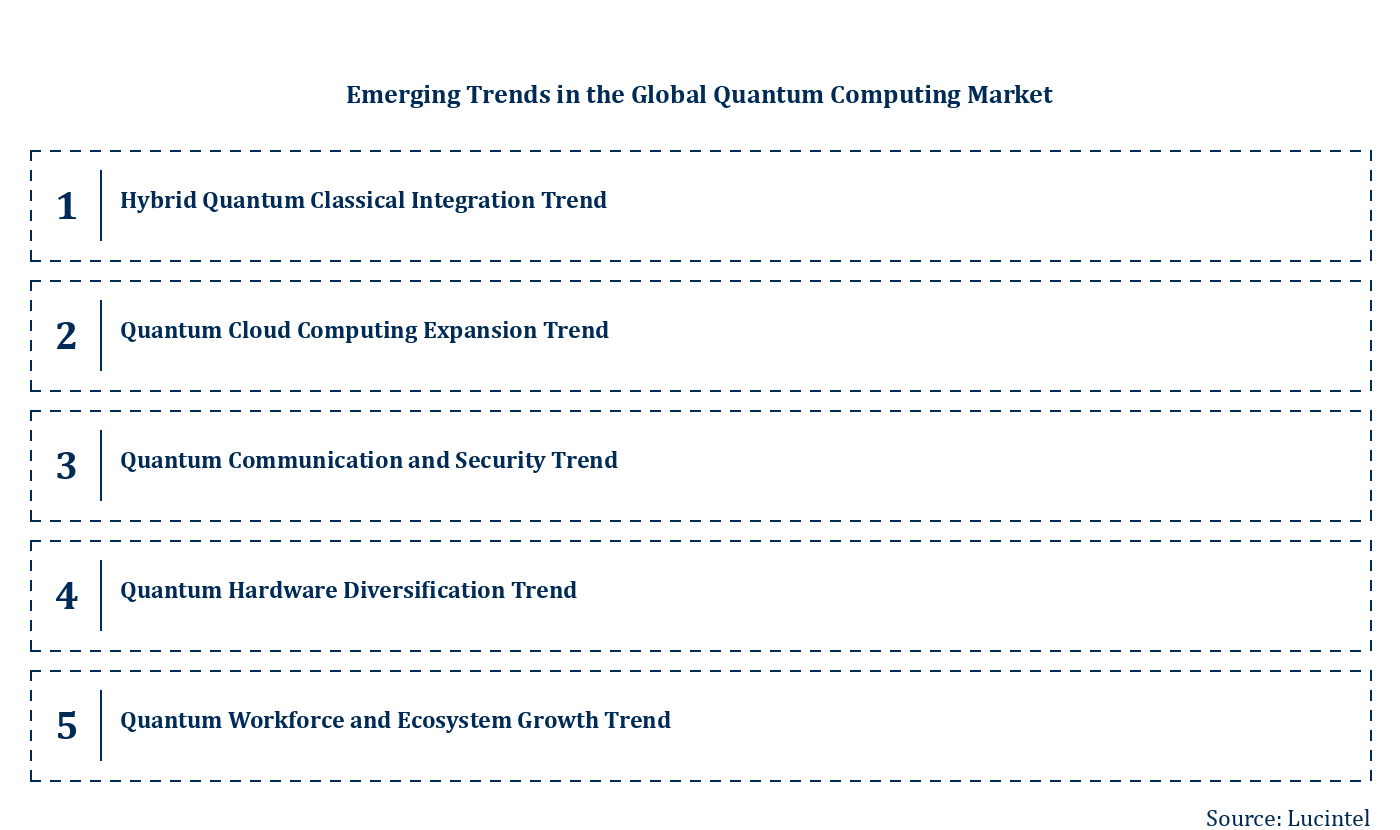
The quantum computing market is entering a transformative phase driven by rapid technological breakthroughs, increased global investment, and expanding real-world experimentation. What was once a purely theoretical field is now evolving into a competitive industrial landscape where governments and corporations are racing to achieve quantum advantage. Key advancements in qubit stability, error correction, hybrid quantum-classical systems, and cloud-based quantum access are accelerating adoption across industries such as pharmaceuticals, finance, logistics, and materials science. At the same time, collaboration between public institutions and private enterprises is strengthening, while geopolitical competition is pushing nations to invest heavily in quantum capabilities. These dynamics are shaping a fast-evolving ecosystem where scalability, reliability, and commercialization are becoming central priorities.
These trends are reshaping the quantum computing market by accelerating commercialization, expanding accessibility through cloud platforms, and strengthening security-driven applications. The convergence of hybrid systems, diversified hardware, and growing talent pipelines is pushing the industry closer to real-world adoption. At the same time, global competition and cybersecurity concerns are ensuring sustained investment and innovation. Together, these developments are transforming quantum computing from a research-driven field into a strategically important technology ecosystem with long-term industrial and geopolitical significance.
Recent Developments in the Quantum Computing Market
The quantum computing market is progressing from experimental research toward early commercial deployment, driven by rapid advancements in hardware, software, and global investment initiatives. Governments and enterprises are increasingly prioritizing quantum technologies for applications in optimization, cryptography, materials science, and artificial intelligence integration. The market is witnessing strong collaboration between academia, startups, and large technology companies, which is accelerating innovation cycles. At the same time, competition among leading nations is intensifying, with strategic funding programs and infrastructure development shaping the direction of growth and long-term commercialization pathways across multiple industries.
These developments are collectively transforming the quantum computing market by accelerating commercialization, expanding accessibility, and strengthening global competitiveness. Advances in hardware scaling and diversified architectures are improving performance, while cloud platforms are democratizing access to quantum resources. Government initiatives are providing strong foundational support, and quantum communication networks are redefining cybersecurity standards. Together, these factors are driving the transition from experimental research to early-stage industrial adoption. As innovation continues to mature, the market is expected to experience faster integration into real-world applications across multiple high-value sectors worldwide.
Strategic Growth Opportunities in the Quantum Computing Market
quantum computing market is emerging as a transformative technology with strong strategic growth potential across multiple application areas including optimization, cryptography, materials science, artificial intelligence, and financial modeling. As enterprises and governments invest heavily in quantum research and infrastructure, practical use cases are beginning to take shape. The convergence of cloud access, hybrid computing models, and hardware advancements is accelerating experimentation. Industries are increasingly exploring quantum solutions to solve complex problems beyond the reach of classical computing, creating new commercial pathways and long-term value creation opportunities globally.
These strategic growth opportunities highlight how quantum computing is transitioning from theoretical research to practical, high-value applications across industries. Optimization, drug discovery, finance, artificial intelligence, and cybersecurity represent key areas where quantum capabilities are beginning to demonstrate measurable impact. As hardware and software ecosystems mature, adoption is expected to accelerate, enabling broader commercialization. The integration of quantum solutions into enterprise workflows will reshape decision-making, enhance computational efficiency, and strengthen security frameworks. Collectively, these opportunities are positioning quantum computing as a foundational technology for future industrial transformation and digital innovation.
Quantum Computing Market Drivers and Challenges
The quantum computing market is experiencing rapid transformation driven by a combination of technological innovation, increasing private and public investment, and evolving regulatory frameworks. Major drivers include advancements in quantum hardware, expansion of cloud-based quantum services, and growing enterprise demand for high-performance computing solutions. At the same time, the market faces significant challenges related to scalability, error correction, talent shortages, and high infrastructure costs. Regulatory concerns surrounding encryption and data security further shape development pathways. Together, these factors are influencing the pace of commercialization and determining how quickly quantum computing can transition from experimental research to practical industrial applications across global markets.
The factors responsible for driving the quantum computing market include:-
The challenges in the quantum computing market are:
The quantum computing market is being shaped by strong growth drivers such as rapid hardware advancements, expanding cloud access, government initiatives, rising demand for high-performance computing, and increasing focus on cybersecurity. These factors are accelerating innovation and pushing the industry closer to real-world applications. However, significant challenges including high costs, technical limitations, and workforce shortages continue to restrict widespread adoption. The balance between these drivers and challenges is defining the pace of commercialization. As technological breakthroughs and talent development progress, the market is expected to transition gradually from experimental research toward scalable and industry-ready quantum computing solutions.
List of Quantum Computing Market Companies
Companies in the market compete on the basis of product quality offered. Major players in this market focus on expanding their manufacturing facilities, R&D investments, infrastructural development, and leverage integration opportunities across the value chain. Through these strategies quantum computing market companies cater increasing demand, ensure competitive effectiveness, develop innovative products & technologies, reduce production costs, and expand their customer base. Some of the quantum computing market companies profiled in this report include-
Quantum Computing Market by Segment
The study includes a forecast for the global quantum computing market by deployment, technology, application, end use, and region.
Country Wise Outlook for the Quantum Computing Market
The quantum computing market has rapidly shifted from experimental research to strategic national competition, with 2026 marking a period of accelerated commercialization, government funding expansion, and early industrial deployments. Across major economies such as the United States, China, Germany, India, and Japan, developments are being shaped by increasing public–private partnerships, breakthroughs in qubit stability, diversification of hardware architectures, and growing interest in quantum networking and encryption. Governments are treating quantum technology as a critical pillar for economic security, defense modernization, and future AI integration. At the same time, companies are advancing toward scalable systems, early revenue generation, and cloud-based quantum access. These global movements collectively indicate that quantum computing is entering a phase of real-world testing and limited deployment across industries including finance, pharmaceuticals, and materials science.
Features of the Quantum Computing Market
Top 5 Companies
Table of Contents
List of Figures
List of Tables
Methodology
Lucintel has been in the business of market research and management consulting since 2000 and has published over 1000 market intelligence reports in various markets / applications and served over 1,000 clients worldwide. This study is a culmination of four months of full-time effort performed by Lucintel's analyst team. The analysts used the following sources for the creation and completion of this valuable report:
- In-depth interviews of the major players in this market
- Detailed secondary research from competitors' financial statements and published data
- Extensive searches of published works, market, and database information pertaining to industry news, company press releases, and customer intentions
- A compilation of the experiences, judgments, and insights of Lucintel's professionals, who have analyzed and tracked this market over the years.
Extensive research and interviews are conducted across the supply chain of this market to estimate market share, market size, trends, drivers, challenges, and forecasts. Below is a brief summary of the primary interviews that were conducted by job function for this report.

Thus, Lucintel compiles vast amounts of data from numerous sources, validates the integrity of that data, and performs a comprehensive analysis. Lucintel then organizes the data, its findings, and insights into a concise report designed to support the strategic decision-making process. The figure below is a graphical representation of Lucintel's research process.

Buy Now
Choose a license that fits your team. Instant PDF delivery.
Prices exclude taxes. Instant delivery. Custom licensing available on request.
Frequently Asked Questions
What is the quantum computing market size?
What is the growth forecast for quantum computing market?
What are the major drivers influencing the growth of the quantum computing market?
What are the major segments for quantum computing market?
Who are the key quantum computing market companies?
Some of the key quantum computing companies are as follows:
- IBM
- D-Wave Quantum
- Microsoft
- Amazon Web Services
- Rigetti Computing
- Fujitsu
- Hitachi
Which quantum computing market segment will be the largest in future?
In quantum computing market, which region is expected to be the largest in next 8 years?
Do we receive customization in this report?
Key Questions
- • What are some of the most promising, high-growth opportunities for the quantum computing market by deployment (on-premises and cloud), technology (trapped ions, quantum annealing, superconducting qubits, and others), application (optimization, simulation, machine learning, and others), end use (space & defense, transportation & logistics, healthcare & pharmaceuticals, chemicals, banking & finance, energy & power, academia, government, and others), and region (North America, Europe, Asia Pacific, and the Rest of the World)?
- • Which segments will grow at a faster pace and why?
- • Which region will grow at a faster pace and why?
- • What are the key factors affecting market dynamics? What are the key challenges and business risks in this market?
- • What are the business risks and competitive threats in this market?
- • What are the emerging trends in this market and the reasons behind them?
- • What are some of the changing demands of customers in the market?
- • What are the new developments in the market? Which companies are leading these developments?
- • Who are the major players in this market? What strategic initiatives are key players pursuing for business growth?
- • What are some of the competing products in this market and how big of a threat do they pose for loss of market share by material or product substitution?
- • What M&A activity has occurred in the last 5 years and what has its impact been on the industry?


