
Polyolefin Film Market
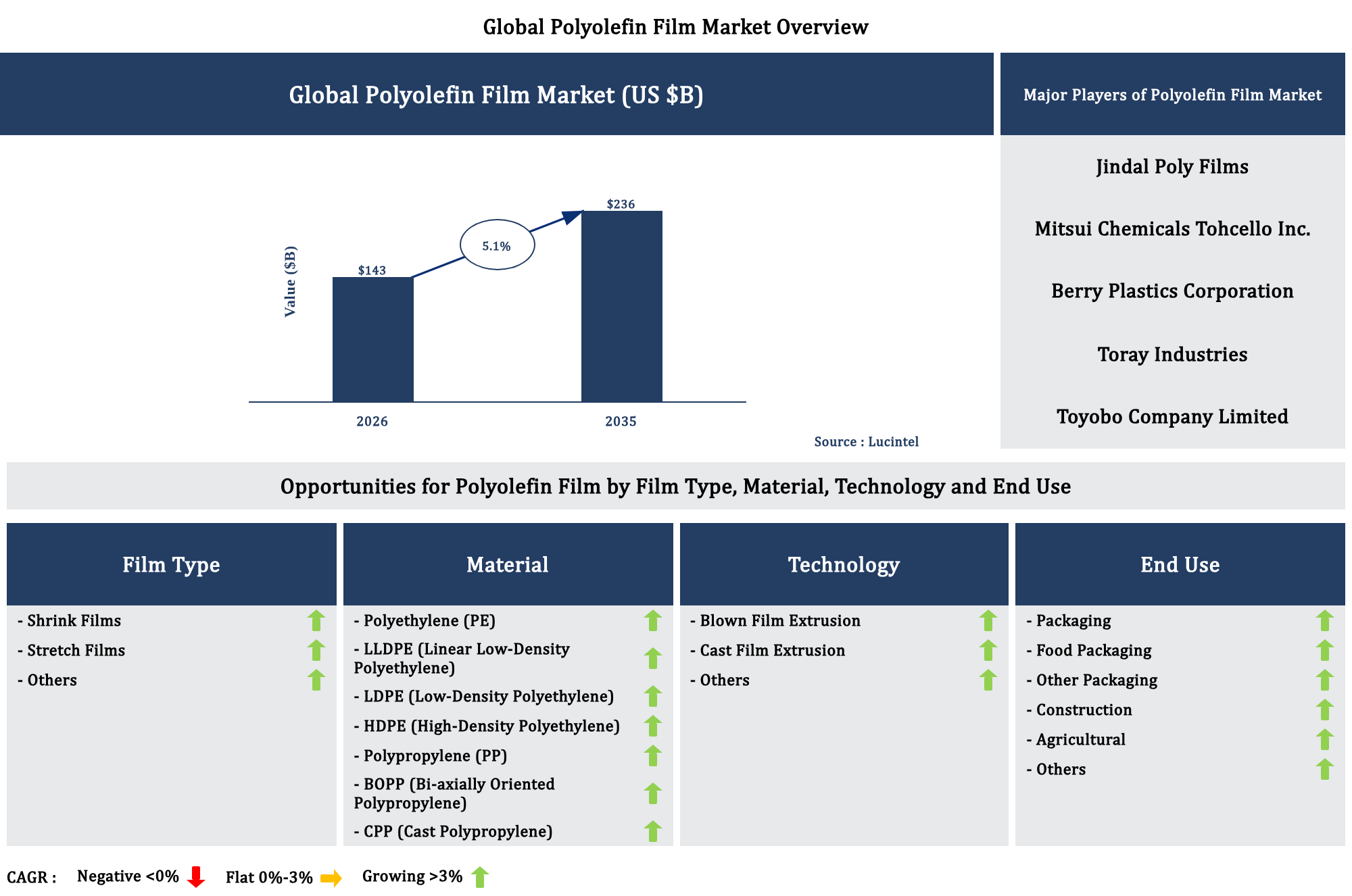
The future of the global polyolefin film market looks promising with opportunities in the packaging, food packaging, other packaging, construction, and agricultural markets. The global polyolefin film market is expected to reach an estimated $236 billion by 2035 with a CAGR of 5.1% from 2026 to 2035. The major drivers for this market are the growing demand for lightweight materials, the increasing demand for focus on sustainable packaging solutions, and the rising demand for agriculture films.
Gain valuable insights for your business decisions with our comprehensive 150+ page report. Sample figures with some insights are shown below.
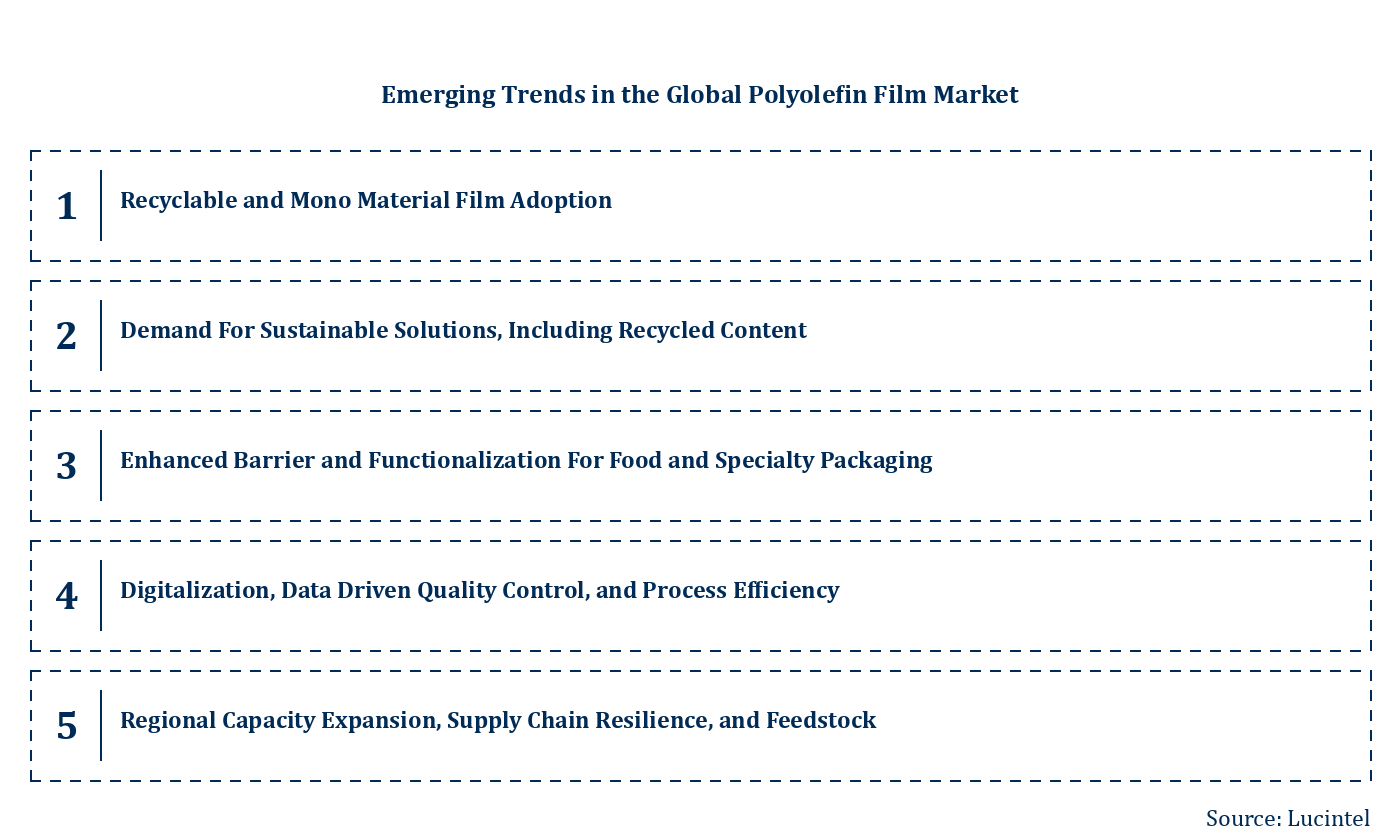
Emerging Trends in the Polyolefin Film Market
The polyolefin film market is evolving rapidly as customers demand better performance, lower cost, and improved sustainability across packaging, industrial materials, agriculture, and specialty applications. Key drivers include regulations restricting plastic waste, rising pressure to reduce carbon footprints, and technological advances in film extrusion, coating, and barrier design. At the same time, supply chain volatility and raw material price swings push manufacturers toward more efficient processes and diversified feedstocks. These forces are shaping product portfolios, production footprints, and go to market strategies. Emerging trends increasingly focus on recyclable structures, downgauging, performance upgrades, digitalization, and localized capacity, which together influence pricing, adoption, and competitive dynamics.
these Trends Are Reshaping The polyolefin film market By Changing What Customers Value: Greater recyclability and measured sustainability, better performance without added material weight, and more consistent quality at lower cost. Digitalization and efficiency improvements improve margins while supporting compliance and traceability. Meanwhile, regional expansion and feedstock diversification strengthen resilience amid volatility. Overall, the market is moving toward smarter, circular, and higher value film solutions that balance regulatory expectations, operational efficiency, and end user performance requirements.
Recent Developments in the Polyolefin Film Market
The polyolefin film market are reshaping how manufacturers meet tightening regulations, sustainability expectations, and shifting packaging needs. Producers are redesigning film structures for recyclability, increasing recycled-content feedstocks, and upgrading coating or barrier layers to maintain product shelf life. At the same time, demand for flexible packaging, food safety, and e-commerce protection is driving capacity expansions and innovation in converting. These five developments highlight where investment is flowing and how value chains are adapting across global packaging markets.
Overall, the polyolefin film market is shifting from volume-only competition toward performance plus sustainability. Recycled-content and design-for-recycling strategies are improving compliance and reducing lifecycle impact. Better barrier and lightweight structures are preserving product quality while cutting material footprints. Bio-based and compostable alternatives are expanding options for high-scrutiny applications. Digital printing and automation raise converter flexibility and support smart labeling. Together, these developments are to increase demand, reshape supplier partnerships, and stabilize prices.
Strategic Growth Opportunities in the Polyolefin Film Market
The polyolefin film market is experiencing strong growth driven by increasing demand across packaging, agriculture, construction, and industrial applications. Rising consumer preference for lightweight, durable, and cost-effective materials is creating new opportunities for manufacturers. Technological advancements and sustainability initiatives are further shaping market expansion. Strategic growth opportunities are emerging in key applications where performance, efficiency, and environmental considerations are critical, enabling companies to innovate, expand capacity, and strengthen their presence in both developed and emerging markets.
The polyolefin film market is poised for sustained growth as demand expands across packaging, food, agriculture, construction, and sustainable applications. These opportunities are driven by changing consumer behavior, technological advancements, and increasing environmental awareness. Companies that focus on innovation, product quality, and sustainability will gain a competitive advantage. Strategic investments in high-growth applications will enable market players to strengthen their position and capture emerging opportunities, ensuring long-term development and resilience in an increasingly competitive global market landscape.
Polyolefin Film Market Drivers and Challenges
The polyolefin film markets are shaped by interconnected technological, economic, and regulatory forces. On the technology side, improvements in resin quality, film extrusion, and coating methods influence barrier performance, heat resistance, and optical properties, directly affecting adoption in packaging and industrial uses. Economically, raw material pricing, capacity expansions, and demand growth from food, agriculture, construction, and consumer goods determine margins and procurement decisions. Regulatory factors including plastic waste rules, food contact standards, and sustainability reporting requirements also affect material selection, recycling pathways, and labeling obligations. Together, these drivers and challenges determine product development priorities, cost structures, and long term market resilience.
The factors responsible for driving the polyolefin film market include:-
The challenges facing the polyolefin film market include:
Conclusion:
The polyolefin film market is driven by rising flexible packaging consumption, continuous advancements in extrusion and performance design, sustainability and circular economy momentum, and expanding industrial and specialty applications. These forces support product differentiation, conversion efficiency, and new end market penetration. However, the market faces meaningful challenges from raw material price volatility, tightening regulatory requirements tied to waste reduction and food safety, and escalating performance expectations in high speed converting environments. Together, these dynamics influence investment decisions, margins, and product roadmaps. Companies that manage cost risk, adapt formulations for compliance and recyclability, and maintain stable quality at scale are best positioned for sustained growth.
List of Polyolefin Film Market Companies
Companies in the market compete on the basis of product quality offered. Major players in this market focus on expanding their manufacturing facilities, R&D investments, infrastructural development, and leverage integration opportunities across the value chain. Through these strategies polyolefin film market companies cater increasing demand, ensure competitive effectiveness, develop innovative products & technologies, reduce production costs, and expand their customer base. Some of the polyolefin film market companies profiled in this report include-
Polyolefin Film Market by Segment
The study includes a forecast for the global polyolefin film market by film type, material, technology, end use, and region.
Country Wise Outlook for the Polyolefin Film Market
The polyolefin film market are increasingly shaped by packaging demand, lightweighting needs, and tighter sustainability regulations across major economies. In the United States, supply chain normalization and strong retail and food packaging consumption are driving adoption of flexible films with improved sealing and barrier performance. In China, large-scale capacity additions and shifting export dynamics are pushing producers toward higher value grades, while recycled-content pathways gain momentum. Germany’s market is influenced by EU packaging rules, chemical recycling pilots, and demand for recyclable mono-material structures. India and Japan are seeing growth tied to food, pharma, and e commerce logistics, alongside material efficiency and recycling initiatives.
Features of the Polyolefin Film Market
Top 5 Companies
Table of Contents
List of Figures
List of Tables
Methodology
Lucintel has been in the business of market research and management consulting since 2000 and has published over 1000 market intelligence reports in various markets / applications and served over 1,000 clients worldwide. This study is a culmination of four months of full-time effort performed by Lucintel's analyst team. The analysts used the following sources for the creation and completion of this valuable report:
- In-depth interviews of the major players in this market
- Detailed secondary research from competitors' financial statements and published data
- Extensive searches of published works, market, and database information pertaining to industry news, company press releases, and customer intentions
- A compilation of the experiences, judgments, and insights of Lucintel's professionals, who have analyzed and tracked this market over the years.
Extensive research and interviews are conducted across the supply chain of this market to estimate market share, market size, trends, drivers, challenges, and forecasts. Below is a brief summary of the primary interviews that were conducted by job function for this report.

Thus, Lucintel compiles vast amounts of data from numerous sources, validates the integrity of that data, and performs a comprehensive analysis. Lucintel then organizes the data, its findings, and insights into a concise report designed to support the strategic decision-making process. The figure below is a graphical representation of Lucintel's research process.

Buy Now
Choose a license that fits your team. Instant PDF delivery.
Prices exclude taxes. Instant delivery. Custom licensing available on request.
Frequently Asked Questions
What is the polyolefin film market size?
What is the growth forecast for polyolefin film market?
What are the major drivers influencing the growth of the polyolefin film market?
What are the major segments for polyolefin film market?
Who are the key polyolefin film market companies?
Some of the key polyolefin film companies are as follows:
- Jindal Poly Films
- Mitsui Chemicals Tohcello Inc.
- Berry Plastics Corporation
- Toray Industries
- Toyobo Company Limited
- Amcor Flexible Limited
- Innovia Films
- Vibac Group
- Garware Polyester Limited
- Uflex Limited.
Which polyolefin film market segment will be the largest in future?
In polyolefin film market, which region is expected to be the largest in next 8 years?
Do we receive customization in this report?
Key Questions
- • What are some of the most promising, high-growth opportunities for the polyolefin film market by film type (shrink films, stretch films, and others), material (polyethylene (PE), LLDPE (linear low-density polyethylene), LDPE (low-density polyethylene), HDPE (high-density polyethylene), polypropylene (PP), BOPP (Bi-axially oriented polypropylene), and CPP (cast polypropylene)), technology (blown film extrusion, cast film extrusion, and others), end use (packaging, food packaging, other packaging, construction, agricultural, and others), and region (North America, Europe, Asia Pacific, and the Rest of the World)?
- • Which segments will grow at a faster pace and why?
- • Which region will grow at a faster pace and why?
- • What are the key factors affecting market dynamics? What are the key challenges and business risks in this market?
- • What are the business risks and competitive threats in this market?
- • What are the emerging trends in this market and the reasons behind them?
- • What are some of the changing demands of customers in the market?
- • What are the new developments in the market? Which companies are leading these developments?
- • Who are the major players in this market? What strategic initiatives are key players pursuing for business growth?
- • What are some of the competing products in this market and how big of a threat do they pose for loss of market share by material or product substitution?
- • What M&A activity has occurred in the last 7 years and what has its impact been on the industry?


