
Report Feature
Polyglycerol Market Trends and Forecast
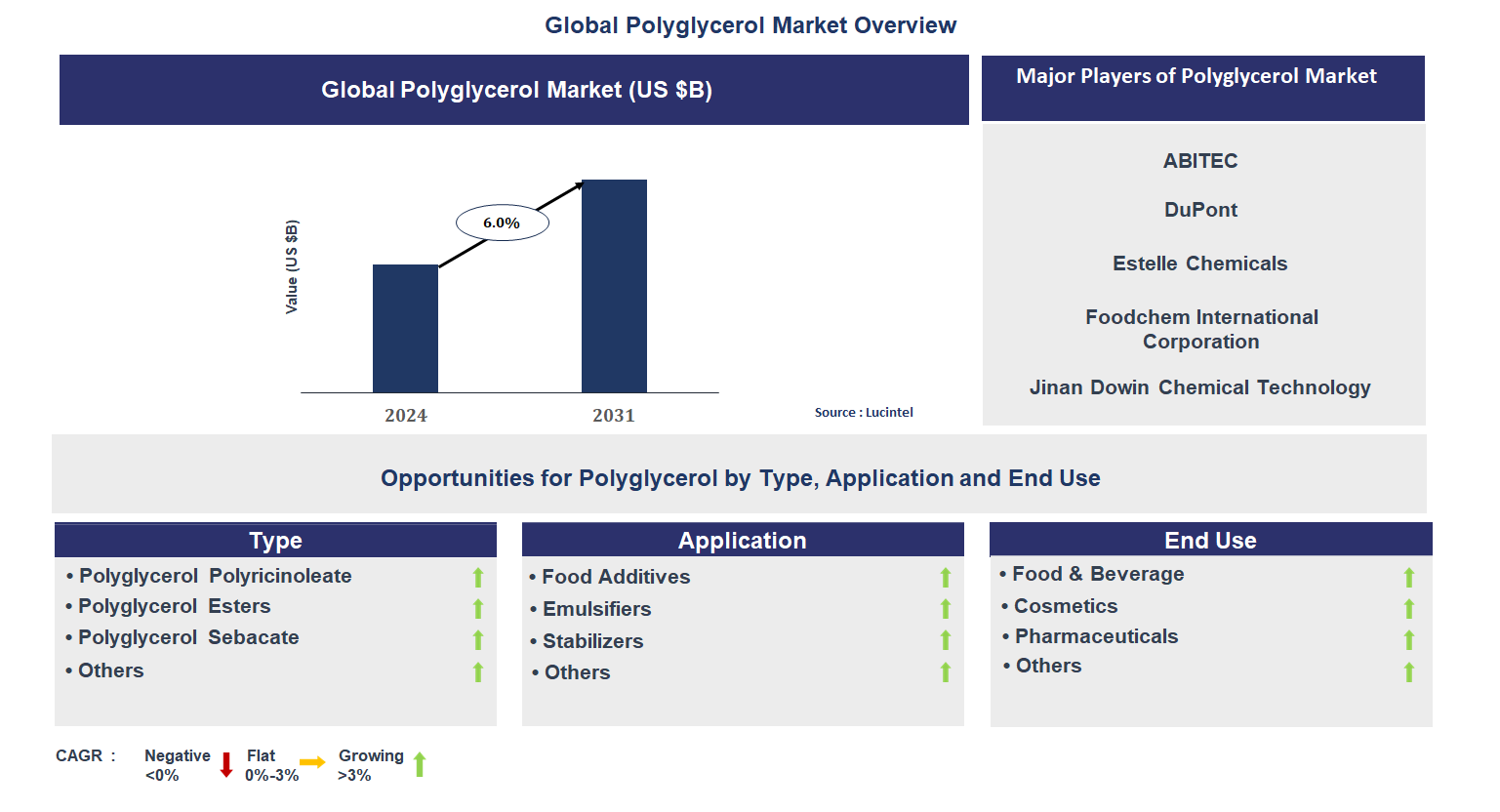
The future of the global polyglycerol market looks promising with opportunities in the food & beverage, cosmetics, and pharmaceutical markets. The global polyglycerol market is expected to grow with a CAGR of 6% from 2025 to 2031. The major drivers for this market are the increasing use of polyglycerol in cosmetics, the rising demand for natural food emulsifiers, and the growing preference for eco-friendly surfactants.• Lucintel forecasts that, within the type category, polyglycerol polyricinoleate is expected to witness the highest growth over the forecast period.
• Within the end use category, cosmetics is expected to witness the highest growth.
• In terms of region, APAC is expected to witness the highest growth over the forecast period. Gain valuable insights for your business decisions with our comprehensive 150+ page report. Sample figures with some insights are shown below.
Emerging Trends in the Polyglycerol Market
The polyglycerol market is evolving with key emerging trends that reflect the shifting consumer preferences, sustainability initiatives, and innovation in production processes. These trends are shaping the future of the market and influencing strategic business decisions.• Rising Demand for Clean-Label Products: Consumers are increasingly seeking products with fewer artificial additives, driving demand for polyglycerol as a natural emulsifier in food and beverages. As clean-label products become a growing trend, polyglycerol serves as an ideal solution to meet the consumer demand for transparency and natural ingredients in food formulations.
• Sustainability and Eco-friendly Production Methods: Sustainability is becoming a dominant trend in the polyglycerol market, with manufacturers adopting bio-based production methods. Eco-friendly production processes not only align with global environmental concerns but also cater to the increasing consumer demand for environmentally responsible products. The trend is pushing companies to innovate and produce sustainable, renewable ingredients like polyglycerol.
• Growth in Personal Care and Cosmetics: Polyglycerol is gaining popularity in the cosmetics sector due to its emulsifying properties and mildness, making it ideal for skincare, haircare, and other personal care formulations. As the beauty industry shifts toward more natural, safe, and effective ingredients, polyglycerol’s role in personal care products is expected to expand significantly.
• Increasing Use in Pharmaceuticals: Polyglycerol is gaining traction in the pharmaceutical industry for its potential use in drug delivery systems, topical formulations, and other pharmaceutical products. As the demand for bio-based ingredients in pharmaceutical formulations grows, polyglycerol is being integrated as a multifunctional ingredient that enhances the stability and performance of various medications.
• Demand for Multi-functional Ingredients: Polyglycerol is gaining importance as a multifunctional ingredient in various industries. Its ability to act as an emulsifier, stabilizer, and surfactant in different formulations is making it increasingly attractive to manufacturers. This demand for multifunctionality is driving its adoption in multiple sectors, from food & beverages to personal care and beyond. These emerging trends highlight the increasing demand for natural, sustainable, and multifunctional ingredients in the polyglycerol market. As consumer preferences continue to evolve, these trends are reshaping the market, encouraging manufacturers to innovate and invest in eco-friendly production methods, cleaner labels, and expanded applications.

Recent Development in the Polyglycerol Market
The polyglycerol market has seen notable developments in recent years, with advancements in production technology, growing demand in various sectors, and increased focus on sustainability. These developments are driving the market’s growth, with companies leveraging innovation and strategic investments to cater to the evolving needs of consumers and businesses.• Advancements in Bio-based Production: A key development in the polyglycerol market is the shift toward bio-based production. Companies are investing in sustainable production methods to create polyglycerol from renewable resources, responding to consumer demand for environmentally friendly ingredients. Bio-based polyglycerol is gaining traction in food, cosmetics, and pharmaceuticals, aligning with sustainability trends.
• Adoption in Clean-Label Foods: As the demand for clean-label food products increases, polyglycerol is gaining popularity as a natural emulsifier. Manufacturers are incorporating polyglycerol into food products to meet consumer preferences for simpler, more transparent ingredients. This shift has opened new growth avenues for polyglycerol in the food & beverage sector, where natural ingredients are increasingly valued.
• Rise in Polyglycerol-based Cosmetics: The growing interest in natural and non-toxic ingredients has fueled the use of polyglycerol in cosmetics and personal care products. Polyglycerol’s mildness and emulsifying properties make it an ideal ingredient for skincare and haircare products, helping brands align with the rising demand for cleaner, safer formulations. The trend is expected to continue driving market growth.
• Expansion in the Pharmaceutical Sector: Polyglycerol’s multifunctional properties have led to its integration in pharmaceutical applications, particularly in drug delivery systems and topical products. As the demand for natural ingredients in pharmaceuticals rises, polyglycerol’s role in enhancing drug stability and performance is becoming more pronounced, contributing to its growing market presence in the sector.
• Growing Market in Emerging Economies: Emerging markets, particularly in Asia-Pacific, are witnessing increased demand for polyglycerol due to the rising middle class, health awareness, and a shift toward natural products. In countries like India and China, the demand for polyglycerol in food, personal care, and pharmaceuticals is expanding as consumer preferences evolve toward more eco-friendly and health-conscious options. Recent developments in the polyglycerol market emphasize sustainability, natural formulations, and multi-functional applications across sectors like food, cosmetics, and pharmaceuticals. Companies are responding to consumer trends by investing in bio-based production methods and diversifying product offerings, helping to drive the continued growth of the polyglycerol market.
Strategic Growth Opportunities in the Polyglycerol Market
As the polyglycerol market continues to grow, there are numerous strategic opportunities for expansion across key applications. Companies that can effectively leverage these opportunities are well-positioned to tap into the increasing demand for natural, sustainable ingredients in multiple industries.• Opportunities in Clean-Label Foods: The growing demand for clean-label food products provides a significant growth opportunity for polyglycerol. Its natural emulsifying and stabilizing properties make it an ideal choice for food manufacturers looking to meet consumer demand for simple, transparent ingredients. This trend is expected to continue to drive growth in the food & beverage sector.
• Expansion in Cosmetics and Personal Care: Polyglycerol’s use in cosmetics is expanding due to its gentle emulsifying properties and mildness. As consumers seek more natural, safe ingredients in their beauty products, there is a significant opportunity for polyglycerol-based formulations in skincare, haircare, and other personal care products. This trend will likely continue as consumer preferences for clean beauty products grow.
• Growth in Pharmaceutical Applications: Polyglycerol’s potential use in pharmaceutical applications, such as drug delivery systems and topical formulations, presents a significant opportunity for growth. The pharmaceutical industry’s shift towards more natural ingredients and sustainable formulations will likely drive demand for polyglycerol, particularly as the market for bio-based ingredients continues to expand.
• Bio-based Production and Sustainability: With increasing demand for sustainable and bio-based ingredients, there is a strategic opportunity for companies to invest in the development of polyglycerol through eco-friendly and renewable production methods. This would appeal to environmentally conscious consumers and align with the growing trend of sustainability across industries.
• Untapped Markets in Emerging Economies: Emerging economies, particularly in Asia-Pacific and Latin America, offer significant growth potential for polyglycerol. Rising incomes, health awareness, and consumer demand for natural products present a strategic opportunity for manufacturers to expand their market presence in these regions, particularly in the food, cosmetics, and pharmaceuticals sectors. The polyglycerol market presents numerous strategic growth opportunities, particularly in the food, cosmetics, pharmaceutical, and emerging market sectors. Companies that invest in sustainable production, clean-label offerings, and multifunctional applications will be well-positioned to capture these opportunities
Polyglycerol Market Driver and Challenges
The polyglycerol market is influenced by various technological, economic, and regulatory factors that drive growth, while also facing certain challenges. These drivers and challenges shape the competitive landscape and market dynamics across industries such as cosmetics, food, pharmaceuticals, and more. Below, we explore the key drivers and challenges influencing the polyglycerol market. The factors responsible for driving the polyglycerol market include: 1. Consumer Demand for Natural Products: The rising consumer preference for natural, eco-friendly ingredients is a key driver for the polyglycerol market. As consumers increasingly choose cleaner, safer products, polyglycerol’s natural, non-toxic properties make it an attractive choice in cosmetics, food, and pharmaceuticals. 2. Sustainability and Bio-based Manufacturing: With the growing focus on sustainability, there is a greater emphasis on using bio-based, renewable resources in production. Polyglycerol, derived from vegetable oils, aligns with this shift, positioning it as a favored ingredient in industries focused on reducing their carbon footprint and supporting sustainable manufacturing practices. 3. Regulatory Push for Safer Ingredients: Governments worldwide are tightening regulations on chemicals used in food, cosmetics, and pharmaceuticals. The growing regulatory support for safe, non-toxic ingredients creates a favorable environment for polyglycerol, which is viewed as a safer, more sustainable alternative to synthetic emulsifiers and stabilizers. 4. Expanding Applications in Food & Beverages: The increasing demand for natural emulsifiers and stabilizers in food & beverages presents a significant driver for polyglycerol. Its ability to enhance product stability while meeting consumer demand for clean-label ingredients drives its adoption in a range of processed foods, dairy, and beverages. 5. Technological Advancements in Production: Advances in polyglycerol production techniques, such as improved bio-manufacturing processes, are enhancing production efficiency and reducing costs. This allows manufacturers to scale up production, making polyglycerol more accessible to a wider range of industries, from food to personal care. Challenges in the polyglycerol market are: 1. High Production Costs: Despite technological advancements, the production costs of polyglycerol remain high, particularly in comparison to synthetic emulsifiers. This can limit its widespread adoption, particularly in cost-sensitive industries like mass-market food production, where price competitiveness is crucial. 2. Limited Consumer Awareness: While polyglycerol is gaining traction, consumer awareness of its benefits remains limited in certain markets. Increased education and marketing efforts are necessary to expand consumer understanding of its advantages in clean-label and eco-friendly formulations. 3. Supply Chain and Raw Material Constraints: Polyglycerol production relies on vegetable oils, which can be subject to supply chain disruptions and fluctuations in raw material prices. This can affect the availability and cost of polyglycerol, particularly in times of agricultural instability or price volatility in raw materials. The polyglycerol market is shaped by key drivers, including consumer demand for natural ingredients, sustainability trends, and regulatory support for safer products. However, challenges such as high production costs, limited consumer awareness, and supply chain issues must be addressed to ensure continued growth. These factors will determine the pace and trajectory of the polyglycerol market in the coming years.List of Polyglycerol Companies
Companies in the market compete on the basis of product quality offered. Major players in this market focus on expanding their manufacturing facilities, R&D investments, infrastructural development, and leverage integration opportunities across the value chain. With these strategies polyglycerol companies cater increasing demand, ensure competitive effectiveness, develop innovative products & technologies, reduce production costs, and expand their customer base. Some of the polyglycerol companies profiled in this report include-• ABITEC
• DuPont
• Estelle Chemicals
• Foodchem International Corporation
• Jinan Dowin Chemical Technology
• Lonza
• Mitsubishi Chemical Holdings Corporation
• Mohini Organics
• Oleon
• RIKEN VITAMIN
Polyglycerol Market by Segment
The study includes a forecast for the global polyglycerol market by type, application, end use, and region.Polyglycerol Market by Type [Value from 2019 to 2031]:
• Polyglycerol Polyricinoleate
• Polyglycerol Esters
• Polyglycerol Sebacate
• Others
Polyglycerol Market by Application [Value from 2019 to 2031]:
• Food Additives
• Emulsifiers
• Stabilizers
• Others
Polyglycerol Market by End Use [Value from 2019 to 2031]:
• Food & Beverage
• Cosmetics
• Pharmaceuticals
• Others
Polyglycerol Market by Region [Value from 2019 to 2031]:
• North America
• Europe
• Asia Pacific
• The Rest of the World
Country Wise Outlook for the Polyglycerol Market
The polyglycerol market has seen significant advancements due to its versatile applications in the food & beverage, cosmetics, and pharmaceutical industries. As a key ingredient used as an emulsifier, stabilizer, and surfactant, its demand is driven by the growing consumer preference for natural ingredients and multifunctional additives. Recent developments across the United States, China, Germany, India, and Japan reflect these trends in a rapidly evolving market.• United States: The United States has seen an increasing focus on sustainable and natural ingredients, driving growth in the polyglycerol market. Companies are investing in research and development to create bio-based polyglycerol products, which cater to the demand for clean-label solutions in food, cosmetics, and pharmaceuticals. Additionally, there is a growing interest in polyglycerol for its emulsifying and stabilizing properties in the health and wellness sector.
• China: In China, the demand for polyglycerol has surged, primarily in the food & beverage and personal care industries. The market is driven by rapid industrialization, increasing consumer awareness of ingredient transparency, and the growing preference for natural, non-toxic additives. Chinese manufacturers are focusing on enhancing production capabilities to meet the demand for high-quality, bio-based polyglycerol for various applications.
• Germany: Germany, with its strong emphasis on sustainability, has emerged as a key market for polyglycerol in Europe. As part of the European Unions green initiatives, German companies are adopting more eco-friendly production methods for polyglycerol. Its use in personal care products, especially skincare, is on the rise due to its natural emulsifying properties. Additionally, the food sector is increasingly incorporating polyglycerol in clean-label formulations.
• India: India’s polyglycerol market is experiencing rapid growth as demand for natural emulsifiers and stabilizers increases in the food, cosmetic, and pharmaceutical industries. The rise in middle-class consumption, coupled with greater health consciousness, is driving the adoption of clean-label products. Additionally, Indian manufacturers are focusing on enhancing their production capabilities to cater to the growing local and export demand for polyglycerol-based products.
• Japan: Japan is a leading market for polyglycerol, particularly in personal care and cosmetics. The growing demand for natural ingredients in Japan’s beauty and skincare products has bolstered the use of polyglycerol due to its mild and effective emulsifying properties. Furthermore, the countrys strong regulations on product safety and ingredient transparency are encouraging manufacturers to adopt polyglycerol as a safe, natural alternative in formulations.

Features of the Global Polyglycerol Market
Market Size Estimates: Polyglycerol market size estimation in terms of value ($B). Trend and Forecast Analysis: Market trends (2019 to 2024) and forecast (2025 to 2031) by various segments and regions. Segmentation Analysis: Polyglycerol market size by type, application, end use, and region in terms of value ($B). Regional Analysis: Polyglycerol market breakdown by North America, Europe, Asia Pacific, and Rest of the World. Growth Opportunities: Analysis of growth opportunities in different types, applications, end uses, and regions for the polyglycerol market. Strategic Analysis: This includes M&A, new product development, and competitive landscape of the polyglycerol market. Analysis of competitive intensity of the industry based on Porter’s Five Forces model.
FAQ
Q1. What is the growth forecast for polyglycerol market? Answer: The global polyglycerol market is expected to grow with a CAGR of 6% from 2025 to 2031. Q2. What are the major drivers influencing the growth of the polyglycerol market? Answer: The major drivers for this market are the increasing use of polyglycerol in cosmetics, the rising demand for natural food emulsifiers, and the growing preference for eco-friendly surfactants. Q3. What are the major segments for polyglycerol market? Answer: The future of the polyglycerol market looks promising with opportunities in the food & beverage, cosmetics, and pharmaceutical markets. Q4. Who are the key polyglycerol market companies? Answer: Some of the key polyglycerol companies are as follows:• ABITEC
• DuPont
• Estelle Chemicals
• Foodchem International Corporation
• Jinan Dowin Chemical Technology
• Lonza
• Mitsubishi Chemical Holdings Corporation
• Mohini Organics
• Oleon
• RIKEN VITAMIN Q5. Which polyglycerol market segment will be the largest in future? Answer: Lucintel forecasts that, within the type category, polyglycerol polyricinoleate is expected to witness the highest growth over the forecast period. Q6. In polyglycerol market, which region is expected to be the largest in next 5 years? Answer: In terms of region, APAC is expected to witness the highest growth over the forecast period. Q7. Do we receive customization in this report? Answer: Yes, Lucintel provides 10% customization without any additional cost.
Table of Contents
List of Figures
List of Tables
Methodology
- In-depth interviews of the major players in this market
- Detailed secondary research from competitors’ financial statements and published data
- Extensive searches of published works, market, and database information pertaining to industry news, company press releases, and customer intentions
- A compilation of the experiences, judgments, and insights of Lucintel’s professionals, who have analyzed and tracked this market over the years.


Buy Now
Choose a license that fits your team. Instant PDF delivery.
Prices exclude taxes. Instant delivery. Custom licensing available on request.
Key Questions
- • What are some of the most promising, high-growth opportunities for the polyglycerol market by type (polyglycerol polyricinoleate, polyglycerol esters, polyglycerol sebacate, and others), application (food additives, emulsifiers, stabilizers, and others), end use (food & beverage, cosmetics, pharmaceuticals, and others), and region (North America, Europe, Asia Pacific, and the Rest of the World)?
- • Which segments will grow at a faster pace and why?
- • Which region will grow at a faster pace and why?
- • What are the key factors affecting market dynamics? What are the key challenges and business risks in this market?
- • What are the business risks and competitive threats in this market?
- • What are the emerging trends in this market and the reasons behind them?
- • What are some of the changing demands of customers in the market?
- • What are the new developments in the market? Which companies are leading these developments?
- • Who are the major players in this market? What strategic initiatives are key players pursuing for business growth?
- • What are some of the competing products in this market and how big of a threat do they pose for loss of market share by material or product substitution?
- • What M&A activity has occurred in the last 5 years and what has its impact been on the industry? For any questions related to Polyglycerol Market, Polyglycerol Market Size, Polyglycerol Market Growth, Polyglycerol Market Analysis, Polyglycerol Market Report, Polyglycerol Market Share, Polyglycerol Market Trends, Polyglycerol Market Forecast, Polyglycerol Companies, write Lucintel analyst at email: helpdesk@lucintel.com. We will be glad to get back to you soon.


