
Report Feature
Outdoor Apparel Market
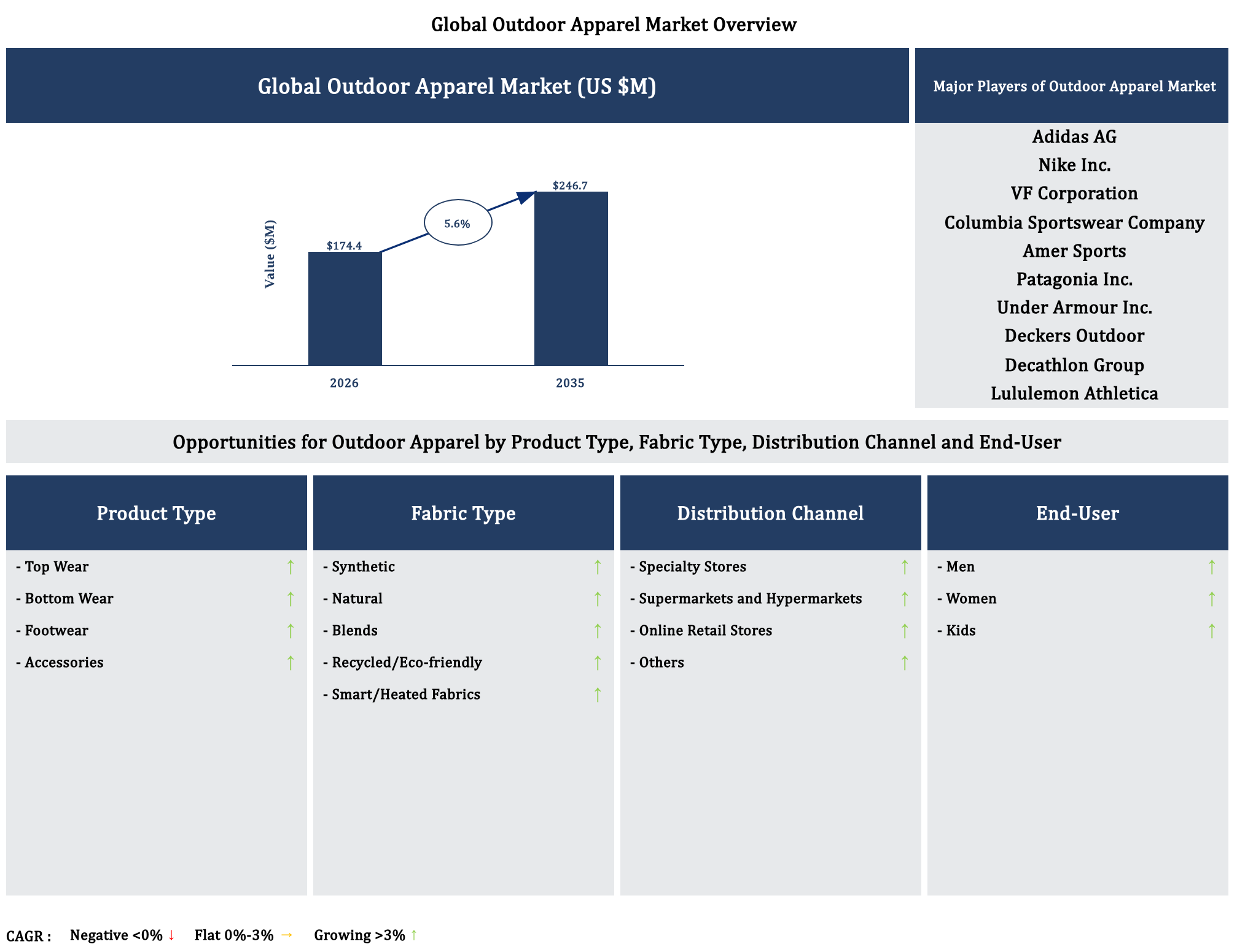
The future of the global outdoor apparel market looks promising with opportunities in the specialty stores, supermarkets and hypermarkets, online retail stores and others markets. The global outdoor apparel market is expected to grow with a CAGR of 5.6% from 2026 to 2035. The major drivers for this market are surge in outdoor recreational participation, rising health and wellness consciousness and expansion of e-commerce and DTC channels.• Lucintel forecasts that, within the end-user category, men will remain the largest segment over the forecast period as high participation in outdoor activities.
• Within the distribution channel category, specialty Stores will remain the largest segment due to the fact that through product expertise, personalized fitting services, and post-purchase support - elements essential for outdoor apparel purchases.
• In terms of regions, North America will remain the largest region over the forecast period due to the increasing number of startups and continuous government support in the region. Gain valuable insights for your business decisions with our comprehensive 150+ page report.
Emerging Trends in the Outdoor Apparel Market
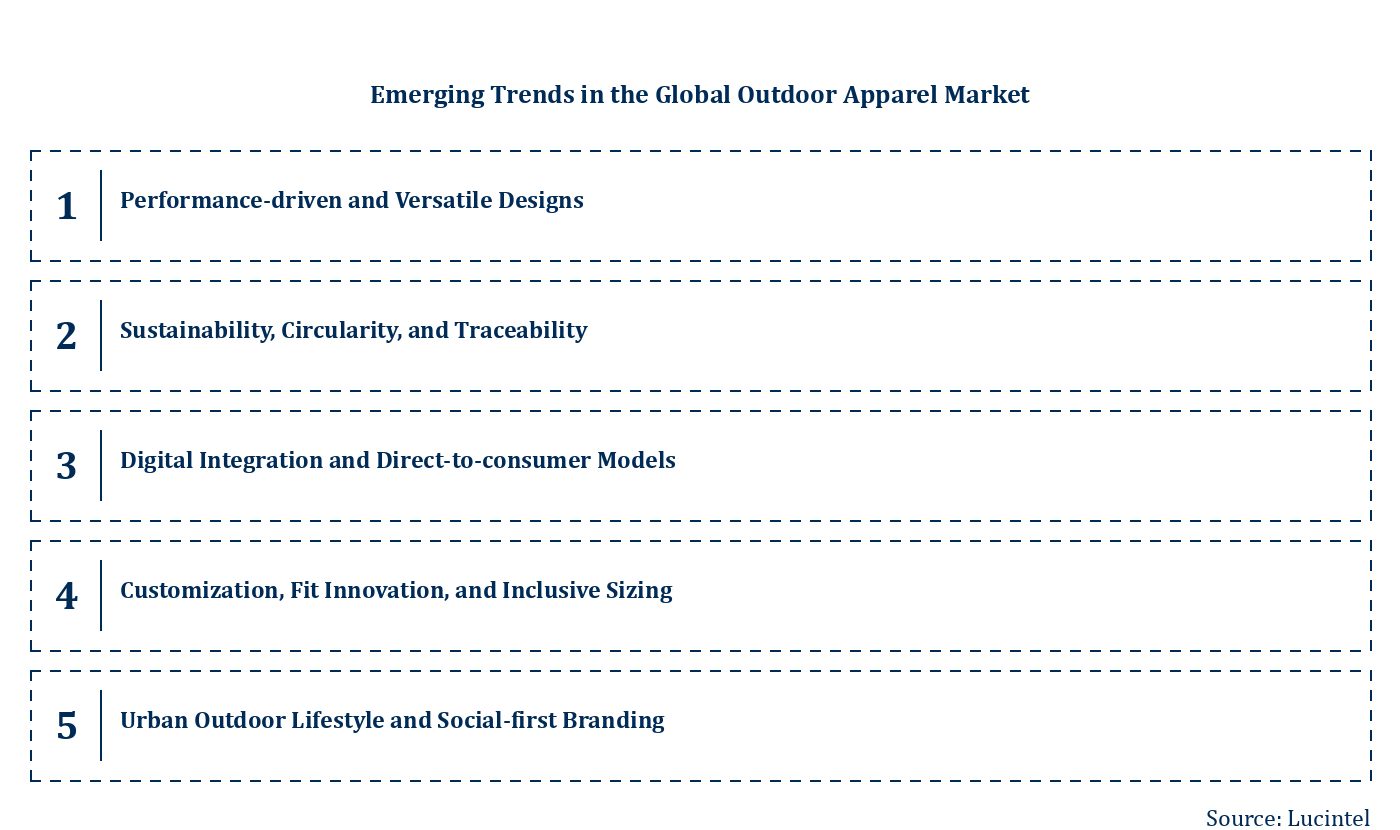
The outdoor apparel market is undergoing significant transformation as consumers redefine how and why they spend time outside. Performance expectations are rising, sustainability pressures are intensifying, and digital behaviors are reshaping purchase journeys. Brands are responding with advanced materials, circular business models, and hyper-personalized product offerings that bridge urban lifestyles and technical adventure. At the same time, climate volatility and social media–driven outdoor culture are influencing design priorities, marketing narratives, and inventory strategies. These emerging trends collectively determine which brands will capture growth, maintain relevance, and build long-term loyalty in an increasingly competitive global landscape.• Performance-Driven and Versatile Designs: Outdoor apparel is shifting toward garments that deliver technical performance for demanding environments while remaining versatile enough for daily urban use, reflecting consumers’ desire to own fewer but more capable pieces.
• Sustainability, Circularity, and Traceability: Brands are rapidly adopting recycled fibers, bio-based materials, repair programs, and resale platforms while improving supply-chain transparency to meet regulatory pressure and consumer expectations for lower-impact outdoor apparel.
• Digital Integration and Direct-to-Consumer Models: The outdoor apparel market is embracing e-commerce, mobile apps, virtual fit tools, and direct-to-consumer channels that enable richer data collection, tighter brand control, and more seamless shopper experiences.
• Customization, Fit Innovation, and Inclusive Sizing: Companies are investing in advanced patterning, diverse body data, and modular features to offer better fit, gender-inclusive designs, and tailored options that serve a broader spectrum of outdoor participants.
• Urban Outdoor Lifestyle and Social-First Branding: Outdoor apparel is increasingly designed and marketed for city-based lifestyles, with fashion-forward silhouettes and social media storytelling that blur the line between streetwear and technical gear to attract younger consumers.
Recent Developments in the Outdoor Apparel Market
The outdoor apparel market is undergoing a phase of rapid transformation driven by shifting consumer lifestyles, climate awareness, and digital innovation. Growing participation in hiking, trail running, and urban outdoor activities is broadening the customer base beyond traditional mountaineers. At the same time, brands are racing to introduce more technical fabrics, circular business models, and direct-to-consumer channels. Macroeconomic uncertainty and supply-chain realignments are also reshaping pricing strategies and sourcing decisions. Together, these developments are intensifying competition, raising the bar on product performance and sustainability, and redefining how consumers discover, evaluate, and purchase outdoor apparel globally.• Acceleration of Sustainable and Circular Design: Brands are rapidly embedding recycled fibers, bio-based materials, and repairable constructions into collections to reduce environmental impact and meet stricter regulations. This development is reshaping sourcing strategies, pushing suppliers to innovate in low-impact textiles, and elevating sustainability from a marketing message to a core value proposition that influences purchase decisions, brand loyalty, and long-term differentiation within the outdoor apparel market.
• Rise of Technical and Versatile Performance Fabrics: There is strong momentum behind lightweight, breathable, and weather-adaptive materials that can transition from backcountry use to daily urban wear. Hybrid garments combining insulation, stretch, and moisture management are gaining traction, enabling consumers to own fewer but higher-performing pieces. This development is driving premiumization, supporting higher average selling prices, and prompting R&D investment in fabric engineering and advanced material science.
• Expansion of Digital and Direct-to-Consumer Channels: Outdoor apparel brands are scaling e-commerce, mobile apps, and brand-owned retail to bypass intermediaries and build deeper relationships with end users. Features such as virtual fitting, personalized product recommendations, and community-based content are improving conversion and retention. This development is altering channel economics, increasing data-driven decision making, and intensifying competitive pressure on traditional wholesale and specialty retail partners.
• Integration of Smart and Connected Features: Select outdoor apparel lines now incorporate sensors, Bluetooth connectivity, and integrated safety features such as fall detection, GPS tracking, and biometric monitoring. While still a niche, this convergence of apparel and wearable technology is creating new value-added use cases for serious hikers, climbers, and endurance athletes. It also opens recurring revenue opportunities through software, services, and data-driven product enhancements.
• Localization of Supply Chains and Nearshoring: In response to geopolitical risk, logistics disruption, and rising freight costs, manufacturers are diversifying production locations and bringing some manufacturing closer to key end markets. This development improves lead times, enhances inventory responsiveness to fast-changing demand, and reduces supply risk for seasonal collections. It also encourages more collaborative planning with suppliers on flexible capacity, material availability, and sustainable production practices.
Strategic Growth Opportunities in the Outdoor Apparel Market
The outdoor apparel market is entering a dynamic growth phase as consumers increasingly prioritize performance, sustainability, and lifestyle functionality across diverse activities. Rising participation in outdoor sports, adventure tourism, and urban outdoor lifestyles is expanding demand across hiking, mountaineering, camping, snow sports, and water sports applications. At the same time, climate variability and environmental awareness are reshaping product expectations, with emphasis on durable, recyclable, and weather-adaptive materials. Digital retail, customization, and smart textiles are unlocking new value pools for brands that can connect technical innovation with style and comfort, positioning the outdoor apparel market for sustained, application-specific expansion.• Hiking and Trekking Apparel: Growing participation in day hikes and long-distance trekking, especially among younger and female consumers, is driving demand for lightweight, breathable, and packable apparel that balances performance with everyday aesthetics. Brands can capture growth by segmenting apparel by trail difficulty and climate, integrating modular layering systems, and emphasizing comfort over long distances. Partnerships with trail organizations, influencer-led route content, and rental or subscription models further expand reach and lifetime value within this high-frequency, repeat-purchase application.
• Mountaineering and Climbing Gear: Technical mountaineering and climbing applications offer premium growth opportunities as participants seek high-spec apparel engineered for extreme weather, abrasion resistance, and safety. Innovations in stretch-woven fabrics, hybrid insulation, and reinforced impact zones enable differentiated performance stories and justify higher price points. Collaborations with elite athletes and guiding services help validate product credibility, while limited-edition alpine capsules and customization options support strong margins and brand loyalty in this specialized, expertise-driven segment.
• Camping and Backpacking Apparel: The surge in car camping, van life, and multiday backpacking is boosting demand for versatile apparel that transitions from trail to campsite and casual wear. Growth lies in multifunctional garments with odor control, quick-dry capabilities, and convertible features that reduce packing volume. Brands can build ecosystems around sleepwear, base layers, and camp comfort pieces, supported by storytelling around family experiences and nature reconnection. Bundled camp-ready outfits and cross-selling with gear such as tents and packs enhance attachment rates and average order values.
• Snow Sports and Winter Performance Wear: Snowboarding, skiing, and winter hiking are accelerating demand for insulated, waterproof, and windproof apparel tailored to variable temperature and intensity levels. Growth is catalyzed by innovations in breathable membranes, body-mapped insulation, and helmet-compatible hoods that improve comfort and safety on the slopes. Brands can segment collections by resort, backcountry, and urban winter commuting, using vivid colorways and collaborations with resorts or events to drive visibility. Rental programs and secondhand platforms also unlock circular revenue in this high-ticket, seasonal application.
• Water Sports and Coastal Outdoor Apparel: Expansion in surfing, paddleboarding, kayaking, and coastal hiking is creating robust demand for water-repellent, UV-protective, and quick-dry apparel. There is strong opportunity to combine technical features such as saltwater resistance and thermal regulation with lifestyle-driven designs suited for beach-to-city transitions. Brands that invest in recycled ocean plastics, reef-safe production narratives, and partnerships with coastal conservation initiatives can command premium positioning. Capsule collections tied to local surf spots and experiential marketing at waterfront hubs further accelerate penetration in this fast-growing, warm-weather application.
Outdoor Apparel Market Drivers and Challenges
The global outdoor apparel market is influenced by a complex mix of technological, economic, environmental, and regulatory dynamics. Advances in performance materials, rising consumer focus on health and wellness, and the rapid expansion of e-commerce are powerful growth catalysts. At the same time, cost volatility in raw materials, intensifying competition, and stricter sustainability regulations introduce significant operational and strategic challenges. Understanding how these factors interact helps brands, retailers, and investors optimize product portfolios, pricing, and supply chains. A nuanced view of both drivers and obstacles is critical for capturing long-term value in the evolving outdoor apparel landscape. The factors responsible for driving the outdoor apparel market include:• Growing Outdoor Recreation Participation: Rising participation in hiking, camping, trail running, climbing, and adventure travel is a fundamental driver for the outdoor apparel market. Urban consumers increasingly seek nature-based experiences for physical fitness, mental well-being, and social connection, expanding the addressable customer base beyond traditional outdoor enthusiasts. Governments and tourism boards promoting national parks and outdoor destinations further encourage frequent outdoor activity. This sustained increase in participation translates into higher demand for specialized apparel such as technical jackets, layering systems, performance base layers, and weather-resistant pants. As more first-time participants upgrade from casual wear to specialized gear, brands benefit from repeat purchases and higher average order values.
• Innovation in Performance Materials and Design: Continuous innovation in fabrics, construction techniques, and product design significantly enhances the value proposition of outdoor apparel. Advances such as lightweight yet durable fabrics, improved waterproof and breathable membranes, moisture-wicking and quick-dry technologies, and temperature-regulating insulation make garments more comfortable and versatile across climates and activities. Ergonomic patterning, stretch materials, and body-mapped ventilation increase mobility and performance, appealing to both serious athletes and lifestyle consumers. Collaborative R&D with material science companies enables brands to differentiate on technical features, justify premium pricing, and command stronger brand loyalty. These innovations also support seasonal product refresh cycles, driving repeat purchases and fueling overall market expansion.
• Rising Health, Wellness, and Lifestyle Trends: A global shift toward healthier lifestyles is pushing consumers to integrate outdoor activities into their daily routines, supporting demand for outdoor apparel. People increasingly view time spent outdoors as essential for stress relief, mental health, and physical fitness, leading to more frequent use of functional apparel beyond occasional trips. Outdoor clothing has also become a fashion-forward lifestyle choice, blurring boundaries between performance gear and everyday wear in urban environments. This athleisure and outdoor-lifestyle convergence encourages consumers to invest in versatile jackets, fleeces, and technical pants that deliver both style and function. As a result, brands can address broader use cases, expand into casual segments, and capitalize on year-round demand.
• Expansion of E-commerce and Omnichannel Retail: The rapid growth of e-commerce and omnichannel retailing significantly strengthens market accessibility for outdoor apparel brands. Online platforms enable consumers to compare technical features, read reviews, and access niche products that may not be stocked in local stores. Direct-to-consumer models allow brands to control storytelling, fit guidance, and sizing tools, reducing barriers to purchase for performance garments that traditionally required in-store fitting. Omnichannel strategies, including click-and-collect, online reservation of in-store stock, and seamless returns, enhance convenience and build trust. Digital marketing, social media, and influencer collaborations amplify brand reach among younger audiences. Collectively, these retail innovations boost conversion rates, broaden geographic penetration, and support scalable, data-driven growth.
• Growing Focus on Sustainability and Ethical Consumption: Increasing environmental awareness is reshaping consumer expectations and driving demand for sustainable outdoor apparel. Shoppers increasingly prioritize garments made from recycled materials, responsibly sourced natural fibers, and low-impact dyes, as well as products certified for fair labor practices. Outdoor enthusiasts, in particular, tend to be highly conscious of environmental preservation, rewarding brands that invest in circular business models, repair services, and transparent supply chains. Companies that commit to measurable sustainability goals can strengthen brand equity, justify premium pricing, and build long-term loyalty. This shift also stimulates innovation in eco-friendly materials and processes, encouraging market-wide upgrades in quality and performance aligned with responsible consumption. The challenges in the outdoor apparel market are:
• Raw Material Cost Volatility and Supply Chain Complexity: The outdoor apparel market faces persistent challenges related to fluctuating prices and uneven availability of key raw materials such as synthetic fibers, technical membranes, and natural fibers like organic cotton or merino wool. Geopolitical tensions, climate impacts, and logistics disruptions can raise input costs and extend lead times, making inventory planning more complex. Brands must decide between absorbing cost increases, which compress margins, or passing them on to consumers, which can dampen demand in price-sensitive segments. Additionally, the need for multiple specialized suppliers and regional manufacturing hubs complicates quality control, traceability, and responsiveness, particularly for smaller brands with less bargaining power.
• Intense Competition and Brand Differentiation Pressure: The outdoor apparel space has become increasingly crowded, with global performance brands, fast-fashion retailers, athleisure players, and direct-to-consumer startups all competing for similar customers. This saturation makes it harder to differentiate based solely on basic technical features, which quickly become industry standards. Aggressive discounting and promotional activity erode price integrity and train consumers to wait for sales. New entrants often mimic successful styles and technologies, intensifying product commoditization. To stand out, brands must invest heavily in authentic storytelling, community engagement, and unique design language, as well as in innovation that addresses specific use cases. These efforts require sustained marketing and R&D spending, pressuring profitability.
• Balancing Sustainability Commitments with Profitability: While sustainability is a powerful driver of consumer preference, implementing meaningful environmental and social initiatives is operationally complex and costly for many outdoor apparel companies. Transitioning to recycled or bio-based materials, adopting cleaner dyeing processes, and ensuring full supply chain transparency involve capital investments, supplier development, and rigorous certification efforts. These initiatives can increase production costs and constrain sourcing options, especially in the short term. At the same time, not all consumers are willing to pay significant premiums for sustainable products, creating a gap between brand positioning and demand elasticity. Companies must carefully manage this balance, ensuring that sustainability programs enhance, rather than undermine, long-term financial performance. Overall, the outdoor apparel market is propelled by growing outdoor participation, rapid material innovation, lifestyle shifts toward wellness, digital retail expansion, and the rising importance of sustainability. These drivers create rich opportunities for brands able to deliver high-performance, versatile, and environmentally responsible products. However, the sector must navigate cost volatility, intense competition, and the operational complexities of scaling sustainable practices. Companies that align technical excellence with authentic values, agile supply chains, and data-driven customer insight will be best positioned to convert these dynamics into durable competitive advantage and resilient, profitable growth over the long term.
List of Outdoor Apparel Market Companies
Companies in the market compete on the basis of product quality offered. Major players in this market focus on expanding their manufacturing facilities, R&D investments, infrastructural development, and leverage integration opportunities across the value chain. Through these strategies outdoor apparel market companies cater increasing demand, ensure competitive effectiveness, develop innovative products & technologies, reduce production costs, and expand their customer base. Some of the outdoor apparel market companies profiled in this report include-• Adidas AG
• Nike Inc.
• VF Corporation
• Columbia Sportswear Company
• Amer Sports
• Patagonia Inc.
• Under Armour Inc.
• Deckers Outdoor
• Decathlon Group
• Lululemon Athletica
Outdoor Apparel Market by Segment
The study includes a forecast for the global outdoor apparel market by product type, fabric type, distribution channel, end-user, and region.Outdoor Apparel Market by Product Type [Value ($M) from 2019 to 2035]:
• Top Wear
• Bottom Wear
• Footwear
• Accessories
Outdoor Apparel Market by Fabric Type [Value ($M) from 2019 to 2035]:
• Synthetic
• Natural
• Blends
• Recycled/Eco-friendly
• Smart/Heated Fabrics
Outdoor Apparel Market by Distribution Channel [Value ($M) from 2019 to 2035]:
• Specialty Stores
• Supermarkets and Hypermarkets
• Online Retail Stores
• Others
Outdoor Apparel Market by End-User [Value ($M) from 2019 to 2035]:
• Men
• Women
• Kids
Outdoor Apparel Market by Region [Value from 2019 to 2035]:
• North America
• Europe
• Asia Pacific
• The Rest of the World
Country Wise Outlook for the Outdoor Apparel Market
The global outdoor apparel market is evolving quickly as consumers prioritize performance, sustainability, and lifestyle versatility. Across major economies, brands are investing in technical fabrics, digitally enabled retail, and circular business models to meet shifting expectations. Climate awareness is pushing demand for durable, repairable, and low-impact garments, while urban lifestyles blur the line between outdoor and everyday wear. At the same time, supply chain resilience, material innovation, and localized design are becoming strategic differentiators. Recent developments in the United States, China, Germany, India, and Japan illustrate how different markets are shaping the next phase of outdoor apparel growth.• United States: The United States outdoor apparel market is seeing strong growth driven by hybrid work lifestyles, with consumers seeking apparel that transitions from trails to urban settings. Leading brands are scaling recycled and bio-based materials, investing in repair and resale platforms, and introducing traceability tools that show product origin and carbon impact. Direct-to-consumer and specialty retail channels are expanding, supported by sophisticated e-commerce and community-based marketing. Collaborations with fitness, tech, and lifestyle brands are broadening appeal beyond core outdoor enthusiasts, while regulations and consumer pressure are accelerating PFAS-free waterproofing and other safer chemistry innovations.
• China: In China, outdoor apparel demand is surging as younger consumers embrace camping, hiking, and “glamping” as lifestyle statements, especially around major urban centers. Domestic brands are rapidly upgrading technical capabilities, from advanced waterproof-breathable membranes to lightweight insulation suitable for varied climates across the country. International brands are localizing designs and marketing around Chinese outdoor culture and social media platforms. Live-streaming commerce and influencer partnerships are critical channels, while government promotion of outdoor sports and tourism supports category expansion. There is also growing interest in functional yet fashion-forward silhouettes that blend streetwear and performance.
• Germany: Germany’s outdoor apparel market emphasizes sustainability, technical reliability, and compliance with stringent environmental standards. Brands are pioneering circular design through repair services, take-back schemes, and fully recyclable garment concepts. There is strong focus on bluesign-approved and certified organic materials, along with PFAS-free waterproofing solutions suited to Europe’s regulatory environment. Consumer expectations in Germany favor long-lasting, minimalist designs rather than trend-driven pieces, reinforcing demand for premium quality and robust warranties. Retailers are enhancing in-store expertise and digital education around layering systems, eco-labels, and product care, reinforcing Germany’s role as a benchmark market for responsible outdoor apparel.
• India: India’s outdoor apparel market is emerging quickly as adventure tourism, trekking, and weekend getaways grow among urban middle-class consumers. International and regional brands are introducing more climate-appropriate offerings, such as lightweight sun-protective fabrics, monsoon-ready shells, and versatile travel gear suited to varied terrains. Price sensitivity remains high, spurring demand for value-driven performance lines and multi-use garments that work for both outdoor activities and casual wear. E-commerce platforms and marketplace apps are crucial in reaching tier-2 and tier-3 cities, while brand partnerships with trekking organizers, adventure clubs, and influencers are building awareness of technical apparel features.
• Japan: Japan’s outdoor apparel market is shaped by a strong culture of craftsmanship, minimalist aesthetics, and meticulous attention to detail. Domestic brands continue to innovate in ultra-lightweight, packable garments tailored to hiking, mountaineering, and urban commuting, often blending traditional materials with cutting-edge textiles. The “outdoor lifestyle” trend is visible in city fashion, with technical shells, fleece, and utility-inspired designs integrated into everyday wardrobes. Retail experiences emphasize curated assortments and knowledgeable staff, and collaborations between outdoor labels and high-end fashion designers are common. Sustainability is gaining traction through small-batch production, repair services, and high-quality products designed for long-term use.

Feature of Outdoor Apparel Market
Market Size Estimates: Outdoor apparel market size estimation in terms of value ($M). Trend and Forecast Analysis: Market trends (2019 to 2025) and forecast (2026 to 2035) by various segments and regions. Segmentation Analysis: Outdoor apparel market size by various segments, such as by product type, fabric type, distribution channel, end-user and region. Regional Analysis: Outdoor apparel market breakdown by North America, Europe, Asia Pacific, and the Rest of the World. Growth Opportunities: Analysis of growth opportunities in different product type, fabric type, distribution channel, end-user and regions. Strategic Analysis: This includes M&A, new product development, and competitive landscape of the outdoor apparel market. Analysis of competitive intensity of the industry based on Porter's Five Forces model. If you are looking to expand your business in this or adjacent markets, then contact us. We have done hundreds of strategic consulting projects in market entry, opportunity screening, due diligence, supply chain analysis, M&A, and more.
FAQ
Q1. What is the growth forecast for outdoor apparel market? Answer: The global outdoor apparel market is expected to grow with a CAGR of 5.6% from 2019 to 2025. Q2. What are the major drivers influencing the growth of the outdoor apparel market? Answer: The major drivers for this market are surge in outdoor recreational participation, rising health and wellness consciousness, expansion of e-commerce and dTC channels Q3. What are the major segments for outdoor apparel market? Answer: The future of the outdoor apparel market looks promising with opportunities in the specialty stores, supermarkets and hypermarkets, online retail stores and others markets. Q4. Who are the key outdoor apparel market companies? Answer: Some of the key outdoor apparel market companies are as follows:• Adidas AG
• Nike Inc.
• VF Corporation
• Columbia Sportswear Company
• Amer Sports
• Patagonia Inc.
• Under Armour Inc.
• Deckers Outdoor
• Decathlon Group
• Lululemon Athletica Q5. Which outdoor apparel market segment will be the largest in future? Answer: Lucintel forecasts that, within the type category, men will remain the largest segment over the forecast period. Q6. In outdoor apparel market, which region is expected to be the largest in next 6 years? Answer: In terms of region, North America is expected to witness the highest growth over the forecast period. Q7. Do we receive customization in this report? Answer: Yes, lucintel provides 10% customization without any additional cost.
Table of Contents
Methodology
- In-depth interviews of the major players in this market
- Detailed secondary research from competitors’ financial statements and published data
- Extensive searches of published works, market, and database information pertaining to industry news, company press releases, and customer intentions
- A compilation of the experiences, judgments, and insights of Lucintel’s professionals, who have analyzed and tracked this market over the years.


Buy Now
Choose a license that fits your team. Instant PDF delivery.
Prices exclude taxes. Instant delivery. Custom licensing available on request.
Key Questions
- • What are some of the most promising, high-growth opportunities for the outdoor apparel market by product type (top wear, bottom wear, footwear, accessories), fabric type (synthetic, natural, blends, recycled/eco-friendly, smart/heated fabrics), distribution channel (specialty stores, supermarkets and hypermarkets, online retail stores, others), end-user (men, women, kids) and region (North America, Europe, APAC, ROW)?
- • Which segments will grow at a faster pace and why?
- • Which region will grow at a faster pace and why?
- • What are the key factors affecting market dynamics? What are the key challenges and business risks in this market?
- • What are the business risks and competitive threats in this market?
- • What are the emerging trends in this market and the reasons behind them?
- • What are some of the changing demands of customers in the market?
- • What are the new developments in the market? Which companies are leading these developments?
- • Who are the major players in this market? What strategic initiatives are key players pursuing for business growth?
- • What are some of the competing products in this market and how big of a threat do they pose for loss of market share by material or product substitution?
- • What M&A activity has occurred in the last 6 years, and what has its impact been on the industry?


