
Report Feature
Materials For Next-Generation Lithography Market Trends and Forecast
The technologies in materials for next-generation lithography technology have recently changed dramatically, from traditional photolithography with UV light to extreme ultraviolet (EUV) lithography. This transition will make it possible to have smaller, more precise semiconductor nodes that meet the demands of AI chip performance. Moreover, advancements in nanopatterning and hybrid materials enhance resolution and speed, which would make next-generation lithography suitable for AI applications that require high-density, high-performance chips.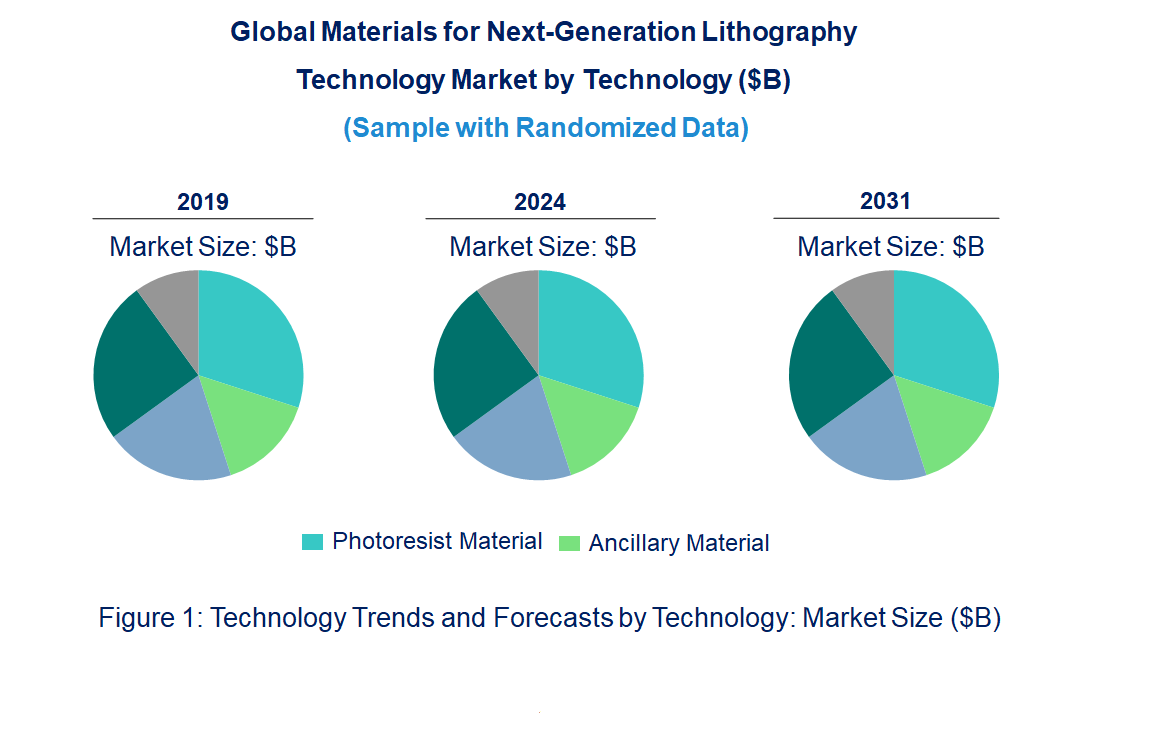
![Materials For Next-Generation Lithography Market Trend and Forecast by End Use Industry [Value from 2019 to 2031]:](https://lucintel.com/images/Materials-for-Next-Generation-Lithography-Technology-Market-Segment.png "Materials For Next-Generation Lithography Market Trend and Forecast by End Use Industry [Value from 2019 to 2031]:")
Emerging Trends in the Materials For Next-Generation Lithography Market
This creates demand for next-generation lithography to keep up with the growing complexities and precision requirements of AI-driven semiconductor chips. Next-generation lithography, a developing technology, relies significantly on these materials for driving forward improvements in processing power and miniaturization efficiency. Five key trends are emerging with the materials for the application of next-generation lithography in AI, as presented below:• Transitioning towards EUV Lithography: EUV lithography is becoming the industry standard for advanced semiconductor manufacturing. Using wavelengths as short as 13.5 nm, EUV allows for much smaller features and denser chip designs, which are so important for AI applications needing high performance and processing power.
• Adoption of High-Resolution Photoresists: The advanced photoresists that may show high-resolution capabilities under EUV light enhance precision and scalability in next-gen chips. These materials allow more intricate patterns, which thereby improve the performance and efficiency of AI chips.
• Nanoparticle-based Materials: Nanoparticles are now being introduced in lithographic processes to get finer patterns and to achieve the accuracy of feature replication. These materials assist in developing chips with higher transistor densities, which are critical for AI workloads requiring rapid processing capabilities.
• Hybrid Lithography Techniques: Hybrid approaches are more commonly being used, which involve combining EUV with multiple patterning techniques. This helps in overcoming the constraints posed by EUV for smaller node sizes and allows AI chips to have better performance as they can have more complex circuit designs at lower costs.
• Alternative Materials for Lithography Development: New alternatives to traditional photoresists, such as nanoimprint lithography (NIL) resins and high-performance dielectrics, are being explored for potential application. These new materials can enable lithography to reach its limit, to push the speed and low-cost production of AI-centric chips with higher capabilities. The continued evolution of materials for next-generation lithography is reshaping the AI semiconductor market. Trending on this are the switch to EUV, photoresist development at ever-high resolutions, and hybrid and alternative material adoptions. They are empowering the creation of more powerful, efficient, and scalable chips, in turn playing a critical role in keeping up with the accelerating demands of AI technologies and powering advancements in AI performance within industries.
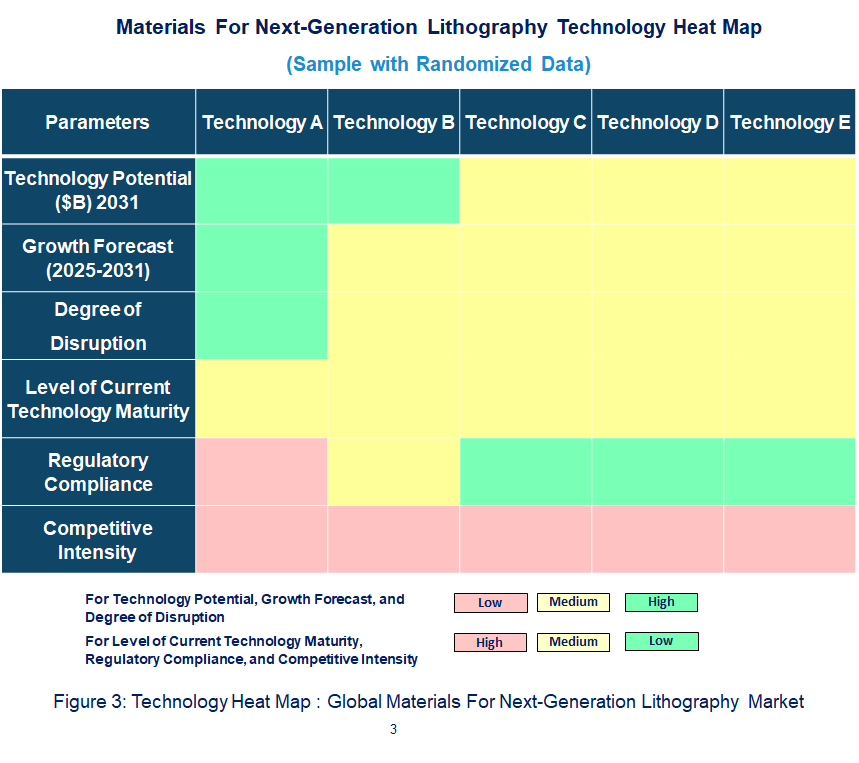
Materials For Next-Generation Lithography Market : Industry Potential, Technological Development, and Compliance Considerations
The fast-moving nature of artificial intelligence in terms of development requires powerful computing that calls for upgradation in the future generation of lithography technology. It is a most critical application in semiconductor processing industries, which require miniaturization for increased performance. So next-generation lithography technologies and advanced materials play a vital role in the advancement of further developed hardware for AI. Technology Potential: Next generation lithography includes extreme ultraviolet (EUV) and nanoimprint lithography for the potential to create more efficient semiconductors at smaller scales. It is a must-have innovation for AI chips to realize faster data processing, less power consumption, and complex models. The materials involved in this process include advanced resists, photo absorbers, and substrates, which facilitate more precise patterning at smaller scales. Degree of Disruption: Such materials and technologies will dramatically affect the semiconductor industry since the chips will be made at an unprecedented performance level. Such applications of AI like deep learning and neural networks need heavy hardware, and any increase in lithography is set to push AI systems into the next levels. Current Technology Maturity: EUV lithography is already used in the manufacturing of leading-edge chips, but its full potential is yet to be exploited. Nanoimprint lithography is still under development for high-volume manufacturing, and material innovations are being made continuously. Regulatory Compliance: Semiconductor manufacturing must adhere to regulations, especially environmental and safety standards. International standards for nanotechnology and material safety must also be met.Recent Technological development in Materials For Next-Generation Lithography Market by Key Players
The evolution of lithography is a key driver for next-generation semiconductor manufacturing as the demand for smaller, more powerful chips continues to surge in support of applications such as artificial intelligence, IoT, and 5 G. Companies that are participating in the production of the materials for next-generation lithography, including photoresists, etching chemicals, and substrates, are trying to push the boundaries beyond what is thought possible in the miniaturization and efficiency metrics. It is these materials that allow semiconductor makers to shrink transistor dimensions and fit the performance requirements of new technologies.• TOK: has developed its EUV (Extreme Ultraviolet) photoresists, which are critical for manufacturing smaller, more powerful chips. The latest resists from TOK are formulated to provide higher resolution and better process stability, which directly translates to higher throughput and yield in semiconductor fabrication. Innovation is key to supporting production at 5nm and beyond.
• JSR: It has been working towards improvement in the quality of photoresist materials, trying to improve EUV lithography. The company has announced newer, more advanced resists that yield higher resolution, better etch resistance, and lower defectivity. The joint work of the company with leading integrated device manufacturers helped optimize EUV technology efficiency for production processes. This will allow even more compact, efficient processors for AI.
• DuPont is working on next-generation materials that include advanced photoresists and etching materials compatible with EUV lithography. Their inventions help to address the challenges in patterning at extremely small scales, especially in the formation of ultra-thin films that are crucial for next-generation semiconductors. Process optimization by DuPont is also improving throughput and yield.
• Shin-Etsu Chemical: It has achieved success in advanced material manufacturing for semiconductor fabrication, particularly in silicon wafer manufacturing. High-purity chemical solutions provided by Shin-Etsu are supporting the enhancement of lithography process efficiency through improved surface quality and reduced defects, an imperative factor for sustaining semiconductor fabrication yields at a high level.
• Fujifilm: It has been diversifying its portfolio of photoresist materials for both EUV and traditional deep ultraviolet (DUV) lithography. The company has developed new resists that provide better resolution and resistance to post-lithography etching processes. These developments are crucial to enable the mass production of smaller chips used in AI and high-performance computing.
• Sumitomo Chemica: Itl has been working on the development of advanced photoresists that have better pattern fidelity and lower defect rates in EUV processes. Their resists are designed to improve the production of smaller semiconductor nodes, addressing challenges such as line-edge roughness and pattern collapse, both of which are significant hurdles in nanometer-scale chip fabrication.
• Allresist: lt has been pushing the boundaries of resist technology by offering materials that are optimized for sub-7nm node production. Their developments in negative and positive tone resists for both EUV and DUV lithography are helping semiconductor manufacturers improve the resolution and uniformity of critical layers, leading to higher yield rates in the production of next-gen chips.
• Micro Resist Technology: It has developed high-performance resists for both EUV and DUV lithography, targeting the fabrication of semiconductor nodes at 5nm and beyond. Their resists are designed for improved resolution and higher etch resistance, which helps to maintain high levels of precision during the lithography process, thereby producing increasingly smaller and more powerful chips.
• Merck: It has been advancing the materials for EUV lithography, including photoresists and other supporting chemicals such as antireflective coatings and hard masks. Their contributions are assisting in overcoming the challenges linked with high-resolution imaging and defectivity at the 3nm node and beyond that supporting the growth of AI hardware and next-gen chips.
• Dongjin Semichem: It has been aggressively investing in developing high-performance materials, which have mainly focused on photoresists and etching agents to enhance the resolution and precision for patterning needed for semiconductor nodes at sub-5nm. Dongjin is, therefore, supporting semiconductor makers to maintain yield and performance through enhanced process stability and defect reduction. These developments in materials for next-generation lithography are critical in the advancements of semiconductor manufacturing technologies for progressively smaller, faster, and lower-power chips. As these companies advance in innovation, their contribution is very important to the ever-advancing AI hardware and next-generation technologies.
Materials For Next-Generation Lithography Market Driver and Challenges
With huge advances experienced in semiconductor manufacturing processes lately, driven by the requirements of next-generation lithography processes to be even more advanced and efficient, growth in the material market for these processes has picked up drastically. The rise in advancement with artificial intelligence (AI) technology brings along a lot of necessity in having smaller but powerful chips. Materials needed in these lithography processes are inevitable but face great challenges and opportunities in today’s tech-savvy landscape. Major Drivers• Advanced AI Hardware Demand: The growth of AI and machine learning is pushing the demand for advanced semiconductor chips, which calls for innovative materials for lithography. These materials allow for smaller transistors, greater processing power, and energy efficiency, all of which are necessary for the next generation of AI processors.
• EUV Lithography: EUV lithography is enabling the production of chips with smaller nodes, allowing for more powerful AI chips. This advance has driven demand for advanced photoresists and materials that can support these processes, driving innovation and improving chip performance.
• Technological Advancements in Nanotechnology: Materials science evolves along with AI. Nanomaterials research helps advance lithography technology, making it possible to develop more precise materials that improve chip design, reduce defects, and enhance the overall performance of AI hardware. Challenges:
• High Production Costs: Next-gen lithography materials, like EUV photoresists, are expensive to develop and produce. The high production costs put this technology out of reach for many companies, thereby limiting access to leading-edge semiconductor manufacturing.
• Material Defects and Yield Issues: As transistor sizes reduce, patterning requires high accuracy. Material defects and low yield during production contribute to higher costs and efficiency reduction in chip manufacturing for semiconductor fabrication; thus, scaling up AI chips becomes a significant challenge. The technological advancements in semiconductor manufacturing increasingly push regulatory challenges regarding environmental effects as well as safety. Sophisticated materials used within these lithography processes have added much more complication to the production process owing to the need for tighter compliance with environmental standards in regards to development and disposal
• Low-Cost, High-Performance Materials: One of the key opportunities is the research that is going on in low-cost photoresists and other materials that maintain high performance. Innovation in this area could cut production costs and make advanced semiconductor technologies more accessible, which would promote further adoption of AI hardware.
• Collaboration and Partnerships Among Key Players: The collaboration between semiconductor manufacturers, materials suppliers, and research institutions will be the source of breakthroughs in lithography materials. By pooling resources and knowledge, these partnerships can overcome challenges related to defects, yield issues, and material efficiency.
• Improvements in Lithography Equipment and Technology: Improvements in the equipment and techniques used in lithography, including EUV machines, are an opportunity. Enhanced lithography equipment, improving resolution and reducing defects, would directly help the development of AI processors and accelerate the production of next-gen chips. The growths in the materials for next-generation lithography technology in the AI technology market are based on its opportunities in future outcomes. Despite the obstacles facing materials with high production costs and defects, as well as regulatory issues, advances are being made in materials through research and development, mutual collaborations, and the development and improvement of lithography technologies. These are significant elements for demand increases in advanced AI chips. They also drive forward new AI technology.
List of Materials For Next-Generation Lithography Companies
Companies in the market compete based on product quality offered. Major players in this market focus on expanding their manufacturing facilities, R&D investments, infrastructural development, and leverage integration opportunities across the value chain. With these strategies materials for next-generation lithography, companies cater to increasing demand, ensure competitive effectiveness, develop innovative products & technologies, reduce production costs, and expand their customer base. Some of the materials for next-generation lithography companies profiled in this report include.• Tokyo Ohka Kogyo
• JSR
• Dupont De Nemours
• Shin-Etsu Chemical
• Fujifilm
• Sumitomo Chemical
Materials For Next-Generation Lithography Market by Technology
• Technology Readiness by Technology Type and Key Applications: Photoresist materials, especially for EUV lithography, are highly mature. Leading-edge materials are already supporting semiconductor nodes as small as 5nm. Their primary applications are in the production of advanced microchips used in AI, consumer electronics, and high-performance computing. Ancillary materials such as antireflective coatings, etchants, and solvents are equally important, improving the accuracy of patterning in lithography. These materials are ready for mass production, with primary applications across semiconductor manufacturing, from memory devices to processors. Both of these technologies are essential to continue scaling down transistors and developing next-generation technologies such as AI processors and 5 G.
• Disruption Potential by Technology Type: There is significant disruption potential for photoresist materials and ancillary materials in semiconductor manufacturing. Photoresists, especially those used in EUV (extreme ultraviolet) lithography, allow for smaller, more efficient chips. The continued development of these materials propels the advancement of Moore’s Law, which will then enable the creation of next-generation AI processors and quantum computing hardware. Ancillary materials like etching agents, antireflective coatings, and solvents are also important for enhancing chip yield and resolution. The improvements in these materials can greatly reduce production costs, improve chip performance, and help transition to smaller nodes. They can thus revolutionize industries based on cutting-edge technology.
• Competitive Intensity and Regulatory Compliance: The competitive intensity in the photoresist and ancillary material markets is high, with leading players like Tokyo Ohka Kogyo, JSR, and DuPont constantly pushing the envelope in terms of innovation and high-performance solutions for semiconductor makers. Companies must continuously invest in R&D to stay ahead in terms of emerging technology and market trends. Also, the company has to adhere to very stringent environmental, health, and safety regulations. This encompasses adherence to international guidelines in chemical safety, material disposal, and manufacturing practices. Companies also face hurdles to sustainability compliance in the absence of detrimental impacts on performance, with alternatives that are more environmentally friendly.
Materials For Next-Generation Lithography Market Trend and Forecast by Technology [Value from 2019 to 2031]:
• Photoresist Material
• Ancillary Material
Materials For Next-Generation Lithography Market Trend and Forecast by End Use Industry [Value from 2019 to 2031]:
• Automotive
• Consumer Electronics
• IT & Telecommunications
• Others
Materials For Next-Generation Lithography Market by Region [Value from 2019 to 2031]:
• North America
• Europe
• Asia Pacific
• The Rest of the World
• Latest Developments and Innovations in the Materials For Next-Generation Lithography Technologies
• Companies / Ecosystems
• Strategic Opportunities by Technology Type
Features of the Global Materials For Next-Generation Lithography Market
Market Size Estimates: Materials for next-generation lithography market size estimation in terms of ($B). Trend and Forecast Analysis: Market trends (2019 to 2024) and forecast (2025 to 2031) by various segments and regions. Segmentation Analysis: Technology trends in the global materials for next-generation lithography market size by various segments, such as end use industry and technology in terms of value and volume shipments. Regional Analysis: Technology trends in the global materials for next-generation lithography market breakdown by North America, Europe, Asia Pacific, and the Rest of the World. Growth Opportunities: Analysis of growth opportunities in different end use industries, technologies, and regions for technology trends in the global materials for next-generation lithography market. Strategic Analysis: This includes M&A, new product development, and competitive landscape for technology trends in the global materials for next-generation lithography market. Analysis of competitive intensity of the industry based on Porter’s Five Forces model.Table of Contents
Methodology
- In-depth interviews of the major players in this market
- Detailed secondary research from competitors’ financial statements and published data
- Extensive searches of published works, market, and database information pertaining to industry news, company press releases, and customer intentions
- A compilation of the experiences, judgments, and insights of Lucintel’s professionals, who have analyzed and tracked this market over the years.


Buy Now
Choose a license that fits your team. Instant PDF delivery.
Prices exclude taxes. Instant delivery. Custom licensing available on request.
Key Questions
- • What are some of the most promising potential, high-growth opportunities for the technology trends in the global materials for next-generation lithography market by technology (photoresist material and ancillary material), end use industry (automotive, consumer electronics, IT & telecommunications, and others), and region (North America, Europe, Asia Pacific, and the Rest of the World)?
- • Which technology segments will grow at a faster pace and why?
- • Which regions will grow at a faster pace and why?
- • What are the key factors affecting dynamics of different technology? What are the drivers and challenges of these technologies in the global materials for next-generation lithography market?
- • What are the business risks and threats to the technology trends in the global materials for next-generation lithography market?
- • What are the emerging trends in these technologies in the global materials for next-generation lithography market and the reasons behind them?
- • Which technologies have potential of disruption in this market?
- • What are the new developments in the technology trends in the global materials for next-generation lithography market? Which companies are leading these developments?
- • Who are the major players in technology trends in the global materials for next-generation lithography market? What strategic initiatives are being implemented by key players for business growth?
- • What are strategic growth opportunities in this materials for next-generation lithography technology space?
- • What M & A activities did take place in the last five years in technology trends in the global materials for next-generation lithography market?


