
Report Feature
Lithography Spin Coaters Market Trends and Forecast
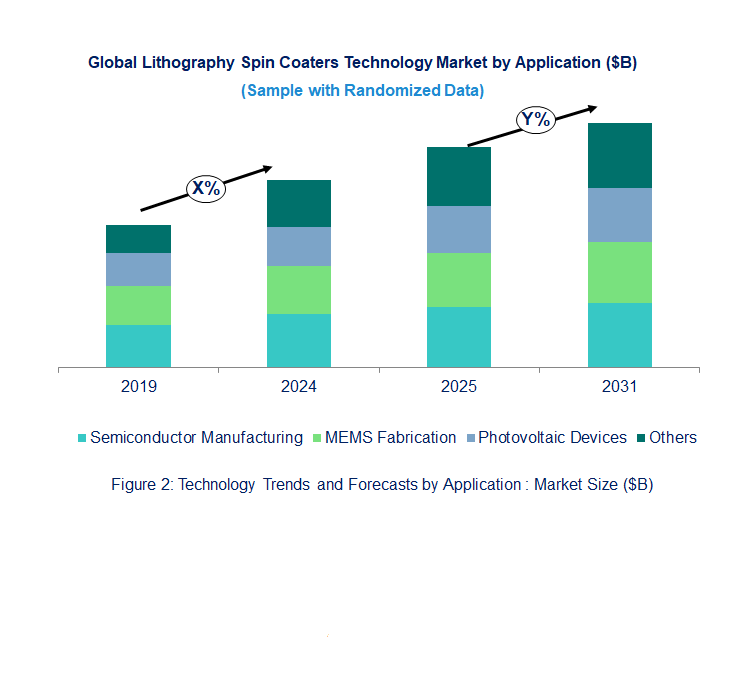
Lithography spin coaters market technologies have taken a tremendous shift in the past couple of years. The sector from manual spin coating technology toward fully automated spin coating system is observed. This aims toward achieving higher precision and reproducibility with efficiency and can be very effective at increasing semiconductor manufacturing processes complexity level. The move toward semi-automated and fully automated spin coaters is driven by the need for higher throughput, better coating uniformity, and reduced human error in precision industries such as semiconductor manufacturing, MEMS fabrication, and photovoltaic device production.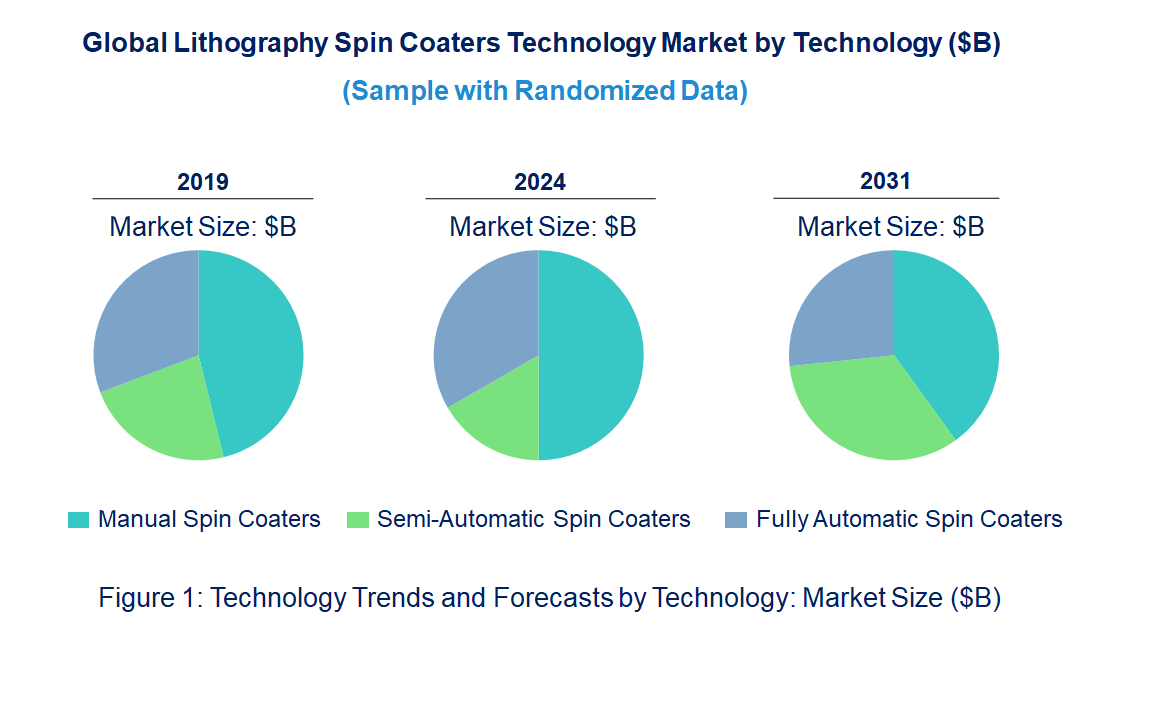
Emerging Trends in the Lithography Spin Coaters Market
The lithography spin coaters market is transforming into a growing portfolio of several key trends reflecting technological developments, higher demands for higher performance, and the need for greater precision. Such drivers are indispensable to driving innovation and further process improvements in manufacturing semiconductor, MEMS, and photovoltaic products.• Towards Completely Automated Spin Coaters: The industry is shifting towards fully automated spin coaters for higher efficiency, consistency, and scalability in high-volume production. Such systems have fewer chances of human error and more precise control over coating thickness, which is a requirement for semiconductor and MEMS fabrication.
• Integration of Advanced Control Systems: Advanced real-time process control and feedback systems are being integrated, thus enabling more precise control over coating parameters such as spin speed, time, and temperature. These systems enhance uniformity, reduce defects, and ensure the desired film properties, crucial for high-performance applications.
• Miniaturization and Increasing Complexity of Devices: With the increasing size reduction and complexity of devices, spin coating techniques are required to achieve higher precision. In the case of semiconductor manufacturing, for instance, the increased complexity of devices requires the achievement of thin, uniform layers through spin coaters to meet the very demanding requirements of nanoscale structures and features.
• Expansion of MEMS and Photovoltaic Devices: MEMS (Micro-Electro-Mechanical Systems) and photovoltaic devices are expanding nowadays. Due to this fact, the requirement for specialized spin coating equipment has increased. There is growing demand from these sectors, which demands innovation in spin coaters for the creation of new materials such as organic photovoltaics and flexible MEMS devices.
• Sustainability and waste reduction: Manufacturers are focusing on sustainability through reducing material waste and improving energy efficiency to the growing environmental concern. New technologies are being developed for the lower consumption of chemicals, solvents, and other resources used during spin coating. These trends are shaping the future of the lithography spin coaters market, enhancing precision, throughput, and sustainability while meeting the growing demands of the semiconductor, MEMS, and photovoltaic industries.
Lithography Spin Coaters Market : Industry Potential, Technological Development, and Compliance Considerations
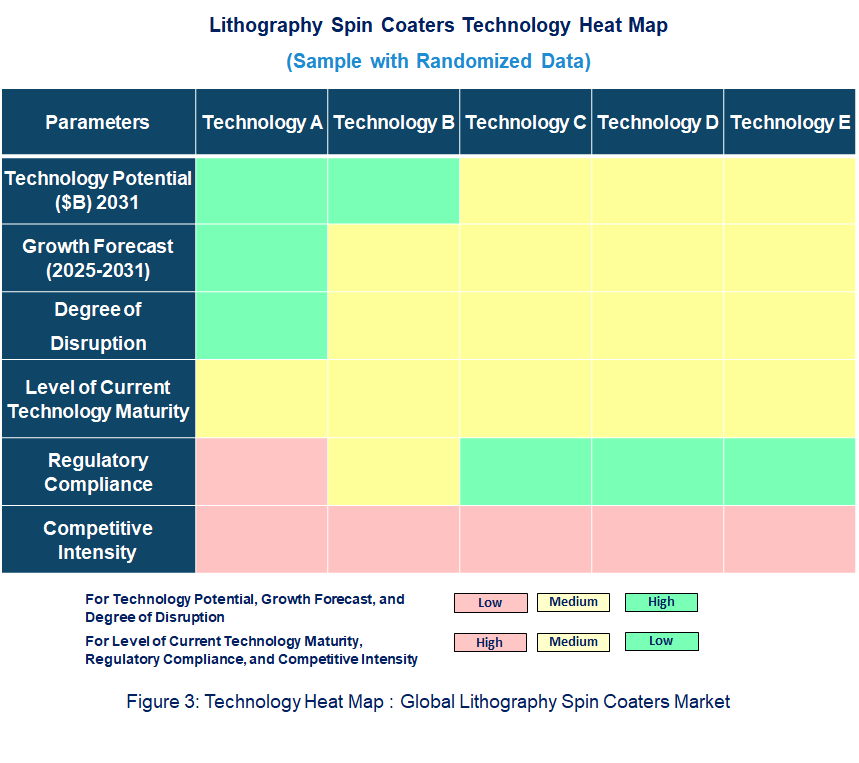
Lithography spin coaters are critical components in semiconductor manufacturing. They create thin, uniform layers of photoresist material on a wafer for patterning in the photolithography process. Advances in technology continue to improve precision, speed, and scalability for semiconductor fabrication.• Technology Potential: The lithography spin coaters improve the technology potential in uniform coating, process control, and material efficiency. Innovations are focused on improving the coating process for advanced semiconductor nodes, such as 7nm, 5nm, and beyond, which will require thinner, more precise layers. Closed-loop systems, real-time process monitoring, and automation should drive higher throughput with fewer defects and material waste. Eco-friendly and sustainable alternatives to traditional photoresists are also becoming increasingly important.
• Degree of Disruption: The disruption is moderate but meaningful. With the move towards the complex nodes in semiconductor manufacturing, the traditional spin coating becomes less feasible, opening the way for new technologies such as nanoimprint lithography and advanced materials. Nonetheless, it will take more time to fully disrupt the market for the spin coater as much investment is required in terms of capital and the industry adhering to its traditional ways of functioning.
• Technology Maturity: Spin coater technology is mature in the semiconductor industry. The equipment and processes have been well established, but advancements in automation, precision control, and new material applications are pushing the technology forward.
• Regulatory Compliance: The spin coater needs to adhere to environmental and safety regulations related to chemicals used, waste management, and energy consumption. Compliance with standards such as ISO certifications ensures that the equipment meets global manufacturing and environmental guidelines.
Recent Technological development in Lithography Spin Coaters Market by Key Players
Many companies in the lithography spin coaters market are innovating to stay competitive and meet the growing demands of the semiconductor and other high-tech industries. Some recent developments from key players in the market include:• SUSS MicroTec: At SUSS MicroTec, they introduced a new fully automated spin coating system with advanced control and monitoring capabilities. It supports superior uniformity and repeatability in semiconductor wafer production and advanced photomask fabrication.
• Laurell Technologies Corporation: Laurell Technologies has engineered an advanced line of fully automated spin coaters that provide enhanced precision with high-throughput capabilities. This equipment is being widely adopted in the MEMS fabrication and pharmaceutical applications where uniform thin films are critical for device functionality.
• Specialty Coating Systems, Inc.: Specialty Coating Systems has introduced a customizable spin coating system that is particularly suited for photovoltaic applications. This new development focuses on improved material compatibility and precise layer thickness control, providing high-quality coatings for the next generation of solar cells.
• MBRAUN: MBRAUN has enhanced its spin coating technology by integrating environmentally friendly processes with their spin coaters. They have optimized the system to reduce chemical waste, addressing growing concerns about sustainability and making the process more eco-friendly without compromising on coating quality.
• Brewer Science, Inc.: Brewer Science has created highly advanced spin coating solutions for semiconductor manufacture. Their innovative technology enables increased accuracy in layer deposition, which gives them a role in fabricating high-performance chips used within new technologies such as 5G and AI.
• Tokyo Electron Limited: Tokyo Electron has developed next-generation spin coaters that support scaling semiconductor manufacturing processes. The company focuses technology on improving the coating uniformity and defect reduction for high-end photomasks production that are produced in lithography.
• Cee Apogee: Cee Apogee has improved its manual and semi-automatic spin coaters with real-time feedback during the coating process. This improves consistency and accuracy in the thin-film deposition process for manufacturers
• Delta Scientific Equipment: Delta Scientific recently unveiled a modular spin coating system suitable for multi-layer thin-film deposition. The system is highly flexible and can be applied to various applications such as the semiconductor industry, MEMS fabrication, and photovoltaic device production.
• Midas System Co., Ltd.: Midas System has launched a compact, fully automated spin-coating machine designed for use in research and small-scale manufacturing environments. The new system offers high precision and repeatability, making it suitable for prototype development in the semiconductor industry.
• Holmarc Opto-Mechatronics Pvt. Ltd.: Holmarc has introduced advanced spin coating technology specifically for optical and MEMS applications. The system allows for accurate control of the layer thickness and is engineered to minimize waste while providing the high-quality deposition needed for optical components and micro-electromechanical systems. With the increasing demands for precision, sustainability, and automation in the lithography spin coating market, companies continue to innovate. The focus on automation, environmentally friendly solutions, and advanced control technologies is boosting the growth of the market in the semiconductor, MEMS, and photovoltaic sectors.
Lithography Spin Coaters Market Driver and Challenges
The lithography spin coaters market is influenced by several growth drivers and challenges. As industries such as semiconductor manufacturing, MEMS fabrication, and photovoltaic device production grow, the demand for high-precision and high-throughput spin coating systems is increasing. However, the industry must also overcome various challenges to sustain its growth. The factors responsible for driving the lithography spin coaters market include:• Increasing Demand for Advanced Semiconductor Devices: The continuous evolution of semiconductor technology, including smaller devices and more advanced chips, drives the need for precise coating technologies. This trend increases the demand for fully automated spin coaters that can handle high-throughput, precision, and uniformity.
• Growth in MEMS and Photovoltaic Industries: The expansion of MEMS devices and solar energy technologies is a significant driver for the lithography spin coaters market. As these industries require thin, uniform films for microdevices and solar cells, the demand for specialized spin coating equipment grows.
• Advances in Automation and Process Control: Automation is driving efficiency in the manufacturing of semiconductors, MEMS, and photovoltaics. Fully automated spin coating systems, integrated with advanced control systems, improve process consistency and reduce labor costs, making them an attractive choice for manufacturers.
• Rising Focus on Sustainable Manufacturing: With increasing pressure for sustainable practices, there is a growing demand for eco-friendly spin coating technologies. Companies that integrate sustainable materials and processes into their spin coating systems are meeting this demand, contributing to growth in the market. Challenges in the lithography spin coaters market are:
• High Equipment Costs: The development and installation of fully automated spin coaters come with significant upfront costs. These high equipment costs can be a barrier for smaller manufacturers or those with limited capital, potentially limiting the widespread adoption of advanced spin coating technologies.
• Material Compatibility and Process Optimization: As the demand for complex materials in semiconductor, MEMS, and photovoltaic industries increases, spin coater manufacturers face the challenge of ensuring material compatibility and process optimization for a wide range of applications. Achieving optimal coating performance for new materials requires constant technological innovation.
• Maintaining Uniform Coating at Higher Throughput: As the industry moves toward larger-scale production, maintaining uniform coating thickness at higher throughput remains a significant challenge. Ensuring that automated systems meet the stringent requirements for consistency in high-volume manufacturing is critical for meeting customer expectations. In conclusion, the lithography spin coaters market is being driven by technological advances in automation, demand for high-precision coatings, and sustainable practices. However, challenges such as high equipment costs and the need for material compatibility need to be addressed to ensure continued growth and innovation in the market. These drivers and challenges will shape the future of the lithography spin coater industry across various high-tech sectors.
List of Lithography Spin Coaters Companies
Companies in the market compete based on product quality offered. Major players in this market focus on expanding their manufacturing facilities, R&D investments, infrastructural development, and leverage integration opportunities across the value chain. With these strategies lithography spin coaters companies cater to increasing demand, ensure competitive effectiveness, develop innovative products & technologies, reduce production costs, and expand their customer base. Some of the lithography spin coaters companies profiled in this report include.• SUSS MicroTec
• Laurell Technologies Corporation
• Specialty Coating Systems, Inc.
• MBRAUN
• Brewer Science, Inc.
• Tokyo Electron Limited
Lithography Spin Coaters Market by Technology
• Technology Readiness by Technology Type for Lithography Spin Coaters Market: Manual spin coaters are ready for low-precision applications in small-scale production. Semi-automatic systems are technologically more developed and appropriate for medium-scale production with improved accuracy. Fully automatic systems are the most technologically advanced and are used in large-scale manufacturing with advanced features such as process control and scalability. The fully automatic system leads in competition with an emphasis on automation and high throughput. All technologies have to adhere to regulatory standards, and automatic systems face the highest compliance requirements because they are used in critical applications like microelectronics and semiconductors.
• Competitive Intensity and Regulatory Compliance of Different Technologies for Lithography Spin Coaters Market: The lithography spin coater market is highly competitive, but the simplicity of the manual spin coaters faces less competition. Semi-automatic spin coaters are competitive in terms of offering better precision at a low cost. Fully automatic systems are dominant in the high-performance area, particularly in semiconductor manufacturing. The regulatory compliance is very high for all technologies, but stricter standards exist for semi-automatic and fully automatic systems, especially for cleanroom environments. Manual systems face fewer regulatory issues, whereas automatic systems face stringent safety, precision, and contamination control issues in high-volume production.
• Disruption Potential of Different Technologies for Lithography Spin Coaters Market: Manual spin coaters are less disruptive in terms of lower precision and limited scalability, but they are cost-effective for small-scale applications. Semi-automatic spin coaters offer better precision and usability, making them competitive in mid-range production. Fully automatic spin coaters have the highest disruption potential as they provide high-speed, precise, and scalable solutions for large-scale manufacturing, especially in the semiconductor and nanotechnology industries. The demand for advanced lithography applications, such as 5G and microelectronics, is increasing the adoption of fully automatic systems, with innovations in automation enhancing their market potential.
Lithography Spin Coaters Market Trend and Forecast by Technology [Value from 2019 to 2031]:
• Manual Spin Coaters
• Semi-Automatic Spin Coaters
• Fully Automatic Spin Coaters
Lithography Spin Coaters Market Trend and Forecast by Application [Value from 2019 to 2031]:
• Semiconductor Manufacturing
• MEMS Fabrication
• Photovoltaic Devices
• Others
Lithography Spin Coaters Market by Region [Value from 2019 to 2031]:
• North America
• Europe
• Asia Pacific
• The Rest of the World
• Latest Developments and Innovations in the Lithography Spin Coaters Technologies
• Companies / Ecosystems
• Strategic Opportunities by Technology Type
Features of the Global Lithography Spin Coaters Market
Market Size Estimates: Lithography spin coaters market size estimation in terms of ($B). Trend and Forecast Analysis: Market trends (2019 to 2024) and forecast (2025 to 2031) by various segments and regions. Segmentation Analysis: Technology trends in the global lithography spin coaters market size by various segments, such as application and technology in terms of value and volume shipments. Regional Analysis: Technology trends in the global lithography spin coaters market breakdown by North America, Europe, Asia Pacific, and the Rest of the World. Growth Opportunities: Analysis of growth opportunities in different applications, technologies, and regions for technology trends in the global lithography spin coaters market. Strategic Analysis: This includes M&A, new product development, and competitive landscape for technology trends in the global lithography spin coaters market. Analysis of competitive intensity of the industry based on Porter’s Five Forces model.Table of Contents
Methodology
- In-depth interviews of the major players in this market
- Detailed secondary research from competitors’ financial statements and published data
- Extensive searches of published works, market, and database information pertaining to industry news, company press releases, and customer intentions
- A compilation of the experiences, judgments, and insights of Lucintel’s professionals, who have analyzed and tracked this market over the years.


Buy Now
Choose a license that fits your team. Instant PDF delivery.
Prices exclude taxes. Instant delivery. Custom licensing available on request.
Key Questions
- • What are some of the most promising potential, high-growth opportunities for the technology trends in the global lithography spin coaters market by technology (manual spin coaters, semi-automatic spin coaters, and fully automatic spin coaters), application (semiconductor manufacturing, mems fabrication, photovoltaic devices, and others), and region (North America, Europe, Asia Pacific, and the Rest of the World)?
- • Which technology segments will grow at a faster pace and why?
- • Which regions will grow at a faster pace and why?
- • What are the key factors affecting dynamics of different technology? What are the drivers and challenges of these technologies in the global lithography spin coaters market?
- • What are the business risks and threats to the technology trends in the global lithography spin coaters market?
- • What are the emerging trends in these technologies in the global lithography spin coaters market and the reasons behind them?
- • Which technologies have potential of disruption in this market?
- • What are the new developments in the technology trends in the global lithography spin coaters market? Which companies are leading these developments?
- • Who are the major players in technology trends in the global lithography spin coaters market? What strategic initiatives are being implemented by key players for business growth?
- • What are strategic growth opportunities in this lithography spin coaters technology space?
- • What M & A activities did take place in the last five years in technology trends in the global lithography spin coaters market?


