
Report Feature
Flash Memory Controller Chip Market Trends and Forecast
The technologies in the flash memory controller chip market have seen a significant shift from legacy NAND flash to 3D NAND flash technology in recent years. This shift has led to greater storage capacity, faster data transfer speeds, and improved efficiency in flash memory devices. In 3D NAND flash, vertical stacking of memory cells increases storage density while overcoming problems such as power consumption and reliability. As a result, memory controllers have adapted to manage this new architecture, providing better error correction and wear leveling, thus enabling greater performance and longevity for storage devices.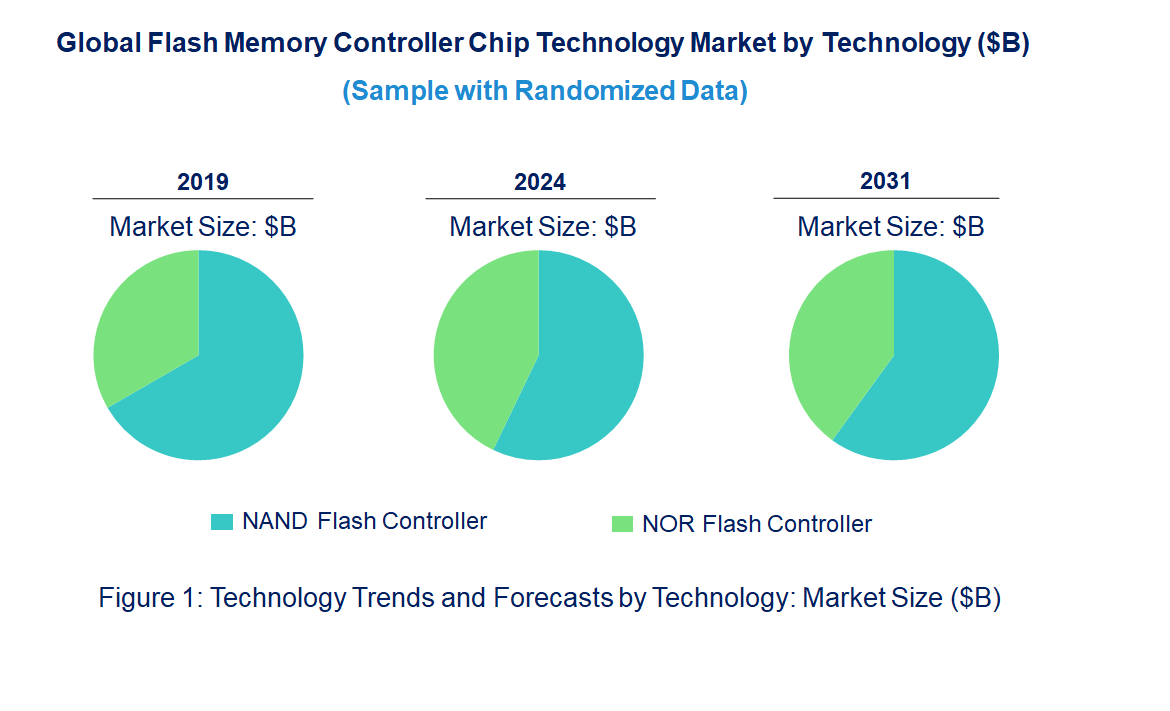
Emerging Trends in the Flash Memory Controller Chip Market
The flash memory controller chip market is transforming due to advanced technologies, high demand for superior storage solutions, and rising use of cloud computing and IoT devices. These trends are driving the development of new memory types, innovative controllers, and memory storage solutions.• 3D NAND Flash Technology Adoption: The industry is increasingly adopting 3D NAND flash memory technology, which improves storage density, performance, and energy efficiency. Memory controllers are designed to support 3D NAND, paving the way for higher-capacity storage solutions in consumer electronics, data centers, and embedded systems.
• Increased Demand for High-Performance SSDs: As the need for faster data access grows, the demand for high-performance solid-state drives (SSDs) is rising. Flash memory controller chips are optimized to handle faster read/write speeds, lower latency, and higher endurance, making them essential for applications in gaming, enterprise storage, and cloud computing.
• AI and Machine Learning: Flash memory controllers are increasingly utilizing AI and machine learning algorithms to optimize performance, data management, and predictive maintenance. These technologies assist in real-time error detection, wear leveling, and power management, significantly enhancing the lifespan and reliability of flash memory devices.
• Focus on Data Security and Encryption: With growing cybersecurity concerns, flash memory controllers are incorporating robust data security features such as end-to-end encryption, secure boot, and real-time data protection. These features are crucial for safeguarding sensitive information in applications like mobile devices, enterprise storage, and financial systems.
• Increasing Adoption in Automotive and Industrial Applications: Flash memory controller chips are becoming increasingly popular in automotive and industrial markets, where high performance and reliability are essential. Autonomous driving and industrial IoT applications, including infotainment systems, require low-power consumption storage with higher performance, pushing memory controllers toward innovation. These emerging trends, such as the shift toward 3D NAND flash, growing demand for SSDs, AI integration, enhanced data security, and increased adoption in automotive and industrial applications, are transforming the market for flash memory controller chips. These advancements enable higher performance, capacity, and security, all key aspects of consumer and industrial evolution.
Flash Memory Controller Chip Market : Industry Potential, Technological Development, and Compliance Considerations
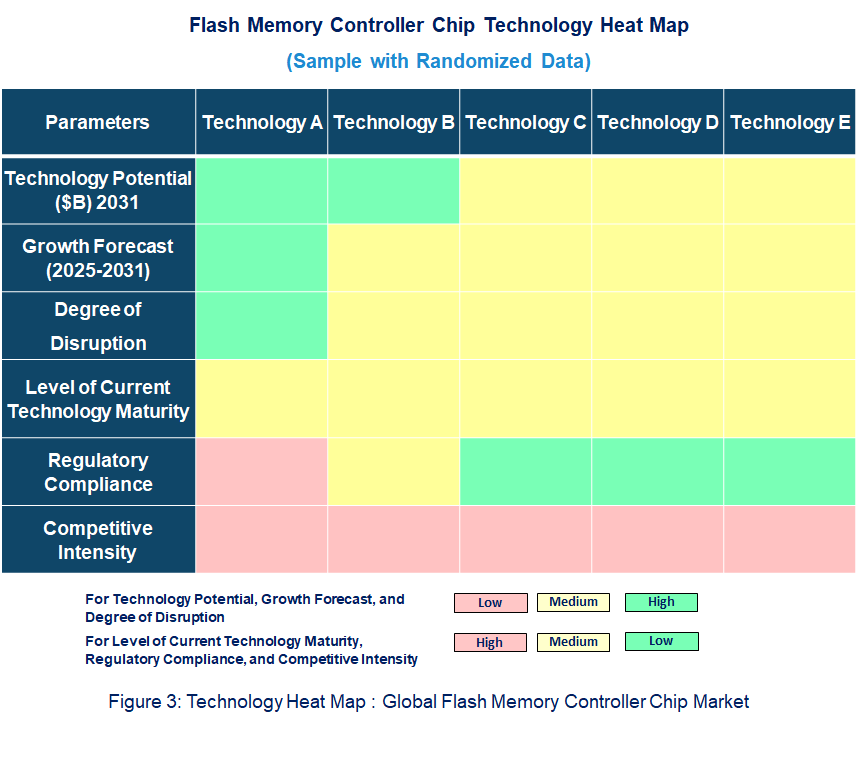
Flash memory controller chips are an essential component of flash memory devices like solid-state drives, USB drives, and memory cards. They oversee data read/write operations, error correction, wear leveling, and power management in flash storage systems. With the growth of industries such as consumer electronics, data centers, and automotive, which require faster and more reliable data storage solutions, the market for flash memory controller chips is booming.• Technology Potential: The potential of flash memory controller technology is limitless, as flash memory technology continues to evolve. 3D NAND technology is enhancing the capacity, speed, and endurance of flash memory, presenting new opportunities for better performance and efficiency from flash memory controllers. Additionally, the growing demand for high-speed data access in all devices makes it critical to manage data integrity, power consumption, and performance through controllers.
• Degree of Disruption: The disruption level is moderate to high because flash memory controllers will drive the widespread adoption of flash memory across devices, from smartphones to large enterprise-grade storage systems for faster data storage. Their significance will continue to grow with the ongoing demand for high-capacity, low-latency storage solutions in applications such as AI, cloud computing, and analytics.
• Technology Maturity: Flash memory controller technology has already reached a mature stage, with established vendors and widespread integration into both consumer and enterprise products. Innovation persists, with new features such as higher-level data encryption, faster data transfer protocols (PCIe 4.0/5.0), and improved power efficiency.
• Regulatory Compliance: The international standards JEDEC (Joint Electron Device Engineering Council) for memory interface and reliability, along with environmental regulations RoHS (Restriction of Hazardous Substances), are adhered to by flash memory controllers. Compliance with these regulations ensures that the product is safe, reliable, and environmentally friendly.
Recent Technological development in Flash Memory Controller Chip Market by Key Players
The flash memory controller chip market has been witnessing rapid developments due to major players like Marvell Technology, Silicon Motion, Phison Electronics, and others. These companies are advancing technology to compete in the rapidly growing storage solutions market.• Marvell Technology Group Ltd.: Marvell continues to innovate with its advanced flash memory controller solutions, focusing on SSDs and enterprise storage applications. The company’s investment in 3D NAND flash memory controller chips has allowed it to stay ahead of competitors by offering higher capacity and performance for both consumer and enterprise markets.
• Silicon Motion Technology Corporation: Silicon Motion is a leader in NAND flash controller solutions, focusing on high-performance SSDs and embedded storage. Recent advancements in 3D NAND technology have greatly improved their product offerings for both consumer electronics and enterprise-level storage solutions.
• Phison Electronics Corporation: Phison is concentrating on improving its PCIe 4.0 and 5.0 NAND flash controllers for use in SSDs, promising to improve read/write access times with higher data throughput rates. Through cutting-edge controller technology, it has been able to cater to the growing requirements of data centers and consumer markets.
• Western Digital Corporation: Western Digital is heavily investing in its flash memory controller technology to support enterprise storage solutions. The company has seen improved capacity and speed on storage products through developments in 3D NAND technology, further enhancing its position in the global flash memory market.
• Micron Technology, Inc.: Micron has gained ground in the flash memory controller chip area by developing products that enhance 3D NAND flash performance in consumer and industrial applications. Their focus on scalable, high-performance solutions has positioned them as a major player in this market.
• Toshiba Corporation: Toshiba continues to develop flash memory controllers optimized for high-end storage solutions, including enterprise-grade SSDs. Their focus on 3D NAND technology has allowed them to address the increasing need for high-capacity, high-performance storage products across various sectors, from consumer electronics to automotive.
• Samsung Electronics Co., Ltd.: For its flagship SSDs used in everything from PCs to data centers, flash memory controller chips are integral. Samsung pioneered the integration of advanced controllers into 3D NAND memory to improve overall performance as well as power efficiency.
• SK Hynix Inc.: SK Hynix has furthered its hold in the flash memory controller market with innovations in SSD controller technology. With high-speed data transfer capabilities and low power consumption, SK Hynix ensures that its products cater to both mobile and enterprise applications.
• Intel Corporation: Intel’s SSD controller technology supports its high-performance NAND flash products, focusing on enterprise and consumer markets. Developments in PCIe Gen4 and Gen5 controllers have been pushing the limits of speed and storage capacity, making Intel a significant player in the high-performance storage market.
• Kingston Technology Company, Inc.: Kingston continues to make strides in the flash memory controller space with value-driven, high-capacity storage solutions. Recently, they have advanced NAND flash controller innovations, serving both consumer and enterprise applications—cost-effective and reliability-focused storage products. These key players are making tremendous strides in developing flash memory controller chip technology, focusing on greater performance, increased storage, and faster data transfer. Innovations in 3D NAND technology and AI integration are at the forefront of flash memory solutions in both consumer and enterprise markets.
Flash Memory Controller Chip Market Driver and Challenges
The flash memory controller chip market is emerging because of technological advancements and shifts in the industry, accompanied by a growing demand for storage solutions with high performance. This field is still plagued by several related concerns, such as competition, security risks, and integration complexity. The factors responsible for driving the flash memory controller chip market include:• Demand for High-Speed and High-Capacity Storage: The need for faster and higher-capacity storage solutions in consumer electronics, data centers, and enterprise applications is increasing. This is fueling demand for advanced flash memory controllers. Efficient management of 3D NAND and other advanced flash technologies will be essential to meet these needs.
• Data Center and Cloud: The rapid expansion of the data centers and cloud computing industry has created a surge in demand for high-performance storage. Flash memory controllers play a key role in optimizing SSD performance for the cloud and enterprise applications, driving the market for this component.
• Technological Innovation in NAND Flash: The ongoing advancement of NAND flash technology, particularly 3D NAND, has led to continuous improvement in the development of more efficient flash memory controllers. With the growth of storage, the need for controllers to sustain higher data throughput, more complex error correction, and superior power management will further escalate innovation in the market.
• SSD Adoption in Consumer Electronics: As SSDs become the norm for consumer electronics products such as laptops, smartphones, and game consoles, there is increased demand for the high performance of flash memory controllers. Since these controllers manage the speed and capacities of SSDs, advanced solutions have been developed to meet the ever-increasing demands of the market. Challenges in the flash memory controller chip market include:
• High Development and Manufacturing Costs: The complexity of developing high-performance flash memory controllers, particularly those supporting 3D NAND technology, requires significant research and development investment. The high manufacturing cost can make these products unaffordable for some companies, thus making them less competitive in the market.
• Security: Flash memory chips store highly sensitive data, making secure data encryption and protection a significant issue. Flash memory controllers must include strong security features, such as end-to-end encryption, to protect the data from cyber threats, adding complexity to their design.
• Integration Complexity and Compatibility: Flash memory controllers must be compatible with a wide variety of NAND flash memory types and configurations, adding complexity to their design and integration. Ensuring smooth integration across different storage solutions and applications remains a key challenge for manufacturers. Drivers for the flash memory controller chip market include the increasing demand for high-performance SSDs, improvements in NAND flash technology, and the growth of data centers. However, challenges such as high development costs, security concerns, and integration complexity must be overcome to ensure that the market continues to grow sustainably.
List of Flash Memory Controller Chip Companies
Companies in the market compete based on product quality offered. Major players in this market focus on expanding their manufacturing facilities, R&D investments, infrastructural development, and leverage integration opportunities across the value chain. With these strategies flash memory controller chip companies cater to increasing demand, ensure competitive effectiveness, develop innovative products & technologies, reduce production costs, and expand their customer base. Some of the flash memory controller chip companies profiled in this report include.• Marvell Technology Group Ltd.
• Silicon Motion Technology Corporation
• Phison Electronics Corporation
• Western Digital Corporation
• Micron Technology, Inc.
• Toshiba Corporation
Flash Memory Controller Chip Market by Technology
• Technology Readiness by Type: Technology readiness is highly mature, with widespread adoption in storage solutions like SSDs and mobile devices. NAND flash controller technology is well-established and ready for high-performance applications in storage solutions. Further improvements are being made to increase density, speed, and endurance for consumer electronics and data centers. NOR Flash controllers are highly suitable for embedded systems, automotive electronics, and firmware storage, where read speeds must be fast and reliable. The competitive landscape for NAND flash is favorable, with strong demand for faster, larger storage across various devices. NOR Flash remains competitive in niche areas such as automotive and industrial applications. Regulatory compliance ensures adherence to safety standards, data integrity, and environmental considerations, with specific requirements based on application areas.
• Competition Intensity and Regulation Compliance: NAND flash controllers face higher competitive intensity compared to NOR flash controllers due to their high speed, capacity, and cost-effectiveness. Therefore, NAND Flash holds a larger share of the flash memory controller chip market. However, NOR flash controllers remain necessary for applications requiring embedded systems and automotive solutions where speed and reliability are critical. Regulatory compliance is crucial for these technologies to ensure safety and environmental impact. NAND Flash controllers must comply with energy efficiency and data integrity standards, while NOR Flash controllers must meet specific regulations for automotive safety and industrial reliability. Companies in both segments must comply with stringent global regulations concerning power consumption, data protection, and product safety to stay competitive.
• Potential for Disruption of Different Technologies: NAND flash controllers and NOR flash controllers have different potentials for disruption in the flash memory controller chip market. NAND flash controllers are driving major disruption due to their high capacity, lower cost, and faster speeds, making them ideal for applications like SSDs, smartphones, and data storage in enterprise systems. NOR flash controllers, although slower and more expensive, provide high reliability and fast random access, making them suitable for embedded systems, firmware storage, and automotive applications. The market is being disrupted by the increasing adoption of NAND flash in consumer electronics and data centers, while NOR flash remains crucial in sectors requiring high reliability and durability, creating complementary roles for both technologies in the overall memory landscape.
Flash Memory Controller Chip Market Trend and Forecast by Technology [Value from 2019 to 2031]:
• NAND Flash Controller
• NOR Flash Controller
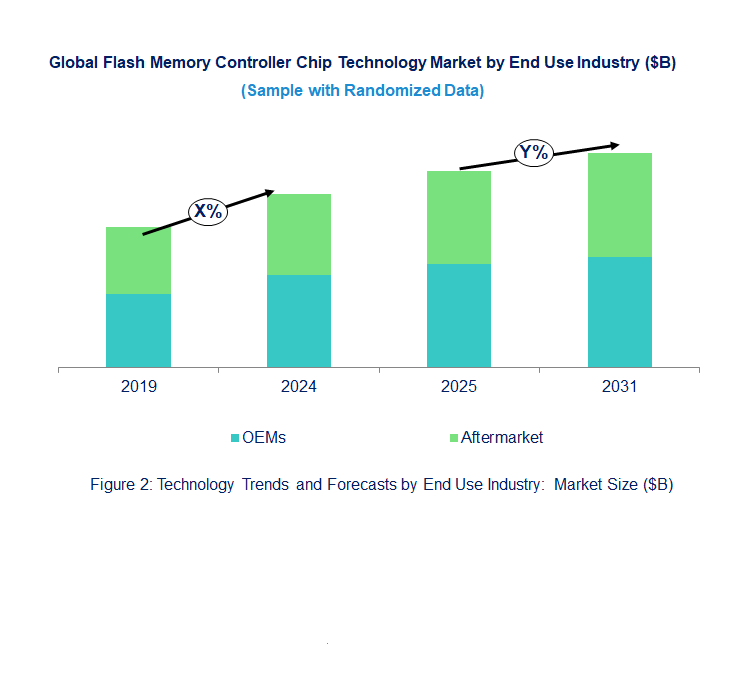
Flash Memory Controller Chip Market Trend and Forecast by End Use [Value from 2019 to 2031]:
• OEMs
• Aftermarket
Flash Memory Controller Chip Market by Region [Value from 2019 to 2031]:
• North America
• Europe
• Asia Pacific
• The Rest of the World
• Latest Developments and Innovations in the Flash Memory Controller Chip Technologies
• Companies / Ecosystems
• Strategic Opportunities by Technology Type
Features of the Global Flash Memory Controller Chip Market
Market Size Estimates: Flash memory controller chip market size estimation in terms of ($B). Trend and Forecast Analysis: Market trends (2019 to 2024) and forecast (2025 to 2031) by various segments and regions. Segmentation Analysis: Technology trends in the global flash memory controller chip market size by various segments, such as end use and technology in terms of value and volume shipments. Regional Analysis: Technology trends in the global flash memory controller chip market breakdown by North America, Europe, Asia Pacific, and the Rest of the World. Growth Opportunities: Analysis of growth opportunities in different end uses, technologies, and regions for technology trends in the global flash memory controller chip market. Strategic Analysis: This includes M&A, new product development, and competitive landscape for technology trends in the global flash memory controller chip market. Analysis of competitive intensity of the industry based on Porter’s Five Forces model.Table of Contents
Methodology
- In-depth interviews of the major players in this market
- Detailed secondary research from competitors’ financial statements and published data
- Extensive searches of published works, market, and database information pertaining to industry news, company press releases, and customer intentions
- A compilation of the experiences, judgments, and insights of Lucintel’s professionals, who have analyzed and tracked this market over the years.


Buy Now
Choose a license that fits your team. Instant PDF delivery.
Prices exclude taxes. Instant delivery. Custom licensing available on request.
Key Questions
- • What are some of the most promising potential, high-growth opportunities for the technology trends in the global flash memory controller chip market by technology (nand flash controller and nor flash controller), end use (oems and aftermarket), and region (North America, Europe, Asia Pacific, and the Rest of the World)?
- • Which technology segments will grow at a faster pace and why?
- • Which regions will grow at a faster pace and why?
- • What are the key factors affecting dynamics of different technology? What are the drivers and challenges of these technologies in the global flash memory controller chip market?
- • What are the business risks and threats to the technology trends in the global flash memory controller chip market?
- • What are the emerging trends in these technologies in the global flash memory controller chip market and the reasons behind them?
- • Which technologies have potential of disruption in this market?
- • What are the new developments in the technology trends in the global flash memory controller chip market? Which companies are leading these developments?
- • Who are the major players in technology trends in the global flash memory controller chip market? What strategic initiatives are being implemented by key players for business growth?
- • What are strategic growth opportunities in this flash memory controller chip technology space?
- • What M & A activities did take place in the last five years in technology trends in the global flash memory controller chip market?


