
Report Feature
Federated Learning & Homomorphic Encryption Market Trends and Forecast
The future of the global federated learning & homomorphic encryption market looks promising with opportunities in the healthcare & life science, banking, financial services & insurance, information technology & telecommunication, manufacturing, energy & utility, and government & defense markets. The global federated learning & homomorphic encryption market is expected to grow with a CAGR of 21.3% from 2025 to 2031. The major drivers for this market are the increasing data privacy needs across sectors, the rising demand for secure collaborative modeling, and the growing adoption of encrypted computation technologies.• Lucintel forecasts that, within the technology category, secure multi-party computation is expected to witness the highest growth over the forecast period.
• Within the end use category, healthcare & life science is expected to witness the highest growth.
• In terms of region, APAC is expected to witness the highest growth over the forecast period.
Gain valuable insights for your business decisions with our comprehensive 150+ page report. Sample figures with some insights are shown below.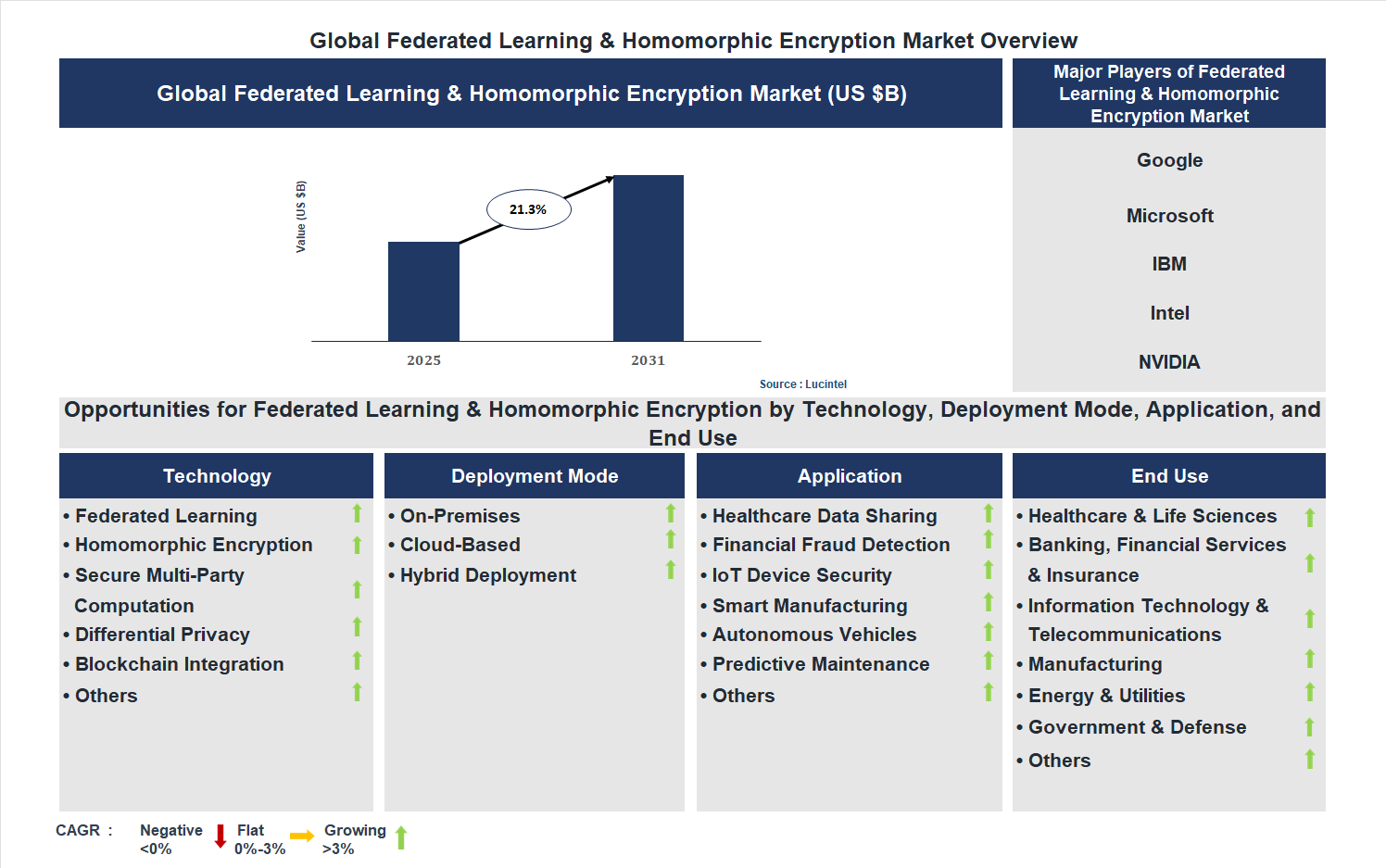
Emerging Trends in the Federated Learning & Homomorphic Encryption Market
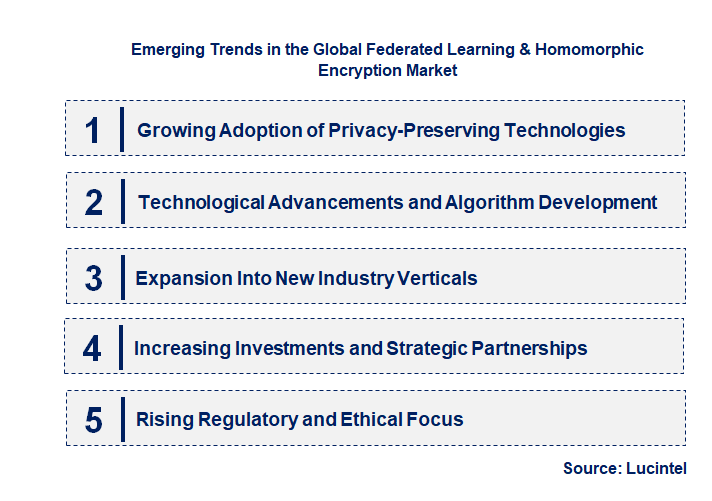
The federated learning & homomorphic encryption market is experiencing rapid growth driven by increasing data privacy concerns, regulatory pressures, and the need for secure data sharing across industries. As organizations seek to leverage data insights without compromising security, innovative technologies like federated learning and homomorphic encryption are gaining prominence. These advancements enable collaborative machine learning and secure data processing while maintaining privacy. The market is also influenced by technological advancements, expanding applications across healthcare, finance, and government sectors, and rising investments from key industry players. These trends are fundamentally transforming how data is handled, analyzed, and protected, fostering a more secure and privacy-centric digital ecosystem.• Growing Adoption of Privacy-Preserving Technologies: As data privacy regulations such as GDPR and CCPA tighten, organizations are increasingly adopting federated learning and homomorphic encryption to comply with legal requirements. These technologies allow data to be processed and analyzed without exposing sensitive information, ensuring privacy while enabling insights. This trend is particularly prominent in healthcare, finance, and government sectors, where data sensitivity is high. The adoption is driven by the need to balance data utility with privacy, fostering trust among users and stakeholders. As a result, the market is witnessing a surge in solutions that prioritize privacy-preserving data analytics.
• Technological Advancements and Algorithm Development: Continuous improvements in algorithms and computational techniques are enhancing the efficiency and scalability of federated learning and homomorphic encryption. Researchers are developing more robust, faster, and less resource-intensive methods, making these technologies more practical for real-world applications. These advancements reduce latency, improve accuracy, and lower costs, broadening the scope of deployment across various industries. The evolution of hardware, such as specialized chips for encryption and distributed computing, further accelerates progress. This trend is making privacy-preserving AI more accessible and effective, fueling market growth.
• Expansion into New Industry Verticals: Initially prominent in healthcare and finance, federated learning and homomorphic encryption are now expanding into sectors like manufacturing, retail, and government. These industries require secure data collaboration for tasks such as predictive maintenance, personalized marketing, and secure voting systems. The ability to analyze data across organizations without sharing raw data is a key driver. This diversification is opening new revenue streams and use cases, increasing market size and competitiveness. As more sectors recognize the benefits of privacy-preserving analytics, the market is poised for significant expansion.
• Increasing Investments and Strategic Partnerships: Major technology firms, startups, and venture capitalists are investing heavily in federated learning and homomorphic encryption solutions. Strategic collaborations are forming between tech companies, academia, and industry players to develop standardized frameworks and open-source tools. These investments accelerate research, product development, and deployment, fostering innovation. Funding also supports startups focusing on niche applications, further diversifying the market. The influx of capital and partnerships indicates strong confidence in the market’s potential, driving rapid growth and technological breakthroughs.
• Rising Regulatory and Ethical Focus: Governments and regulatory bodies are emphasizing data privacy and security, prompting organizations to adopt compliant solutions. Ethical considerations around data usage are also influencing market dynamics, encouraging transparency and accountability. This regulatory environment incentivizes the adoption of federated learning and homomorphic encryption as compliant, ethical alternatives to traditional data sharing. Companies that proactively align with these standards gain competitive advantages. The trend underscores the importance of privacy-centric AI development, shaping future market strategies and fostering trust among consumers and regulators.
In summary, these emerging trends are reshaping the federated learning & homomorphic encryption market by promoting privacy-centric data analytics, fostering technological innovation, expanding industry applications, attracting investments, and aligning with regulatory standards. This evolution is paving the way for a more secure, efficient, and ethically responsible digital landscape.
Recent Development in the Federated Learning & Homomorphic Encryption Market
The federated learning & homomorphic encryption market has experienced significant growth driven by increasing data privacy concerns, advancements in AI, and the need for secure data sharing across industries. As organizations seek to leverage distributed data without compromising privacy, innovative solutions are emerging to address these challenges. Recent developments reflect a focus on enhancing security, scalability, and efficiency, which are crucial for widespread adoption. These innovations are transforming how data is processed and analyzed, enabling more secure and collaborative AI applications. The following key developments highlight the current trajectory and future potential of this evolving market.• Integration of Federated Learning with Homomorphic Encryption: This development combines federated learnings decentralized data processing with homomorphic encryptions secure computation, enabling privacy-preserving AI model training across multiple data sources without exposing raw data. It enhances data security and compliance, fostering trust among stakeholders and expanding use cases in healthcare, finance, and IoT sectors.
• Advancements in Homomorphic Encryption Algorithms: Researchers have developed more efficient and scalable homomorphic encryption schemes, reducing computational overhead and latency. These improvements make secure data processing more practical for real-time applications, broadening the market scope and encouraging adoption in industries requiring rapid data analysis, such as autonomous vehicles and financial trading.
• Deployment of Privacy-Preserving AI Platforms: Several companies have launched integrated platforms that facilitate federated learning with homomorphic encryption, simplifying deployment for enterprises. These platforms offer user-friendly interfaces and robust security features, accelerating adoption and enabling organizations to implement secure AI solutions without extensive technical expertise.
• Regulatory and Standardization Initiatives: Governments and industry bodies are establishing standards and regulations for privacy-preserving AI technologies. These initiatives promote interoperability, security benchmarks, and compliance frameworks, fostering a trustworthy environment for market growth and encouraging organizations to adopt federated learning and homomorphic encryption solutions.
• Expansion into New Industry Verticals: The market is witnessing increased adoption in emerging sectors such as healthcare, where sensitive patient data is protected; finance, for secure transaction analysis; and smart cities, for secure data sharing among IoT devices. This diversification drives market expansion and highlights the versatility of these technologies in addressing sector-specific privacy challenges.
In summary, these developments are significantly impacting the federated learning & homomorphic encryption market by enhancing security, efficiency, and regulatory compliance. They are enabling broader adoption across diverse industries, fostering innovation, and paving the way for more secure, privacy-preserving AI applications. As these technologies mature, the market is poised for rapid growth and increased integration into critical data-driven processes worldwide.
Strategic Growth Opportunities in the Federated Learning & Homomorphic Encryption Market
The federated learning & homomorphic encryption market is experiencing rapid growth driven by increasing data privacy concerns, regulatory requirements, and the need for secure data sharing across industries. As organizations seek innovative solutions to leverage data without compromising security, key applications are emerging as significant growth drivers. These applications span healthcare, finance, automotive, retail, and government sectors, each presenting unique opportunities for technological advancement and market expansion. The convergence of federated learning and homomorphic encryption offers a promising pathway to enable secure, decentralized data processing, fostering trust and compliance while unlocking new revenue streams and operational efficiencies.• Healthcare: Enhanced patient data privacy and collaborative research: Federated learning allows hospitals and research institutions to collaboratively analyze sensitive health data without sharing raw information, improving diagnostics and personalized medicine while maintaining compliance with privacy regulations.
• Finance: Secure fraud detection and risk management: Financial institutions utilize these technologies to analyze transaction data securely, enabling real-time fraud detection and credit scoring without exposing sensitive customer information, thus strengthening security and customer trust.
• Automotive: Privacy-preserving autonomous vehicle data sharing: Automotive companies leverage these solutions to share vehicle data for improved AI model training while safeguarding user privacy, accelerating the development of autonomous driving technologies and enhancing safety features.
• Retail: Personalized, privacy-compliant customer insights: Retailers employ federated learning to analyze consumer behavior across multiple locations without compromising individual privacy, enabling targeted marketing and inventory optimization that boost sales and customer satisfaction.
• Government: Secure data sharing for public services: Governments utilize these technologies to securely share and analyze citizen data across agencies, improving public service delivery, enhancing security, and ensuring compliance with data protection laws.
In summary, these growth opportunities are significantly impacting the federated learning & homomorphic encryption market by enabling secure, privacy-preserving data utilization across diverse applications. This fosters increased adoption, drives innovation, and opens new revenue streams, positioning the market for sustained expansion and technological leadership.
Federated Learning & Homomorphic Encryption Market Driver and Challenges
The federated learning & homomorphic encryption market is influenced by a variety of technological, economic, and regulatory factors. Rapid advancements in artificial intelligence and data privacy have driven the adoption of federated learning to enable decentralized data processing while maintaining privacy. Simultaneously, the increasing need for secure data sharing has propelled homomorphic encryption to the forefront of data security solutions. Economic factors such as rising data monetization and digital transformation initiatives further fuel market growth. However, regulatory frameworks around data privacy and security pose significant challenges. The interplay of these drivers and challenges shapes the markets trajectory, influencing innovation, adoption rates, and competitive dynamics across industries.The factors responsible for driving the federated learning & homomorphic encryption market include:
• Technological Advancements: Rapid innovations in AI, machine learning, and encryption technologies have enabled more efficient and scalable federated learning and homomorphic encryption solutions. These advancements facilitate secure, decentralized data processing, fostering trust among organizations and encouraging adoption across sectors such as healthcare, finance, and government. As technology continues to evolve, the capabilities of these solutions expand, making them more practical and accessible, thus accelerating market growth.
• Growing Data Privacy Concerns: Increasing awareness of data privacy issues and stringent regulations like GDPR and CCPA have heightened the demand for privacy-preserving technologies. Federated learning allows models to be trained across multiple devices or servers without transferring raw data, while homomorphic encryption ensures data remains encrypted during processing. These features address privacy concerns, enabling organizations to leverage data insights without compromising security, thereby driving market expansion.
• Rising Adoption of AI and IoT: The proliferation of AI applications and Internet of Things (IoT) devices generates vast amounts of sensitive data that require secure processing. Federated learning enables collaborative AI model training without data centralization, while homomorphic encryption secures data during analysis. This synergy supports industries in deploying intelligent, privacy-preserving solutions, fueling demand for these technologies and expanding the market.
• Increasing Digital Transformation Initiatives: Organizations across industries are investing in digital transformation to enhance operational efficiency and customer experience. Incorporating federated learning and homomorphic encryption into digital strategies helps companies comply with privacy regulations while leveraging data insights. This integration promotes innovation and competitive advantage, further propelling market growth as businesses seek secure, scalable data solutions.
• Strategic Collaborations and Investments: Major tech firms and startups are forming strategic partnerships and investing heavily in federated learning and homomorphic encryption research. These collaborations accelerate product development, standardization, and deployment, making solutions more mature and widely available. Increased funding and industry cooperation foster a robust ecosystem, supporting market expansion and technological breakthroughs.
The challenges facing this Market include:
• High Computational and Implementation Costs: Implementing federated learning and homomorphic encryption requires significant computational resources and expertise. The complex algorithms demand substantial processing power, leading to high infrastructure costs. Additionally, integrating these technologies into existing systems can be technically challenging and resource-intensive, which may hinder adoption, especially among small and medium-sized enterprises.
• Limited Standardization and Interoperability: The lack of universal standards and protocols for federated learning and homomorphic encryption creates compatibility issues among different platforms and solutions. This fragmentation hampers seamless integration, increases development time, and raises concerns about security and compliance. Without standardized frameworks, widespread adoption remains slow, and interoperability challenges persist.
• Performance and Scalability Constraints: Homomorphic encryption, in particular, often results in increased computational overhead, leading to slower processing times and reduced system efficiency. Scalability becomes a concern when handling large datasets or numerous participants in federated learning networks. These performance limitations can restrict real-time applications and large-scale deployments, impeding market growth and technological adoption.
In summary, the federated learning & homomorphic encryption market is driven by technological innovations, privacy concerns, and digital transformation efforts, which collectively foster growth and adoption. However, high costs, lack of standardization, and performance issues pose significant hurdles. The interplay of these factors will shape the markets evolution, requiring ongoing innovation, collaboration, and regulatory clarity to realize its full potential. As solutions mature and challenges are addressed, the market is poised for substantial expansion, offering secure, privacy-preserving data processing capabilities across diverse industries.
List of Federated Learning & Homomorphic Encryption Companies
Companies in the market compete on the basis of product quality offered. Major players in this market focus on expanding their manufacturing facilities, R&D investments, infrastructural development, and leverage integration opportunities across the value chain. With these strategies federated learning & homomorphic encryption companies cater increasing demand, ensure competitive effectiveness, develop innovative products & technologies, reduce production costs, and expand their customer base. Some of the federated learning & homomorphic encryption companies profiled in this report include-• Microsoft
• IBM
• Intel
• NVIDIA
• Amazon Web Services
• Meta
• Apple
• Qualcomm
• Huawei
Federated Learning & Homomorphic Encryption Market by Segment
The study includes a forecast for the global federated learning & homomorphic encryption market by technology, deployment mode, application, end use, and region.Federated Learning & Homomorphic Encryption Market by Technology [Value from 2019 to 2031]:
• Federated Learning
• Homomorphic Encryption
• Secure Multi-Party Computation
• Differential Privacy
• Blockchain Integration
• Others
Federated Learning & Homomorphic Encryption Market by Deployment Mode [Value from 2019 to 2031]:
• On-Premises
• Cloud-Based
• Hybrid Deployment
Federated Learning & Homomorphic Encryption Market by Application [Value from 2019 to 2031]:
• Healthcare Data Sharing
• Financial Fraud Detection
• IoT Device Security
• Smart Manufacturing
• Autonomous Vehicles
• Predictive Maintenance
• Others
Federated Learning & Homomorphic Encryption Market by End Use [Value from 2019 to 2031]:
• Healthcare & Life Sciences
• Banking, Financial Services & Insurance
• Information Technology & Telecommunications
• Manufacturing
• Energy & Utilities
• Government & Defense
• Others
Federated Learning & Homomorphic Encryption Market by Region [Value from 2019 to 2031]:
• North America
• Europe
• Asia Pacific
• The Rest of the World
Country Wise Outlook for the Federated Learning & Homomorphic Encryption Market
The federated learning & homomorphic encryption market has experienced significant growth driven by increasing data privacy concerns, advancements in AI, and the need for secure data sharing across industries. As organizations seek to leverage distributed data without compromising privacy, technological innovations and regulatory pressures are shaping market dynamics. Countries are adopting these technologies to enhance data security, comply with data protection laws, and improve AI model performance. The evolving landscape reflects a global push towards more secure, privacy-preserving machine learning solutions, with key players investing heavily in research and development to stay competitive.• United States: The US market has seen rapid adoption of federated learning and homomorphic encryption, driven by major tech companies and startups focusing on healthcare, finance, and automotive sectors. Regulatory frameworks like GDPR and CCPA have spurred innovation in privacy-preserving AI. Investments in R&D are high, with collaborations between academia and industry enhancing technological capabilities. The US government is also exploring these technologies for national security and defense applications, further accelerating market growth.
• China: China is rapidly advancing in federated learning and homomorphic encryption, with government initiatives promoting AI and data security. Major Chinese tech giants are investing heavily in developing secure AI solutions for sectors such as banking, healthcare, and smart cities. The country’s focus on data sovereignty and national security has led to increased adoption of these technologies. Additionally, China’s regulatory environment encourages innovation while emphasizing data privacy, positioning it as a key player in the global market.
• Germany: Germany’s market is characterized by a strong emphasis on data privacy and security, aligning with the European Union’s GDPR regulations. Leading automotive and manufacturing companies are integrating federated learning and homomorphic encryption to enable secure, collaborative AI development. The country is also investing in research through public-private partnerships to advance these technologies. Germany’s focus on industrial applications and privacy compliance makes it a significant player in the European market for secure AI solutions.
• India: India is witnessing growing interest in federated learning and homomorphic encryption, particularly in banking, healthcare, and telecommunications. The government’s Digital India initiative promotes secure data sharing and AI innovation. Startups and tech firms are exploring these technologies to address data privacy concerns while enabling AI-driven services. Increased funding from government and private investors is fueling research and deployment, with a focus on scalable, cost-effective solutions suitable for India’s diverse data landscape.
• Japan: Japan is actively adopting federated learning and homomorphic encryption to enhance data security in sectors like healthcare, manufacturing, and finance. The government’s AI strategy emphasizes privacy-preserving technologies to foster innovation while complying with strict data protection laws. Japanese companies are collaborating with international partners to develop advanced secure AI solutions. The market is also supported by government grants and research programs aimed at integrating these technologies into critical infrastructure and industrial applications, positioning Japan as a key player in secure AI development.

Features of the Global Federated Learning & Homomorphic Encryption Market
Market Size Estimates: Federated learning & homomorphic encryption market size estimation in terms of value ($B).Trend and Forecast Analysis: Market trends (2019 to 2024) and forecast (2025 to 2031) by various segments and regions.
Segmentation Analysis: Federated learning & homomorphic encryption market size by various segments, such as by technology, deployment mode, application, end use, and region in terms of value ($B).
Regional Analysis: Federated learning & homomorphic encryption market breakdown by North America, Europe, Asia Pacific, and Rest of the World.
Growth Opportunities: Analysis of growth opportunities in different technologies, deployment mode, applications, end uses, and regions for the federated learning & homomorphic encryption market.
Strategic Analysis: This includes M&A, new product development, and competitive landscape of the federated learning & homomorphic encryption market.
Analysis of competitive intensity of the industry based on Porter’s Five Forces model.

FAQ
Q1. What is the growth forecast for federated learning & homomorphic encryption market?Answer: The global federated learning & homomorphic encryption market is expected to grow with a CAGR of 21.3% from 2025 to 2031.
Q2. What are the major drivers influencing the growth of the federated learning & homomorphic encryption market?
Answer: The major drivers for this market are the increasing data privacy needs across sectors, the rising demand for secure collaborative modeling, and the growing adoption of encrypted computation technologies.
Q3. What are the major segments for federated learning & homomorphic encryption market?
Answer: The future of the federated learning & homomorphic encryption market looks promising with opportunities in the healthcare & life science, banking, financial services & insurance, information technology & telecommunication, manufacturing, energy & utility, and government & defense markets.
Q4. Who are the key federated learning & homomorphic encryption market companies?
Answer: Some of the key federated learning & homomorphic encryption companies are as follows:
• Microsoft
• IBM
• Intel
• NVIDIA
• Amazon Web Services
• Meta
• Apple
• Qualcomm
• Huawei
Q5. Which federated learning & homomorphic encryption market segment will be the largest in future?Answer: Lucintel forecasts that, within the technology category, secure multi-party computation is expected to witness the highest growth over the forecast period.
Q6. In federated learning & homomorphic encryption market, which region is expected to be the largest in next 5 years?
Answer: In terms of region, APAC is expected to witness the highest growth over the forecast period.
Q7. Do we receive customization in this report?
Answer: Yes, Lucintel provides 10% customization without any additional cost.
Table of Contents
List of Figures
List of Tables
Methodology
- In-depth interviews of the major players in this market
- Detailed secondary research from competitors’ financial statements and published data
- Extensive searches of published works, market, and database information pertaining to industry news, company press releases, and customer intentions
- A compilation of the experiences, judgments, and insights of Lucintel’s professionals, who have analyzed and tracked this market over the years.


Buy Now
Choose a license that fits your team. Instant PDF delivery.
Prices exclude taxes. Instant delivery. Custom licensing available on request.
Key Questions
- • What are some of the most promising, high-growth opportunities for the federated learning & homomorphic encryption market by technology (federated learning, homomorphic encryption, secure multi-party computation, differential privacy, blockchain integration, and others), deployment mode (on-premises, cloud-based, and hybrid deployment), application (healthcare data sharing, financial fraud detection, IoT device security, smart manufacturing, autonomous vehicles, predictive maintenance, and others), end use (healthcare & life sciences, banking, financial services & insurance, information technology & telecommunications, manufacturing, energy & utilities, government & defense, and others), and region (North America, Europe, Asia Pacific, and the Rest of the World)?
- • Which segments will grow at a faster pace and why?
- • Which region will grow at a faster pace and why?
- • What are the key factors affecting market dynamics? What are the key challenges and business risks in this market?
- • What are the business risks and competitive threats in this market?
- • What are the emerging trends in this market and the reasons behind them?
- • What are some of the changing demands of customers in the market?
- • What are the new developments in the market? Which companies are leading these developments?
- • Who are the major players in this market? What strategic initiatives are key players pursuing for business growth?
- • What are some of the competing products in this market and how big of a threat do they pose for loss of market share by material or product substitution?
- • What M&A activity has occurred in the last 5 years and what has its impact been on the industry? For any questions related to Federated Learning & Homomorphic Encryption Market, Federated Learning & Homomorphic Encryption Market Size, Federated Learning & Homomorphic Encryption Market Growth, Federated Learning & Homomorphic Encryption Market Analysis, Federated Learning & Homomorphic Encryption Market Report, Federated Learning & Homomorphic Encryption Market Share, Federated Learning & Homomorphic Encryption Market Trends, Federated Learning & Homomorphic Encryption Market Forecast, Federated Learning & Homomorphic Encryption Companies, write Lucintel analyst at email: helpdesk@lucintel.com. We will be glad to get back to you soon.


