
Report Feature
Digital Twin Cable-Stayed Bridge Market Trends and Forecast
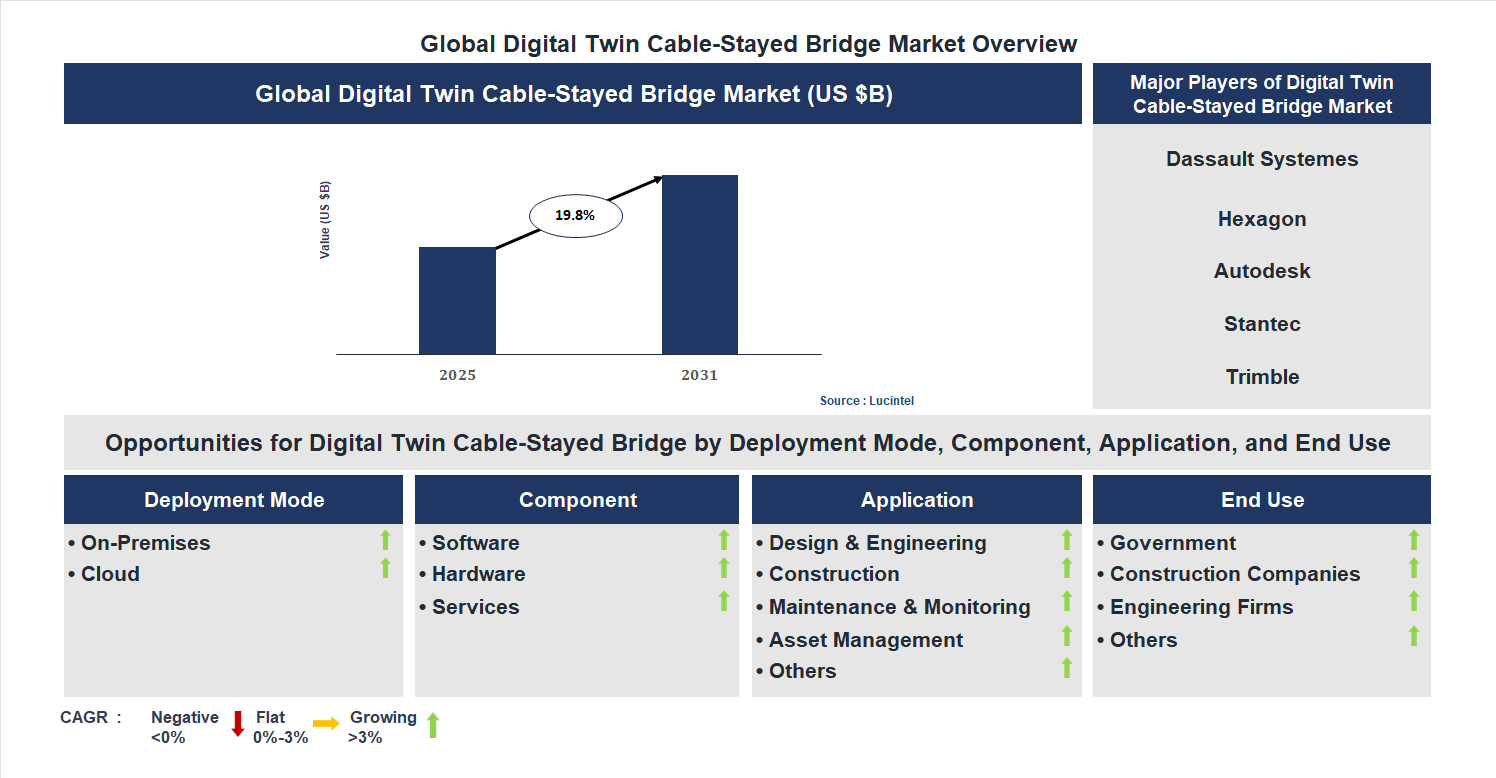
The future of the global digital twin cable-stayed bridge market looks promising with opportunities in the government, construction company, and engineering firm markets. The global digital twin cable-stayed bridge market is expected to grow with a CAGR of 19.8% from 2025 to 2031. The major drivers for this market are the increasing focus on predictive infrastructure maintenance, the rising need for real-time structural monitoring, and the growing adoption of digital engineering technologies.• Lucintel forecasts that, within the deployment mode category, on-premise is expected to witness higher growth over the forecast period.
• Within the end use category, engineering firm is expected to witness the highest growth.
• In terms of region, APAC is expected to witness the highest growth over the forecast period. Gain valuable insights for your business decisions with our comprehensive 150+ page report. Sample figures with some insights are shown below.
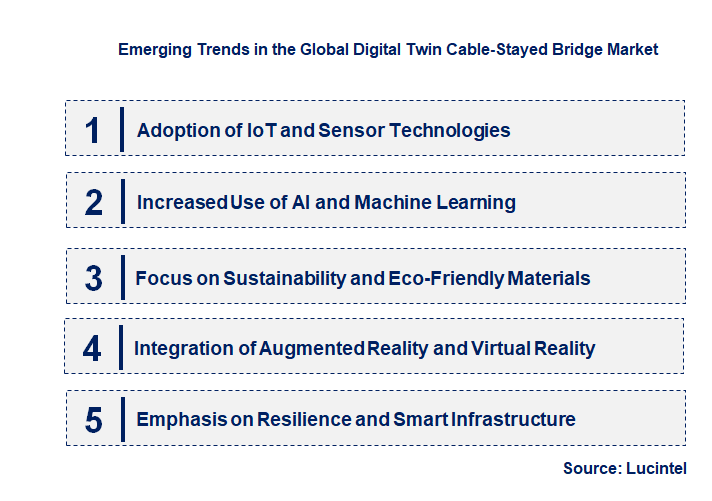
Emerging Trends in the Digital Twin Cable-Stayed Bridge Market
The digital twin cable-stayed bridge market is experiencing rapid growth driven by technological advancements and increasing infrastructure demands. Digital twin technology enables real-time monitoring, predictive maintenance, and enhanced design processes, transforming how bridges are constructed, maintained, and managed. As urbanization accelerates and infrastructure investments rise globally, the integration of digital twins into cable-stayed bridge projects is becoming essential. This market is characterized by innovation, increased efficiency, and improved safety standards. The following key trends highlight the evolving landscape of this market, reflecting its shift towards smarter, more sustainable, and resilient infrastructure solutions.• Adoption of IoT and sensor technologies: The integration of Internet of Things (IoT) devices and sensors into cable-stayed bridges allows for continuous data collection on structural health, environmental conditions, and usage patterns. This real-time data feeds into digital twins, enabling proactive maintenance and reducing downtime. The impact is significant, as it enhances safety, extends the lifespan of bridges, and lowers maintenance costs by predicting issues before they escalate.
• Increased use of AI and machine learning: Artificial intelligence and machine learning algorithms are being incorporated into digital twin platforms to analyze vast amounts of data generated by sensors. These technologies facilitate predictive analytics, optimize maintenance schedules, and improve decision-making processes. The result is more efficient management of bridge infrastructure, reduced operational costs, and improved safety standards, making bridges more resilient to wear and environmental stresses.
• Focus on sustainability and eco-friendly materials: The market is witnessing a shift towards sustainable construction practices, with digital twins playing a crucial role in designing eco-friendly cable-stayed bridges. Digital simulations help in selecting sustainable materials, optimizing structural designs for minimal environmental impact, and monitoring ecological effects during construction and operation. This trend promotes greener infrastructure, aligns with global sustainability goals, and reduces the carbon footprint of bridge projects.
• Integration of augmented reality (AR) and virtual reality (VR): AR and VR technologies are increasingly being used alongside digital twins for visualization, training, and maintenance. Engineers and stakeholders can virtually explore bridge models, identify potential issues, and plan interventions more effectively. This enhances collaboration, reduces errors, and accelerates project timelines, ultimately leading to safer and more efficient bridge management.
• Emphasis on resilience and smart infrastructure: The market is prioritizing the development of resilient cable-stayed bridges capable of withstanding natural disasters and climate change impacts. Digital twins enable simulation of various stress scenarios, helping engineers design more robust structures. This trend ensures long-term durability, enhances safety, and supports the development of smart, adaptive infrastructure that can respond dynamically to changing environmental conditions. In summary, these emerging trends are fundamentally reshaping the digital twin cable-stayed bridge market by fostering innovation, improving safety, and promoting sustainability. The integration of advanced technologies like IoT, AI, AR, and VR is enabling smarter infrastructure management, reducing costs, and extending the lifespan of bridges. As these trends continue to evolve, they will drive the market towards more resilient, efficient, and environmentally conscious solutions, ultimately transforming the future of bridge engineering and infrastructure development.
Recent Development in the Digital Twin Cable-Stayed Bridge Market
The digital twin cable-stayed bridge market is experiencing rapid growth driven by technological advancements and increasing infrastructure investments worldwide. Digital twin technology enables real-time monitoring, predictive maintenance, and enhanced design processes for cable-stayed bridges, improving safety and efficiency. As urbanization accelerates and infrastructure modernization becomes a priority, stakeholders are adopting digital twin solutions to optimize bridge performance and lifespan. This market's evolution is also influenced by innovations in IoT, AI, and data analytics, which facilitate more accurate simulations and proactive management. These developments are transforming traditional bridge engineering, making digital twins an essential component of modern infrastructure projects.• Adoption of IoT sensors: Integration of IoT sensors in cable-stayed bridges allows continuous data collection, enabling real-time monitoring of structural health, which improves safety and reduces maintenance costs.
• AI-driven predictive analytics: Implementation of AI algorithms helps predict potential failures and maintenance needs, minimizing downtime and extending the lifespan of bridges.
• Enhanced simulation capabilities: Advanced digital twin platforms now offer more detailed and accurate simulations of bridge behavior under various conditions, aiding in better design and risk assessment.
• Increased government and private sector investments: Rising funding for infrastructure projects worldwide is accelerating the deployment of digital twin technology in cable-stayed bridges, fostering market growth.
• Development of standardized protocols: The creation of industry standards for digital twin implementation ensures interoperability and reliability, encouraging broader adoption across regions. These developments are significantly impacting the market by improving safety, reducing costs, and enabling smarter infrastructure management. The integration of advanced technologies is making digital twin solutions more accessible and effective, leading to widespread adoption and innovation in the cable-stayed bridge sector.
Strategic Growth Opportunities in the Digital Twin Cable-Stayed Bridge Market
The digital twin cable-stayed bridge market is experiencing rapid growth driven by advancements in IoT, AI, and data analytics. These technologies enable real-time monitoring, predictive maintenance, and enhanced safety, transforming infrastructure management. As urbanization accelerates and infrastructure investments increase, the adoption of digital twin solutions in cable-stayed bridges is becoming essential for efficient operation and longevity. Key applications such as construction, maintenance, safety management, design optimization, and asset management are presenting significant growth opportunities. These developments are not only improving operational efficiency but also reducing costs and enhancing safety standards, thereby shaping the future landscape of bridge infrastructure management.• Construction: Accelerating project planning and execution : Digital twin technology allows for virtual simulations of bridge construction, reducing errors and optimizing resource allocation, which shortens project timelines and lowers costs.
• Maintenance: Enabling predictive maintenance : Continuous data collection from sensors helps predict component failures before they occur, minimizing downtime and extending the lifespan of bridges.
• Safety Management: Enhancing real-time safety monitoring : Digital twins provide real-time visualization of structural health, enabling immediate response to potential hazards and improving overall safety protocols.
• Design Optimization: Improving structural design processes : Digital twins facilitate virtual testing of design variations, leading to more resilient and cost-effective bridge structures before physical construction begins.
• Asset Management: Streamlining lifecycle management : Digital twin platforms offer comprehensive data for asset tracking, condition assessment, and lifecycle planning, resulting in better resource allocation and reduced operational costs. In summary, these growth opportunities are significantly impacting the digital twin cable-stayed bridge market by promoting smarter, safer, and more cost-efficient infrastructure. They enable stakeholders to make data-driven decisions, improve project outcomes, and extend the lifespan of critical bridge assets, ultimately transforming the future of bridge management and construction.
Digital Twin Cable-Stayed Bridge Market Driver and Challenges
The digital twin cable-stayed bridge market is influenced by a variety of technological, economic, and regulatory factors. Advances in digital twin technology enable more precise modeling and maintenance of infrastructure, leading to increased adoption. Economic growth and urbanization drive demand for innovative construction solutions, while regulatory standards promote safety and sustainability. However, challenges such as high implementation costs, technological complexity, and regulatory hurdles can impede market growth. Understanding these drivers and challenges is essential for stakeholders to navigate the evolving landscape effectively and capitalize on emerging opportunities within this sector. The factors responsible for driving the digital twin cable-stayed bridge market include:-• Technological Advancements: The rapid development of digital twin technology, IoT sensors, and data analytics has revolutionized infrastructure management. These innovations enable real-time monitoring, predictive maintenance, and enhanced safety of cable-stayed bridges. As technology becomes more affordable and sophisticated, adoption rates increase, leading to improved operational efficiency and reduced downtime. The ability to simulate and analyze bridge performance virtually allows engineers to optimize design and maintenance strategies, ultimately extending the lifespan of infrastructure assets and reducing costs.
• Urbanization and Infrastructure Development: Growing urban populations and the need for efficient transportation networks are fueling demand for innovative bridge solutions. Governments and private entities are investing heavily in infrastructure projects to accommodate increasing traffic and ensure safety. Digital twin technology offers a means to streamline construction processes, monitor structural health, and plan maintenance proactively. This integration enhances project outcomes, reduces delays, and ensures the longevity of cable-stayed bridges, making them a preferred choice for modern urban infrastructure.
• Economic Growth and Investment: Rising economic activity and increased funding for infrastructure projects are significant drivers. Countries aiming to modernize their transportation networks are investing in smart infrastructure, including digital twin-enabled bridges. These investments are motivated by the potential for cost savings, improved safety, and sustainability. The ability to simulate various scenarios and optimize resource allocation attracts public and private sector funding, accelerating market growth and fostering innovation within the industry.
• Regulatory and Safety Standards: Stringent safety regulations and standards worldwide are pushing for advanced monitoring and maintenance solutions. Digital twin technology helps meet these requirements by providing continuous, real-time data on structural integrity. Governments and regulatory bodies are encouraging the adoption of digital solutions to ensure compliance, reduce risks, and enhance safety. This regulatory push acts as a catalyst for market expansion, prompting stakeholders to integrate digital twin systems into their infrastructure management practices. The challenges facing this digital twin cable-stayed bridge market include:-
• High Implementation Costs: Deploying digital twin technology involves significant initial investment in hardware, software, and skilled personnel. Many stakeholders, especially in developing regions, find these costs prohibitive, limiting widespread adoption. Additionally, ongoing maintenance and data management expenses can strain budgets. This financial barrier slows down the integration of digital twin solutions into existing infrastructure, hindering market growth and delaying the realization of long-term benefits.
• Technological Complexity and Integration Issues: Implementing digital twin systems requires sophisticated technology and seamless integration with existing infrastructure. Compatibility issues, data security concerns, and the need for specialized expertise pose significant hurdles. The complexity of accurately modeling large-scale structures like cable-stayed bridges demands advanced sensors, data processing capabilities, and robust cybersecurity measures. These challenges can lead to delays, increased costs, and resistance from stakeholders unfamiliar with digital twin technology.
• Regulatory and Standardization Challenges: The lack of standardized protocols and regulatory frameworks for digital twin implementation creates uncertainty. Variations in standards across regions complicate cross-border projects and hinder interoperability. Additionally, regulatory approval processes can be lengthy and complex, delaying project deployment. This regulatory ambiguity discourages investment and slows market expansion, as stakeholders seek clarity on compliance requirements and risk management strategies. In summary, the digital twin cable-stayed bridge market is driven by technological innovation, urbanization, economic investment, and regulatory support. However, high costs, technological complexity, and regulatory uncertainties pose significant challenges. These factors collectively influence the pace and scope of market growth. While opportunities for efficiency and safety improvements are substantial, overcoming barriers will require strategic investments, standardization efforts, and technological advancements. The market's future depends on balancing these drivers and challenges to foster sustainable development and innovation.
List of Digital Twin Cable-Stayed Bridge Companies
Companies in the market compete on the basis of product quality offered. Major players in this market focus on expanding their manufacturing facilities, R&D investments, infrastructural development, and leverage integration opportunities across the value chain. With these strategies digital twin cable-stayed bridge companies cater increasing demand, ensure competitive effectiveness, develop innovative products & technologies, reduce production costs, and expand their customer base. Some of the digital twin cable-stayed bridge companies profiled in this report include-• Dassault Systemes
• Hexagon
• Autodesk
• Stantec
• Trimble
• Ansys
• Fugro
• AVEVA Group
• Environmental Systems Research Institute
• Bentley Systems Incorporated
Digital Twin Cable-Stayed Bridge Market by Segment
The study includes a forecast for the global digital twin cable-stayed bridge market by deployment mode, component, application, end use, and region.Digital Twin Cable-Stayed Bridge Market by Deployment Mode [Value from 2019 to 2031]:
• On-Premises
• Cloud
Digital Twin Cable-Stayed Bridge Market by Component [Value from 2019 to 2031]:
• Software
• Hardware
• Services
Digital Twin Cable-Stayed Bridge Market by Application [Value from 2019 to 2031]:
• Design & Engineering
• Construction
• Maintenance & Monitoring
• Asset Management
• Others
Digital Twin Cable-Stayed Bridge Market by End Use [Value from 2019 to 2031]:
• Government
• Construction Companies
• Engineering Firms
• Others
Digital Twin Cable-Stayed Bridge Market by Region [Value from 2019 to 2031]:
• North America
• Europe
• Asia Pacific
• The Rest of the World
Country Wise Outlook for the Digital Twin Cable-Stayed Bridge Market
The digital twin cable-stayed bridge market has experienced significant growth driven by advancements in smart infrastructure, IoT integration, and digital modeling technologies. Governments and private sectors are increasingly investing in digital twin solutions to enhance the design, construction, and maintenance of cable-stayed bridges. This trend is evident across major economies, where technological innovation and infrastructure modernization are priorities. The market's evolution reflects a focus on sustainability, safety, and cost-efficiency, with emerging digital tools enabling real-time monitoring and predictive analytics. These developments are shaping the future of bridge engineering, making structures more resilient and adaptable to changing environmental and operational conditions.• United States: The U.S. market has seen rapid adoption of digital twin technology for cable-stayed bridges, driven by government infrastructure initiatives and private sector investments. Key advancements include the integration of IoT sensors for real-time structural health monitoring and the use of AI-driven analytics to predict maintenance needs. Several high-profile projects now utilize digital twins to optimize design and operational efficiency, with a focus on sustainability and safety standards. The U.S. also emphasizes cybersecurity measures to protect digital infrastructure, fostering innovation through public-private partnerships and research collaborations.
• China: China continues to lead in digital twin applications for cable-stayed bridges, leveraging its extensive infrastructure development programs. Recent developments include large-scale implementation of digital twin platforms for major bridges, enhancing construction precision and lifecycle management. The country is investing heavily in 5G connectivity and IoT devices to enable real-time data collection and analysis. Chinese firms are also focusing on integrating AI and machine learning to improve predictive maintenance and reduce downtime. These efforts support China's broader goals of smart city development and sustainable urbanization, positioning it as a global leader in digital infrastructure.
• Germany: Germany's market is characterized by a focus on innovation and sustainability, with significant investments in digital twin technology for bridge maintenance and safety. Recent developments include the deployment of digital twins for aging infrastructure, enabling proactive maintenance and extending service life. German companies are pioneering the use of digital twins combined with BIM (Building Information Modeling) to improve design accuracy and operational management. The emphasis on environmental standards and energy efficiency is reflected in the adoption of digital solutions that facilitate eco-friendly construction practices and resilient infrastructure planning.
• India: India is rapidly adopting digital twin technology to address its growing infrastructure needs, especially in urban areas. Recent developments include pilot projects for digital twin-enabled monitoring of cable-stayed bridges in major cities, aiming to improve safety and reduce maintenance costs. The government’s focus on smart city initiatives and digital transformation is driving investments in IoT and sensor technologies. Indian firms are collaborating with international technology providers to develop cost-effective digital twin solutions tailored to local conditions. These efforts are part of broader strategies to modernize infrastructure and enhance urban resilience amid rapid urbanization.
• Japan: Japan's market is advancing through the integration of digital twin technology in aging bridge infrastructure and disaster resilience planning. Recent developments include the use of digital twins for earthquake preparedness and real-time structural health monitoring. Japanese companies are leveraging AI and robotics to enhance maintenance procedures and extend the lifespan of critical infrastructure. The government promotes digital innovation in civil engineering, emphasizing safety standards and disaster mitigation. Japan's focus on sustainability and technological excellence continues to drive the adoption of digital twin solutions, positioning it as a leader in resilient and smart infrastructure development.

Features of the Global Digital Twin Cable-Stayed Bridge Market
Market Size Estimates: Digital twin cable-stayed bridge market size estimation in terms of value ($B). Trend and Forecast Analysis: Market trends (2019 to 2024) and forecast (2025 to 2031) by various segments and regions. Segmentation Analysis: Digital twin cable-stayed bridge market size by various segments, such as by deployment mode, component, application, end use, and region in terms of value ($B). Regional Analysis: Digital twin cable-stayed bridge market breakdown by North America, Europe, Asia Pacific, and Rest of the World. Growth Opportunities: Analysis of growth opportunities in different deployment mode, components, applications, end uses, and regions for the digital twin cable-stayed bridge market. Strategic Analysis: This includes M&A, new product development, and competitive landscape of the digital twin cable-stayed bridge market. Analysis of competitive intensity of the industry based on Porter’s Five Forces model.
FAQ
Q1. What is the growth forecast for digital twin cable-stayed bridge market? Answer: The global digital twin cable-stayed bridge market is expected to grow with a CAGR of 19.8% from 2025 to 2031. Q2. What are the major drivers influencing the growth of the digital twin cable-stayed bridge market? Answer: The major drivers for this market are the increasing focus on predictive infrastructure maintenance, the rising need for real-time structural monitoring, and the growing adoption of digital engineering technologies. Q3. What are the major segments for digital twin cable-stayed bridge market? Answer: The future of the digital twin cable-stayed bridge market looks promising with opportunities in the government, construction company, and engineering firm markets. Q4. Who are the key digital twin cable-stayed bridge market companies? Answer: Some of the key digital twin cable-stayed bridge companies are as follows:• Dassault Systemes
• Hexagon
• Autodesk
• Stantec
• Trimble
• Ansys
• Fugro
• AVEVA Group
• Environmental Systems Research Institute
• Bentley Systems Incorporated Q5. Which digital twin cable-stayed bridge market segment will be the largest in future? Answer: Lucintel forecasts that, within the deployment mode category, on-premise is expected to witness higher growth over the forecast period. Q6. In digital twin cable-stayed bridge market, which region is expected to be the largest in next 5 years? Answer: In terms of region, APAC is expected to witness the highest growth over the forecast period. Q7. Do we receive customization in this report? Answer: Yes, Lucintel provides 10% customization without any additional cost.
List of Figures
List of Tables
Methodology
- In-depth interviews of the major players in this market
- Detailed secondary research from competitors’ financial statements and published data
- Extensive searches of published works, market, and database information pertaining to industry news, company press releases, and customer intentions
- A compilation of the experiences, judgments, and insights of Lucintel’s professionals, who have analyzed and tracked this market over the years.


Buy Now
Choose a license that fits your team. Instant PDF delivery.
Prices exclude taxes. Instant delivery. Custom licensing available on request.
Key Questions
- • What are some of the most promising, high-growth opportunities for the digital twin cable-stayed bridge market by deployment mode (on-premises and cloud), component (software, hardware, and services), application (design & engineering, construction, maintenance & monitoring, asset management, and others), end use (government, construction companies, engineering firms, and others), and region (North America, Europe, Asia Pacific, and the Rest of the World)?
- • Which segments will grow at a faster pace and why?
- • Which region will grow at a faster pace and why?
- • What are the key factors affecting market dynamics? What are the key challenges and business risks in this market?
- • What are the business risks and competitive threats in this market?
- • What are the emerging trends in this market and the reasons behind them?
- • What are some of the changing demands of customers in the market?
- • What are the new developments in the market? Which companies are leading these developments?
- • Who are the major players in this market? What strategic initiatives are key players pursuing for business growth?
- • What are some of the competing products in this market and how big of a threat do they pose for loss of market share by material or product substitution?
- • What M&A activity has occurred in the last 5 years and what has its impact been on the industry? For any questions related to Digital Twin Cable-Stayed Bridge Market, Digital Twin Cable-Stayed Bridge Market Size, Digital Twin Cable-Stayed Bridge Market Growth, Digital Twin Cable-Stayed Bridge Market Analysis, Digital Twin Cable-Stayed Bridge Market Report, Digital Twin Cable-Stayed Bridge Market Share, Digital Twin Cable-Stayed Bridge Market Trends, Digital Twin Cable-Stayed Bridge Market Forecast, Digital Twin Cable-Stayed Bridge Companies, write Lucintel analyst at email: helpdesk@lucintel.com. We will be glad to get back to you soon.


