
Report Feature
Combat Vehicle System Market Trends and Forecast
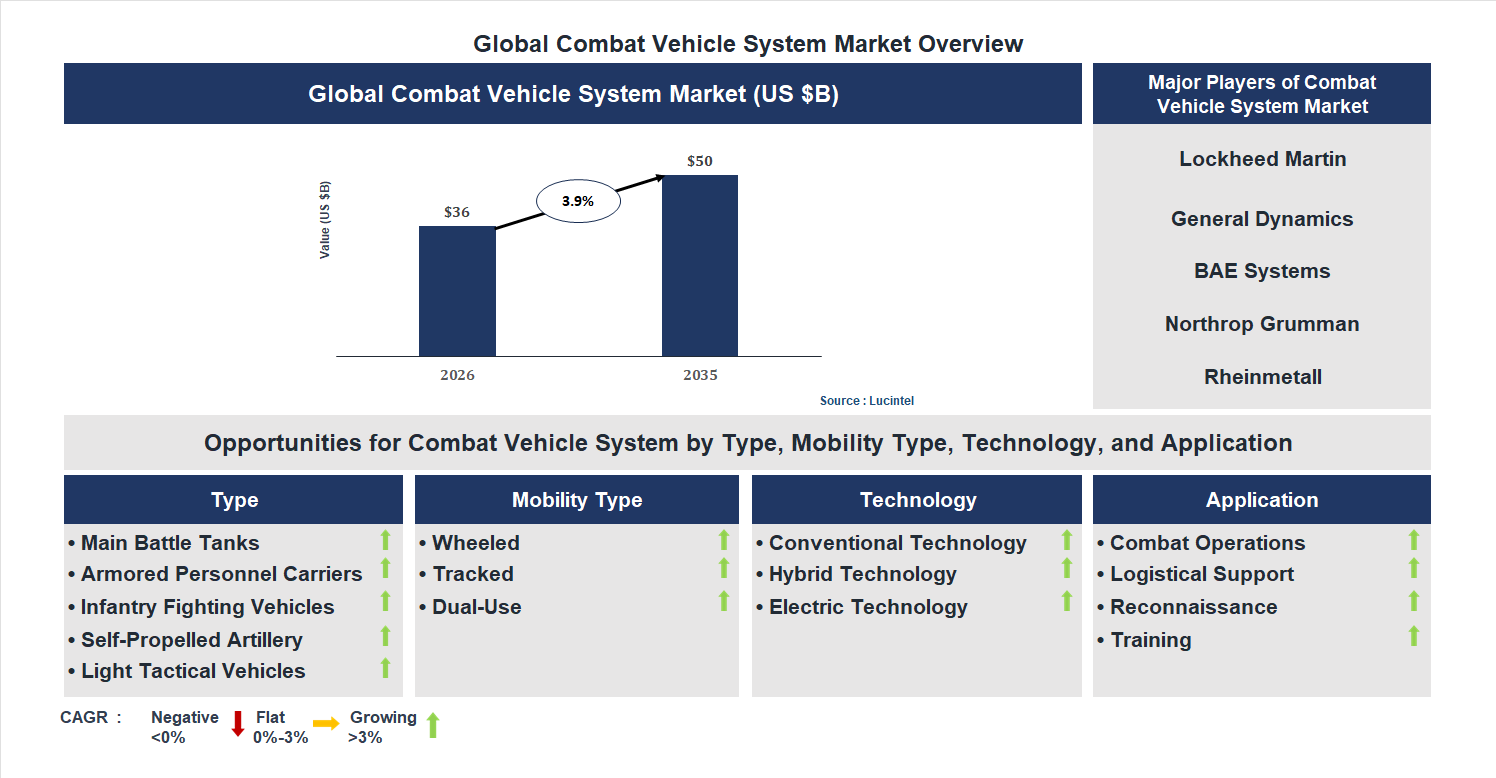
The future of the global combat vehicle system market looks promising with opportunities in the combat operation, logistical support, reconnaissance, and training markets. The global combat vehicle system market is expected to reach an estimated $50 billion by 2035 with a CAGR of 3.9% from 2026 to 2035. The major drivers for this market are the increasing demand for advanced combat vehicle systems, the rising defense budgets supporting vehicle modernization, and the growing focus on battlefield mobility solutions.• Lucintel forecasts that, within the type category, main battle tank is expected to witness the highest growth over the forecast period.
• Within the application category, combat operation is expected to witness the highest growth.
• In terms of region, North America is expected to witness the highest growth over the forecast period. Gain valuable insights for your business decisions with our comprehensive 150+ page report. Sample figures with some insights are shown below.
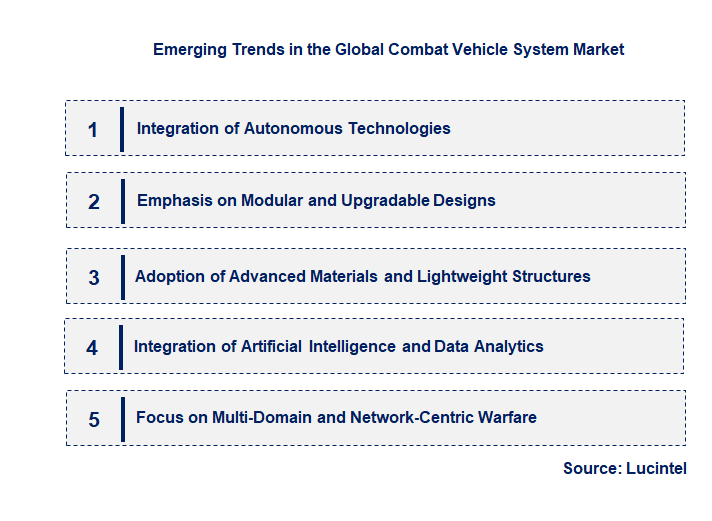
Emerging Trends in the Combat Vehicle System Market
The combat vehicle system market is experiencing rapid evolution driven by technological advancements, shifting geopolitical landscapes, and increasing defense budgets worldwide. As nations seek to modernize their armed forces, innovative solutions are emerging to enhance battlefield effectiveness, survivability, and operational efficiency. These developments are not only transforming traditional combat vehicles but also integrating cutting-edge technologies such as automation, artificial intelligence, and advanced materials. The markets growth is further fueled by rising security concerns and the need for versatile, multi-domain combat systems. Understanding these key trends is essential for stakeholders aiming to capitalize on the evolving landscape and develop competitive strategies.• Integration of Autonomous Technologies: The adoption of autonomous and semi-autonomous systems is revolutionizing combat vehicles by reducing crew risk and increasing operational efficiency. These systems include driverless tanks, unmanned ground vehicles (UGVs), and drone integration, enabling remote operation and enhanced battlefield awareness. The impact is significant, as autonomous vehicles can operate in hazardous environments, perform reconnaissance, and support logistics, thereby reducing human casualties and increasing mission success rates.
• Emphasis on Modular and Upgradable Designs: Modern combat vehicles are increasingly designed with modular architectures that allow for easy upgrades and customization. This trend enables militaries to adapt vehicles to evolving threats without complete replacements, saving costs and extending service life. Modular systems facilitate rapid integration of new weaponry, sensors, and communication tools, ensuring that vehicles remain technologically relevant and versatile across different combat scenarios.
• Adoption of Advanced Materials and Lightweight Structures: To improve mobility, survivability, and fuel efficiency, manufacturers are incorporating advanced materials such as composites, ceramics, and lightweight alloys into vehicle construction. These materials reduce overall weight without compromising strength, enabling faster maneuverability and better protection against ballistic threats. The impact is a significant enhancement in vehicle performance, allowing for rapid deployment and improved battlefield survivability.
• Integration of Artificial Intelligence and Data Analytics: AI-driven systems are increasingly embedded in combat vehicles for real-time data processing, threat detection, and decision-making support. These technologies enhance situational awareness, automate routine tasks, and enable predictive maintenance, reducing downtime. The deployment of AI is transforming combat strategies by providing commanders with actionable insights, improving response times, and increasing overall operational effectiveness.
• Focus on Multi-Domain and Network-Centric Warfare: Combat vehicles are now being developed to operate seamlessly across land, air, sea, and cyber domains through integrated network systems. This trend promotes interoperability, coordinated operations, and real-time data sharing among different military branches. The impact is a more cohesive and flexible battlefield presence, allowing forces to respond swiftly to emerging threats and conduct complex multi-domain missions with higher precision and efficiency. These emerging trends are fundamentally reshaping the combat vehicle system market by fostering innovation, enhancing operational capabilities, and enabling more adaptable and resilient military assets. The integration of autonomous systems, modular designs, advanced materials, AI, and multi-domain connectivity is driving a new era of combat vehicle development, ensuring that armed forces remain prepared for future challenges.
Recent Developments in the Combat Vehicle System Market
The combat vehicle system market is experiencing rapid advancements driven by technological innovation, increased defense budgets, and evolving security threats. Countries are investing heavily in modernizing their armed forces with advanced systems to enhance battlefield effectiveness. These developments are creating new opportunities for manufacturers and suppliers, fostering competition, and encouraging integration of cutting-edge technologies. As global security dynamics shift, the markets growth prospects are expanding, prompting stakeholders to focus on innovation, interoperability, and sustainability to meet future defense needs.• Growing Demand for Modernized Combat Vehicles: The need for upgraded, technologically advanced combat vehicles is rising globally. Countries aim to improve battlefield survivability, mobility, and firepower, leading to increased procurement of next-generation tanks, armored vehicles, and infantry fighting vehicles. This demand is driven by geopolitical tensions and the need for rapid deployment capabilities, creating significant growth opportunities for defense contractors and technology providers.
• Integration of Autonomous and Unmanned Systems: The incorporation of autonomous and unmanned systems into combat vehicles is transforming battlefield operations. These systems enhance situational awareness, reduce human risk, and improve operational efficiency. The development of drone-enabled vehicles and autonomous combat platforms is opening new markets, encouraging innovation in AI, sensor technology, and robotics, and fostering strategic partnerships among defense firms.
• Emphasis on Network-Centric Warfare: Modern combat vehicles are increasingly integrated into network-centric warfare systems. This connectivity allows real-time data sharing, improved command and control, and coordinated operations across multiple platforms. The focus on interoperability and secure communication networks is driving investments in advanced communication systems, software, and cybersecurity, significantly impacting the design and deployment of future combat vehicle systems.
• Focus on Sustainability and Green Technologies: Environmental concerns and operational cost reductions are prompting the adoption of sustainable technologies in combat vehicles. Innovations include hybrid powertrains, lightweight materials, and energy-efficient systems. These advancements aim to reduce the carbon footprint, improve fuel efficiency, and meet regulatory standards, creating new avenues for research and development, and influencing procurement strategies in the defense sector.
• Expansion of Regional Markets and Export Opportunities: Emerging markets in Asia, the Middle East, and Africa are increasing their defense budgets and seeking modern combat systems. This expansion offers lucrative export opportunities for established defense manufacturers and encourages regional collaborations. The diversification of supply chains and localization efforts are also shaping the market landscape, fostering global competition and innovation. The overall impact of these developments is a dynamic, technologically advanced combat vehicle market characterized by increased innovation, strategic collaborations, and expanding regional opportunities. These trends are enhancing military capabilities worldwide, fostering competitive growth, and shaping the future landscape of defense technology.
Strategic Growth Opportunities in the Combat Vehicle System Market
The combat vehicle system market is experiencing rapid growth driven by increasing defense budgets, technological advancements, and evolving security threats. Countries are investing heavily in modernizing their armed forces with advanced armored vehicles, drones, and integrated systems. The demand for enhanced protection, mobility, and firepower is creating significant opportunities across various applications. Innovation in autonomous systems and network-centric warfare further fuels market expansion, making it a critical area for defense contractors and governments worldwide.• Modernization of Military Fleets: The upgrade of existing combat vehicles with advanced armor, weaponry, and communication systems presents a substantial growth opportunity. Countries aim to enhance battlefield survivability and operational efficiency, leading to increased procurement of upgraded tanks, armored personnel carriers, and infantry fighting vehicles. This segment benefits from technological innovations such as hybrid powertrains and modular designs, enabling flexible and scalable solutions tailored to specific defense needs.
• Development of Autonomous and Unmanned Vehicles: The integration of autonomous technology into combat vehicles is revolutionizing warfare. Unmanned ground vehicles (UGVs) and autonomous systems offer strategic advantages like reduced troop exposure and increased operational precision. Market players are investing in AI-driven navigation, sensor integration, and remote operation capabilities. This segment includes autonomous reconnaissance vehicles, bomb disposal units, and combat support systems, opening new avenues for defense modernization and tactical superiority.
• Expansion of Network-Centric Warfare Systems: The increasing adoption of networked combat systems enhances situational awareness and coordination among military units. Integrated command, control, communications, computers, intelligence, surveillance, and reconnaissance (C4ISR) systems enable real-time data sharing and decision-making. This growth opportunity involves developing interoperable platforms, secure communication networks, and advanced sensor integration, which are critical for modern battlefield dominance and joint operations across land, air, and sea domains.
• Rising Demand for Specialized Combat Vehicles: The need for specialized vehicles tailored to specific operational environments is expanding. This includes mine-resistant ambush-protected (MRAP) vehicles for asymmetric warfare, amphibious combat vehicles for coastal operations, and urban warfare vehicles with enhanced maneuverability. These niche segments address unique tactical challenges, driving innovation in design, armor, and weapon systems. Governments seek versatile, mission-specific platforms to improve operational effectiveness in diverse terrains and threat scenarios.
• Increasing Focus on Cybersecurity and Electronic Warfare Integration: As combat vehicles become more digitally connected, cybersecurity and electronic warfare (EW) capabilities are vital. Protecting systems from cyber threats and jamming attacks is a key growth area. Incorporating EW modules for signal disruption and electronic countermeasures enhances vehicle survivability. This segment involves developing hardened communication links, secure data encryption, and integrated EW systems, ensuring combat vehicles remain resilient against modern electronic and cyber threats. The overall market growth is propelled by technological innovation, modernization initiatives, and strategic defense investments. These opportunities collectively enhance combat vehicle capabilities, ensuring military forces are better equipped, protected, and prepared for future conflicts. As governments prioritize defense modernization, the market is expected to witness sustained expansion, fostering innovation and competitive advancements across all segments.
Combat Vehicle System Market Driver and Challenges
The combat vehicle system market is influenced by a complex interplay of technological advancements, economic factors, and regulatory frameworks. Rapid innovations in weaponry, armor, and automation are transforming military capabilities worldwide. Economic considerations such as defense budgets and geopolitical tensions drive demand, while regulatory policies shape procurement and development processes. These factors collectively impact market growth, competitiveness, and innovation trajectories. Understanding these drivers and challenges is essential for stakeholders aiming to navigate this dynamic landscape effectively and capitalize on emerging opportunities while addressing potential obstacles. The factors responsible for driving the combat vehicle system market include:-• Technological Innovation: The continuous development of advanced weapon systems, automation, and AI integration enhances combat efficiency and survivability, fueling market growth. Countries invest heavily in R&D to maintain technological superiority, leading to increased procurement of next-generation combat vehicles. These innovations also enable lighter, more versatile systems, expanding operational capabilities across diverse terrains and scenarios. As military forces seek to modernize their fleets, the demand for cutting-edge combat vehicle systems accelerates, creating a competitive landscape driven by technological progress.
• Defense Budget Allocations: Increasing defense budgets worldwide, especially among major military powers, directly boost the procurement and upgrade of combat vehicle systems. Governments prioritize modernization to counter emerging threats, leading to sustained demand. Budget allocations influence the scale and scope of military modernization programs, enabling the acquisition of advanced tanks, armored vehicles, and supporting systems. This financial commitment ensures continuous market growth, fostering innovation and expanding manufacturing capacities to meet rising global defense needs.
• Geopolitical Tensions and Security Concerns: Rising regional conflicts and geopolitical instability prompt nations to enhance their military capabilities, including combat vehicles. Countries seek to strengthen their defense postures to deter potential threats, leading to increased orders for modernized systems. These tensions often accelerate procurement cycles and stimulate technological advancements to address evolving warfare requirements. As a result, geopolitical factors serve as a significant driver, ensuring sustained demand for combat vehicle systems in volatile regions.
• Strategic Alliances and Defense Partnerships: International collaborations and defense pacts facilitate technology transfer, joint development, and procurement of combat vehicle systems. Alliances such as NATO promote interoperability and shared defense strategies, expanding market opportunities. These partnerships often lead to co-development projects, reducing costs and accelerating deployment timelines. The collaborative approach enhances technological capabilities and broadens the customer base, thereby fueling market expansion driven by strategic alliances. The challenges in the combat vehicle system market are:
• High Development and Procurement Costs: Developing advanced combat vehicles requires significant investment in R&D, manufacturing, and testing, which can be prohibitively expensive. Budget constraints and economic downturns may limit defense spending, delaying or reducing procurement plans. Additionally, the high costs associated with integrating new technologies pose financial risks, potentially impacting profitability and market growth. Cost overruns and lengthy development cycles further complicate project execution, making affordability a critical challenge for manufacturers and military buyers alike.
• Rapid Technological Obsolescence: The fast pace of technological innovation can render existing combat vehicle systems obsolete quickly. Military systems must continually evolve to counter new threats, requiring ongoing upgrades and replacements. This rapid obsolescence increases lifecycle costs and complicates long-term planning. Manufacturers face pressure to innovate continuously, which can strain resources and lead to increased R&D expenses. For militaries, balancing modernization with budget constraints becomes a persistent challenge, risking gaps in operational readiness.
• Regulatory and Export Restrictions: Stringent defense regulations and export controls limit market access and technology transfer. Countries often impose restrictions to safeguard national security, complicating international sales and collaborations. These regulatory barriers can delay project timelines and increase compliance costs. Additionally, geopolitical considerations may restrict the sale of certain systems to specific regions, reducing market opportunities. Navigating complex legal frameworks requires significant expertise, and non-compliance risks penalties, further complicating market expansion efforts. The combat vehicle system market is shaped by rapid technological advancements, substantial defense investments, and geopolitical dynamics, which collectively drive growth. However, high costs, rapid obsolescence, and regulatory hurdles pose significant challenges. These factors create a competitive environment where innovation and strategic planning are crucial. While opportunities for modernization and international collaboration abound, stakeholders must navigate financial, technological, and regulatory complexities. Overall, the markets future will depend on balancing these drivers and challenges to sustain growth and technological leadership in defense capabilities.
List of Combat Vehicle System Companies
Companies in the market compete on the basis of product quality offered. Major players in this market focus on expanding their manufacturing facilities, R&D investments, infrastructural development, and leverage integration opportunities across the value chain. With these strategies combat vehicle system companies cater increasing demand, ensure competitive effectiveness, develop innovative products & technologies, reduce production costs, and expand their customer base. Some of the combat vehicle system companies profiled in this report include-• Lockheed Martin
• General Dynamics
• BAE Systems
• Northrop Grumman
• Rheinmetall
• Thales Group
• KMW
Combat Vehicle System Market by Segment
The study includes a forecast for the global combat vehicle system market by type, mobility type, technology, application, and region.Combat Vehicle System Market by Type [Value from 2019 to 2035]:
• Main Battle Tanks
• Armored Personnel Carriers
• Infantry Fighting Vehicles
• Self-Propelled Artillery
• Light Tactical Vehicles
Combat Vehicle System Market by Mobility Type [Value from 2019 to 2035]:
• Wheeled
• Tracked
• Dual-Use
Combat Vehicle System Market by Technology [Value from 2019 to 2035]:
• Conventional Technology
• Hybrid Technology
• Electric Technology
Combat Vehicle System Market by Application [Value from 2019 to 2035]:
• Combat Operations
• Logistical Support
• Reconnaissance
• Training
Combat Vehicle System Market by Region [Value from 2019 to 2035]:
• North America
• Europe
• Asia Pacific
• The Rest of the World
Country Wise Outlook for the Combat Vehicle System Market
The combat vehicle system market is experiencing rapid evolution driven by technological advancements, shifting defense strategies, and increasing geopolitical tensions worldwide. Countries are investing heavily in modernizing their armed forces with innovative combat vehicles to enhance battlefield capabilities. This global competition is fostering innovation in areas such as automation, armor protection, and weapon systems. The United States, China, Germany, India, and Japan are key players, each focusing on unique strategies to strengthen their military infrastructure. These developments reflect broader trends toward increased defense spending and technological integration, shaping the future landscape of combat vehicle systems across these nations.• United States: The US is advancing its combat vehicle technology with the development of next-generation armored vehicles like the Abrams X and Stryker variants. Emphasis is placed on integrating AI, automation, and enhanced protection features. The US Army is also investing in robotic and unmanned systems to augment traditional combat vehicles, aiming for increased battlefield efficiency and safety. Additionally, modernization efforts include upgrading existing platforms with advanced sensors and communication systems to improve situational awareness and interoperability.
• China: China is rapidly expanding its combat vehicle capabilities, focusing on indigenous development of tanks such as the Type 99 and Type 15 light tanks. The country emphasizes automation, firepower, and mobility enhancements. China’s military modernization includes integrating advanced targeting systems, active protection systems, and network-centric warfare capabilities. The Chinese government is also investing in unmanned ground vehicles and hybrid propulsion systems to bolster its strategic and tactical advantages in regional conflicts.
• Germany: Germany continues to innovate in combat vehicle systems through the upgrade of its Leopard 2 tanks, incorporating new armor, fire control systems, and digital communication networks. The Bundeswehr is exploring the integration of hybrid and electric propulsion to improve efficiency and reduce logistical burdens. Germany is also investing in the development of modular vehicle platforms that can be adapted for various combat scenarios, emphasizing interoperability within NATO alliances and enhancing overall operational flexibility.
• India: India is focusing on indigenous development of combat vehicles, including the Arjun Mk III tank and the future-ready Future Ready Combat Vehicle (FRCV). The country emphasizes enhancing armor protection, firepower, and mobility. India is also investing in unmanned systems and network-centric warfare capabilities to modernize its military forces. Collaborations with international defense firms are ongoing to incorporate advanced technologies, aiming to reduce reliance on imports and bolster self-sufficiency in combat vehicle production.
• Japan: Japan is modernizing its combat vehicle fleet with a focus on mobility, survivability, and integration of advanced electronics. The Type 10 tank represents Japan’s efforts to develop a highly agile and technologically sophisticated platform with active protection systems and networked battlefield capabilities. Japan is also exploring the use of unmanned systems and robotic vehicles to complement manned units, aligning with its strategic emphasis on regional security and defense modernization amid regional tensions.

Features of the Global Combat Vehicle System Market
Market Size Estimates: Combat vehicle system market size estimation in terms of value ($B). Trend and Forecast Analysis: Market trends (2019 to 2025) and forecast (2026 to 2035) by various segments and regions. Segmentation Analysis: Combat vehicle system market size by various segments, such as by type, mobility type, technology, application, and region in terms of value ($B). Regional Analysis: Combat vehicle system market breakdown by North America, Europe, Asia Pacific, and Rest of the World. Growth Opportunities: Analysis of growth opportunities in different types, mobility types, technologies, applications, and regions for the combat vehicle system market. Strategic Analysis: This includes M&A, new product development, and competitive landscape of the combat vehicle system market. Analysis of competitive intensity of the industry based on Porter’s Five Forces model.
FAQ
Q1. What is the combat vehicle system market size? Answer: The global combat vehicle system market is expected to reach an estimated $50 billion by 2035. Q2. What is the growth forecast for combat vehicle system market? Answer: The global combat vehicle system market is expected to grow with a CAGR of 3.9% from 2026 to 2035. Q3. What are the major drivers influencing the growth of the combat vehicle system market? Answer: The major drivers for this market are the increasing demand for advanced combat vehicle systems, the rising defense budgets supporting vehicle modernization, and the growing focus on battlefield mobility solutions. Q4. What are the major segments for combat vehicle system market? Answer: The future of the combat vehicle system market looks promising with opportunities in the combat operation, logistical support, reconnaissance, and training markets. Q5. Who are the key combat vehicle system market companies? Answer: Some of the key combat vehicle system companies are as follows:• Lockheed Martin
• General Dynamics
• BAE Systems
• Northrop Grumman
• Rheinmetall
• Thales Group
• KMW Q6. Which combat vehicle system market segment will be the largest in future? Answer: Lucintel forecasts that, within the type category, main battle tank is expected to witness the highest growth over the forecast period. Q7. In combat vehicle system market, which region is expected to be the largest in next 8 years? Answer: In terms of region, North America is expected to witness the highest growth over the forecast period. Q8. Do we receive customization in this report? Answer: Yes, Lucintel provides 10% customization without any additional cost.
List of Figures
List of Tables
Methodology
- In-depth interviews of the major players in this market
- Detailed secondary research from competitors’ financial statements and published data
- Extensive searches of published works, market, and database information pertaining to industry news, company press releases, and customer intentions
- A compilation of the experiences, judgments, and insights of Lucintel’s professionals, who have analyzed and tracked this market over the years.


Buy Now
Choose a license that fits your team. Instant PDF delivery.
Prices exclude taxes. Instant delivery. Custom licensing available on request.
Key Questions
- • What are some of the most promising, high-growth opportunities for the combat vehicle system market by type (main battle tanks, armored personnel carriers, infantry fighting vehicles, self-propelled artillery, and light tactical vehicles), mobility type (wheeled, tracked, and dual-use), technology (conventional technology, hybrid technology, and electric technology), application (combat operations, logistical support, reconnaissance, and training), and region (North America, Europe, Asia Pacific, and the Rest of the World)?
- • Which segments will grow at a faster pace and why?
- • Which region will grow at a faster pace and why?
- • What are the key factors affecting market dynamics? What are the key challenges and business risks in this market?
- • What are the business risks and competitive threats in this market?
- • What are the emerging trends in this market and the reasons behind them?
- • What are some of the changing demands of customers in the market?
- • What are the new developments in the market? Which companies are leading these developments?
- • Who are the major players in this market? What strategic initiatives are key players pursuing for business growth?
- • What are some of the competing products in this market and how big of a threat do they pose for loss of market share by material or product substitution?
- • What M&A activity has occurred in the last 5 years and what has its impact been on the industry? For any questions related to Combat Vehicle System Market, Combat Vehicle System Market Size, Combat Vehicle System Market Growth, Combat Vehicle System Market Analysis, Combat Vehicle System Market Report, Combat Vehicle System Market Share, Combat Vehicle System Market Trends, Combat Vehicle System Market Forecast, Combat Vehicle System Companies, write Lucintel analyst at email: helpdesk@lucintel.com. We will be glad to get back to you soon.


